
Whatsoever

WhatsoeverYouDo

Today’s readings (click below to open in new tab/window):
Psalms 89:1-18; 147:1-11, Joshua 3:1-13, Romans 11:25-36, Matthew 25:31-46


In the Parable of the Sheep and the Goats, a king judges and divides all the nations of the world – blessed sheep on his right hand and accursed goats on his left. To the sheep he says: “I was hungry and you gave me food, I was thirsty and you gave me something to drink, I was a stranger and you welcomed me, I was naked and you gave me clothing, I was sick and you took care of me, I was in prison and you visited me.” The sheep ask when they did these things for him, and he explains whenever they did it for the least of his brothers, they did it for him. How we understand this message hinges on how we understand Jesus’s use of “brothers.”

Many hear a call to social justice, to consider all who are in need the brothers (and sisters) of Christ. Scripture – in both Old and New Testament passages – certainly calls us to show mercy and hospitality to the poor and marginalized, so this reading seems in character. Others focus on how “brother” is used elsewhere in Matthew, and associate it with “follower.” Under this interpretation, the story is about the consequences of how people receive specifically the disciples and – by extension – preachers of the Gospel. The second camp is concerned the first camp promotes a social gospel reducing salvation to a list of specific good works. The first camp calls this an oversimplification of their position and claims those who truly receive Christ respond to those in need.

Between these camps lies the beauty of parables, which are open to interpretation. Not to say we can impose whatever meaning suits our current whim, or that Jesus’s intent is unimportant, but that more than one aspect of the truth can be revealed. Is it not vital to welcome the Gospel and aid its bearers? And once we do so, will we not view our relationship to “the least” in a new light that inspires us to serve them? Our relationship to the Gospel is inseparable from our relationship to the world.

Comfort: You can’t go wrong welcoming the Gospel and serving the needy.

Challenge: Our fellow Christians, who have different understandings of the Gospel than we do, can be the hardest not to judge. Make it a point this week to engage such people in conversation, with the intent only of understanding, not persuading.

Prayer: Gracious and Merciful God, grant me the patience and humility to understand the lessons of scripture. Amen.

Discussion: Is there one interpretation of this parable you prefer over the other? Is it the same one you feel is more “authentic?”

Join the discussion! If you enjoyed this post, feel free to join an extended discussion as part of the C+C Facebook group. You’ll be notified of new posts through FB, and have the opportunity to share your thoughts with some lovely people. Or feel free to comment here on WordPress, or even re-blog – the more the merrier!

Questions That Matter

stupidanswers

Today’s readings (click below to open in new tab/window):
Psalms 116; 147:12-20, Deuteronomy 3:18-28, Romans 9:19-33, Matthew 24:1-14


In Matthew 24, Jesus begins to talk about his eventual return. He speaks about what signs and trials the disciples can expect before the “end of the age.” Despite expectations of his earliest followers, it didn’t happen quickly, and ever since some Christians have spent great effort assembling world events like pieces of an end-times jigsaw puzzle. Others insist on creating a rift between science and religion, pitting evolution against creationism. Is it possible to spend so much time focusing on the beginning and the end that we lose sight of the middle – the only time we can actually know?

While knowledge is important on its own merit, it can be a mistake to hang our faith on specific, unknowable questions, or to judge whether someone else is “our kind” of Christian based on their answers. So what sort of faith questions should we be asking ourselves and each other? Evaluating them against another question might help: Will the answer affect my faith or how I live my life? Developing a relationship with Christ; feeding the hungry; sharing the Good News: none of these depend on arguments for or against evolution, or whether the end is nigh. A life lived in love, justice and mercy transcends apologetics and refutations. Defense of a certain idea or school of thought can easily become an idol substituted for true faith. Hundreds of end time predictions have been wrong. What do we suppose the people who pinned their faith on these predictions did the day after the world ended?

Jesus did talk about the beginning and the end, but the greater part of his lessons was about the middle – about living in right relationship with God and each other. Shouldn’t we spend our limited time and energy on the things Jesus emphasized? Endless debate doesn’t clothe the naked or comfort the sick. If Jesus does show up tomorrow, we might rather be caught doing what he told us to do.

So here’s a question: what can we do for the least of our brothers and sisters? The answer matters to Jesus and to us.

Comfort: We don’t need all the answers to follow Jesus.

Challenge: The next time someone wants to engage you in divisive theological debate, instead invite her/him to share in works of mercy.

Prayer: Gracious and Merciful God, lead me always to the right questions. Amen.

Discussion: Are you able to confidently say: “I don’t know?” Why or why not?

Join the discussion! If you enjoyed this post, feel free to join an extended discussion as part of the C+C Facebook group. You’ll be notified of new posts through FB, and have the opportunity to share your thoughts with some lovely people. Or feel free to comment here on WordPress, or even re-blog – the more the merrier!

Relay Race

OLYMPUS DIGITAL CAMERA

Today’s readings (click below to open in new tab/window):
Psalms 108; 150, Numbers 27:12-23, Acts 19:11-20, Mark 1:14-20


One of the hardest lessons of faith is learning to trust that God will come through, but not always according to our preferred schedule – or in our lifetime. As the nation of Israel drew nearer and nearer to entering the promised land, God reminded Moses that, because of past disobediences, Moses would not be entering it with them. After forty years of wandering, Moses must have found the disappointment almost unbearable. Can we imagine, were we to be in Moses’s sandals, not clinging to some sliver of hope that God might relent and let us in, if only for a day? Yet Moses chose to trust God and contribute to a smooth transition in leadership.

From the decades wandering in the desert, to the church being established in Acts, to our modern day, faith is a community experience. Our current vocabulary around faith emphasizes personal salvation, and that is an element of it, but the peace we pray for and the justice we long for are not personal but communal transformations. Maturing in that faith includes recognizing when it is time to pass the torch. Projects and missions near and dear to our hearts may not be fully realized in our own lifetimes. A narrow, individual perspective interprets this as failure, but a faith founded in community – in the eternal Body of Christ – invests hope in the long game.

Whether we are retiring from ministry or can no longer find time to serve as bake sale coordinator, merely stepping aside is not enough; when possible we should work to ease the transition for both our community and the person assuming our burden. When the Lord named Joshua as Moses’s successor, Moses presented him to the congregation, and personally commissioned him to lead the people. How humbling it must have been for Moses to admit the people could enter the promised land with or without him. Yet for a long time he was God’s chosen instrument of liberation and survival, and there must have been immense satisfaction as well.

Faith is not a sprint, or a marathon, but a relay race.

Comfort: You alone are not responsible for the fate of the world.

Challenge: When it is time to pass along your responsibilities, do so with grace.

Prayer: Eternal God, teach me to appreciate the time and tasks you have given me, as well as the opportunity to rest in your peace. Amen.

Discussion: Do you have trouble letting other people do things their own way?

Join the discussion! If you enjoyed this post, feel free to join an extended discussion as part of the C+C Facebook group. You’ll be notified of new posts through FB, and have the opportunity to share your thoughts with some lovely people. Or feel free to comment here on WordPress, or even re-blog – the more the merrier!
Heat vs Light

heatlight

Today’s readings (click below to open in new tab/window):
Psalms 122; 149, Numbers 24:12-25, Romans 8:18-25, Matthew 22:23-40


The Sadducees – an aristocratic group of Jewish religious leaders who did not believe in resurrection – were determined to discredit Jesus. They had a vested interest in maintaining the status quo with Rome by squashing this rabble-rousing preacher.  Their attempts to trick him into appearing foolish consistently backfired.

According to Mosaic law, if a married Jewish man died, his brother was to marry his widow. The Sadducees posed a scenario in which a woman was married to seven different brothers, because each had to marry her when another brother died. Which brother, they wanted to know, would be her husband in the resurrection?

At first it may sound like  legitimate question, but it’s actually a pretty juvenile approach, not unlike asking whether Superman could beat up The Hulk, or what would happen if a werewolf and a vampire bit each other at the same time. Sure it might provide hours of heated distraction for people who get geeked over hypothetical situations, but it doesn’t mean anything.

Jesus stopped this whole line of “reasoning” in its tracks by telling the Sadducees they couldn’t even ask the right question. “In the resurrection,” Jesus told them, “they neither marry nor are given in marriage, but are like angels in heaven.”

When the Sadducees retreated, the Pharisees – who were political rivals but united against the common enemy of Jesus – tested him by asking what was the most important commandment. Jesus said:

‘You shall love the Lord your God with all your heart, and with all your soul, and with all your mind.’ This is the greatest and first commandment. And a second is like it: ‘You shall love your neighbor as yourself.’ On these two commandments hang all the law and the prophets.”

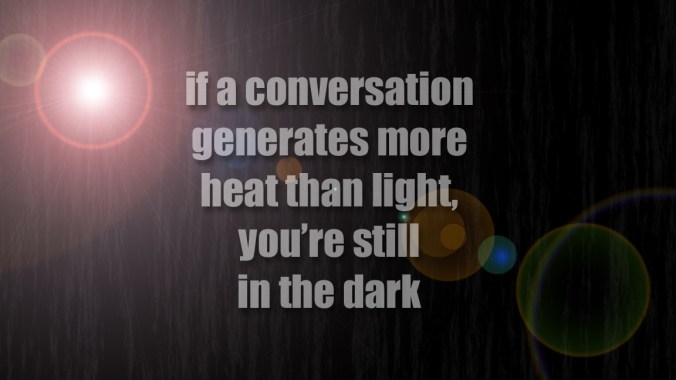
Some Christians thrive on essentially meaningless debates over technicalities which seem vital to theology wonks, but bruise and break the Body of Christ; we’ve got the evidence of hundreds of denominational scars. When we’re drawn into conversations which are more invested in division than unity, especially with other Christians, let’s remember the two great commandments. They teach us to ask better questions.

Comfort: Nobody has all the answers.

Challenge: Including you.

Prayer: Lord of Heaven and Earth, I love you with all my heart, mind, and soul. Give me strength to love my neighbor as myself, and to love myself well. Amen.

Discussion: Have you ever gotten into a debate that generated a lot of heat and little or no light?

Join the discussion! If you enjoyed this post, feel free to join an extended discussion as part of the C+C Facebook group. You’ll be notified of new posts through FB, and have the opportunity to share your thoughts with some lovely people. Or feel free to comment here on WordPress, or even re-blog – the more the merrier!

God or Caesar?

1467384667330.jpg

Today’s readings (click below to open in new tab/window):
Psalms 88; 148, Numbers 24:1-13, Romans 8:12-17, Matthew 22:15-22

Political parties thrive on an “Us vs. Them” mentality, so beware equating faith with politics. It’s difficult enough to find a congregation aligning with all our religious values, so how could any secular organization hope to do so? While we should stand on our principles, political affiliation – whether Left, Right, or Center – is not a litmus test for determining who is a “real” Christian.  When politics and faith become so entangled that the issues of a party – regardless of whether they have anything to do with the Gospel – acquire religious status and devotion, political affiliation becomes an idol.

The Pharisees tried to trap Jesus by asking whether Jews should pay Roman taxes. He answered: “Give to the emperor the things that are the emperor’s, and to God the things that are God’s.” His answer stymied them, in no small part because he didn’t actually answer the question! Some interpret this passage as implying we should honor state obligations as long as they don’t interfere with religious ones; if the emperor’s face is stamped on the coin of the realm, we can return it to him as required. Does this seem a little out of character for the Jesus who would flip the entire social order so the last will be first? Let’s not confuse a reconciling faith with one that merely appeases. Might this interpretation have Jesus giving too much regard to the state? Could we instead say Jesus teaches us the state is a reality we live with, but it does not impact our faith? Christians in capitalist democracies aren’t more or less Christian than those living happily under monarchies or socialism.

Since in truth everything belongs to God, nothing really belongs to the emperor (or any government). We live our faith regardless of the emperor or president. We can have an opinion on taxes – or any number of secular issues – but if we elevate them to religious status we fall into the Pharisees’ trap. Friends, family and associates may push us, even unwittingly, toward such traps. Instead let’s follow Jesus’ example, and not flip the coin of false choices.

Comfort: God’s nature is the same regardless of circumstance.

Challenge: Do some study of Christians in other countries.

Prayer: God of Hope, teach me to recognize what is important to you. Amen.

Discussion: if you have a political affiliation, has it ever come into conflict with your faith?

Join the discussion! If you enjoyed this post, feel free to join an extended discussion as part of the C+C Facebook group. You’ll be notified of new posts through FB, and have the opportunity to share your thoughts with some lovely people. Or feel free to comment here on WordPress, or even re-blog – the more the merrier!