Lake of Doubt

lake-2063957_1920

Today’s readings (click below to open in new tab/window):
Psalms 104; 149, Ezra 9:1-15, Revelation 17:1-14, Matthew 14:22-36


Employers tend to base their decisions about promotions around two criteria: qualifications and seniority. How they balance these criteria depends largely on what kind of business environment they have. In a unionized factory, for instance, seniority plays a larger role than it would in a tech start-up where youth may provide more advantage. Just because someone has been around the longest doesn’t mean they’re the best at their job or the most qualified to lead, manage, or train others and neither does being the best at hottest new skill set. In both cases, and most others, failing to balance these criteria properly poses a danger of setting someone up to fail.

When the boatful of disciples were startled to see Jesus walking toward them across the lake, Peter cried, “Lord, if it is you, command me to come to you on the water.” As Peter crossed the water the wind picked up and he panicked and began to sink. Of course Jesus didn’t let him drown, but pulled him from the water and said “You of little faith, why did you doubt?”

After the boat landed at Gennesaret, word spread quickly among the people. They brought many sick people to Jesus and sought “to touch even the fringe of his cloak; and all who touched it were healed.”

Peter, who had been with Jesus since the beginning, thought he had the faith to follow Jesus anywhere and folded in the crunch, but among the people of Gennesaret who had little experience but lots of faith many were healed . It’s probably no accident these stories appear back-to-back in Matthew’s Gospel. In earlier chapters, the author stresses that what Jesus is able to accomplish through us depends a great deal on the degree of faith we exhibit.

The less susceptible we are to worldly distractions, and the more we rely on Christ than ourselves, the more confidently we can stride across that lake of doubt. Some of that comes from experience, and some from the childlike faith which is too fervent to be discouraged. It is a balance we must learn to recognize within ourselves. Jesus doesn’t set us up to fail, so let’s not do it to ourselves by second guessing him or imposing our own will. Whether we’re Peter or a hopeful stranger, let us be humble enough to trust Christ will do what he says he will. It is through humility he promotes the first to be last.

Comfort: Christ is invested in your spiritual success.

Challenge: Try to be honest objective when understanding your own strengths and weaknesses.

Prayer: Lord I believe. Help my unbelief. Amen.

Discussion: How does doubt hold you back?

Join the discussion! If you enjoyed this post, feel free to join an extended discussion as part of the C+C Facebook group. You’ll be notified of new posts through FB, and have the opportunity to share your thoughts with some lovely people. Or feel free to comment here on WordPress, or even re-blog – the more the merrier!

Multiplied

chef-s-exposition-1325027

Today’s readings (click below to open in new tab/window):
Psalms 51; 148, Ezra 7:27-28, 8:21-36, Revelation 15:1-8, Matthew 14:13-21


When we think about the origin of Holy Communion, we generally reflect on the Last Supper, or the Words of Institution from the Gospels or 1 Corinthians. These passages recollect Jesus comparing the bread and wine to his body and blood, and asking his disciples to remember him by doing the same.

Yet the association between Jesus and bread doesn’t begin with the Last Supper. In John’s Gospel, Jesus refers to himself as the Bread of Life. And in all four Gospels, we read the story of feeding the multitudes with loaves and fishes. In two of them, it happens a second time.

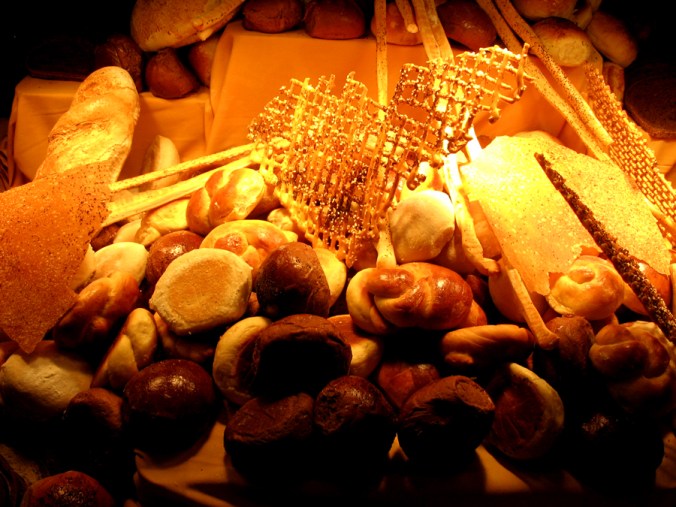
In Matthew’s telling of the first feeding, the disciples were ready to dismiss the crowd because it was late and everyone was hungry. Instead Jesus told the disciples to feed them. The disciples, having only five loaves and two fish, were naturally skeptical but did as he ordered. As the familiar story goes there were a dozen baskets of food left over after five thousand men plus women and children ate their fill.

Isn’t this the essence of the church in action? We don’t dismiss people in need to return after they’ve fended for themselves, but greet them with inclusive hospitality. Even more, we meet those needs trusting not in numbers and naysayers but in the power of Christ to multiply our efforts beyond what we can imagine on our own. And through all of it, we share the message of the Kingdom of Heaven in both word and deed. As the disciples didn’t simply keep what they had to split among themselves, we know our resources do not exist for our own benefit, but to enable us to serve others.

The time we spend remembering Christ while receiving communion is only half the way we honor him. The other half is in trusting him to use us to turn that morsel of bread into a feast for the world. The love and mercy we receive are meant for more than hoarding and sharing only among those who already know Christ. Let us trust they are resources that won’t be depleted but multiplied as we share them.

Comfort: When what we have is blessed by Christ, it will be more than enough.

Challenge: Trust that Christ has a vision greater than yours.

Prayer: Lord, thank you for welcoming me to your table, and for the opportunity to welcome others. Amen.

Discussion: Have you ever been able to do more with your resources than you would have thought possible?

Join the discussion! If you enjoyed this post, feel free to join an extended discussion as part of the C+C Facebook group. You’ll be notified of new posts through FB, and have the opportunity to share your thoughts with some lovely people. Or feel free to comment here on WordPress, or even re-blog – the more the merrier!
Cowards Pass the Mustard

blossom-1785901_1920

Today’s readings (click below to open in new tab/window):
Psalms 97; 147:12-20, Ezra 7:(1-10) 11-26, Revelation 14:1-13, Matthew 14:1-12


Batman famously characterizes criminals as a “superstitious and cowardly lot.” After reading Matthew’s account of the execution of John the Baptist, we may be inclined to agree.

When Herod Antipas heard about Jesus, he was convinced John the Baptist had been raised from the dead with terrifying new powers. Was he superstitious? Definitely. But the unjust circumstances of John’s death had Herod looking over his shoulder out of guilt as much as superstition. Cowardly? Yes again. Herod condemned John to death because he was afraid to break an unwise oath to Salome (the daughter of Herodias who was Herod’s sister-in-law, niece and lover) in front of his guests. Herodias had Salome request John’s head on a platter, because John protested her incestuous relationship with Herod. Herod himself had no taste for John’s particularly gruesome execution, but he valued social standing and power above justice. Herod shows us dictators and their ilk are paranoid for a reason: the evil deeds required to secure power will come back to haunt you. Jesus may not have been John the Super-Zombie Baptist, but he was everything Herod feared.

In the previous chapter of Matthew, Jesus compared the Kingdom of God to a mustard seed. In his day, wild mustard was a weed farmers tried to keep off their lands, but it always came back. Keeping it in check required constant vigilance, or it became a great nuisance that choked out the crops. That is what the inhabitants of the Kingdom of God are to the unjust: a constant threat that keeps popping up in unexpected places. When unjust dictators rise to power, they nearly always kill, imprison or otherwise silence those who cry for justice, but doesn’t there always seem to be a new mustard crop springing up?

Great evil is rarely born fully formed, but is built from an accumulation of casually unjust acts; at any point Herod could have stopped the chain of events that led from his relationship with Herodias to John’s execution. Similarly, the Kingdom of God sprouts from tiny, persistent seeds. Let love and justice grow wildly in our hearts until they choke out evil.

Comfort: If we don’t cut love back, it just keeps growing.

Challenge: Pay attention to your small acts; they build the larger you.

Prayer: Teach me, Lord, to act justly, even when it’s not convenient.

Discussion: What small acts of kindness have kept you from despair?

Join the discussion! If you enjoyed this post, feel free to join an extended discussion as part of the C+C Facebook group. You’ll be notified of new posts through FB, and have the opportunity to share your thoughts with some lovely people. Or feel free to comment here on WordPress, or even re-blog – the more the merrier!

Scripture and Life’s Seasons

20171102_093453.jpg

Today’s readings (click below to open in new tab/window):
Psalms 89:1-18; 147:1-11, Nehemiah 13:4-22, Revelation 12:1-12, Matthew 13:53-58


As the end of our two-year devotional cycle draws near, we return to Psalm 1, containing the words: “[H]is delight is in the law of the LORD, and on his law he meditates day and night. He is like a tree planted by streams of water, which yields its fruit in season and whose leaf does not wither.”

We might like the idea of spending more time exploring scripture, but the reality of dwelling on it day and night may seem daunting, maybe even unnecessary. After we’ve read through the Bible (or the parts we consider important) once or twice, we may begin to feel we “get it” and become satisfied with our understanding. While we may learn some favorite passages to rely on in times of stress or joy, we may also feel the readings at church or bible have grown redundant, and start mentally composing a grocery list when “that scripture” comes up in the rotation. Does this sound like the delight promised in the Psalm?

If our study of scripture is to yield fruit we must return to it with the regularity and reliability of the seasons. Consider your own story for a moment. As you have matured, what new insights have you gained into the narrative of your life? How often does your understanding of the characters in your story evolve? What about your opinion of yourself and your actions? How do you view once beloved books, movies, and television programs from childhood? Though our core personalities are unlikely to change, what we knew firmly at fifteen may be a different story at fifty. And there is a certain delight in realizing we have better insight than we used to.

The same is true of our study of scripture. Each time we meditate on a passage, the experiences we’ve gained influence our understanding of the text. Sometimes the experience was intentional, such as reading a Bible commentary offering historical context. Other times the experience was more organic: hearing “love is patient, love is kind”  on a wedding day is very different than hearing it after twenty years of living within a marriage. Life helps us understand scripture in new ways, and regular scripture reading helps us understand new things about life.

Comfort: Scripture is always waiting for us with new depths of truth.

Challenge: Commit to daily scripture reading through the end of the year.

Prayer: Gracious and merciful God, may your Word be ever on my heart.

Discussion: Has your understanding of any particular piece of scripture evolved over time?

Join the discussion! If you enjoyed this post, feel free to join an extended discussion as part of the C+C Facebook group. You’ll be notified of new posts through FB, and have the opportunity to share your thoughts with some lovely people. Or feel free to comment here on WordPress, or even re-blog – the more the merrier!

The Field

real-estate-1739189_1920

Today’s readings (click below to open in new tab/window):
Psalms 42; 146, Nehemiah 12:27-31a, 42b-47, Revelation 11:1-19, Matthew 13:44-52


Imagine you’re in the city on a gray, windy day. The first hesitant drops of rain have started to fall and of course you don’t have an umbrella with you. There are nine blocks between you and home, but if you cut across that big, overgrown lot which has been empty for so long the “For Sale” sign has faded to a whisper of a suggestion, you can cut a few of those off.  The downside is the tall buildings to the north and south of it creating a wind tunnel, so you pull up your collar and pull down your hat as you step into the tall grass.

When you’re about two thirds of the way across the wind parts the grass around what looks like – but surely could not be – a gold bar peeking out of the ground. It surely could not be, but you veer off course to see what it is. And it is indeed a gold bar. And while you’re crouched down to dig it out, you notice another one buried a little deeper. And another.  You wander the field and realize it is literally littered with gold which can’t be seen from the street or the buildings – only by someone crouched in the dirt and tall weeds.

What to do?

If you’re like the man Jesus describes in today’s analogy about the Kingdom of Heaven, you kick dirt over all the gold you can see, empty your bank account, pawn your guitar collection, and sell some plasma until you can make a cash offer on the lot as is. No thank you, you tell the realtor, cleaning it up won’t be necessary.

That’s where the Kingdom of Heaven is. Hidden in a run-down lot in the declining part of town where no one expects to find it. Except it’s not gold, it’s an opportunity to be loved and to love. And while it can still be hard to find it’s not hidden in the dirt; it’s buried in the hearts of people who can’t believe they have treasure inside them. And it’s not your bank account you have to empty (though maybe you will), but yourself – of pride, anger, fear, hate, and selfishness. That’s the price of admission to the Kingdom.

When you find this treasure, what will you do with it?

Further reading:
For thoughts on Psalm 42, see God Will Wait and Deep Calls to Deep.

Comfort: The Kingdom is available to everyone.

Challenge: When you find it, seize it – regardless of the cost.

Prayer: As a deer longs for flowing streams, so my soul longs for you, O God. (Psalm 42:1)

Discussion: What’s the most precious thing you’ve sacrificed to attain?

Join the discussion! If you enjoyed this post, feel free to join an extended discussion as part of the C+C Facebook group. You’ll be notified of new posts through FB, and have the opportunity to share your thoughts with some lovely people. Or feel free to comment here on WordPress, or even re-blog – the more the merrier!

Climbing the Walls of Doubt

wall-2848475_1920

Today’s readings (click below to open in new tab/window):
Psalms 5; 145, Nehemiah 6:1-19, Revelation 10:1-11, Matthew 13:36-43


Not all our best efforts at self-improvement will be accepted positively by others. Some people just have a knack for criticism and suspicion of things that don’t remotely affect them. Decline a cocktail at a party, and someone will suggest you “loosen up” without bothering to ask why you don’t drink. Stick with your portion control plan at a holiday meal, and someone will be miffed you passed on their thumbprint cookies. Withdraw from office gossip, and become the latest victim of side-eye.

It’s seems we’re even more susceptible to doubts if we drank too much, ate too much, or gossiped too much in the past. And just mention that you want to lose weight or value your virginity in the wrong forum and you’ll find out you are fat-shaming or slut-shaming when you were only talking about yourself.

When the citizens of Jerusalem decided to rebuild the wall that protected their city, the surrounding people grew suspicious. They started rumors that the wall meant the Jews intended to rebel. They tried to stop the work from being completed by distracting Nehemiah, who led the effort. When distraction didn’t work, they tried discouragement. But the citizens of Jerusalem persisted, and after fifty-two days the wall was complete.

What happened to the doubters and naysayers? According to Nehemiah, “they were afraid and fell greatly in their own esteem.” The successful completion of the wall told them the Jews had something driving them that the rest of them didn’t: the Lord. Like many people who feel the need to express discouragement and doubt, their actual motive was to disguise their own emptiness.

Let’s be conscious of not becoming one of the naysayers. If we experience an urge to criticize or belittle someone’s efforts, let’s ask ourselves why. Are we trying to help them? Should it matter to us? Does it hit a little too close to home? If we can’t encourage, we can keep silent.

If, when embarking on an effort to make positive changes in ourselves or our communities, we don’t get the support we’d like, let’s remember Nehemiah working atop that ever growing wall. His enemies thought it was the wall they feared, but it was the possibility of Nehemiah’s success. If someone can see our improvement only in terms of their (real or projected) failure, we don’t need to defend our choices to them – our choices will defend us.

Comfort: Good choices are their own reward.

Challenge: Examine what your urges to criticize say about you.

Prayer: Rescue the weak and the needy; deliver them from the hand of the wicked. (Psalm 82:4)

Discussion: How do you handle discouragement from others?

Join the discussion! If you enjoyed this post, feel free to join an extended discussion as part of the C+C Facebook group. You’ll be notified of new posts through FB, and have the opportunity to share your thoughts with some lovely people. Or feel free to comment here on WordPress, or even re-blog – the more the merrier!

Class War and Class Peace

railway-1758208_1920

Today’s readings (click below to open in new tab/window):
Psalms 103; 150, Nehemiah 5:1-9, Acts 20:7-12, Luke 12:22-31


“Class warfare” is a term left over from the Marxist rhetoric of the late nineteenth and early twentieth centuries. Over time its frequency of use has shifted away from leftist thinkers who embraced Marx’s idea that “the history of all society up to now is the history of class struggles” which they felt the lower economic classes were losing, toward the right who interpret “struggle” as “warfare” and generally use it to describe what they feel are political and economic socialist attacks – usually in the form of wealth redistribution – against the rich.

The cultures of Europe and Asia have long been class conscious and it shapes much of their history and societal expectations. In the United States we pride ourselves on class mobility. The American Dream, after all, is for each generation to work hard and succeed beyond the previous one. Anyone with ambition, so the legend goes, ought to be able to rise to whatever level of society they like. Ignoring class barriers promotes the story that we rise and fall on our merits. It also makes it easier to ignore our responsibilities because we can explain away the less fortunate as less deserving. If we are indeed exceptional it’s not because we have risen above class structure, but because we have done our best to deny it.

Jesus did not ignore class divisions. Claiming the first would be last and the last would be first was a direct acknowledgment of them. Some were economic, some were religious, and others were tribal. His answer was not to pretend they would go away, but to help us understand how they hurt people on both sides of a given divide. When he told the rich young man he needed to give everything away, it wasn’t an endorsement of forced wealth redistribution, but an indictment of what the young man valued. He doesn’t tell any of us we have a right to take what others have earned, but he does tell us we ultimately don’t have a right to what we’ve earned either – because it all comes from God, and should be used to God’s glory.

In the Book of Nehemiah, the prophet chastises the rich who would ignore and even benefit from the plight of the poor. The rich became richer by accepting children of their less fortunate (that is, starving) fellow Jews into slavery and charging interest on people’s debts – a practice forbidden under Mosaic law. We may not be religiously forbidden to charge interest, but we are the home of a payday loan economy designed to charge the highest interest to those who can least afford it (and justify it with the supposedly moral neutral concept of “risk”). Our poorest children are not (generally) sold into slavery, but they are much more likely to die or be wounded in the service of a nation which asks relatively little of its wealthiest citizens. The wealthy aren’t even the ones who bear the brunt of the waste they disproportionately generate; landfills and toxic dumps aren’t set up in suburbs full of millionaires.

Marxism isn’t the answer of course. Neither is free market capitalism. Nor is any worldly ideology. Jesus calls us to look at the world around us as it is – classes and all – and make the sacrifices necessary to make it more just – which in the kingdom means to put the last first – whether we are legally required to or not. We shouldn’t need the government to tell us how to redistribute our wealth; Jesus already has. Are we willing to do it?

Further Reading: For thoughts on today’s passage from Acts, see The Ledge.

Comfort: Whatever our class, we are the same before God.

Challenge: Don’t ignore the reality of class divides. Try to approach them as Christ did.

Prayer: The LORD works vindication and justice for all who are oppressed. (Psalm 103:6)

Discussion: Do you think there is a class system in the United States?

Join the discussion! If you enjoyed this post, feel free to join an extended discussion as part of the C+C Facebook group. You’ll be notified of new posts through FB, and have the opportunity to share your thoughts with some lovely people. Or feel free to comment here on WordPress, or even re-blog – the more the merrier!

Even a Miracle Needs a Hand

teamwork-1788413_1920

Today’s readings (click below to open in new tab/window):
Psalms 63; 149, Nehemiah 4:1-23, Revelation 7:(4-8) 7:9-17, Matthew 13:31-35


We’ll help our Maker
To make our dreams come true,
But I can’t do it alone,
So here’s what we’re gonna do

You hope and I’ll hurry,
You pray and I’ll plan
We’ll do what’s necessary ’cause
Even a miracle needs a hand

“Even a Miracle Needs a Hand”
by Maury Laws

In the 1974 television special ‘Twas the Night Before Christmas, a young mouse who lives in the home of a human clockmaker potentially ruins Christmas for the entire town – twice. This young mouse isn’t much of a believer in anything, but the clockmaker’s song choosing hope over helplessness motivates him to try to fix what he’s broken by embracing both his skills and a little faith.

Now a Christmas special that barely acknowledges Jesus is hardly scripture, but it’s not exactly at odds with scripture either.

When the Jewish people returned to Jerusalem after decades of exile in Babylon, their city was “in ruins with its gates burned.” Just because King Cyrus had released them and allowed them to rebuild the temple didn’t mean they weren’t surrounded by hostile tribes and nations. They decided that in order to restore their security they needed to rebuild the wall which had once surrounded Jerusalem. Their hostile neighbors plotted to stop them, but the citizens of Jerusalem and Jews of the surrounding area gathered, prayed, and planned to move forward. They rebuilt the wall with tools in one hand, weapons in the other, and a firm grip on faith.

When we feel firmly convicted about something, it’s not always enough to have faith it will come to pass; we must learn to recognize when we are called to be an instrument of its realization. And it might not always be in a way we – or others – expect. If for example a church wants to become a weather amnesty shelter, greeting people and providing cots and blankets is only part of the story. Some seemingly less charitable work, such as seeking permits and updating liability insurance, needs to be done in defense of the mission.

Like the Jewish guards on the wall, it may appear some people aren’t doing the heavy lifting (or are impeding it), but their efforts are necessary to make sure it gets done. For one person to place a stone, two may need to stand guard. And it may take someone else calling to us from the middle of the ruins to realize we have any part to play at all.

Further Reading: For thoughts on today’s passage from Matthew, see Mustard Seeds.

Comfort: Even you can be an instrument of God’s work.

Challenge: Remember that because someone is not playing the part that’s important to you doesn’t mean the part they play is unimportant.

Prayer: Do good, O LORD, to those who are good, and to those who are upright in their hearts. (Psalm 125:4)

Discussion: In your faith community, family, or circle of friends, who does the work you are not suited for? What work can you do well that others can not?

Join the discussion! If you enjoyed this post, feel free to join an extended discussion as part of the C+C Facebook group. You’ll be notified of new posts through FB, and have the opportunity to share your thoughts with some lovely people. Or feel free to comment here on WordPress, or even re-blog – the more the merrier!

Uprooted

tree-2845119_1920

Today’s readings (click below to open in new tab/window):
Psalms 84; 148, Nehemiah 2:1-20, Revelation 6:12-7:4, Matthew 13:24-30


Jesus shared several parables about how, in the end, God will separate the good from the evil. He compared them to sheep and goats, good guests and bad guests, and – in today’s parable – wheat and weeds. A farmer sowed good seed in a field, but an enemy snuck in while everyone was asleep and sowed weeds among the wheat. When they started to sprout together, the field hands asked whether they should pull the weeds. The farmer told them not to, because they would uproot the good with the bad. They were to wait until the harvest, when they could be separated safely.

While this parable is primarily about the final judgment, it has other things to tell us as well.

We share the world with many people who don’t share our values. For that matter, we share it with many fellow Christians whose values don’t exactly align with ours. Because this is so, Christians are often tempted to turn our criticisms and judgments outward. Jesus had a parable for that too, one about pointing out the speck in a neighbor’s eye when there’s a log in our own. We are called to repentance … and we are called to invite others to repentance … but we are not called to force it on anyone. That’s between them and God. Jesus’s contemporaries were experts at condemning others for the most minor infractions of the law, yet had very little inclination to turn that criticism on themselves.

Yes scripture contains guidance on responding to those who sin, but arguably it is about those who sin against us, and specifically those who are fellow believers. When we become preoccupied with tearing out the sins we see in others, rather than focusing on changing our own flaws and hearts, the roots of our spirit never have the chance to grow deep. Without deep roots the fruit we bear will be puny, and make for a sorry witness. When we go after others, we damage ourselves.

When we do turn our attention toward others, be they weeds or wheat, perhaps our energy is best spent on tending the common ground by stripping away injustices that poison and enriching it with the mercy and love that feeds our souls. In the end we may not have the power to turn weeds into wheat, but we have a savior who turned water into wine and death into life. Let him decide what’s possible.

Comfort: You are not responsible for someone else’s repentance.

Challenge: You are responsible for letting them know it’s possible.

Prayer: O LORD God of hosts, hear my prayer; give ear, O God of Jacob! (Psalm 84:8)

Discussion: How distracted do you let yourself get by other people’s lives?

Join the discussion! If you enjoyed this post, feel free to join an extended discussion as part of the C+C Facebook group. You’ll be notified of new posts through FB, and have the opportunity to share your thoughts with some lovely people. Or feel free to comment here on WordPress, or even re-blog – the more the merrier!

Growing Gratitude

worshipping-god-2101347_1920

Today’s readings (click below to open in new tab/window):
Psalms 116; 147:12-20, Nehemiah 1:1-11, Revelation 5:11-6:11, Matthew 13:18-23


For you have delivered my soul from death,
my eyes from tears,
my feet from stumbling.

I walk before the LORD
in the land of the living.

I kept my faith, even when I said,
“I am greatly afflicted”;

I said in my consternation,
“Everyone is a liar.”

It’s hard to overestimate the importance of gratitude in improving our attitude. From bestselling books, to inspirational speakers, to social media challenges, we encounter reminders to be grateful all over the place. The United States and other countries have set aside national holidays of thanksgiving dedicated specifically to the idea (if not always the practice) of gratitude.

But there is a subtle yet important difference between thanks and gratitude. Thanks is reaction; we offer it in response to something we’ve been given – things like presents, good health, food, service, and encouragement. Gratitude is a state of mind that exists beyond and between the gifts. We may become more acutely aware of it under certain conditions, but real gratitude comes from within us, not from what others have done for us.

The author of Psalm 116 was both thankful and grateful. His reasons for thanks are abundantly clear: the Lord has kept him from stumbling, dried his tears, and rescued him from death. His gratitude is apparent in different verses. Even during times of difficulty, the psalmist keeps his faith. He doesn’t have to deny his state of affliction or the misdeeds of liars to maintain gratitude, because it doesn’t require us to be thankful for our present circumstances. Gratitude sustains us when we feel like we have nothing at present to be thankful for.

Gratitude is not just a state of heart, but a practice. We can build emotional and spiritual resilience by being intentional about our practice. Daily reflection or journaling on why we are grateful can help us through those rougher patches. Expressing gratitude is an important component of our regular worship. In times of stress, a litany of gratitude can calm us. When life is overwhelmingly busy, focusing on gratitude can help us get our priorities straight.

Gratitude is a gift and a prayer which centers and grounds us. When we have to dig deep for it, we find a wellspring of the holy.

Comfort: Our God has done great things for us.

Challenge: Let us learn to be grateful even when things aren’t great.

Prayer: I will offer to you a thanksgiving sacrifice and call on the name of the LORD. (Psalm 116:17)

Discussion: What are you grateful for today?

Join the discussion! If you enjoyed this post, feel free to join an extended discussion as part of the C+C Facebook group. You’ll be notified of new posts through FB, and have the opportunity to share your thoughts with some lovely people. Or feel free to comment here on WordPress, or even re-blog – the more the merrier!