Love Better

1449419762969

Readings: Psalms 24; 150, Amos 6:1-14, 2 Thessalonians 1:5-12, Luke 1:57-68


Traditionally the theme of the second week of Advent is Love. Often “love” evokes warm feelings of family, friends, and romance. However, depending on a person’s life circumstances, those feelings may be mixed with longing, loneliness, hope, and other emotions.

Sorting out feelings about feelings? Well, love is complicated. Advent adds yet another wrinkle: love as the world falls apart.

The prophet Amos and the apostle Paul both share harsh words about the future. Amos tells the people of Israel they have offended God so mightily that He is “raising up against you a nation, O house of Israel, […] and they shall oppress you from Lebo-hamath to the Wadi Arabah.” Paul in his second letter to the church in Thessalonica tells them they who do not obey the Gospel “will suffer the punishment of eternal destruction, separated from the presence of the Lord and from the glory of his might.” While these passages definitely drive home the message that God desires righteousness, they don’t much describe a God who define Love as a gooey confection of simple affection.

Except in these examples, God’s anger exists because people are too focused on false righteousness and not enough on love. The people of Israel were making ritual sacrifices like clockwork, but ignoring and exploiting the poor. “Obeying the Gospel” wasn’t about rules but about loving God and loving our neighbors as ourselves. These prophets warned us separation from God occurs when we fail to love God and each other.

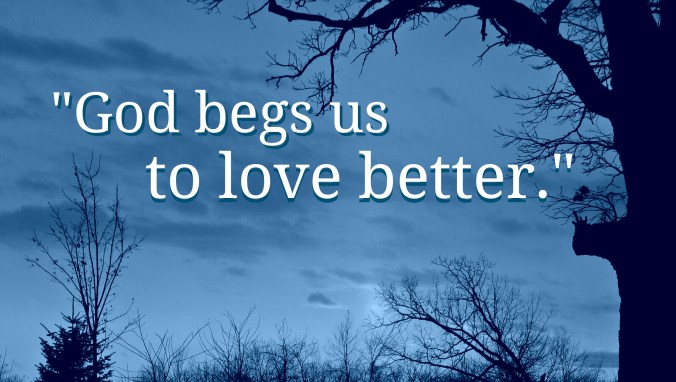
Throughout the Bible, God sends warning after warning about the consequences of failing to love. He sends us Jesus so we may be reconciled to him in love, and before that sends us John the Baptist to tell us Jesus is on the way. Love is complicated. Think about your own relationships where love has been broken: it’s rarely a sudden snap, but a slow dissolution with opportunities for one or both sides to repent. God begs us to love better.

Advent is a season for reflecting on how well we love God and each other. Before the world falls apart, God call us to love. Afterward, it is the only thing that saves us.

Comfort: God loves us even in anger.

Challenge: Work on a relationship where love has been broken.

Prayer: Make me to know your ways, O LORD; teach me your paths. Lead me in your truth, and teach me, for you are the God of my salvation; for you I wait all day long. (Psalm 25:4-5)

Discussion: How has your understanding of love changed over time?

Join the discussion! If you enjoyed this post, feel free to join an extended discussion as part of the C+C Facebook group. You’ll be notified of new posts through FB, and have the opportunity to share your thoughts with some lovely people. Or feel free to comment here on WordPress, or even re-blog – the more the merrier!

The Jumble

20171208_123910-01.jpeg

Celebrating Christmas without observing Advent is like taking a victory lap before the race starts.

At least, that’s how I’ve felt about it for many years.

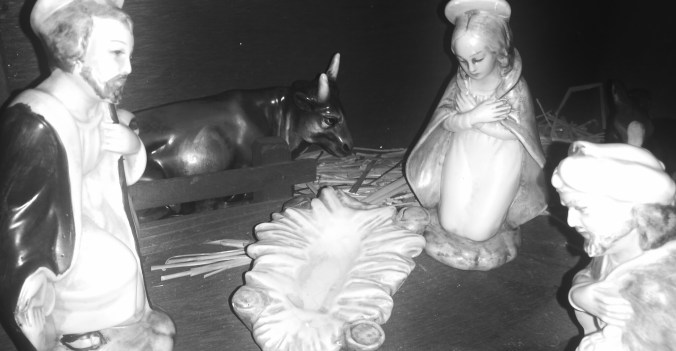
Most of the rest of the world – both secular and Christian – begs to differ. On the Friday after Thanksgiving, the whole country seems to flip a switch that turns on  the Christmas twinkle and bustle with Advent getting barely a nod from those chocolate-laced calendars which start on December 1st whether that’s the actual beginning of the season or not. Maybe we feel we’ve done enough Advent-ing when we hold off on dropping the Baby Jesus into the nativity scene until the morning of. Our Christmas expectations have grown so extravagant that we spend a liturgical season of solemnity with decorating, shopping, wrapping, baking, and singing when we could be mourning a broken world. Okay, not a great selling point, but it is why Jesus showed up.

I’ve been a lot more concerned with the War on Advent than the War on Christmas (which by the way was  decisively won by retailers decades ago – you might be glad to know Christmas won). I find a certain perverse glee in reminding people Christmas Day wasn’t a federally recognized holiday until 1870, and that in the 17th century Christians campaigned to keep Christmas celebrations illegal in several of the original colonies and in England.

For all their faults, Puritans really understood the importance of observing a Bleak Midwinter.

And yet ironically … I find being a prophet of doom about Advent does little to advance the pro-Advent agenda. So instead, I have come to realize – reluctantly at first and more gratefully these days – that in the midst of all that inappropriately-timed caroling (hey, I’m working on it!), people are indeed facing the brokenness in our communities and our world. They’re just not putting as somber a face on it as my narrow vision demands.

Charities of all kinds depend on the generosity that wells forth in the Advent/Christmas season for their very survival. In places of employment, colleagues take collections and pool resources to make Christmas day special for the less fortunate (whose wish lists often include household supplies and other things many of us can take for granted). The Marines deploy their Toys for Tots campaign to bring joy to children, and civilians make extra efforts to remember those deployed around the world under unthinkable conditions.

Are these kindnesses a bit of Advent-like awareness? Yes. Do they address the larger injustices that prophets like Amos and Isaiah – perennial Advent favorites – warn us about? Not as much as they could.

But it’s all a start. Despite my affection for a neatly structured liturgical calendar, Advent and Christmas and all those other seasons are not how life plays out in the real world. In the real world, every day – every hour – is a jumble of hope, joy, expectation, repentance, mercy and all the other things that make up existence. Advent preparation isn’t just for Christmas. And Christmas celebration isn’t just for December 25th.

That saying about having Christmas in our hearts all year around? It’s also true for the lessons of Advent, Easter, Pentecost, and every other season and holiday of our faith.

May the peace of our Lord Jesus Christ be with you all.

Hope. Always.

1449326142133

Readings: Psalms 90; 149, Amos 5:18-27, Jude 17-25, Matthew 22:15-22


Ever since the world began, people have been predicting its end. For many that “end” is not so much a final obliteration, as a renewal when the evil, violence, and injustice will be swept away to make room for something better. The prophet Amos speaks of the day when God will “let justice roll down like waters, and righteousness like an ever-flowing stream.” When we read headlines and watch the news, don’t we long for the same?

We can react to adversity with despair or with hope. While we may naturally tend toward one or the other, it is ultimately a choice. In the midst of suffering hope may seem futile or naive, but it has real consequences. Repeated studies show that a positive attitude promotes healing from illness and surgery. On a fundamental level, hope is essential to survival; hunger, thirst, and fear may seem like negatives, but they are hard-wired into us with an assumption that we will continue to live.

Though hope is more than a belief in continued existence. Despair also assumes existence but resigns us to inaction and victimhood, where hope spurs us to positive action. Hope makes charity possible, because it allows for positive change. Without the promise of hope could we even contemplate mercy?

In an age when tragedy around the world is broadcast into our homes 24 hours a day in high definition, hope can be hard to maintain. The truth is that on the whole violence in the world has been decreasing steadily for decades. Data and statistics are not necessarily comforting in the face of immediate crisis, so how do we work (and it is intentional work) to maintain hope? Minister and children’s television host Fred Rogers famously quotes his mother who told him the best thing to do in times of disaster is “look for the helpers” – people who move toward a tragedy to improve the situation. While it seems counterintuitive, could the Kingdom actually be ushered in when we move nearer to tragedy, where we are also nearer to mercy and charity? That is the end we hope for.

Comfort: We are closer to the promises of the God’s Kingdom every day.

Challenge: You can’t help everyone, but somewhere nearby there is a tragic situation waiting for you to inject hope into it. Find it and act.

Prayer: Restore us, O God of hosts; let your face shine, that we may be saved. (Psalm 80:7)

Discussion: Is hope something that comes naturally to you?

Join the discussion! If you enjoyed this post, feel free to join an extended discussion as part of the C+C Facebook group. You’ll be notified of new posts through FB, and have the opportunity to share your thoughts with some lovely people. Or feel free to comment here on WordPress, or even re-blog – the more the merrier!
Hope Astutely

1449236593541

Readings: Psalms 102; 148, Amos 5:1-17, Jude 1-16, Matthew 22:1-14


In the aftermath of Hurricane Katrina, thousands of volunteers arrived to help the residents of New Orleans recover. Among them were con artists who accepted large down payments for construction work then skipped town. Every year Americans with terminal and/or chronic diseases spend hundreds of millions of dollars on unproven and frequently dangerous “cures.” People who can barely afford to eat donate money they can’t afford to televangelists who teach a  fraudulent prosperity gospel. Politicians convince generation after generation to blame the latest wave of immigrants (Irish, Asians, Jews, Syrians, etc.) for societal ills because they know fear mongering is good campaign strategy.

When people are desperate or afraid, they are especially vulnerable to the false comforts of people who tell them what they want to hear. The author of Jude warned early Christians to be wary of people spreading false doctrine that taught self-glorification over submission to Christ: “These are grumblers and malcontents; they indulge their own lusts; they are bombastic in speech, flattering people to their own advantage.” Today we don’t worry much about the religious orgies contemporary with Jude’s audience, but we should be wary of leaders who conflate secular concerns like capitalism (and other economic systems), democracy (and other government systems),  or nationalism (and other tribalist systems) with Christianity in order to exploit our fears and insecurities.

In the parable of the wedding banquet, Jesus describes the wedding of a king’s son where many were invited but chose not to attend, and this lack of commitment resulted in their deaths as commanded by the king. The king’s slaves collected a second round of guests including everyone they found on the street, but even these guests were not all safe, “for many are called but few are chosen.” Those chosen few sought hard truths over a diluted and convenient message.

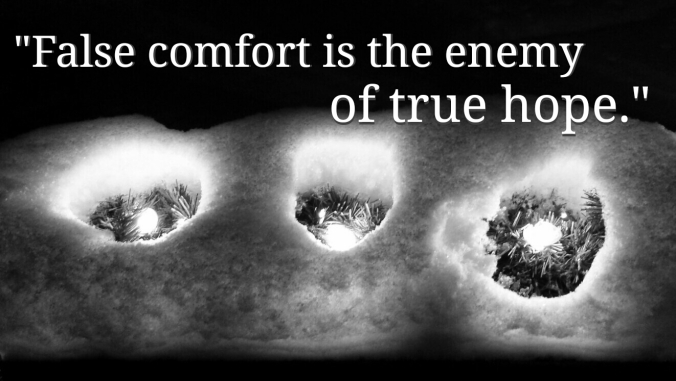
Our world can be scary. Our instincts can be base. Many will take advantage of that combination to spread beliefs that are not in our best spiritual interests. False comfort is the enemy of true hope. Let us be wise and make sure our hope is placed in Christ.

Comfort: We can identify true hope by comparing it to Christ’s example.

Challenge: Be wary of people who would exploit your faith for their own gain.

Prayer: I keep the LORD always before me; because he is at my right hand, I shall not be moved. (Psalm 16:8)

Discussion: Are there any parts of your life where your secular expectations are in conflict with your religious ones? If not … why not?

Join the discussion! If you enjoyed this post, feel free to join an extended discussion as part of the C+C Facebook group. You’ll be notified of new posts through FB, and have the opportunity to share your thoughts with some lovely people. Or feel free to comment here on WordPress, or even re-blog – the more the merrier!

Hope Realistically

1449111283187

Readings: Psalms 18:1-20; 147:12-20, Amos 4:6-13, 2 Peter 3:1-10, Matthew 21:33-46


Wouldn’t it be nice if people of faith were assured peaceful, healthy, uncomplicated lives? Some preachers – mostly of the “send us your money to pray over” variety – claim disease and difficulty can be overcome by faith alone, and that adversity simply fills a void where faith is lacking. The prophet Amos, describing God’s attempts to use drought, famine, and plague to convince the people of Israel to return to him, would claim differently. The faithful and the wicked suffered the consequences of the wicked together. When the world experiences similar troubles today, whether we believe they are sent directly by God or the natural consequences of our own misguided actions, faith is not guaranteed to shield us.

In Jesus’s parable of the landowner, tenant farmers kill the blameless servants who have come to collect the agreed upon share of the harvest on behalf of their master the landowner. One might expect the aura of authority lent by their master would protect the servants, but it does not. One can find many parallels in our modern world, where Christians continue to be persecuted for their faith. From actual martyrdom and execution to depression, addiction, illness, and crime,,, our faith exempts us from none of it.

If we are not spared suffering, why have faith at all?

Faith is the source of hope. We believe in God’s eternal plan of justice and salvation, and trust our sufferings are finite. As part of a larger body, we know the suffering and even destruction of one part does not have to mean the death of the whole. We stand in the center of the wreckage and devastation – and sometimes the wreckage and devastation dwell in the center of us – but we do not allow them to define us. In the face of seemingly endless disaster, is there anything realistic about hope? There is if our hope is dependent not on this moment, but on the faith that the Kingdom of God will not be denied. The ailing body of humankind will be raised to true life again. A stumble is still a step forward.

Comfort: God is with us through suffering, whether or not it is of our own making.

Challenge: When others suffer, let’s offer support instead of empty words.

Prayer: Guard me as the apple of the eye; hide me in the shadow of your wings, from the wicked who despoil me, my deadly enemies who surround me. (Psalm 17:8-9)

Discussion: Do you think there is anyone who hasn’t somehow caused someone else to suffer?

Join the discussion! If you enjoyed this post, feel free to join an extended discussion as part of the C+C Facebook group. You’ll be notified of new posts through FB, and have the opportunity to share your thoughts with some lovely people. Or feel free to comment here on WordPress, or even re-blog – the more the merrier!

Hope Authentically

1449028560917

Readings: Psalms 50; 47, Amos 3:12-4:5, 2 Peter 3:1-10, Matthew 21:12-22


In the New International Version of the Bible, the word “hypocrite” (or some variant of it) appears roughly four dozen times. About half of those instances are attributed to Jesus as he chastised the self-righteous. Amos and other prophets condemn example after example of the hypocrisy of God’s people. They say God finds it so detestable that no quantity or quality of sacrifices can make up for it.

As we hope for the coming of the Kingdom, let’s do what we can to eliminate the hypocrisies in our own lives. We all have them; they’re virtually inescapable. Maybe we don’t feel we are capital-H hypocrites like those who troubled Jesus, but condemning them while ignoring our own failings is … well … hypocritical.

These behaviors are insidious, because often we justify our hypocrisy enough not to be bothered by it. Like when we rail against the sleazy tactics of the opposing political party, yet turn a blind eye toward less than honorable actions of our own side because they are doing it “for the right reason.” Or when we compromise our principles (“I believe in sustainability!”) because they might cost us money (“But fair trade coffee is a dollar more per pound!”). And when we claim to follow Christ, then find reasons to blame the poor, the alien, the imprisoned, the sick, and the sinful for their plight rather than love and serve them as we’ve been told.

The Kingdom we hope for is not one where everyone else changes and we get to bask in the satisfaction of how right we’ve been all along. To be good citizens of the Kingdom — now or in the future — we can’t assume we’ll be better people because the world will be a better place. That’s like saying: “I’ll learn to turn the other cheek when you cease to offend me.” To the contrary, the world will be a better place because we will be better people living into the fullness of Christ’s love.

It’s not easy to face our own hypocrisy, nor realistic to think we will eliminate it entirely, but the nearer we draw to Christ the more authentic we become.

Comfort: God loves us as we are, and because God loves us we can be better.

Challenge: Ask someone you trust to point out an area where you can be hypocritical.

Prayer: Hear a just cause, O LORD; attend to my cry; give ear to my prayer from lips free of deceit. (Psalm 17:1)

Discussion: What hypocrisies have you discovered within yourself?

Join the discussion! If you enjoyed this post, feel free to join an extended discussion as part of the C+C Facebook group. You’ll be notified of new posts through FB, and have the opportunity to share your thoughts with some lovely people. Or feel free to comment here on WordPress, or even re-blog – the more the merrier!

For the record…

… Since the Lectionary is cyclical, the recent and upcoming Advent posts are polished up versions of ones written two years ago. It was a very different political atmosphere, so please don’t read too much about current events into their intent. But maybe don’t read too little into them either; the prophetic cry for justice is ongoing and timeless.

Hope Justly

20151130_232850

Readings: Psalms 33; 146, Amos 3:1-11, 2 Peter 1:12-21, Matthew 21:23-32


The Old Testament contains over a dozen books named for prophets. Most of them contain the same message for the people of God: repent and embrace the justice God requires of you or the consequences of your actions will destroy you. God seems to have no desire to punish his people — why else provide them so many warnings? — yet when we read the words of the prophets we can’t help but feel the inevitably of their self-destruction.

Amos tells us “the Sovereign Lord does nothing without revealing his plan to his servants the prophets” and says the people hear the lion roar yet do not fear. Rather, they content themselves with fulfilling the letter of the law while ignoring its purpose: to bring justice to God’s people. Nearly 800 years later, Jesus was the roaring lion the people chose to ignore. His message to the leadership of the time could have come from Amos: while paying lip service to the Lord, you are ignoring holy truths. When faced with the question of Jesus’s authority, they feigned ignorance rather than risk losing their grip on the people by telling the truth.

To what prophetic cries for holy justice do we turn a deaf ear today? In what ways are we trading the demands of justice for personal convenience? What groups of people do we allow to be vilified or victimized for political or financial expedience? In this age of information overload, any failure to recognize the voices which cry out for an end to poverty, racism, sexism, exploitation, and countless other ills requires a willful ignorance rivaling the pharisees. We are being warned. Will we be as hard-hearted as those who denied Amos and Jesus?

It’s not too late. Whether Christ returns tomorrow or a million years from now, today we can choose to be a people whose actions court blessing rather than wrath. Advent is a time to say: “I hear you. I see you. I long for the justice denied you, and tremble before God that I have been party to it.” Advent is the time to roar like a prophet.

Comfort: Christ comes into the world to deliver justice to the persecuted.

Challenge: Read about human trafficking and the seafood industry. Think about how you can value justice as part of the price for goods and services.

Prayer: Let all the earth fear the LORD; let all the inhabitants of the world stand in awe of him. For he spoke, and it came to be; he commanded, and it stood firm. (Psalm 33:8-9)

Discussion: Who does it seem God might be warning today? Through whom is God speaking?

Join the discussion! If you enjoyed this post, feel free to join an extended discussion as part of the C+C Facebook group. You’ll be notified of new posts through FB, and have the opportunity to share your thoughts with some lovely people. Or feel free to comment here on WordPress, or even re-blog – the more the merrier!

 

Hope Humbly

2015-11-30-scaled

Readings: Psalms 122; 145, Amos 2:6-16, 2 Peter 1:1-11, Matthew 21:1-11


What does it mean to wait for Christ? In one sense it means preparing our hearts and spirits for the promise of Christmas. Whether we all agree about the historical details of the nativity, we share a fairly common understanding about its message. In another sense, it means preparing ourselves for the return of Christ at some future time — and we have a lot less agreement about what that means. Some of us think of it as a literal embodiment of Revelation. Others are less certain of the details but envision a physical return. Still others think of it in metaphorical terms and don’t much separate the future Kingdom of Heaven from the present. Almost certainly none of us knows exactly, and Christ will continue to thwart expectations. It’s kind of his thing.

In Matthew 21, Jesus arrives in Jerusalem on a donkey. This gesture symbolized his defiance of both Roman authority and the expectations of the Jewish people. The Jews were expecting a warrior messiah, a political figure who would throw off the chains of Roman tyranny in bloodshed and battle. Instead, they got a man who refused earthly titles and allowed his persecutors to execute him. A donkey where they expected a stallion.

Jesus will throw over our expectations as well (if he hasn’t already). So how should we prepare? Maybe the best thing to do is carry on as if we don’t know exactly what to expect. Because we don’t.

The second letter of Peter advises us to cultivate the qualities describing a life in Christ, each quality laying a foundation for the next: goodness, knowledge, self-control, perseverance, godliness, mutual affection, and love. Without them  he says our vision of Christ is nearsighted and blind. Before we make the same mistake as Christ’s contemporaries and insist our understanding of the messiah must be the right one — or insist someone else’s must be the wrong one —let’s concentrate on working up the rungs of Peter’s ladder of virtues from goodness to love. Those rungs are held together between rails of humility and faith. As we hope for Christ’s return, let’s hold tightly to both.

Comfort: We can always grow while we wait to encounter Christ more fully.

Challenge: At the end of each day this week, reflect on where you might have better exercised humility.

Prayer: May God continue to bless us; let all the ends of the earth revere him. (Psalm 67:7)

Discussion: How do you think your understanding of Jesus might differ from someone else’s?

Join the discussion! If you enjoyed this post, feel free to join an extended discussion as part of the C+C Facebook group. You’ll be notified of new posts through FB, and have the opportunity to share your thoughts with some lovely people. Or feel free to comment here on WordPress, or even re-blog – the more the merrier!
Hope Cautiously

2015-11-29-scaled

Readings: Psalms 24, 150; Amos 1:1-5, 1:13-2:8; 1 Thessalonians 5:1-11; Luke 21:5-19


Advent is the season when we prepare for the arrival of Christ. This arrival has a dual nature, as we celebrate his birth and Bethlehem and anticipate his eventual return. Every year it is a cycle within a cycle.

The history of injustice similarly repeats itself. Ethnic tensions, disregard and abuse of the poor, corrupted court systems, war crimes, and other ills have existed throughout all of human history. Whether or not we like to admit it, no nation or people is immune. When the formerly oppressed gain power they may take their turn to become the oppressor, and are blind to it because they still think themselves righteous.

Such was the case with Israel when farmer-turned-prophet Amos spoke to them. Israel had struggled long and hard to become a prosperous nation, but Amos told them they were no better than the wicked nations surrounding them. Amos accused the Israelites of “selling the righteous for silver, and the needy for a pair of sandals […] trampling the head of the poor into the dust of the earth, and pushing the afflicted out of the way.” The leadership of Israel declared themselves righteous because they followed the rules of sacrifice and ritual, but they were indifferent to God’s greater demands of love and justice.

The theme for this first week of Advent is Hope. The flip side of hope is recognition that the world can be bleak, for why would we hope if we didn’t long for things to be better? Amos reminds us part of that recognition needs to be an examination of our own hearts, actions, and inactions. It’s human nature to believe our actions are justified … and to provide justification when we aren’t sure. We don’t always want to face ourselves when we’ve been part of an injustice or we’ve been willfully ignorant about our own contribution to societal problems. If in reading that last sentence you assumed it was accusing you of something specific … it wasn’t but maybe your consciences is. Maybe start there.

The good news of Advent is that we don’t end “there.” In the weeks ahead, we will live into the promise of Hope.

Comfort: Hope is promised to everyone.

Challenge: This Advent season, begin an examination of your conscience and begin owning up to the things that get in the way of hope.

Prayer: For the sake of my relatives and friends I will say, “Peace be within you.” For the sake of the house of the LORD our God, I will seek your good (Psalm 122:8-9)

Discussion: There are countless things to hope for. Which is most pressing to you right now?

Join the discussion! If you enjoyed this post, feel free to join an extended discussion as part of the C&C Facebook group. You’ll be notified of new posts through FB, and have the opportunity to share your thoughts with some lovely people. Or feel free to comment here on WordPress, or even re-blog – the more the merrier!