Jesus, Life of the Party

image
Today’s readings (click below to open in new tab/window):
Psalms 51; 148, Genesis 6:1-8, Hebrews 3:12-19, John 2:1-12


Christianity is serious business. The language of our faith uses words like sacrifice, atonement, sin, repentance, blood, and crucifixion with alarming regularity. We often speak of love as a demanding experience. We revere saints who deprived themselves of all earthly pleasures and martyrs who died in horrible ways. Suffering and death are undeniable parts of our collective story. If we are supposed to be willing to follow Christ to the cross, why do we ever sing songs like “I’ve Got the Joy, Joy, Joy, Joy Down in My Heart?”

Despite the bloody reality of the cross and the traditional fire and brimstone sermons we have heard, suffering is not the default position of the Kingdom of God. Christ did not suffer and die just so we could continue suffering and dying. In the book of John, his first public sign is turning water into wine at a wedding banquet. That’s right: he made his public debut at a party, and performed a miracle so the party wouldn’t have to stop. It wasn’t just any party though – it was a celebration of life recognizing a joyous bond between two people, and the bond between each of them and God.

The Cana story does not appear in other Gospels, but in Matthew Jesus describes the Kingdom of God as a wedding banquet where outcasts feast. In this life suffering may be inevitable, but we don’t need to wear it like a uniform to be good Christians. To the contrary, Jesus had little regard for people who put their suffering on display as a show of piety. We are to confront head on the suffering of the world and help where we can, and to rely on God when we ourselves suffer, but we are never to be resigned to misery. While suffering is sometimes the cost of staying the course on the way to the feast, it is not God’s desire for us. The ultimate purpose of the crucifixion was eternal life. Jesus came to heal us, to teach us to forgive, and to celebrate with us. Let’s not forget to RSVP.

Comfort: God wants us to be joyful.

Challenge: Best as you can, don’t run away from people’s suffering; confront it with them without being consumed by it.

Prayer: Lord, lead me to those whom I can help, and open my hearts and hands to them. Amen.

Discussion: Suffering is part of life. Is there a way to make it useful?

Join the discussion! If you enjoyed this post, feel free to join an extended discussion as part of the C+C Facebook group. You’ll be notified of new posts through FB, and have the opportunity to share your thoughts with some lovely people. Or feel free to comment here on WordPress, or even re-blog – the more the merrier!

Wretched Refuse(d)

statue-of-liberty-2407489_1920Welcome to the first entry of C+C 2.0. As mentioned near the end of last year, I’m going to do some pieces that are a departure from the devotional and invitational posts. This one hits on topics that some consider political – specifically some comments recently made by our president – but I have no interest in partisanship. I do have interest in the intersection of America and Christianity. If that piques your interest, read on; otherwise another devotional will be up soon. Peace!


“Why do we want all these people from ‘shithole countries’ coming here?”
– President Donald J. Trump

So at last it’s laid clearly on the table; this is what a “Christian nation”  – or at least the representative it elects – thinks about immigration. We can cry all we want about how he doesn’t really represent us, but we elected him. He’s no surprise.

Let me make this clear from jump: this isn’t about legal or illegal immigration. The justice of that situation also desperately needs attention, but it’s a separate matter.

No, this is about how some of the wealthiest people in one of the wealthiest countries in the world view poor people, especially non-white poor people. It’s about failing to recognize the context of history, and how many of these “shithole” nations find themselves in dire straits largely due to colonial and capitalist exploitation by the rich and powerful – sometimes from the West and sometimes internally – and then dismissing them as failed states full of less-than-human beings.

This is about how a faith community claiming to follow a savior who said “Whatsoever you failed to do for the least of my brothers and sisters, you failed to do for me” (yeah, that’s the second part) could view and treat the “least” with passive contempt.

It’s about how America – in sad parallel with American Christianity – has become less a refuge of freedom for those oppressed  by empire, poverty, and discrimination …  and more an empire itself ferociously hoarding wealth and power in one hand while waving a flag of equality and freedom in the other. The crosses stretching across America have become support poles for the ultimate velvet rope of the most exclusive club, defining who gets in and who stays out based on who the owners of the nation (and the faith) like to be seen with.

America is in the business of continental gentrification. Now that we’ve pushed out the savages and ruffians and got the neighborhood up and running, we don’t want to let in “those” people who will take advantage of it and ruin it. Never mind the inconvenient history of building it on the backs of wave after wave of “those” people. African and Asian and Eastern European and Jewish and Catholic and Latin American and the endless variety of people we saw as less-than-human beings for a generation or so until we were up in arms about the next group threatening to ruin the neighborhood. Thanks for finishing that railroad. Your seat is in the back. Your neighborhood is across town.

In large part, immigration has long been a recruitment effort. The Polish and Hungarian neighborhoods in my town were the direct result of businesses bringing in entire communities to meet labor demands. These people didn’t come because they were already wealthy and successful. They came for the opportunity to escape shitholes. Without them, wealth sat idle. With them, it built cities, communities, churches, museums, and the rest of a nation.

But here’s the difference between running a business and running a nation. Once a business is done with the cheap labor (or replacing the expensive labor with automation) those people are no longer the responsibility of the business. A nation is never done with its responsibility. Citizens are not FTEs. We need to take them into account, or they will turn on each other.

It’s no coincidence this swell of populism is occurring during a time of divided wealth, deteriorating infrastructure, and decreasing church attendance. A national or religious empire (and have they ever really been separate in the West?) in decline is an animal which has cornered itself, and is therefore a danger to itself. When we were tackling frontiers, risk brought reward. Now that we have nowhere to expand and those we trampled on are forcing us to face the questionable tactics we used for that expansion, the greatest risk is admitting we’re not who we think we are. Even the middle and lower classes are defensive of criticisms of the rich when tribal reputation is all they have left to cling to.

I don’t actually think of America as a Christian nation, nor would I like it to be. I’m not at all keen on anything that smacks of theocracy. When you get my government in your religion they aren’t “two great tastes that taste great together” (anyone remember those commercials?); they’re more – and excuse my presidential language here – a shit sandwich.

But despite our worse instincts, some actual Christ-like influence has managed to permeate the culture. Those words about the tired, poor, huddled masses on the State of Liberty may be a product of an enlightened France, but they resonate with the religion that says God backs a loser. Even when our country – and our faith – don’t live up to the hype, citizens and would-be-citizens cling to the ideal expressed in those words. After all, most our families didn’t come here because the government was recruiting the already successful, but because the nation welcomed, needed, and sometimes stole the poor; some part of us remembers where we’ve come from, even when our own success and fear of sharing it diminish our enthusiasm for extending that same dream to others.

Businesses that contribute to society. Nations that contribute to the world. Faith that contributes to the Kingdom.  Have we – or our representatives – forgotten they are all built on the “least of these?”

A powerful business, nation, or faith that turns its focus inward and seeks to protect itself at the expense of others is not a reflection of Christ. Heck we’d have to get out the silverware polish and a sandblaster to uncover even the barest glimmer of common decency.

If you really want to give a hand up instead of a handout, you have to be willing to get your hands dirty. Yes, welcoming the stranger is scary. Christ says welcome them anyway. Yes, a small minority will want to take advantage. Christ says give to all who ask of you.  (Right about now you’re tempted to rationalize that into something practical. Why? Christ wasn’t practical.)  Yes, your way of life may feel threatened. Christ says there is no greater love than to lay down your life for your friend, and if we truly claim Christ as our friend, who then can we exclude from friendship?

A church or a nation that gets disheveled and dirty because it’s in the business of turning the hopeless into the hopeful is doing its job. Christianity and America are not meant to be beautiful, sterile showplaces focused on preserving their own self-proclaimed wonderfulness. They are meant to be sources of justice in not just a legal sense but a moral one, and justice takes guts and grime.

Through our faith language and our nigh-religious devotion to capitalism, we have turned spiritual and economic salvation into “I’ve-got-mine” individual experiences, when true salvation is communal. Doing so has impoverished us in countless ways. True salvation seeks not to isolate, but to replicate. When much is given, much is expected. Jesus said that, too.

Why do we want all these people from shithole countries coming here?

If we are Christian, the answer is “Jesus said so.”

If we are American, the answer is “they have and will make us stronger.”

If we are both, why are we still asking the question?

God out of Nazareth

1452742030612

Today’s readings (click below to open in new tab or window):
Psalms 97; 147:12-20, Genesis 4:17-26, Hebrews 3:1-11, John 1:43-51


Soon after Philip the apostle met Jesus, he found his friend Nathanael and said:”We have found him about whom Moses in the law and also the prophets wrote, Jesus son of Joseph from Nazareth.” Nathanael replied: “Can anything good come out of Nazareth?” Of course he was swayed once he actually met Jesus, but his initial skepticism is noteworthy.

The village of Nazareth did not have much of a reputation. It was small and relatively obscure. Suggesting the Messiah could emerge from Nazareth seemed ridiculous even to its own citizens, who repeatedly rejected Jesus and his teachings. Yet a Nazarene he was, defying all doubt and eclipsing all expectations.

It’s not fair, but the world pigeonholes people based on the circumstances of their birth. Inner city kids are thugs. Immigrants from the middle east are suspected terrorists. Women are less capable than men and men are less nurturing than women. Pretty people are stupid and nerds are lonely. Stereotypes  are endless. Like Nathanael we sometimes encounter someone who demolishes one of our biases, but many of them remain unchallenged. One might think that being subjected to a stereotype would make a person less likely to do the same to others, but it isn’t so. We all justify our own biases and the world is poorer for it.

Where is your Nazareth? It may be an actual place, like Detroit or Syria. It may lie in an opposing political or religious ideology. It could be buried in the pigmentation of someone’s skin cells.You may not be able to locate it easily, because it doesn’t necessarily stand out as a place you actively dislike, but perhaps a place you can casually dismiss. Nazareth is any place or circumstance you use as an excuse to invalidate a person or their voice.

Jesus overcame all the obstacles of his birth. So can we, because we are children of God. And we need to give others the same chance. Let us each work to examine and dismantle our prejudices so we can look at each other and see the face of Christ, Nazarene and Messiah.

Comfort: You are more than any label. You are a child of God.

Challenge: Ask a friend you trust what your biases are. Don’t argue with them about what they say, just listen with an open mind and heart.

Prayer: Loving God, teach me to see you in all people, even when I don’t want to.

Discussion: What biases have you formerly held which you no longer hold?

Join the discussion! If you enjoyed this post, feel free to join an extended discussion as part of the C+C Facebook group. You’ll be notified of new posts through FB, and have the opportunity to share your thoughts with some lovely people. Or feel free to comment here on WordPress, or even re-blog – the more the merrier!

Blame Game

1452656920356

Today’s readings (click below to open in new tab/window):
Psalms 89:1-18; 147:1-11, Genesis 4:1-16, Hebrews 2:11-18, John (1:29-34) 35-42


The story of Cain and Abel is the original tale of sibling rivalry. Cain, the first child of Adam and Eve, was a “tiller of the ground” and made God an offering of his harvest. His brother Abel was a shepherd, and offered God the finest of his flock. God favored Abel’s offering but not Cain’s, and in jealous anger Cain slew Abel with a rock. Instead of killing Cain, God instead banished him east of Eden and placed a mark of protection on him so no one else would kill him either.

Stories of rivalry are seldom so extreme, but Cain made a common mistake: when things didn’t go his way, he assumed the role of victim.

When God noticed Cain was angry because his offering was not respected, he asked Cain: “Why are you angry, and why has your countenance fallen? If you do well, will you not be accepted?” Cain never stopped to ask himself (or God) what he might have done differently. Instead he directed his anger toward Abel. God had advised him: “And if you do not do well, sin is lurking at the door; its desire is for you, but you must master it.” As God predicted, blaming Abel for his failure led to an even bleaker fate.

Our reaction to failure determines the course of our future. Not being honest with ourselves about our own contributions to a failed effort can have disastrous results for ourselves and those around us. Even when we feel someone has taken advantage of us, we can ask whether and how we made it possible. This doesn’t excuse the other person, but restores our sense of control over the situation and prepares us for similar situations in the future.

We’ll never know why God  rejected Cain’s offer, because he didn’t ask. When we bungle a project at work or handle a family situation poorly, it’s tempting, easy, and human to blame the circumstances, a co-worker, or a spouse. Once that’s out of your system, you need to look inward. In any situation, you are the only person you can control.

Comfort: When you make mistakes, God is not waiting to condemn but to help.

Challenge: Reconsider a situation – from a time when you were an adult – where you blame someone else for failure or problems. Ask yourself what you might have done differently, and what could you do differently in the future.

Prayer: God, teach me to see myself as I am, not as I pretend to be. Amen.

Discussion: How often do you play the victim?

Join the discussion! If you enjoyed this post, feel free to join an extended discussion as part of the C+C Facebook group. You’ll be notified of new posts through FB, and have the opportunity to share your thoughts with some lovely people. Or feel free to comment here on WordPress, or even re-blog – the more the merrier!

Naked and Unashamed

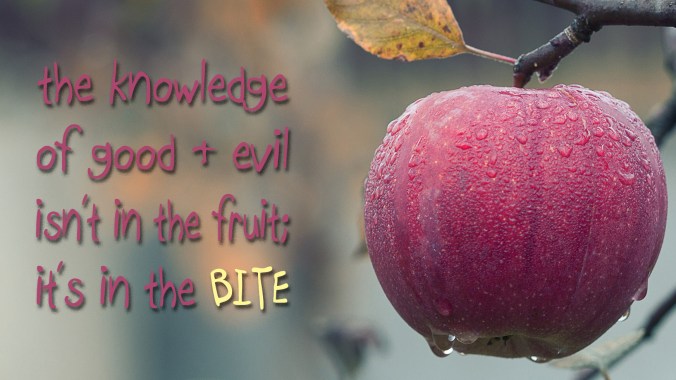
apple-1122537_1920

Today’s readings (click below to open in new tab/window):
Psalms 42; 146, Genesis 3:1-24, Hebrews 2:1-10, John 1:19-28


“Who told you that you were naked?”

That’s the question God asks Adam and Eve when He finds they have covered themselves in fig leaves because they are ashamed. No one had to tell them; they knew as soon as they ate the fruit from the Tree of Knowledge of Good and Evil. What exactly about their nakedness was shameful? Minutes earlier it hadn’t bothered them – or God – at all. Perhaps it wasn’t the physical nakedness that shamed them, but the spiritual nakedness. That’s a lot harder to cover up.

Was there really anything special about the fruit? If God had commanded them not to sit in the Lawn Chair of the Knowledge of Good and Evil, the serpent would have reminded them how tired their legs were. It was inevitable.

Our reason for desiring “forbidden fruit” always seems solid … right up until we begin to pay the consequences. Like every human being, Adam and Eve already had the capacity for good and evil, but because they had not been disobedient, they did not have the knowledge of it. Immediately upon disobeying God they became aware of how deeply flawed they actually were. Like any one of us, they didn’t want those flaws exposed to the world or to God. Fumbling to conceal themselves only made mistakes more apparent. Whether or not we believe in a literal Eden, the story teaches us that as soon as we are aware of our disobedience, we feel separated from God.  The knowledge is not contained in the fruit, but in the bite.

It took a Christ who was willing to die on our behalf to reveal to us that God loves and forgives us despite our flaws. Our vain and impossible attempts at perfecting ourselves – our fig leaves – only further separate us from God, because we inevitably fall short and condemn ourselves. We’d be better off never having covered up at all. Christ invites us to drop the fig leaves and return to God on God’s terms – spiritually naked and humbly dependent. Christ uncovers our shame, and covers us in love.

Comfort: God loves you just as you are.

Challenge: In what ways are you still trying to prove yourself to God? How can you let go of these “fig leaves?”

Prayer: Loving Creator, I present myself humbly before you. I trust that you love me despite my sins and failures. I thank you for Christ who strengthens and redeems me. Amen.

Discussion: What tempts you? How do you feel after you give in?

Join the discussion! If you enjoyed this post, feel free to join an extended discussion as part of the C+C Facebook group. You’ll be notified of new posts through FB, and have the opportunity to share your thoughts with some lovely people. Or feel free to comment here on WordPress, or even re-blog – the more the merrier!

Math Nerd Theology

1452489798883

Today’s readings (click below to open in new tab/window):
Psalms 5; 145, Genesis 2:4-9 (10-15) 16-25, Hebrews 1:1-14, John 1:1-18


First, a short math lesson. When you square any number, positive or negative, the result is always a positive number: 3 x 3 = 9 and -3 x -3 = 9. Fairly straight forward, yes? (If not, don’t worry; there won’t be a quiz). However, some equations can’t be solved without finding the square root of a negative number. Since such a number does not exist, mathematicians invented an imaginary unit named i. Perhaps it’s more correct to say they discovered it; philosophers have debated for centuries whether mathematical concepts are invented or discovered. In either case, the square of i is -1. No one can hold up i fingers or charge $i for a pound of bananas, but i is necessary to calculate the square root of -9, which is 3i. 

End of math lesson. But what was the point?

The Gospel of John tells us that in the beginning, there was the Word, and the Word was with God, and the Word was God. In the original Greek, John uses the term logos, which means “word” but also means “reason.” John’s logos is Christ, so John is claiming Christ has been present and co-existent with God from before the beginning of the world. How can this be? Like i, faith in the logos solves an otherwise impossible problem. John has no direct evidence for it, but he invents/discovers it to make sense of God’s relationship with the world expressed through Christ. Some may call it imaginary, but it is also necessary.

Critics of faith often mock it for lacking reason. If your faith comes under fire for being unreasonable, think of i (but not too hard, or your brain may start to itch). Just because something can’t be pointed to or counted doesn’t mean it’s not essential to the fabric of the universe. We don’t call the entire field of mathematics a sham because it relies on an “imaginary” unit. The claim of Hebrews 11:1 that “faith is the evidence of things unseen” is our version of i, the necessary but unknowable solution for morality, eternity, and the soul.

And we thought algebra would never be good for anything.

Comfort: Faith isn’t about seeing, but believing.

Challenge: Call your algebra teacher and apologize for not paying more attention.

Prayer: All powerful Creator, I thank you for being present in the world, though your mystery is beyond my understanding. Amen.

Discussion: Have you ever found a use for something you thought would be useless when you learned it?

Join the discussion! If you enjoyed this post, feel free to join an extended discussion as part of the C+C Facebook group. You’ll be notified of new posts through FB, and have the opportunity to share your thoughts with some lovely people. Or feel free to comment here on WordPress, or even re-blog – the more the merrier!


Telescope or Kaleidoscope?

1452400078790

Today’s readings (click below to open in new tab/window):
Psalms 104; 150, Genesis 1:1-2:3, Ephesians 1:3-14, John 1:29-34


The first Biblical account of creation tells the story of God creating for six days and resting on the seventh. That story is immediately followed by a second one that differs in detail but still ends with the first human beings in a garden paradise. When we recall the stories, we often blur the lines between them, taking a six-day schedule from one, a borrowed rib from another. The Biblical creation accounts don’t stop with Genesis. Proverbs, Job, John, multiple Psalms – these and other passages provide widely varied accounts of how God went about creating the world. How is it they can be so different, yet part of a unified whole?

The Gospels are similar. Each tells the story of Jesus from a different viewpoint, so they are similar but not the same. Studies show that eyewitness accounts are notoriously unreliable, yet sometimes our legal system still depends on them. The more witnesses who can corroborate key details, the better. A telescope is accurate but limited by its singular field of vision; a kaleidoscope gives us many angles of the same view.

Let’s consider our own histories. When we and our siblings or friends reminisce about childhood, we don’t all recall it the same way. Ever listen to a married couple tell a story jointly? There is quite a bit of give and take, argument and correction as they navigate their way through the tale. Witnesses, friends, or partners, they are all working toward finding truths that can only be reconstructed by layering multiple perspectives and insights.

When we dive into the big questions – Who am I? Why am I here? What’s it all about? – no single story tells us all we need to know. The compilers of the Bible were not concerned that the creation stories “agree” because that’s not the point. Even the “conflict” between Genesis and science disappears when we consider facts and truth are not revealed in a single snapshot, but in multiple exposures over a long period of time. If we insist that only one story is factual, we’ll never know which ones are true.

Comfort: We don’t have to have all the answers.

Challenge: We have to keep asking the questions.

Prayer: God of Creation, help me to value your truth more than my own certainty. Amen.

Discussion: Every family has its own mythology. What’s one of your family’s most meaningful stories? If you don’t have a family, what makes a story meaningful to you?

Join the discussion! If you enjoyed this post, feel free to join an extended discussion as part of the C+C Facebook group. You’ll be notified of new posts through FB, and have the opportunity to share your thoughts with some lovely people. Or feel free to comment here on WordPress, or even re-blog – the more the merrier!

Why Three Kings?

1452051859496

Today’s readings (click below to open in new tab/browser):
Psalms 72; 147:1-11, Isaiah 49:1-7, Revelation 21:22-27, Matthew 12:14-21
Epiphany readings: 
Isaiah 60:1-6, Ephesians 3:1-12, Matthew 2:1-12


Today we celebrate Epiphany, the manifestation of Christ to the gentiles. Traditionally the gentiles are represented by the Magi. The gospel of Matthew tells us wise men followed a star from the east, paid tribute to the infant Christ, and returned home by a different route because a dream warned them King Herod was plotting against the newly-born messiah. Most nativity scenes depict them as three kings, though there is no scriptural basis for their rank or count other than the number of gifts.

Maybe they’re better off dropping the king bit and sticking to being just wise. Psalm 72 describes what it means for God’s presence to be felt throughout the gentile world, and kings don’t fare well. They bow before the presence, offer tribute, and oppressive ones are crushed. On the other hand the poor, needy, and oppressed are mentioned favorably ten times in this twenty-verse psalm. God judges them with justice; he defends, delivers, redeems, helps, pities, and saves them. Jesus’s message of the first being last and the last being first doesn’t originate with him; it is a natural evolution of the messages of the psalmists and the prophets. Jesus is the one who brought it home.

A mainstay of modern Roman Catholic social teaching is a preferential option for the poor. In other words, Christians are obligated to serve those who are impoverished financially and/or spiritually. Theologians of other denominations share similar teachings. Depending on our worldview, how we choose to meet that obligation can take many forms. Christ has trusted us with a duty, and also trusts us to determine the best means to execute that duty. Sometimes that means we can disagree about how we should serve. What it never means is starting from an attitude where the poor – of pocket or spirit – are a nuisance, morally lacking, or lesser than anyone else. Whatsoever we do for the least among us, we do also for Christ. We are to be kings bowing to babes.

The Magi’s gifts of gold, frankincense, and myrrh represented royalty, holiness, and death. Jesus re-gifted them to us as humility, grace, and life regardless of our worthiness. Let’s pay it forward.

Comfort: God’s love is for all, not just the privileged or perfect.

Challenge: What programs in your local community help the poor? How can you help them?

Prayer: Loving God, thank you for all I have. I will not forget that you ask me to share it with those who have less. Amen.

Discussion: We are often distrustful or uncomfortable with people who have significantly more or less material wealth than we do. Why do you think that is?

Join the discussion! If you enjoyed this post, feel free to join an extended discussion as part of the C+C Facebook group. You’ll be notified of new posts through FB, and have the opportunity to share your thoughts with some lovely people. Or feel free to comment here on WordPress, or even re-blog – the more the merrier!

It Takes a Village to Raise a Lazarus

community

Today’s readings (click below to open in new tab/window):
Psalms 99; 146, Jonah 2:2-9, Ephesians 6:10-20, John 11:17-27, 38-44
Eve of Epiphany Readings:
Isaiah 66:18-23, Romans 15:7-13 


Is  faith sufficient as an individual experience, or does it need to be shared among a community of believers? When Jesus returned to Bethany because his friend Lazarus had died, the grief of Mary and Martha, sisters of Lazarus, was certainly shared. Neither knew what to expect, but they shared faith in Jesus. They only knew that in their time of great grief, they needed to be with him. Even after he told them he was the resurrection and the life, the sisters didn’t imagine he would bring Lazarus back to them. When he asked the mourners to roll back the stone covering the tomb, Martha said four days had passed and there would be a stench. Yet moments later Jesus commanded Lazarus to walk out of the tomb, and he did.

Jesus was the source, but it was a community that made his final sign meaningful.
Mary and Martha, each with an imperfect but united faith, together believed that whatever Jesus thought fit to ask, God would deliver. At least a few mourners must have volunteered to move the stone, as it was large and heavy enough to cover the mouth of a cave. The gathered crowd  listened to Jesus loudly giving thanks to God for their benefit so they might believe. Finally, Lazarus arose and returned to his friends and family, restoring their community.

Experienced in isolation, faith may be a comfort to us but it’s of little use to the greater body of Christ. When a community shares its faith – when one person answers Christ’s call to dive into the stench and darkness of tombs like poverty and disease, and another person trusts God to provide even when a loved one is caught in the hopeless living death of addiction, and the rest of us are inspired by and act because of their belief, and therefore sisters and brothers we thought lost forever return to us – that community finds new life as no individual could.

Faith requires community to achieve its fullest expression. Our own imperfect faith is a gift because it reminds us to seek others.

Comfort: When you have faith you are never alone.

Challenge: Explore a faith community that is unfamiliar to you.  Perhaps a charity, or another congregation. If you can, spend some time helping them with their mission.

Prayer: Thank you God for easing my burden by making me only one member of a larger body in Christ. Amen.

Discussion: What do you find most rewarding about community? Most difficult?

Join the discussion! If you enjoyed this post, feel free to join an extended discussion as part of the C+C Facebook group. You’ll be notified of new posts through FB, and have the opportunity to share your thoughts with some lovely people. Or feel free to comment here on WordPress, or even re-blog – the more the merrier!