
Good for the Soul

IMG_0322

Today’s readings (click below to open in new tab/window):
Psalms 42; 32, Daniel 9:3-10, Hebrews 2:10-18, John 12:44-50


Alcoholics Anonymous teaches us: “You are only as sick as your secrets.” The author of Psalm 32 knew this well. He wrote of his formerly deceitful spirit:

While I kept silence, my body wasted away
through my groaning all day long.
For day and night your hand was heavy upon me;
my strength was dried up as by the heat of summer.

Today we might describe a secret as eating away at us or causing us to lose sleep. The longer we convince ourselves to keep our sins secret, the larger the role they play in our lives, yet somehow we convince ourselves an admission of guilt would be worse than the physical and psychological destruction we inflict upon ourselves. We fear the consequences of revealing our truths – often for good reason – but until we face them, we will not know peace. We want relief from our pain, but we turn to the bad medicine of substance abuse, anger, self-righteousness, or self-harm rather than swallow the bitter yet effective pill of confession.

Whether it is a one-on-one sacrament as observed by Roman Catholics and Lutherans or a community prayer and assurance of pardon during other Protestant liturgies, most Christian denominations practice some form of confession and absolution. Corporate confession is a valuable reminder of our ongoing need to evaluate and improve our behaviors and attitudes, but it is rarely a catalyst for deep change. Individual confession – to a priest, pastor, counselor, friend, or support group – forces us to confront truths in a personally meaningful way. Sometimes we have to admit them to others before we can really believe them. God’s forgiveness is always available to us, but first we must recognize what it is we need forgiveness for.

Guilt is a great weight. We can shift its useless burden from shoulder to shoulder, desperately growing weaker while trying to convince others we are strong … or we can confess our weakness. God’s forgiveness is not about shaming our weakness or balancing the load, but about teaching us to drop it entirely.  Each secret we speak is a weight we no longer carry.

Comfort: God’s forgiveness is always available, because He is more interested in loving us than damning us.

Challenge: Unburden yourself a little this week. Pick a sin or secret that troubles you and confess it to a trusted friend, minister, or counselor.

Prayer: Lord Jesus Christ, have mercy on me, a sinner.

Discussion: Has anyone confessed a secret to you? How did it make you feel?

Join the discussion! If you enjoyed this post, feel free to join an extended discussion as part of the C+C Facebook group. You’ll be notified of new posts through FB, and have the opportunity to share your thoughts with some lovely people. Or feel free to comment here on WordPress, or even re-blog – the more the merrier!

Just Deserts and Just Desserts

1455376584499

Today’s readings (click below to open in new tab/window):
Psalms 43; 149, Ezekiel 39:21-29, Philippians 4:10-20, John 17:20-26


Have you heard the term “food desert?” A food desert is generally understood as an area – usually urban, usually economically distressed – where circumstances limit people’s access to affordable, nutritious food. Picture an inner city neighborhood loaded with overpriced convenience store snacks, but no groceries with fresh produce. Because the available food is junk, people living in food deserts are commonly both overweight and undernourished.

Paul had never heard of food deserts when he told the Philippians he had “learned the secret of being well-fed and of going hungry, of having plenty and of being in need” (Phil 4:12).  He did recognize that we never have so much abundance that we don’t still need Jesus. We can grow fat on the riches of the world, but they will never give us true life. Yet even a small taste of the Bread of Life will leave us satisfied. Like Paul, we will “[learn] to be content with whatever [we] have” (v 11).

We’re all familiar with the practice of giving something up for Lent, a symbolic fast demonstrating our solidarity with Christ’s forty days in the desert. An equally important but less frequently observed tradition is almsgiving, or giving to people in need. Our Lenten sacrifice has more meaning when these practices go hand-in-hand. It’s not our business to judge anyone’s sacrifice, but there is a qualitative difference between giving up chocolate because it dovetails with weight loss goals, and giving up a daily five-dollar latte and donating the money to a food bank instead.

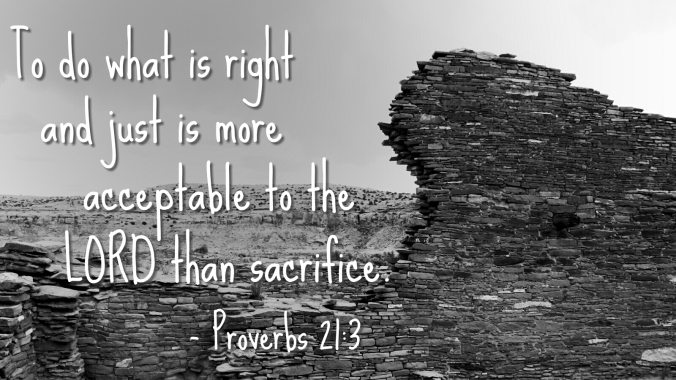
Our wilderness fast with Christ is a time of spiritual growth. The deeper we sink our roots into that desert, the more Living Water we will find.  Desert plants are biologically efficient and waste little energy on unnecessary processes, yet when resources allow they produce stunning blooms. Which of our resources could be put to better use in deserts both spiritual and nutritional? What sacrifices can we make so others might blossom in the love Christ calls us to share? Time and again the prophets remind us God loves mercy above sacrifice, but sometimes we must sow sacrifice to reap mercy.

Comfort: Like Paul, you can learn to be content under all circumstances.

Challenge: Learn more about food deserts and how you can help. What sacrifices of time and money might you be able to make to help people with little access to nutritional food?

Prayer: Gracious and merciful God, I thank you for all things you have given me. Help me understand which are mine to use, and which you have entrusted me to share with others in need. When my hunger for food is satisfied, may I feel even more strongly a hunger to share the Bread of Life with the world. Amen.

Discussion: On what do you spend a lot of time and energy which gives you little to no nourishment in return? Do you think it would be possible to reprioritize that time and energy?

Join the discussion! If you enjoyed this post, feel free to join an extended discussion as part of the C+C Facebook group. You’ll be notified of new posts through FB, and have the opportunity to share your thoughts with some lovely people. Or feel free to comment here on WordPress, or even re-blog – the more the merrier!

Sour Grapes

Turnthenandlive

Today’s readings (click below to open in new tab/window):
Psalms 22; 148, Ezekiel 18:1-4, 25-32, Philippians 4:1-9, John 17:9-19


It’s a prophet’s job to tell us what we don’t want to hear. The more righteous or justified we think we are, the less we’re going to want to hear it … but the more we need to. The prophet Ezekiel told the Israelites in exile that God was banishing a particular expression: “The parents have eaten sour grapes, and the children’s teeth are set on edge.” In other words: stop blaming your past for your current problems.

The Israelites liked to blame their exile on the sins of the previous generation. Ezekiel told them to stop making excuses and get right with God. Like children who d on’t want to be responsible for themselves, they replied: “It’s not fair!” God brushed off their protests. Maybe their parents had made terrible mistakes, but now these children were all grown up and needed to control the one thing they could: their own behavior.

Some people undergo years of therapy to unlearn the toxic habits of an unhealthy past. Others with less traumatic experiences grow on their own. Understanding the root of our problems is only ever a starting point. Unfortunately, many people who identify the origin of their unhealthy behaviors use it as an excuse to justify the poor choices they continue to make in the present. According to Ezekiel, God’s not having it.

As we live through Lent, let’s be honest with ourselves and God about our own shortcomings. After all, there’s nothing about us God doesn’t already know. He loves us anyway, and too much to let us keep fooling ourselves. When He tells the Israelites: “Get yourselves a new heart and a new spirit!” He could be talking to us. Sometimes our hearts and spirits are like homes cluttered with junk we’ve inherited. Because we fear loss we cling to it long after it’s useful (if it ever was) when we need to be clearing out the old to make room for the new, or maybe just for some light and air. We must repent of it to follow Christ. In the words of Ezekiel: “Turn, then, and live.”

Comfort: With Christ’s help, you can clean your spiritual house and let in the light of God.

Challenge: Clean out a closet. As you decide which things to discard, also think about what things from your past you are allowing to hold you back.

Prayer: Gracious and merciful God, show me how to turn and live. As I face the dark corners of my soul, fill them with your light and make them new. Teach me to set my sights not on where I regret having been, but on where you would have me go. Amen.

Discussion: What changes you have already made give you confidence about the making the changes you still need to face?

Join the discussion! If you enjoyed this post, feel free to join an extended discussion as part of the C+C Facebook group. You’ll be notified of new posts through FB, and have the opportunity to share your thoughts with some lovely people. Or feel free to comment here on WordPress, or even re-blog – the more the merrier!

Mercy in the Middle

1455164781896

Today’s readings (click below to open in new tab/window):
Psalms 102; 27; 147:12-20, Habakuk 3:1-10 (11-15) 16-18, Philippians 3:12-21, John 17:1-8


One of singer Amy Grant’s most powerful songs is “Ask Me,” the true story of a young girl who experiences sexual abuse in her home. The arc of the song is hopeful, but not naive. Ms. Grant follows in the footsteps of psalmists and prophets struggling to understand where God could be in the middle of terrible trials. Lent is the perfect time for us to ask these questions, to mourn the state of the world. This season reminds us why we need the savior to enter God’s creation again and again.

Psalm 102 uses striking images to illustrate its author’s misery. He eats ash and drinks tears. His bones burn like a furnace. His heart withers like grass. His enemies taunt him until he is helpless as a little bird on a rooftop. Psalm 27 is the plea of someone whose enemies devour his flesh and exhale violence. The prophet Habakuk has visions of war and famine. Yet in the midst of these terrible events, all these writers cry out to the Lord. Habakuk says despite all the horrors around him, “I will rejoice in the LORD; I will exult in the God of my salvation.”

Faith does not require us to pretend we are okay with everything in our lives. When parents or children fall seriously ill, when civilians are bombed, when we lose a job, when we struggle with depression, when natural disasters destroy communities … God does not require us to meekly accept it. We can rant and rail to God about injustice and pain because – as Ms. Grant sings – “He’s in the middle of [our] pain, in the middle of [our] shame.”

Sometimes life stinks, and God knows it. Psalmists, prophets, and terrified little girls survive not by pretending God makes everything OK, but by finding the peace that comes through suffering authentically in God’s presence. Christ is God’s incarnate presence in a grieving world. He doesn’t come to meet uncomplaining cheerleaders, but to share in our suffering and redeem it through his own. Embrace the brokenness of yourself and the world, for that is where peace begins.

Comfort: God is always with you, even when your suffering makes him seem far away.

Challenge: Throughout Lent, look for opportunities to let someone share their struggles with you. Don’t try to fix it – just be present.

Prayer: Gracious and merciful God, thank you for suffering with me through my struggles. Please help me to lean on your mercies when my difficulties seem overwhelming. As I bare my soul to you, share your peace with me so others may see it also. Amen.

Discussion: This reflection is on specific readings, but chances are no matter when you read this you are aware of some unfolding tragedy. How are you responding to it?

Join the discussion! If you enjoyed this post, feel free to join an extended discussion as part of the C+C Facebook group. You’ll be notified of new posts through FB, and have the opportunity to share your thoughts with some lovely people. Or feel free to comment here on WordPress, or even re-blog – the more the merrier!

Ego to Ashes

1455077864911

Today’s readings (click below to open in a new tab/window):
Psalms 5; 147:1-11, Amos 5:6-15, Hebrews 12:1-14, Reading Luke 18:9-14


Ash Wednesday is the day Christians around the world begin the annual Lenten pilgrimage. Most of us will travel more spiritually than physically, and hopefully in a direction taking us closer to God in Christ. Our modes of transportation vary: prayer, fasting, giving something up, taking something extra on – the possibilities are limitless. And like physical pilgrims, we may find we need to carefully select which belongings will travel well to a destination we may not know much about.

Today’s parable from Luke highlights one possession it might be better to leave behind: ego. When we read about the Pharisee who thanks God he is not the tax collector praying nearby, we aren’t surprised Jesus says the tax collector (who is humbly praying for mercy) is more justified before God. Most of us – even religious leaders – identify more with the character of the tax collector than the Pharisee. But should we? Is it truth or ego that tells us we are appropriately humble?

The moment we thank God we are not the Pharisee (or one of the people at that church), we are guilty of his sin: pride and judgment. In Jesus’ time, the message of beloved sinners was revolutionary. People needed to hear it. Twenty centuries on, as a faith community familiar with Jesus’s teachings, we need to be careful not to wear the tax collector’s humility as the latest fashion of outward righteousness. Letting go of the idea that we have the right ideas about God can be scary, because it erodes our comfortable, Christian identity.

As we prepare for our Lenten journey, let’s unpack the thick cloak of ego to make room for humble uncertainty. This type of uncertainty isn’t so much doubt as an intentional loosening of our preconceived notions of God and self, so we can be open to growth. If we cling too tightly to who we are, we are closed to who God would have us become.

Sometimes we are the Pharisee. Sometimes we are the tax collector. Most often we are a mix of both. God will help us find the balance.

Comfort: Our Lenten journey to the cross may be frightening, but the promise of resurrection is certain.

Challenge: What person or group do you possibly feel superior to? Pray for the humility to love them without judgment.

Prayer: Merciful God, give me a heart humble and open enough to know your glory.

Discussion: How are you observing Lent this year?

Systems Check

businessasusual

Today’s readings (click below to open in new tab/window):
Psalms 42; 146, Proverbs 30:1-4, 24-33, Philippians 3:1-11, John 18:28-38


When the Jewish leaders arrested Jesus and took him to the Roman governor Pilate, “they did not enter the palace, because they wanted to be able to eat the Passover.” Let that sink in for a moment… They found ritual uncleanliness unacceptable, but framing a prophet because he might actually be speaking on behalf of God was fine. Jesus was right to compare them to tombs whitewashed on the outside and rotten on the inside.

Under Roman occupation, Jewish leaders had no authority to execute anyone but they didn’t let this technicality discourage them. By saying Jesus claimed to be a king, they made him a rival of Caesar and therefore backed Pilate into a political corner. Jesus was advocating throwing off the Roman yoke for the Kingdom of God, but that didn’t suit their purpose so they twisted the truth to fabricate evidence against him. The tactic could be ripped from today’s headlines: self-righteous group misrepresents the facts to serve some narrowly defined greater good. Pilate asked Jesus “What is truth?” and we’ve been fudging the answer ever since.

Who are the villains in this piece? Should we point to scheming Pharisees, oppressive Romans, treacherous Judas, or fair-weather crowds? The truth is, everyone was guilty. The systems in place allowed corrupt leaders to act with impunity, communities to shift blame upward, and individuals to convince themselves they had no choice when they didn’t want to consider real but difficult options. In other words, business as usual.

In what Christ-betraying systems do we knowingly or unknowingly participate? How do we help perpetuate poverty, discrimination, violence, human trafficking, and other evils? If we knew the child sold into slavery to provide us cheap sneakers was Christ, would our cries for justice be louder and our choices different? We need to examine these questions when we make purchases, accept employment, and wield – or fail to wield – privilege and influence. Choosing God’s justice often requires choosing inconvenience, discomfort, and expense.  In God’s system, where the last are first, what does it mean to look out for number one? It means working toward justice for countless others.

Comfort: Every step you take toward justice is a step toward Christ.

Challenge: Lent starts tomorrow. This year give up apathy.

Prayer: Forgive me, Lord, for not wanting to know what I do.

Discussion: Have you ever made different choices after learning “how the sausage was made?”

Join the discussion! If you enjoyed this post, feel free to join an extended discussion as part of the C+C Facebook group. You’ll be notified of new posts through FB, and have the opportunity to share your thoughts with some lovely people. Or feel free to comment here on WordPress, or even re-blog – the more the merrier!

 

Fail to Succeed

dumbbell-1306867-1920x1280

Today’s readings (click to open in new tab/window):
Psalms 5; 145, Proverbs 27:1-6, 10-12, Philippians 2:1-13, John 18:15-18, 25-27


Bodybuilders know the secret to success is failure. A muscle grows bigger and stronger only when it is worked until it fails. They reach for more than they know they can do, because they know the reward will be a stronger body. Every successful workout teaches them the limit of their strength.

Most of us are not experts at judging our own limits, physical or spiritual. When pressed we overestimate or underestimate our abilities. Many people who have gone through a crisis with a parent or child have said: “I didn’t know I could do it until I had to!”

Peter didn’t understand his own limits. Shortly before his crucifixion, Jesus predicted Peter would deny him three times. Of course Peter insisted he would never deny Jesus, but once the rubber hit the road Peter’s fear was greater than his faith. We can shake our heads at Peter, and insist just as hard as he did that we would not have been so faithless, but the truth is we don’t know. We have the advantage of knowing how it all turns out, but for Peter and the other disciples, Jesus’s death brought terror and confusion.

And yet … Jesus also predicted Peter would be the rock upon which he built his church. Jesus didn’t pick someone with a perfect faith, because that someone doesn’t exist. Later when Jesus appeared to the disciples after his resurrection, he asked Peter three times: “Do you love me?” For each failure, Jesus offered an opportunity for redemption.

Attempting only what we know is possible is not faith, it is fear. To grow our faith, we must be willing to test its limits – to trust God to carry us through things we don’t think we can do. When things don’t work out, remember Peter.

God knows we will fail. He can use each of those failures to make us better: more humble, more compassionate, less judgmental. We may need some recovery time – bodybuilders typically wait 24-48 hours before working the same muscles again – but after we recover we know our faith is stronger than it was before.

Comfort: Failure is always an option. Through God, so is redemption.

Challenge: Pick something you’ve been afraid to try, and trust God to see you through it. Even if you fail at it, God will be with you to dust you off.

Prayer: Thank you, O Lord, for the challenges which strengthen me. Amen.

Discussion: Have you ever been stronger than you thought you could be? If so, what or whom do you credit?

Join the discussion! If you enjoyed this post, feel free to join an extended discussion as part of the C+C Facebook group. You’ll be notified of new posts through FB, and have the opportunity to share your thoughts with some lovely people. Or feel free to comment here on WordPress, or even re-blog – the more the merrier!

Fearfully and Wonderfully Made

1454871305319

Today’s readings (click to open in a new tab/window):
Psalms 139; 150, Malachi 4:1-6, 2 Corinthians 3:7-18, Luke 9:18-27


Is the concept of an all-knowing God intimidating or comforting? The author of Psalm 139 finds great comfort in the idea that God has been and always will be with him, from conception through death. He portrays God’s constant presence not as one of judgment, but one of personal investment. As God’s carefully wrought works of art, “fearfully and wonderfully made,” we are each of us His precious creation.

Artists frequently compare their own creations to children; how could we be less to God? Like all good parents, He does not coerce our love through threats, nor does He abandon us when we make mistakes. God has our best interests at heart; Jesus assures us no father, when his child asks for a fish, would hand him a snake. Good parents can be strict, but always with an eye toward guiding and challenging children to be their best selves.

Psalm 139 provides beautiful images of the relationship God intends to have with us: guide, artist, parent, creator. Jesus used similar metaphors to describe our relationship to God, and they can help us explore His unknowable yet always loving nature. Whether we are living in the light or the darkness, God desires an intimate connection with each of His children.

Focusing on  God’s presence in our lives, even when we don’t necessarily “feel” it, inspires us to rise to the opportunity of being our best selves. Without reducing God’s role in our lives merely to a supportive buddy or life coach, we can contemplate God’s presence as we devise plans, make decisions, and take actions. Pausing to reflect on how God might view an action before we commit to it can help us transcend fleeting impulses which may not serve us well. If such reflection nags our conscience or sense of guilt, they may be signposts pointing us to a better – if sometimes more difficult – path. God does not promote shame but does encourage us to have self-control. God’s presence is not a fist knocking us down, but a hand lifting us up. Let’s grab it and be the wonderful creations God intended.

Comfort: God is with us always, waiting to lift us ever higher.

Challenge: Before going to bed each night, reflect on which of the day’s actions glorified God, and which you might have done differently if you’d been keeping God in mind. Thank God for loving you enough to help you do better tomorrow.

Prayer: Thank you God for always calling me toward the right direction.

Discussion: Can you imagine yourself as a work of art? If not, why not? If so, what kind of art would you be?

Join the discussion! If you enjoyed this post, feel free to join an extended discussion as part of the C+C Facebook group. You’ll be notified of new posts through FB, and have the opportunity to share your thoughts with some lovely people. Or feel free to comment here on WordPress, or even re-blog – the more the merrier!

Barnacle-Free Faith

barnacles and crustations

Today’s readings (click below to open in new tab/window):
Psalms 104; 149, Genesis 29:1-20, Romans 14:1-23, John 8:47-59


One characteristic of an effective movement, whether religious or secular, is an ability to stay focused. Unfortunately, the older and larger a movement grows, the more likely it is to lose focus. We need look only as far as the church to see a primary example. Early Christians were focused around the idea that Jesus was the savior, and through him all sin was forgiven. They had de facto leaders but no real bureaucracy, and were more focused on freedom than restriction.

Is that what the church looks like today? Can we imagine Peter poring over investment policy revisions, or Paul reading the latest theories on why you should have one third more seats than you do members? These activities aren’t wrong in and of themselves, but if we’re not careful we may start thinking and behaving as if the point of church is to perpetuate church, rather than to serve God.

One of Paul’s purposes in writing to the Roman (and other) churches was to encourage them to stick to the basics of the faith. Like present-day churches, the simple ideas and practices that bound them as a community began to accumulate individual and cultural restrictions. Like barnacles on a ship – sometimes known as fouling organisms – these additions adversely impacted the performance and structure of the church. Paul told the Romans they needed to scrape off “fouling” ideas.

Today’s church can be just as prone to fouling ideas. Most of the time we can recognize them because they separate us from each other or the world around us. Any time we decide someone who professes dedication to Christ is not a “real” Christian because their denomination, practices, or identity don’t fit our mold, we are probably victims of fouled faith. Rifts have developed over everything from whether coffee is allowed in the sanctuary to politically correct language in hymns to the proper order of a liturgy. As Christians, we are called to find ways to rise above such trivialities and unite rather than divide.

Paul adds a wrinkle though: we can’t just write off people with sincerely held belief in more rules than we believe as silly or misguided. In Paul’s example, the “strong” who believed no food was unclean didn’t need to make a show of eating certain foods to the “weak” who clung to prior practices. Relationship with Christ and God is central to faith and community, so causing someone to feel they were undermining that relationship was not “walking in love;” if someone believed something was unclean, it was indeed unclean to them. Your stumbling blocks and someone else’s may differ.

Of course, if it’s our belief-barnacle we will struggle to recognize it as such, and the older and bigger it is, the more difficult it will be to scrape off. Then there’s the danger that in our zeal to tear off the non-essentials we carelessly go too far and scrape away part of the hull; we don’t want to damage or discard what is necessary and true. And there’s the balance of community: learning to respect each other’s sincerely held beliefs and practices without imposing them on each other – and over time stripping away all that is not part of Christ.

Faith is not always simple, but let’s resist the temptation to complicate it unnecessarily. If we focus on winning souls instead of winning arguments, the barnacles on our faith fall away much more easily.

Comfort: Christ is the lens that focuses our faith.

Challenge: What barnacles have you accumulated? Scrape them off.

Prayer: God of Abundance, I will keep my eye on Christ. Amen

Discussion: If you’re not a sailor, barnacles may not mean much to you. What are some other metaphors for religious or spiritual “clutter?”

Join the discussion! If you enjoyed this post, feel free to join an extended discussion as part of the C+C Facebook group. You’ll be notified of new posts through FB, and have the opportunity to share your thoughts with some lovely people. Or feel free to comment here on WordPress, or even re-blog – the more the merrier!

Recycled

glass-garden-2-1200905-1600x1200

Today’s readings (click below to open in new tab/window):
Psalms 97; 147:12-20, Genesis 27:30-45, Romans 12:9-21, John 8:21-32


When Esau discovered his brother Jacob had tricked their father into giving him the blessing that rightfully belonged to Esau, he was overcome with rage. This “blessing” was not a religious one, but a method of passing on rights to the land and possessions of a patriarch to his heir. The lands, wealth, and armies that Esau was sure he would inherit instead would go to the younger brother who had plagued him all his life. Esau would get the leftovers and move to a foreign land. Jacob would continue the line that would lead from Abraham to Jesus.

History unfolds in unexpected, often unwelcome ways. We might expect Jesus would come from a long line of noble, respectable, gracious ancestors. While they included royalty and priests, his family tree was shaky from the roots up. Abraham lied and tried to do an end run around God’s plan for him, fathering the Ishmaelites in the process. Isaac, like his father Abraham, lied about his relationship to his wife in order to secure business arrangements. Jacob stole his brother’s inheritance and lived in hiding for years. His son Judah sold his own brother into slavery and impregnated a woman he thought was a prostitute. And on, and on, and on …

The history of Jesus’ ancestors isn’t just a little suspect – it’s out-and-out tawdry.  From one perspective it could undermine his authority and credibility; people are judged by their families all the time. But from another point of view, it could be considered encouraging or even liberating. If God could work through families like these, imagine the potential in boring old us? So many of us waste that potential because we are waiting to feel worthy. We talk about what we could or will do if and when we were better, more organized, more stable, healthier, or “holier” people. We look at others who do the things we wish we could do and assume they are smarter, better connected, and generally “have it together.” After considering where Jesus came from … still think so?

God meets us where we are, warts and all, and offers to lead us beyond where we hoped to be. When we spend more time trusting God and less time doubting that we could be useful to God, no part of us is wasted, no talent unused. Our creator pulls us from the trash heap and turns us into something beautiful. No one is ever “ready” for that.

Comfort: God doesn’t throw anyone away.

Challenge: For one week, up your recycling game. Is it something you can stick with?

Prayer: Thank you God for loving me beyond my comprehension. Amen.

Discussion: What’s something you’ve found a new use for that someone else might have thrown away?

Join the discussion! If you enjoyed this post, feel free to join an extended discussion as part of the C+C Facebook group. You’ll be notified of new posts through FB, and have the opportunity to share your thoughts with some lovely people. Or feel free to comment here on WordPress, or even re-blog – the more the merrier!