Sleight of Hand

magician-859303_1920

Today’s readings (click below to open in new tab/window):
Psalms 89:1-18; 147:1-11, Genesis 27:1-29, Romans 12:1-8, John 8:12-20


Sometimes the Bible reads like a soap opera. In Genesis 27, Rebekah convinces her son Jacob to wear goat skin on his neck and hands to fool his blind father into thinking he is his older, hairier twin brother Esau. He does this to secure his father Isaac’s blessing, which will mean he inherits leadership of his clan. Isaac does indeed (and improbably) grant his blessing to the “wrong” son, in an apparently irrevocable act. When the real Esau demands things be made right, all Isaac has left to offer is a meager consolation prize of a blessing that basically promises Esau the things Jacob didn’t already get.

To our modern sensibilities, developed in a culture of upward mobility, it seems unfair that deception is rewarded thusly. In Jacob’s time, though, people couldn’t earn authority based on merit; authority was inherited or taken by force. If Jacob (or his mother on his behalf) wanted equal opportunity without resorting to outright violence, he had no other choices but to scheme his way to it.

Many cultures have a “trickster” figure: Loki in Norse mythology; Raven in Native American lore; Anansi in West African folk tales. Jacob is a similar figure who outwits his brother multiple times, and even outwrestles an angel physically and mentally. Trickster figures, despite having questionable ethics, often bring benefits to mankind despite the will of the gods. This is where Jacob differs: God had already chosen him to continue Isaac’s lineage, and the tricks seem to support that.

For the most part we want and expect people to play by the rules. Deception rubs us the wrong way and leads to chaos. But what if the rules are not the same for everyone (as they almost never are, especially the unspoken ones)? The Bible has many stories of oppressed people who use the methods available to them to overcome. Deception is not a virtuous act, but sometimes it takes a trickster to turn oppression around. Someone who, say, subverts Roman and Jewish expectations and leads us to eternal life by sacrificing his own. The difference between a hero and a villain often depends on who writes the history book.

Comfort: God’s will eventually plays out.

Challenge: It may not play out in ways we like.

Prayer: Protect me, O God, for in you I take refuge. Amen. (Psalm 16:1)

Discussion: “The ends justifies the means” is a sentiment which can cut both ways. Do you think questionable means are ever justified?

Join the discussion! If you enjoyed this post, feel free to join an extended discussion as part of the C+C Facebook group. You’ll be notified of new posts through FB, and have the opportunity to share your thoughts with some lovely people. Or feel free to comment here on WordPress, or even re-blog – the more the merrier!


A Stone’s Throw from Grace

stones-1523693-1279x852

Today’s readings (click below to open in new tab/window):
Psalms 42; 146, Genesis 26:1-6, 12-33, Hebrews 13:17-25, John 7:53-8:11


You don’t have to be a Christian to recognize the quote, “Let he who is without sin cast the first stone.” It’s the pivotal line from a story in John’s Gospel. In this story, the scribes and Pharisees brought to Jesus a woman who’d been caught in adultery. The prescribed Mosaic punishment was death by stoning, but the Pharisees – knowing that stoning wasn’t exactly Jesus’s style – asked him what should be done. They hoped to trap him into contradicting the law so they could bring charges against him. Jesus paused for a bit, wrote something on the ground, and then gave his famous answer. One by one her accusers slipped away until only Jesus was left. He refused to condemn her, saying only “Go and sin no more.”

The inclusion of this story in John’s Gospel is not without controversy. It doesn’t appear in the earliest manuscripts, and many editions of the Bible are sure to note this. It’s kind of ironic that such a questionable story became one of the most recognizable. Why does this story compel us?

Perhaps because – authentic or not – it embodies an idea that it seems we need to hear and learn over and over again. If our relationship with God is about pointing out what other people are doing wrong, instead of humbly examining our own hearts, we aren’t getting the message.

Do we as a faith community need to hear about the reality of sin and immorality? Absolutely. Do we as a faith community need to point to and single out and shame it everywhere we (think we) see it? Absolutely not.

Why is it so many non-Christians (and former Christians) see the faith as full of people ready to cast stones? Well … they’re not entirely wrong. The loudest messages shouted from beneath the Christian banner tend to be ones of condemnation. Now loudest doesn’t mean exclusive or truest or most frequent, but it does disproportionately influence what people perceive and remember.

Christ’s message isn’t one of condemnation; it is of love. We all know John 3:16 and wave it around a lot to point out who is “saved” and who isn’t, but for some reason we don’t spend nearly as much time on 3:17: “For God did not send his Son into the world to condemn the world, but to save the world through him.” Condemnation cuts people off or turns them off, and neither wins anyone to Christ. But we like it. We struggle with (and succumb to) the same temptation as the Pharisees to twist scripture to justify punishing or imposing our will on others. Once Christianity became the dominant force of the Western world, we seemed to forget forcing the Good News on people is bad news.

Grace invites us in and asks us to leave the door open; religion is an excuse to shut people out. When Jesus tells us what is sinful, it’s not so we know when to punish or control other people; it’s so we know when we are creating a rift between ourselves and God. If other’s people sin does not affect us or exploit the innocent, it’s none of our business. In a culture where the Christian majority has learned to take offense at the idea of sharing public space with people who don’t share our faith or values (and we forget even within Christianity they are nuanced), it affects us far less than we like to think it does. Every one of us has enough planks in his or her eye to keep us too busy to worry about someone else’s speck.

We are forgiven. That is a thought that should be so humbling we can’t conceive of throwing stones. Instead, let us pass on the message of grace and love by being Christ’s open hands to the world.

Comfort: God’s love will deliver us from fear.

Challenge: Ask yourself what temptations you find hardest to resist, then ask what need is still not being met by giving in to them.

Prayer: In you O Lord I seek refuge and peace. Amen.

Discussion: What fears drive your behavior?

Join the discussion! If you enjoyed this post, feel free to join an extended discussion as part of the C+C Facebook group. You’ll be notified of new posts through FB, and have the opportunity to share your thoughts with some lovely people. Or feel free to comment here on WordPress, or even re-blog – the more the merrier!

From Fear to Faith

IMG_20180205_074320

Today’s readings (click below to open in new tab/window):
Psalms 5; 145, Genesis 25:19-34, Hebrews 13:1-16, John 7:37-52


Delayed gratification.

It’s not something that comes naturally to most of us. As a matter of fact, it’s often the opposite of our nature. We spend our lives in bodies that are convinced death lies around every corner. Because our bodies don’t know when food might be available again, they tell us to store energy by overeating now. Because they don’t know whether pain and discomfort will stop, they demand relief in the form of drinks and pills. Because they are desperate to reproduce they talk us into mistaking lust for love and connection.

Bodies can feel like temples to the gods of despair, where we sacrifice the future to survive the present.

Esau and Jacob were the twin sons of Isaac and Rebekah. “When the boys grew up, Esau was a skillful hunter, a man of the field, while Jacob was a quiet man, living in tents.” (Gen 25:27) One day Esau returned famished from the field, and demanded Jacob share his food. Jacob instead offered to sell it to his brother – in exchange for Esau’s birthright as the older son. Esau, caught up in his body’s hunger, agreed. “Thus Esau despised his birthright.” (v 34)

How often do we – like Esau – sell ourselves short to satisfy an immediate longing?

And yet … Christ’s promise of eternal life helps us to rise above the limitations of our mortal bodies. Perhaps part of being born again is reclaiming the birthright we have despised through sin. When we the hungry know the assurance of the bread of life and the living water, we are no longer driven by fear, but by love. Our bodies, gifts from God, become instruments of service rather than masters of need.

To become servants in the image of Christ, we have to learn to put the needs of others before our own desires – to take that which was once first to us and make it last. Our longings may still tempt us, but we can choose better when not gripped by fear. We can be cooperative instead of competitive. Our temptations can help us develop empathy for those who still fear, for we were once in their place and it was humble love, not force or intimidation or arrogance, that saved us.

Delaying gratification for the purpose of retaining our birthright will always be a struggle, but that struggle is where we can identify in some small way with Christ crucified. It is where we learn to be more than bodies and find the fulfillment of being part of The Body. It is where perfect love casts out fear “So we can say with confidence ‘The Lord is my helper; I will not be afraid. What can anyone do to me?’” (Heb 13:6)

Comfort: God’s love will deliver us from fear.

Challenge: Ask yourself what temptations you find hardest to resist, then ask what need is still not being met by giving in to them.

Prayer: In you O Lord I seek refuge and peace. Amen.

Discussion: What fears drive your behavior?

Join the discussion! If you enjoyed this post, feel free to join an extended discussion as part of the C+C Facebook group. You’ll be notified of new posts through FB, and have the opportunity to share your thoughts with some lovely people. Or feel free to comment here on WordPress, or even re-blog – the more the merrier!
Sticks and Stones

4th-grade-word-magnet-board-1562771-1279x939

Today’s readings (click below to open in new tab/window):
Psalms 103; 150, Genesis 24:50-67, 2 Timothy 2:14-21, Mark 10:13-22


We all grew up hearing some variation on “sticks and stones may break my bones but words will never harm me.”

Turns out life is more complicated than childhood nursery rhymes.

Words are paradoxical things. While they are little more than scribbles or puffs of air we agree have certain meaning, they can actually contain immense power and create considerable harm. Laws and their consequences hinge on the order of words and the punctuation between them. Contracts can bind or fail based on a comma or its absence. Some words expressed too freely threaten the powers that be and become cause for censorship and prosecution.

Classes of people can be created simply because we impose upon them a word that describes a single one of their characteristics. Take for example the idea of people being “black” or “white.” We all started out the same color and became more varied through circumstances of time, climate, and genetics. Before we started to travel and become reacquainted with each other, we didn’t think of ourselves as white or black – we were just people. It’s such an inexact distinction that over time we had to invent yet more words (and legal categories) to describe people who didn’t fall neatly into one of those two categories. Yet those words – arbitrary and inaccurate as they are – have had a real and tremendous harm on the history and freedom of millions.

It seems the more we insist on parsing words, the less we agree on them. Take for example the phrase “Black Lives Matter.” It’s a simple statement in response to a documented and ongoing history of disproportionate violence against black people by authorities, yet many insist on reading something anti-white into it. We see an “only” at the beginning where there is none. We insist a “too” at the end would clear things up. We want to overwrite it with the essentially meaningless “All Lives Matter” because then we don’t have to face actual and specific problems.

In 2 Timothy, Paul advises the church to “avoid wrangling over words, which does no good but only ruins those who are listening.” In other … words … getting caught up in semantics does no service to the church. Rather, it creates false divisions and distracts us from the central message of the Gospel. Schisms have occurred over such unnecessary distinctions. Scholars and theologians in their ivory towers may wage battles (both well intentioned and prideful) over such matters, but the rest of us could pretty comfortably stick with The Word of God – the Logos, the Christ – and loving God and loving our neighbors. Insisting on the “right” words – such as the Sinner’s Prayer to accept Jesus, or a specific Bible translation – alienates us both from each other and from unbelievers who look upon the petty squabbling (and therefore the faith) with justifiable skepticism.

Sticks and stones can break bones, but they can also build shelters. Are we using words to harm or heal? Are we twisting other people’s words to fit our own agendas and assumptions? When we speak, do people hear Jesus … or hear us trying to prove we hear Jesus (and forcing them to also)?

Let us pray for discernment about which words to embrace and which to let go, which to support and which to oppose. Let us be humble in wielding their power, as Christ calls the last to be first. Let our yes be yes, our no be no, and all our other words authentic and carefully considered.

Comfort: When words hurt, Christ is there to heal.

Challenge: Precise use of language is important for communication, but avoid nitpicking and dismissing people over semantics when you know their intent.

Prayer: God, may I be quick to listen and slow to speak. Amen.

Discussion: “Black Lives Matter” is often portrayed as an anti-authority movement because of a few sensationalized stories of people behaving radically under its banner. Early Christianity had the same reputation, and in later years after becoming the authority had a history of violence and oppression. How is any movement different from its best and worst examples?

Join the discussion! If you enjoyed this post, feel free to join an extended discussion as part of the C+C Facebook group. You’ll be notified of new posts through FB, and have the opportunity to share your thoughts with some lovely people. Or feel free to comment here on WordPress, or even re-blog – the more the merrier!

The Good Consultant

1454766986357

Today’s readings (click below to open in new tab/window):
Psalms 63; 149, Genesis 24:28-38, 49-51, Hebrews 12:12-29, John 7:14-36


As a profession, consultants have a mixed reputation. After consultants have provided expensive professional expertise, employees commonly respond (correctly) with: “They didn’t tell us anything we didn’t already know.” If this is the case, is the service valuable or not? It can be — if what the business really needed was confirmation, not innovation. It may not sound as poetic as The Good Shepherd, but Jesus was also The Good Consultant.

When Jesus had grown popular enough that Jewish authorities began plotting to kill him, he had two choices: go into hiding, or follow his calling. Despite the danger, he began preaching openly in the temple during Sukkot, one of the most important festivals of the year. People marveled that he, who had not been taught, could teach so wisely. Jesus responded by saying his teachings were not his own but those of God. He advised anyone who doubted his credentials to apply a simple litmus test: was he speaking for his own glory, or for the glory of God? “Anyone who resolves to do the will of God will know whether the teaching is from God or whether I am speaking on my own.”

In this particular case he was preaching about their hypocrisy when it came to applying the Law of Moses, but he wasn’t providing any new information. Many prophets before him told the people of Israel their observation of the law was meaningless — even offensive — to God if they weren’t offering mercy and justice to the least among them. Like many enterprises, they were too busy performing day-to-day operations to step back and ask whether they were really fulfilling their mission in the best way. They knew the right things, but needed Jesus and other prophets / consultants to spur them to change direction.

In our spiritual lives as in our work lives, we need to recognize when established authorities are glorifying themselves and the status quo over the mission, and when outside voices are telling us what we already know to be true. The Good Consultant steers us away from hypocrisy and ego toward mercy and justice.

Comfort: When your conscience tells you to choose mercy over the wishes of authority, you should probably listen to it.

Challenge: Oftentimes following Jesus means defying “business as usual.” Make time to step back and measure your beliefs and actions against the teachings of Christ.

Prayer: God, I will do my best to listen to your voice above all others – including my own. Amen.

Discussion: When you ask your friends or colleagues for advice, how often do you already know what the right answer is?

Join the discussion! If you enjoyed this post, feel free to join an extended discussion as part of the C+C Facebook group. You’ll be notified of new posts through FB, and have the opportunity to share your thoughts with some lovely people. Or feel free to comment here on WordPress, or even re-blog – the more the merrier!
King Incognito

1454643091887

Today’s readings (click below to open in new tab/window):
Psalms 84; 148, Genesis 24:1-27, Hebrews 12:3-11, John 7:1-13


Many cultures have folk tales about a king incognito, that is a king (or sometimes a prince or more unusually a queen) who disguises himself and roams his kingdom. The results of his secret adventure depend largely on whether he is a just king or an unjust one. For example, a just king may uncover plots against him and so prevent them from hatching. An unjust king may be discovered and suffer – even die – as a result. The tone of these stories generally reflect the people’s feelings about their current ruler.

Near the end of his ministry, Jesus arranged such an outing.

The Festival of Booths (Sukkot) was happening in Judea. He sent his disciples without him, saying: “I am not going to this festival, for my time has not yet fully come.” After they departed, he went to the festival alone and disappeared into the crowd. In an era without cameras, not having a group of disciples around him was disguise enough. He was the talk of the festival, and many Jews were looking for him. Some said he was a good man, and others said he was deceiving the people.

Have you heard the phrase: “What someone thinks about you is none of your business?” Knowing what the people thought about him had no ultimate effect on Jesus’s mission. Can we imagine he was surprised to hear both good and bad news? Realistically, what else could we expect? In the verses that follow today’s reading from John, Jesus reveals himself to the crowd and begins preaching. His time had come, and in the end the king must reveal himself.

Other people’s opinions do not matter when we are carrying out the work of the Kingdom of God. While we remain open-minded and listen to what people tell us about their needs, we are to respond as Christ calls us to, whether it makes us popular or not. Some people may love us for it, some may hate us, and some of each may be fellow Christians. When we are following Christ, God’s is the only opinion that matters.

Comfort: You are accountable to no one but God.

Challenge: Do not let other people’s opinions and reactions inflate your ego or deflate your spirit.

Prayer: Breath of Life, help me to learn to rely only on you. Amen.

Discussion: Think about how other people’s opinions have influenced your behavior, for better or worse. What would you have done differently if you didn’t care?

Join the discussion! If you enjoyed this post, feel free to join an extended discussion as part of the C+C Facebook group. You’ll be notified of new posts through FB, and have the opportunity to share your thoughts with some lovely people. Or feel free to comment here on WordPress, or even re-blog – the more the merrier!

The Cloud

image

Today’s readings (click below to open in new tab/window):
Psalms 116; 147:12-20, Genesis 23:1-20, Hebrews 11:32-12:2, John 6:60-71


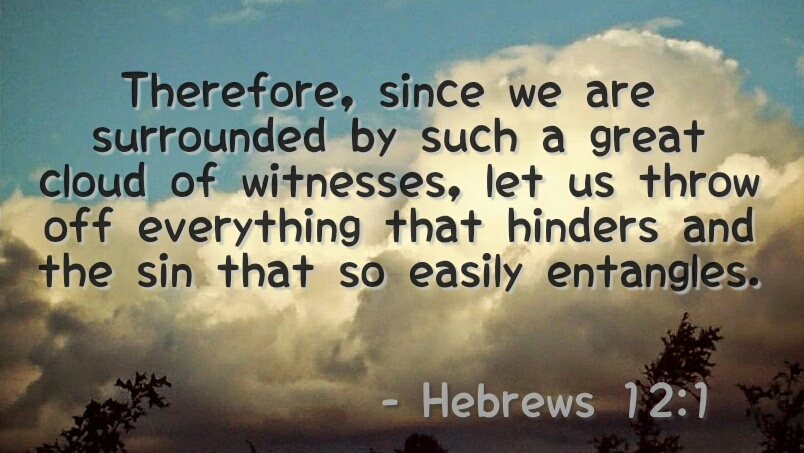
Pauls’s letter to the Hebrews describes the faith of many heroes of the Old Testament, including Abel, Noah, Abraham, Moses and others. None of them were perfect, but by faith they did amazing things. They are examples and inspirations that endure. Paul describes them – and all the faithful departed – as a “great cloud of witnesses” that surrounds us always.

Over the years the cloud has only grown larger.

From the 20th century alone we might add names of heroes like Martin Luther King, Jr., Edith Stein, and Dietrich Bonhoeffer. Or minds like C.S. Lewis, Thomas Merton, and Dorothy Day. Still more are less well known, but influential in our lives. When we struggle we can look to their lives, works, and words for strength.

Yet during difficult times, many of us insist on toughing it out alone. We convince ourselves no one has experienced the pain, grief, loss, or doubt that we endure. We isolate ourselves because no one could possibly understand us, relate to our situation, or stand to be around us. The beauty of leaning on the cloud of witnesses is that they are beyond feeling burdened by us. And they have so much to teach us.

Feeling despair? Crack open The Dark Night of the Soul by Saint John of the Cross, and you’ll probably start to feel like an amateur. Not much of a reader? Listen to recordings of the Psalms – number 137 reveals anguish at its purest. We don’t seek out these works to wallow in misery like a jilted lover listening to break-up songs, but because they offer wisdom from others who have overcome similar trials. Otto von Bismarck wrote: “A fool learns from his mistakes, but a truly wise man learns from the mistakes of others.” We can also learn from their triumphs.

Despite our occasional insistence to the contrary, we are never alone. Those witnesses who have gone before us, and those who stand beside us today, are a mortal manifestation of the strength and hope that come from faith. No matter where we are in life, we can plug into The Cloud.

Comfort: The entire history of God’s people is available to support you.

Challenge: Next time you feel compelled to isolate yourself because you think others wouldn’t understand, get in touch with someone to share your story.

Prayer: Thank you, Lord, for the legacy of all who have come before me. Help me to be a worthy heir and addition to the great cloud of witnesses. Amen.

Discussion: In times of difficult, are you more likely to go it alone, or ask for assistance? What do you think that reveals about your attitude toward those who need help?

Join the discussion! If you enjoyed this post, feel free to join an extended discussion as part of the C+C Facebook group. You’ll be notified of new posts through FB, and have the opportunity to share your thoughts with some lovely people. Or feel free to comment here on WordPress, or even re-blog – the more the merrier!