No Noise is Good Noise

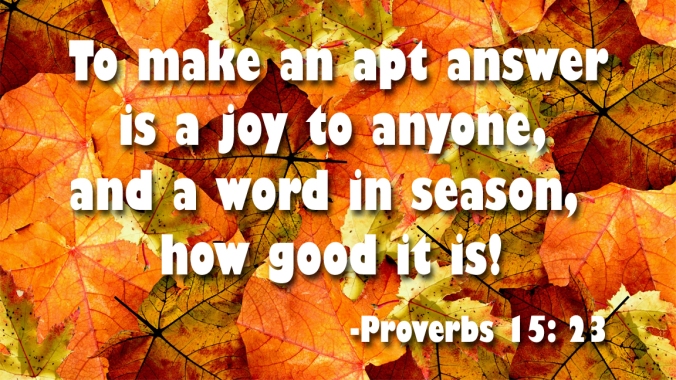
aptanswer

Today’s readings (click below to open in new tab/window):
Psalms 123; 146, Proverbs 15:16-33, 1 Timothy 1:18—2:15, Matthew 12:33-42


The mind of the righteous ponders how to answer, but the mouth of the wicked pours out evil.

The ear that heeds wholesome admonition will lodge among the wise.

Those who ignore instruction despise themselves, but those who heed admonition gain understanding.

– Proverbs 15:28, 31, 32

The Book of Proverbs is a collection of pithy sayings, instructions, and poems from several sources. Chapters 10 through 22 are attributed to Solomon, but he probably did not author them directly. Proverbs contains many themes, and one of the most prominent is wisdom.

A lot of this wisdom centers on the idea that, frankly speaking, we should know when to keep our mouths shut.

In our culture, most conversations pretend to be exchanges of ideas, but we generally lack tolerance for the silence necessary to thoughtfully reflect on what someone is saying to us. Instead we fill “awkward” silences by speaking whatever comes to mind first. Often we are mentally formulating our response before the other person finishes talking. And too often our default response mode is rebuttal rather than reflection. This is especially true when the discussion is about a disagreement, and we are more concerned with making our case – with winning the argument – than considering what the other person might have to add to our understanding. Spirited debate can be invigorating, even fun, but how often are we listening to respond, rather than listening to learn?

When we receive constructive criticism, we don’t have to immediately reply with a defense; we can take time to mull it over. When someone is experiencing grief or pain, we don’t have to offer cliched sentiments because we feel we have to say something comforting; we can simply be with that person. When someone is telling us about their problems we don’t have to offer unsolicited solutions; we can support them better with open ears and open arms. In these situations and many more, taking time to think will improve what we have to say, or show us we needn’t say anything.

Listening without feeling a need to respond every time will make us better friends, better parents, better co-workers, and better followers of Christ. Don’t be afraid of silence; that’s when we can hear God speak.

Comfort: Being slow to respond is often a sign of depth, not ignorance.

Challenge: For the remainder of the week, whenever possible, count to five before responding – or thinking about responding – to questions, news, etc. Note how these pauses affect the conversations.

Prayer: Loving God, teach me to listen for you in the silence. Amen.

Discussion: In what situations do you find it difficult to hold your tongue, even when you know better than to speak?

Join the discussion! If you enjoyed this post, feel free to join an extended discussion as part of the C+C Facebook group. You’ll be notified of new posts through FB, and have the opportunity to share your thoughts with some lovely people.

No Time Like The Present

honor and glory

Today’s readings (click below to open in new tab/window):
Psalms 135; 145, Proverbs 10:1-12, 1 Timothy 1:1-17, Matthew 12:22-32


Paul did not start out sympathetic to Christians. He was born to  Jewish parents with Roman citizenship, an unusual status. As a devout Jew he considered followers of Jesus a threat both to both the faith and to the relatively secure status of Jews under Roman occupation. For years he persecuted Christians, literally hunting them down and delivering men and women for imprisonment and execution. As he wrote to Timothy: “I am grateful to Christ Jesus our Lord, who has strengthened me, because he judged me faithful and appointed me to his service, even though I was formerly a blasphemer, a persecutor, and a man of violence.”

Yet he was the greatest evangelist in the history of the church.

Can you imagine the resistance Paul faced from other Christians as he began his ministry? He was the embodied scourge of Rome across the backs of those who followed Christ. Why would anyone believe him when he said he was reformed? When people claim to change their minds or begin to behave differently, we suspect insincerity and our suspicions are often confirmed. But Paul persevered despite his critics, who included such important Christian figures as Peter. The zeal which had once driven him as “a man of violence” had been redirected.

If God could reform a villain like Paul, the rest of us should have great hope indeed.

When we try to change for the better, people will inevitably bring up our pasts and question our credibility. We may be embarrassed when that happens, but like Paul we can use that opportunity to testify to God’s grace. Whether we’ve decided to improve in a small way, like declining to indulge in office gossip, or in a more significant way, like seeking reconciliation with an estranged family member, our past does not need to be a source of shame.

Rather, by humbly acknowledging our past sins – not excusing them  or getting “holier than thou” – we can speak a powerful truth about how God’s grace has transformed our present. Paul was humble, but not ashamed. Persistent, but not defensive. His faith eventually became undeniably obvious to all. Whatever your sin or past, God can do the same for you.

Comfort: God wants to free you from the prison of your past.

Challenge: Forgiving your own past is an important step in forgiving others.

Prayer: Merciful God, thank you for your gift of grace. May my life be a testimony to the power of your saving love. Amen.

Discussion: What parts of your own past have you not been able to forgive? Do you think you need to forgive yourself before you can believe God forgives you?

Join the discussion! If you enjoyed this post, feel free to join an extended discussion as part of the C+C Facebook group. You’ll be notified of new posts through FB, and have the opportunity to share your thoughts with some lovely people.

Just Because

where-were-you

Today’s readings (click below to open in new tab/window):
Psalms 103; 150, Job 38:1-11; 42:1-6, Revelation 19:4-16, John 1:29-34


Some questions have no answers, or at least none we can understand. Job was a righteous man who’d been greatly blessed by God; he had a large family, lands and livestock, and good health. When Satan (not the devil we think of, but a member of God’s court known as The Accuser) claimed Job would lose faith if God revoked his favor, God took the bet. He killed Job’s family and livestock, struck him down with terrible disease, and left him a ruined man sitting on a dung heap.

Job’s friends tried to explain why these terrible things happened to him. Saying he must have sinned, they blamed Job for his own ills, but he knew he was innocent. Like well-meaning people at a funeral who tell bereaved family members “it’s part of God’s plan,” Job’s well-meaning friends didn’t manage to offer one comforting word. We all desperately want things to make sense, but sometimes they just don’t.

When Job finally gets to confront God, God’s response is pretty unsatisfying: “Where were you when I created the earth, the seas, and the heavens?” In other words: “know your place.” God doesn’t even feel obligated to disclose the wager. Sure God gives Job a new family and restores his fortunes, but can that ever make up for what was lost?

Is there any comfort to be found in this story? If we can let go of our need to explain everything, there is the comfort of a certain harsh wisdom. Sometimes disaster will rain down on you for no apparent reason. It won’t be your fault, and honestly there may not be a silver lining. Trying to assign it a purpose may leave you looking and feeling as ignorant as Job’s friends.

We. Don’t. Always. Get. To. Know.

However, we can know that in the midst of our worst times, and God is with us and rooting for us not to lose faith. If there’s a lesson to be learned, learn it. But don’t let your need to find one be more important than your need to trust God anyway.

Comfort: When bad things happen to you, sometimes it is the unknowable nature of the world, not a reason to believe you are being punished.

Challenge: When you can’t find meaning in tragedy, you may be called to make meaning from it.

Prayer: God, I will trust you always. Amen.

Discussion: What in your life doesn’t seem fair? If you stop insisting that it make sense, does that make it easier or more difficult to accept?

Join the discussion! If you enjoyed this post, feel free to join an extended discussion as part of the C+C Facebook group. You’ll be notified of new posts through FB, and have the opportunity to share your thoughts with some lovely people.

Make Time for Miracles


Nest

Today’s readings (click below to open in new tab/window):
Psalms 104; 149, Proverbs 8:22-36, 3 John 1-15, Matthew 12:15-21


So often our faith is tangled in doctrine, politics, and other distractions. We rely on it in (or find it lacking) in times of difficulty or sadness. The church emphasizes sin, sacrifice, and the cross. When we focus on the glory of resurrection, it is inevitably linked to the suffering that led up to it. These are all realities in our life, but they are not the only realities.

God called the creation good. We are loved enough to be saved. There is beauty all around us but most of our busy lives permit so little time to appreciate it and draw spiritual sustenance from it. Scriptures like Psalm 104 are important because they remind us the story of creation is not all about battling the forces of evil and repenting of our own wickedness; it is also about the marvels God has showered on this world.

When we have the opportunity, we need to take time to simply appreciate the wonders around us. When we are tired or hurting, it strengthens us to understand there is something glorious happening. The seasons themselves are cyclical miracles of rebirth, growth, maturation, and rest. Winter snows melting into spring rivers; summer harvest yielding to autumn abundance; no matter what time of year, we are in the middle of a miracle.

In addition to the seasons, the psalmist writes about the diversity of life, from birds to fish to cattle to trees to flowers. He writes about valleys with rushing rivers, majestic mountains, and lush fields. Day and night and everything they each reveal has a purpose. Between the tiniest creature creeping on the ground and the moon illuminating us from high above, the world is full of beauty that exists because God is good.

This goodness is not always foremost in our minds. When we experience disease, poverty, oppression, or any of a host of ills, it may seem far away, even impossible. Yet it exists alongside us at all times. Finding time to find the good may not solve our problems, but ignoring the good makes God seem all the more distant.

Comfort: You have permission to take time out from everything else to find beauty in the world.

Challenge: Each day this week, write down three beautiful things you have observed.

Prayer: God of Creation, thank you for the wonders all around me. Amen.

Discussion: In places of war or extreme poverty, beauty may seem absent entirely. Can it be found there?

Join the discussion! If you enjoyed this post, feel free to join an extended discussion as part of the C+C Facebook group. You’ll be notified of new posts through FB, and have the opportunity to share your thoughts with some lovely people.

Civil Disobedience

mercy_not_sacrifice

Today’s readings (click below to open in new tab/window):
Psalms 51; 148, Proverbs 8:1-21, 2 John 1-13, Matthew 12:1-14


The Gospels contain several examples of Christ breaking the Law to serve a greater good. In today’s reading from Matthew he hits the Pharisees with a double whammy. First, he and his hungry disciples pick heads of grain to eat while they are walking through a field, though the Law forbid harvesting on the Sabbath. Then Jesus heals a man with a withered hand (also work forbidden on the Sabbath) and justifies it by asking his critics if, had they only one sheep and it fell into a ditch on the Sabbath, would they lift it out?

As followers of Christ we understand God “desires mercy and not sacrifice” yet many civil and religious laws attempt to bind us to legalism over mercy. When are we called to civil disobedience – that is, disobeying the law out of Christian conscience? Without respect to their merit, some examples include conscientious objectors during wartime, refusal to sign marriage certificates for gay couples, and passing out food to homeless people despite local ordinances forbidding it. Further complicating the matter, Paul tells us in many scriptures to obey the civil authorities because they have been appointed by God.

What can we learn from Jesus’s examples of lawbreaking? Jesus breaks the law to show mercy to others – the sick, the hungry, and the outcast. He doesn’t do it to benefit himself, or to make a show of his piety. To the contrary, his actions compelled religious leaders to seek his destruction. Even when he cleansed the temple by driving out the money changers and livestock dealers, he was confronting a system that was technically legal but exploiting the disadvantaged. That’s the flip side of the coin: pretending our adherence to the law excuses our unmerciful behaviors.

We can’t opt out of society’s laws altogether – that’s simply anarchy – but when the law compels us to do something contrary to God’s desire for mercy, we must stand for God. Like Jesus we must be willing to suffer the consequences of obeying that higher law. And we must do it with the humility of a king whose only crown was thorns.

Comfort: You don’t have to fight every little aspect of society that doesn’t dovetail with your faith…

Challenge: …but you should be willing to stand up in the face of injustice.

Prayer: God of wisdom, teach me when to humbly respect authority, and when to humbly confront it. Amen.

Discussion: Have you broken the law – or the rules – to show mercy?

Join the discussion! If you enjoyed this post, feel free to join an extended discussion as part of the C+C Facebook group. You’ll be notified of new posts through FB, and have the opportunity to share your thoughts with some lovely people.

Yoke and Unburden

1463691099228.jpg

Today’s readings (click below to open in new tab/window):
Psalms 97; 147:12-20, Proverbs 7:1-27, 1 John 5:13-21, Matthew 11:25-30


A yoke, according to Merriam-Webster, is “a wooden bar or frame by which two draft animals (as oxen) are joined at the heads or necks for working together.” When Jesus began his ministry, the people of Israel were still yoked to the Mosaic law and its heavy-handed application. Not only was this law burdensome on its own, the leaders had come to use it as a tool for oppressing the poor and the downtrodden.

When Jesus told his disciples, “my yoke is easy, and my burden is light,” he was inviting them to hitch themselves instead to the divine love of God he brought to earth. Instead of being tethered to an unyielding law that dragged them along mercilessly to the inevitable grave, they could be partnered with forgiveness and mercy.

Note that Jesus did not offer to unyoke them entirely. Ultimately we are all yoked to something, and that something helps determine the direction we travel and how heavy our burden. What are you yoked to? Maybe it’s a career that drags you along at breakneck pace. Or maybe it’s an addiction that grows heavier and heavier with each step. It could be something as beautiful as a family, but even that can take us where we’d rather not be, and the burden can be heavy. If we are yoked to self-interest, the burden may seem light but pivoting on only one point leads us to travel a tight and pointless circle.

Whatever you’re yoked to, do you like the direction it pulls you? Does the burden it places on you wear you down or build you up? When we yoke ourselves to Christ, he will steer us toward faith, but never force us. A gentle tug of conscience is all that’s needed to pull us back on the path.

No matter what ties us down, Christ offers something better. We can still have a career and a family and many other pleasant and meaningful things in our lives, but Christ will guide us through them, rather than let them steer us. We’re all tilling the same field; how we’re yoked determines whether it is killing or sustaining us.

Comfort: Following Jesus does not limit us, but frees us.

Challenge:  Meditate on what you are yoked to. As yourself whether it’s the right thing.

Prayer: God of hope, I will follow where you lead me. Amen.

Discussion: What are you yoked to? Is it something you should free yourself from?

Join the discussion! If you enjoyed this post, feel free to join an extended discussion as part of the C+C Facebook group. You’ll be notified of new posts through FB, and have the opportunity to share your thoughts with some lovely people.

Unhappy Medium

driver

Today’s readings (click below to open in new tab/window):
Psalms 89:1-18; 147:1-11, Proverbs 6:1-19, 1 John 5:1-12, Matthew 11:16-24


Let’s face it: personal standards can be pretty arbitrary. Consider safe driving speed. For many, a reckless driver is someone who passes us, and a timid driver is someone we pass. Unless our cruise control is set exactly to the current speed limit (itself often a relatively arbitrary standard), what basis do we have for this judgment?

Jesus faced similar artificial standards from religious leaders. They complained he was a drunkard and glutton who fraternized with sinners. When they confronted him about their concerns, Jesus reminded them that when John the Baptist fasted and abstained, they accused him of being possessed. You just can’t please some people.

“But wait,” you might say, “isn’t there such a thing as a happy medium?” Certainly there was some acceptable range for drink and dining that might have pleased his detractors, but they almost as certainly would not all have agreed on the upper and lower limits of that range. My happy medium is to the left of yours, and to the right of the next person’s. Whatever our rationale for a standard, there is always personal bias involved.

Supreme Court Justices who agree with our interpretation of the constitution are “impartial,” and those who don’t are “activists.” The same goes for scripture: those who aren’t literal about the sames passages we choose to take literally are “cherry picking” (and there’s no one who is literal about all of it). Even within a political party adopting one platform, or a denomination which follows a single creed, your mileage will vary from your neighbor’s. If Jesus announced his return standing in a bar and with a beer in hand, some Christians would cheer and others reject him. And if John the Baptist was… well, John the Baptist, he’d be too holy for some and not enough for others.

If there were only three people on Earth we’d have four religions, so let’s try to overcome the perverse urge to focus on meaningless differences.  Christians are one body; the least we can do is learn to share the road with each other to caravan behind Christ.

Comfort: You don’t have to please other people …

Challenge: … and they don’t have to please you.

Prayer: Lord I thank you for the beautiful diversity of your creation. Please help me to see all things first with love. Amen.

Discussion: Which of your standards have you had to adjust over the years? Which do you refuse to adjust?

Join the discussion! If you enjoyed this post, feel free to join an extended discussion as part of the C+C Facebook group. You’ll be notified of new posts through FB, and have the opportunity to share your thoughts with some lovely people.

Deep Calls To Deep

deeptodeep

Today’s readings (click below to open in new tab/window):
Psalms 42; 146, Proverbs 4:1-27, 1 John 4:7-21, Matthew 11:7-15


“Faith: Sometimes it makes you miserable!”

Not much of a sales pitch, is it? But it’s true. The church teaches us to depend on God always, but often we may feel as if God just isn’t coming through for us – maybe isn’t there at all.  Enduring such disappointment and confusion may be harder than rejecting belief altogether; after all, we can’t be angry with someone whom we don’t believe exists.

When and why did we start believing that doubt and anger stand in opposition to faith? Christ and Paul both taught faith does not protect us from the evils of the world, but promises us something beyond.

The author of Psalm 42 wasn’t afraid to express doubt and anger. He says tears have been his food while his enemies mock him by asking “Where is your God?” Their taunts feel like a deadly wound to his body. The psalmist asks, “Why are you cast down, O my soul, and why are you disquieted within me?”  Yet he knows he will praise the Lord again soon, even as his suffering continues.

Your suffering is not a failure of faith. Nor are your anger, confusion, and fear. Allowing yourself to feel these things is an indication of a solid faith that outlast all hardships. Expecting faith to eliminate such feelings can only end in a discouragement which truly does erode our faith. Your ability to cling to your faith during times of adversity is a much more powerful, truthful testimony than pretending faith creates all good times and no bad – people are too smart to buy that story.

Two images in Psalm 42 are especially well-known. One compares the psalmist’s desire to know God to a deer panting for water. Only God can slake the thirst for assurance, but the thirst will always return, and so the psalmist will always return to God. The other is captured in the phrase “deep calls to deep,” which refers to the primal cycle of tides and waves. They ebb and flow, rise and fall, but the power behind them is immeasurable, steady, and eternal. We can’t control the waves, but we can trust their creator.

Comfort: At every point in life, through every emotion, God is steady.

Challenge: Embrace your doubt; it doesn’t deter God.

Prayer: Thank you, eternal God, for understanding, accepting, and loving me no matter what my heart holds. Amen.

Discussion: Do you trust God to love you through your anger and disappointment?

Join the discussion! If you enjoyed this post, feel free to join an extended discussion as part of the C+C Facebook group. You’ll be notified of new posts through FB, and have the opportunity to share your thoughts with some lovely people.

No Harm, No Foul

offense defense

Today’s readings (click below to open in new tab/window):
Psalms 5; 145, Proverbs 3:11-20, 1 John 3:18-4:6, Matthew 11:1-6


As Jesus’s ministry was beginning to really take off, John the Baptist was locked up by Herod. Even from prison John heard of the impact Jesus was having, and so he sent his own disciples to find out if this man really was the messiah. They asked Jesus, “Are you the one who is to come, or are we to wait for another?” Rather than answer with a simple yes or no (did Jesus ever answer with yes or no?) Matthew tells us Jesus instructed them to remind John of the signs he was performing, and concluded by saying, “And blessed is anyone who takes no offense at me.”

Does simply lacking offense seem like a pretty low bar for blessings?  Later in Matthew 12 he will say of false prophets: “Those who are not with me are against me,” but in Luke and Mark, when the disciples complain to Jesus about strangers casting out demons in his name, he tells them, “Those who are not against us are for us.” People who look for reasons to draw lines between “us” and “them” may tend to favor the Matthew passage, but Jesus was addressing people prophesying falsely in his name, not neutral or uncommitted parties. Regarding people who aren’t actively condemning Christians, today’s scripture and the Luke/Mark passages seem to say: “no harm, no foul.”

So how is it Christianity has become virtually synonymous with trumped up outrage over things which don’t truly impact us?  Why do some of us insist an inability to impose our brand of doctrine on others is a form of oppression? If we’re going to own accessories branded with “WWJD (What Would Jesus Do)?” we better be prepared to answer “Root out hypocrisy in our own institutions and stop worrying about people who prefer ‘Happy Holidays!'” In some countries Christians are actually silenced, imprisoned, or killed. That is oppression. The local public elementary school celebrating an inclusive “Winter Festival” is peaceful pluralism. Besides, do you really want public schools teaching your children religion? What brand of Christianity would it be – if it were Christian at all?

Jesus and Paul spoke to and taught believers who would were part of a small, oppressed minority. Embracing that persecution mentality in a country where over 70% of the citizens identify as Christian can twist the good news into something scary.

Let’s opt out of outrage culture, and redirect that energy toward Kingdom work: feeding the hungry, caring for the sick, clothing the naked. If we are not for them, we are against them.

Comfort: People are going to disagree with you, and that’s OK.

Challenge: Leave it for God to take care of.

Prayer: Merciful and gracious God, please help me let go of my own ego and insecurity so I may offer a glimpse of Christ’s love to all I meet.

Discussion: Do you ever mistake being persecuted for not being charge, or being censored for being challenged?

Join the discussion! If you enjoyed this post, feel free to join an extended discussion as part of the C+C Facebook group. You’ll be notified of new posts through FB, and have the opportunity to share your thoughts with some lovely people.

Babel to Pentecost

pentecost.jpg

Today’s readings (click below to open in new tab/window):
Psalms 104; 150, Deuteronomy 16:9-12, Acts 4:18-21, 23-33, John 4:19-26

Pentecost readings:
Genesis 11:1-9, Psalm 104:24-34, 35b, , Acts2:1-21


Genesis tells us the first people of the earth built a city named Babel, and in that city built a tower which aspired to reach the heavens. God was displeased with this development, for he said mortals would soon be unstoppable, so he struck down the tower and confused the tongues of the people so they spoke different languages. Humanity was scattered across the earth. This story of Babel is often told as an introduction to the story of Pentecost.

On the day of Pentecost, which scripture tells us was ten days after the resurrected Christ ascended into heaven, the Holy Spirit in the form of tongues of flame descended upon the gathered disciples. The surrounding crowd came from many lands, and each person heard the disciples speaking in his or her native language. Some people assumed the excited crowd must have been drunk, even though it was only nine in the morning. Peter assured them no one was drunk, and this event was a sign of fulfillment of prophecy. The Holy Spirit (also called the Advocate or Paraclete) promised by Christ had begun to work among the people.

How telling that the Holy Spirit’s first gift to us was the ability to understand each other. In our largely monolingual culture we take that for granted, but in much of the world traveling from your home for a distance less than the breadth of Ohio can result in a language barrier. Yet even within our common language, we lack common understanding. Never take for granted that your frame of reference or your assumptions and inferences are the same as anyone else’s. The unspoken meaning of words like “love” and “family” and “God” can vary widely from person to person. We may share a common vocabulary, but communication – like jazz and poetry – is all about context.

We should continue to rely on the Spirit to help us understand each other, to teach us to listen before we speak. God’s kingdom does not require forced uniformity of speech and thought; it is a place where those once scattered by pride reunite in understanding.

Comfort: The Holy Spirit works among us to further the kingdom.

Challenge: Pray and work to free yourself from the biases and assumptions of your own language, experience, and culture. Understand how this is not a rejection of your heritage.

Prayer: Creator God, thank you for the gift of the Holy Spirit. May the Spirit guide and teach me to live and teach with the compassionate heart of Christ. Amen.

Discussion: What do you think when you hear someone speaking a language you can’t understand?

Join the discussion! If you enjoyed this post, feel free to join an extended discussion as part of the C+C Facebook group. You’ll be notified of new posts through FB, and have the opportunity to share your thoughts with some lovely people.