Fear of the Fear of the Lord

fearthelord

Today’s readings (click below to open in new tab/window):
Psalms 97; 145, Exodus 14:21-31, 1 Peter 1:1-12, John (14:1-7) 8-17


After God parted the Red Sea so Israel could flee Pharaoh’s advancing army, God closed it again over the soldiers and the chariots and drowned them all. Afterward “the people [of Israel] feared the LORD and believed in the LORD and in his servant Moses.” Psalms and Proverbs tell us “fear of the Lord is the beginning of wisdom,” but modern Christians, particularly more progressive ones, aren’t always comfortable with the idea of a God we should fear. After all, doesn’t Jesus tell us repeatedly: “Be not afraid?”

After four centuries in slavery, the Israelites were not at all convinced the Lord was either powerful or on their side. As the story of Exodus unfolds, their lack of faith surfaces again and again, but the demonstration of power at the Red Sea must have been unimaginably (if temporarily) sobering. This God they didn’t think much of – and practically mocked – could wipe out armies at will. Serving such a God had to be at least a little intimidating.

The most commonly used Hebrew word for this type of fear is yirah, which can mean anything from an anticipation of pain or danger to a sense of reverence, awe, or wonder. We like to emphasize that second part more than the first, but straight-on fear is a healthy part of our emotional makeup.

Even loving parents know fear is sometimes a necessary element of teaching children; a one-year old can’t be reasoned out of touching a hot stove. Throughout childhood they force us to do things for our own good. As we mature, that fear evolves into more of a healthy respect. Don’t many of us, on some level, well into adulthood, retain a fear of disappointing our parents not because we think they will punish us or withdraw their love, but because that relationship means so much to us? In a similar manner, hopefully our childish notion of a God waiting to smite sinners eventually gives way to understanding the God described to us by Christ. Fear of God may be the beginning of wisdom, but it is never the end.

Comfort: Our understanding of God and relationship with God are always evolving. It is OK to feel many ways about God, from fearful to playful, as long as we maintain respect.

Challenge:  Meditate on how fear might be masking other feelings.

Prayer: Grant me the courage, O Lord, to follow you wherever you would lead me. It is in your service that I find freedom. Amen.

Discussion: What is something you fear? What other emotions are entangled in that fear? Respect? Shame? Confusion?

Join the discussion! If you enjoyed this post, feel free to join an extended discussion as part of the C+C Facebook group. You’ll be notified of new posts through FB, and have the opportunity to share your thoughts with some lovely people.
No Turning Back

faithforsafety

Today’s readings (click below to open in new tab/window):
Psalms 93; 150, Exodus 14:5-22, 1 John 1:1-7, John 14:1-7


Pharaoh quickly regretted his decision to free Israel and sent his army to bring them back. When Israel saw the approaching army, the people were frightened and declared it was better to live in servitude than to die in the wilderness. Moses assured them the Lord would save them if they stood firm.The Lord parted the Red Sea so Israel could pass through it, then He closed it over the Egyptian army of soldiers and chariots.

We often choose servitude when we should be trusting the Lord to lead us  through the wilderness. Maybe it’s the servitude of acceptance; we hide our true selves – the people God created us to be – when we fear the wilderness of judgment. Then there’s the servitude of success. Our culture tells us bigger (homes, cars, etc) equals better quality of life. How many of us would seriously consider scaling back our standard of living to find peace – or follow Christ? Servitude to safety is also common. Maybe we would die for our right to be Christians, but would we put ourselves in danger to actually follow the teachings of Christ?

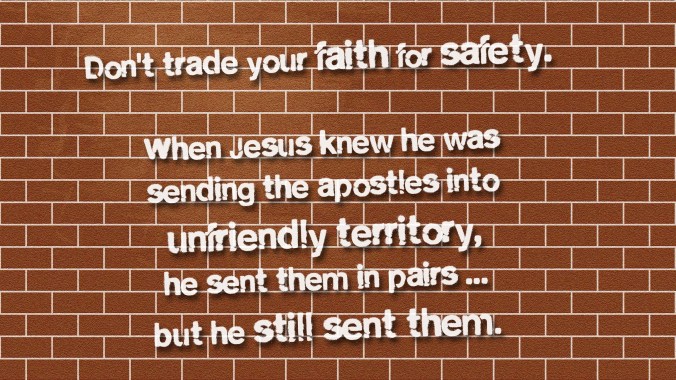
Most of us are comfortable briefly venturing into the wilderness of hunger, poverty, and sickness like tourists being led on a soup-kitchen safari, but – citing common sense and a need for security – we let others do the dangerous work of exploring that terrain and creating safe outposts for us to visit. We can strike a balance; because Jesus knew he was dispatching the apostles into unfriendly territory, he sent them in pairs … but he still sent them.

Facing an uncertain future, Israel quickly began to look back on centuries of slavery as “the good old days.” When we pine for the “simplicity” of the past, we tend to gloss over the bad parts like slavery, genocide, racism, sexism, disease, violence, and lack of indoor plumbing. Perhaps that’s because we are in the servitude of denial that all these things are still problems today.

Faith calls us to the wilderness. Fear tells us to turn back. Only one of those directions leads to the promised land.

Comfort: The future may seem uncertain to you, but it is all in God’s hands.

Challenge: God not promise us lives of ease or comfort.

Prayer: God of justice, help me embrace your freedom even when it frightens me. Thank you for leading me through the wilderness. Amen.

Discussion: Where do you feel drawn, but afraid, to serve?

Join the discussion! If you enjoyed this post, feel free to join an extended discussion as part of the C+C Facebook group. You’ll be notified of new posts through FB, and have the opportunity to share your thoughts with some lovely people.

Rod and Staff

1459594711536.jpg

Today’s readings (click below to open in new tab/window):
Psalms 23; 149, Exodus 13:17-14:4, 2 Corinthians 4:16-5:10, Mark 12:18-27


Psalm 23 is arguably the most recognized psalm in the psalter. It chronicles the typical day in the life of a shepherd and flock, through danger and safely home again. The metaphor of Christians as sheep may seem less than flattering; author Russell Banks once observed sheep were only slightly more intelligent than lawn furniture. Critics of the faith have said it accurately describes mindless followers, but the metaphor is not so much about following as about the relationship binding a shepherd and his flock.

At the end of the day, a shepherd uses a rod to count and inspect each sheep for injuries, a practice known as passing “under the rod.” The rod can also be thrown in front of a sheep to startle it back on course. Although other images of rods, such as “spare the rod and spoil the child” and Proverbs 13:24 (“He who withholds his rod hates his son,
But he who loves him disciplines him diligently.”) are more about discipline, the audience of this psalm knew the rod was not used to strike, but to tend.

Impulsive pursuits may leave us stranded in a spiritual bramble. We get caught up following other sheep and find ourselves in unfamiliar or even hostile territory. We tangle ourselves in gossip at work or church. We feel pressure to overspend in order to keep up appearances with friends and neighbors. As a result, we feel lost, overwhelmed, or out of control. At these times, depending on our relationship to our shepherd can literally save us.

To Jesus’ contemporaries the rod and staff were symbols of loving authority. When he called himself the Good Shepherd, Jesus was telling his listeners, “I have your best interests at heart, and often that will require a course correction.” Are we challenged when trying to integrate the ideas of “love” and “authority” into a unified whole? Have we learned to picture the rod in Jesus’ hand as an instrument of punishment or nurture?

We may not be immediately comfortable accepting the humility necessary to admit we need shepherding, but eventually we realize it is a true blessing that our God does not send us alone into the wilderness. Following Christ will always lead us home.

Comfort: Christ seeks to rescue every sheep, no matter how lost.

Challenge: If possible, visit a meditation labyrinth (or use a finger labyrinth). As you move to the center, meditate on a problem that has you feeling lost. On the way out, ask God to lead you home, and give thanks for Jesus, the Good Shepherd.

Prayer: Merciful and loving God, always lead me home to you.

Discussion: How do you feel about being disciplined? How do you react to it?

Join the discussion! If you enjoyed this post, feel free to join an extended discussion as part of the C+C Facebook group. You’ll be notified of new posts through FB, and have the opportunity to share your thoughts with some lovely people.

Idol Tales

1459543953388.jpg

Today’s readings (click below to open in new tab/window):
Psalms 96; 148, Exodus 13:1-2, 11-16, 1 Corinthians 15:51-58, Luke 24:1-12


In Luke’s telling of the story of the first Easter morning, several women who followed Jesus from Galilee – not just the two Marys – visit his tomb to finish preparing his body for burial with spices and perfume. Instead of Christ’s body they find two men dressed in dazzling clothes (presumably angels) who tell them Christ has risen. The women return to the remaining eleven disciples to deliver this astonishing news, “but these words seemed to them an idle tale, and they did not believe them.”

Huh?

Several recent studies have shown the male brain processes male and female voices differently – essentially tuning out the latter. Unfortunately, the preponderance of responses to this study are about how women can help men listen better by altering their voices. Few if any responses (full disclosure: didn’t find one) teach men how to listen better to women; on the contrary, it almost becomes an excuse. How often do we dismiss the firsthand experience of others because they don’t communicate in our preferred manner? In the case of the women disciples, their firsthand experience was dismissed until it was verified by a man (Peter). People with disabilities, transgender people, ethnic minorities, and many other groups outside the “norm” know what it’s like to have their stories ignored or declared lies until someone from the “right” social group corroborates them.

It’s easy to dismiss someone’s story if – like the eleven – your frame of reference is a bunch of people sharing your worldview and hiding away from facts which contradict their assumptions. If we treat someone who begs us to listen as weak or a victim, we may be denying a prophet. When someone has actually been in the trenches perfuming a corpse, deciding which restroom won’t get them beaten up, or navigating a wheelchair through city streets with no cut-ins … we need to listen to the truths they tell, not sweep them aside until we can find a reason to personally relate.

The faces of the poor and oppressed may change over time, but Christ calls to us through them in the same voice across the ages.

Comfort: Listening to people who have different experiences than yours helps you to better understand the diversity of God’s creation.

Challenge: Learn about the struggles of people who suffer from hidden disabilities.

Prayer: Grant me, O Lord, ears to hear and eyes to see the stories of your children who struggle unnoticed. Let me never ignore the voice of Christ calling for justice. Amen.

Discussion: Whom are you prone to ignore or dismiss because of their social group?

Join the discussion! If you enjoyed this post, feel free to join an extended discussion as part of the C+C Facebook group. You’ll be notified of new posts through FB, and have the opportunity to share your thoughts with some lovely people.

God of History

church-window-2294961_1920

Today’s readings (click below to open in new tab/window):
Psalms 47; 147:12-20, Exodus 13:3-10, 1 Corinthians 15:41-50, Matthew 28:16-20


God visited ten plagues upon Egypt before Pharaoh freed the Hebrews. Scholars estimate these plagues unfolded over a period anywhere from a month to a year, but even a week of boils, locusts, and other disasters must have felt unending. The last and worst one – the death of the firstborn of Egypt – was so terrible that God assured Moses Pharaoh would finally relent. It would be so effective the people would need to be ready on a moment’s notice, without even enough time to let bread rise. The Lord commanded them to prepare unleavened (yeast-free) dough, and they took it with them when Pharaoh ordered them to depart. Baked in the wilderness, this unleavened bread was literally their first taste of freedom in four centuries.

In Exodus, the Lord gives explicit and emphatic commandments about observing Passover properly. During the Passover Seder meal, Jews recount the story of their flight from Egypt. Maintaining such an observance has helped them preserve their identity across thousands of years. For all of us, remembering where we come from – both the good and bad parts – makes us wiser about where we are headed.

A workplace phenomenon called “drift” – which occurs when someone becomes overly comfortable with a duty and cuts corners – causes many avoidable errors. Many people who reach weight-loss goals find the pounds creeping back on because success has made them lax in their diet or exercise regimens. Western Christians leading comfortable lives can easily forget the Gospel should “comfort the afflicted and afflict the comfortable.” When we forget the past, we fail to understand the meaning of the present. Memories – personal, family, and cultural – need to be preserved lest we begin to think we are entirely self-made.

Edmund Burke said: “Those who don’t know history are destined to repeat it.” Living as if our present situation was inevitable will lead us to take it for granted. There’s no Passover without bondage in Egypt. We can’t be a resurrection people without a crucifixion. Let’s remember the bitter taste of our failures to stay on course, and our sweet successes to keep moving forward.

Comfort: Our pasts – overcoming the bad, benefiting from the good – inform who we are today. Your story is important.

Challenge: Read about the meaning of the Passover Seder.

Prayer: God of History, thank you for the lessons of our spiritual ancestors. May my words and deeds honor those who have gone before, especially Jesus the Christ. Amen.

Discussion: What important parts of history do you think get neglected?

Join the discussion! If you enjoyed this post, feel free to join an extended discussion as part of the C+C Facebook group. You’ll be notified of new posts through FB, and have the opportunity to share your thoughts with some lovely people.

The Rest of the Story

historyvtruth

Today’s readings (click below to open in new tab/window):
Psalms 98; 146, Exodus 12:28-39, 1 Corinthians 15:12-28, Mark 16:9-20


The phrase “history is written by the victors” is usually attributed to Winston Churchill or Walter Benjamin. The implication is that each culture or civilization gaining prominence rewrites history as propaganda flattering itself. Some facts may be inconvenient or unavoidable, but over time the need to define ourselves as the good guys spins them; consider recent proposed textbook revisions redefining slaves as “immigrants” and the slave trade as the “Atlantic triangular trade,” or Canadian First Nations peoples mutually agreeing to “make room” for European settlers.

Could this idea influence our reading of the Passover story in Exodus?

Moses had been trying to convince Pharaoh to let the Hebrews leave captivity to worship in the wilderness. Every time Pharaoh refused to free them – the text says God “hardened Pharaoh’s heart” – God sent another plague upon Egypt. These escalated in severity until finally, in the dead of night, God slew all the firstborn of Egypt. Through Moses God warned the Hebrews to mark their doorways with blood, so their houses were passed over for death. As grief devastated Egypt, Pharaoh finally relented.

Exodus was written by the Hebrew people for the Hebrew people. Of course they are its heroes … but God also created the Egyptians. They were estranged from Him and worshipped other Gods, but surely He took no joy in slaughtering His children. Our Christian story traces its roots through the history of the Hebrew people, so we celebrate this victory, but can we imagine the horror of this story from the perspective of an Egyptian peasant family losing their only son?

In numerous biblical passages, God forbade the Jews to return to Egypt. Yet when the infant Jesus was in danger of being killed by Herod, God instructed Joseph to flee to Egypt, where he and his family stayed for years. Moabites, Uzzites, and Samaritans were similarly vilified, but God raised heroes from them and Christ spoke freely with them. When we wrestle to reconcile texts like the Passover narrative to God’s loving nature (and we should), we should also be wrestling with our own attitudes about personal, cultural, and historical enemies. People on the losing side of history have stories too.

Comfort: It’s OK to think critically and ask questions of difficult Biblical material. God will always be able to handle your questions and doubts.

Challenge: Do some research into history as relayed by people who didn’t fare so well.

Prayer: God of the past, present, and future, guide me so my contributions to the story of humankind are just and merciful. Amen.

Discussion: What parts of your national history are subject to “whitewashing?”

Join the discussion! If you enjoyed this post, feel free to join an extended discussion as part of the C+C Facebook group. You’ll be notified of new posts through FB, and have the opportunity to share your thoughts with some lovely people.

Rolling Away the Stones

rock-in-hand-1238868-1920x1440

Today’s readings (click below to open in new tab/window): 
Psalms 97; 145, Exodus 12:14-27, 1 Corinthians 15:1-11, Mark 16:1-8


When Mary Magdalene and Mary the mother of James visited the tomb of Jesus, they found the stone rolled aside and the tomb empty, nothing but a shroud left behind. A young man in a white robe told them Jesus had already gone ahead to Galilee.

If we open ourselves to God’s love and forgiveness, resurrection is a process as native as breathing. We can see it at work in addictions recovery, mended relationships, and lives rebuilt after disaster or tragedy. The difference between surviving and thriving is our daily willingness to embrace the possibility of resurrection – of an entirely new life in God’s love.

The stones that entomb us – grudges, disappointments, anger, bitterness, hate – can seem difficult or impossible to roll away. What if they only seem heavy because we refuse to let go of them? A light stone, if held long enough, becomes a tiresome burden. The most difficult roadblock to resurrection can be our unwillingness to simply let go of burdens we have clung to because their weight anchors us to a familiar place. Change – even good change – is something we tend to resist. Resurrection is a hand open to possibility, and you can’t open your hand while holding on to something else.

On a mission trip to Lake Charles, Louisiana we were helping repair the damage done by Hurricane Rita. Miz Stanley’s home was scheduled for light repairs, but once there we learned the trauma of the storm and the death of her husband had driven the elderly owner to develop a hoarding compulsion. The hoarding and accompanying health hazards had estranged her from her children and grandchildren. One woman in our group had experience helping people transition from independent to assisted living, and knew how to coach someone to let go of possessions. Talk about resurrection! Over the course of a week we cleared out an entire floor of her house, and Miz Stanley continued to progress long after we left. Her relationship with her family was renewed, all because she literally let go of the old. The same possibility exists for all of us.

Comfort: The possibility of resurrection is always within arm’s length.

Challenge: When you pray this week, pray with your arms outstretched.

Prayer: Merciful and loving God, I am open to all the possibilities you offer!

Discussion: What stones do you refuse to let roll away from you?

Join the discussion! If you enjoyed this post, feel free to join an extended discussion as part of the C+C Facebook group. You’ll be notified of new posts through FB, and have the opportunity to share your thoughts with some lovely people. Or feel free to comment here on WordPress, or even re-blog – the more the merrier!

Risen and Recognized

1459099239295.jpg

Easter readings (click below to open in new tab/window):
Acts 10:34-43, Psalm 118:1-2, 14-24, Acts 10:34-43, Luke 24:1-12

Today’s daily readings:
Psalms 93; 150, Exodus 12:1-14, John 1:1-18, Luke 24:13-35


Jesus Christ is risen today! Alleluia!

Where will we encounter him? Cleopas and another disciple (possibly his wife, who was present at the crucifixion) were on the road to Emmaus when they met him. Surprised that he didn’t seem to know about recent events in Jerusalem, they spoke of the crucifixion and the empty tomb. Though he interpreted for them the meaning of everything that had happened, they still did not know who he was. When he sat down to eat with them and blessed bread and broke it, “their eyes were opened” and they knew the risen Christ. “He had been made known to them in the breaking of the bread.”

Like the disciples who met him on the road, or the boat full of disciples who later saw him on the shore but didn’t recognize him, our vision of Christ can be limited by our expectations.

When we limit Christ to what we already know of him, we are not following the living Christ, but worshiping a lifeless photograph. Christ didn’t rise so we could wrap ourselves in a shroud-like faith that preserves but does not reveal.

To find the living Christ we often have to take time away from the safe and familiar worship at the foot of the cross – because he is no longer there!

The risen Christ may seem like a stranger, but we will recognize him by his love. When he breaks bread with our enemies. When he stands on a cold street corner protesting injustice. When he holds the hand of a lonely friend with a terminal diagnosis. When he digs a well on a desert reservation so people don’t have to drive two hours for water every day. When he welcomes refugees fleeing violence into his home for weeks at a time. Christ does all these things when we, as his only body here on earth, do these things. It is then when others who do not know him may see his nature revealed in us. It is then we can declare our redeemer lives.

Jesus Christ is risen today! Alleluia!

Comfort: Our savior lives, and he lives in us!

Challenge: Today of all days, greet everyone with love.

Prayer: Dear LORD I give thanks for the Risen Christ! May I live ever more deeply into the love you have shown us through his sacrifice and resurrection. Your grace and mercy are endless. May my praise be endless as well. Amen.

Discussion: Despite being a resurrection people, we often entomb our faith by confining it to church. How can you let yours free in the world?


Inside Out

Untitled-1

Today’s readings (click below to open in new tab / window):
Psalms 43; 149, Lamentations 3:37-58, Hebrews 4:1-16, Romans 8:1-11


How do you go on?

After one of your closest companions betrays your beloved teacher …
After fear has driven you to deny your friend and savior …
After the messiah to whom you dedicated your life lies in a tomb…

… how do you go on?

The disciples would have begun observing the weekly Sabbath shortly before sundown on the day of Christ’s crucifixion. Candles would be lit. Prayers would be said. Songs sung. Meals eaten. Outward signs of mourning were forbidden on the Sabbath. Everything would have looked normal on the outside, but inside … grief and chaos.

Whatever activity or (this being the Sabbath) inactivity occupied their bodies, the disciples’ minds must have been on the tomb, not far away, with a body freshly lain and a stone newly rolled across it. From the outside it would have looked like any other tomb, but inside … incomprehensible injustice.

The scribes and Pharisees, Herod and Pilate, and everyone else who feared or hated Christ’s teachings were settling back into a sense of restored order, perhaps even contentment that they had successfully squelched this would-be king and prevented rebellion. The world looked the same as it had before, with the same people holding power, but deep inside … the rules of victory were being rewritten.

We spend a lot of time in this state, appearing one way to the world while, for better or worse, experiencing a wholly different inner life. Holy Saturday represents the tipping point of that experience. On that day, the disciples were resigned to the calm and ordered injustice of the flesh, while their souls were in torment. After that day, they were willing to sacrifice themselves on the altar of the Gospel, because nothing could shake the peace they had found in Christ. What a remarkable change!

What state are we in today? Is our world orderly but our faith easily shaken? Is our world in turmoil but our faith a rock? Or are we somewhere in-between, living an extended Holy Saturday moment, broken but hoping despite the evidence that justice will reign?

On the outside today may seem like any other day, but inside …

Comfort: The story isn’t over.

Challenge: Sometimes we have to give up exterior respectability to find interior peace.

Prayer: God of hope, today we mourn the injustice of the world. Send us peace. Send us love. Send us Christ. Amen.

Discussion: When has your outward stability masked inward change?

Join the discussion! If you enjoyed this post, feel free to join an extended discussion as part of the C+C Facebook group. You’ll be notified of new posts through FB, and have the opportunity to share your thoughts with some lovely people. Or feel free to comment here on WordPress, or even re-blog – the more the merrier!
Holy Friday

1458878752643.jpg

Today’s readings (click below to open in new tab/window):
Psalms 22; 148, Lamentations 3:1-9, 19-33, 1 Peter 1:10-20, John 13:36-38

Readings for Good Friday:
Isaiah 52:13-53:12, Psalm 22, Hebrews 10:16-25, John 18:1-19:42


If “Good Friday” seems like an odd name for a day commemorating a crucifixion, understand that good used to mean holy. All over the world, Christians re-enact Christ’s journey to Golgotha (also called Calvary) and his terrible execution. From congregations reading the passion together, to prayer groups walking the stations of the cross in troubled neighborhoods, to entire towns becoming Jerusalem for the day, Christians feel compelled to relive the story.

Because we know how the story turns out, we may find it easy to judge the crowds whose cheers turned to condemnation, or Peter, who – as Christ predicted – denied knowing him not not once, not twice, but three times. Certainly we would not have shouted “Crucify him!” We could never deny him … could we?

Let’s assume we could. Actually, let’s assume we have – because it’s true. None of us lives perfectly. That being the case, isn’t it comforting to know the person Jesus hand-picked to found the church was as flawed as we are? Maybe that’s why in passion stories most of us play the angry mob: to be reminded each of us is in need of forgiveness, and so don’t have the right to judge anyone. Christ later assured Peter he was still loved, but surely the knowledge of that moment of fear, weakness, and betrayal never left him. And almost as surely that memory helped forge the compassion and mercy for others that would have been necessary to speak for Christ.

When we feel like judging, let’s remember Peter – weak, frightened, impulsive, imperfect Peter. Then let’s remember Christ forgave him, as he forgives us, and calls us to forgive. It was the sin of the world that Christ forgave on that cross, including the sin of our own imperfect mercy and tarnished compassion.

From noon this day until Sunday morning, the disciples were without Christ. They thought the story was over, and despaired. This holy Friday and Saturday, let’s contemplate what it would mean to live without hope of forgiveness for ourselves and others. Today Christ hangs on the cross. We shouted “Crucify him!” Now we weep.

Comfort:

Challenge: Pray for forgiveness.

Prayer: Lord Jesus Christ, son of the living God, have mercy on me, a sinner.

Discussion: What does Good Friday mean to you?

Join the discussion! If you enjoyed this post, feel free to join an extended discussion as part of the C+C Facebook group. You’ll be notified of new posts through FB, and have the opportunity to share your thoughts with some lovely people. Or feel free to comment here on WordPress, or even re-blog – the more the merrier!