Decrease to Increase

YourBest

Today’s readings (click below to open in a new tab/window):
Psalms 15; 147:1-11, Genesis 9:18-29, Hebrews 6:1-12, John 3:22-36


The ministry of John the Baptist was a big success. Business was so good he had customers lined up from Bethany to Aenon, where he moved because it had more water to let him do his job. He had his own disciples and irritated all the right authorities. Yet when Jesus arrived on the scene, John willingly gave it all up. John knew something we often forget: successful ministry is not determined by numbers or longevity, but by how well it advances the message and mission of Christ. When John’s followers began flocking to Jesus, John didn’t start planning how to win them back. Instead he said of Jesus: “He must increase, but I must decrease.”

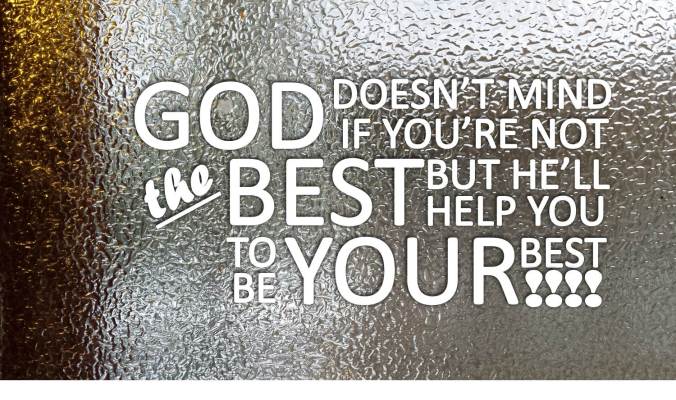
Christian ministry is not a competition, but our competitive nature can sneak into it. Choir solos, sermons, fundraisers, offerings, praise hands, potluck contributions – sometimes we can’t help comparing these things, especially if we are good at them. If healthy competition pushes us to do our best work, the ministry may benefit. When we start thinking of our collaborators as rivals, we do a disservice to everyone, and undermine the community and the ministry. Whether an individual or church, we let our lights shine to illuminate the love of Christ, not to put a spotlight on ourselves. Even if we are the very best at something, sometimes we must intentionally step aside to let others play their parts. Being our best – not the best – is what matters.

Mature preachers will say praise and criticism are the same. In other words, they hear feedback, but do Christ’s work for the sake of the work, not the reaction. Praise does not swell their heads, and criticism does not defeat them. This ego-free attitude requires cultivation, but our work will be the better for it. There’s nothing wrong with enjoying a compliment for a job well done, but if our focus moves from Jesus to acquiring compliments (or members, or money, or readers), our work suffers.

For others to increase, sometimes we must decrease. But if we do it to help Jesus increase, we rise along with him.

Comfort: The best ministries are collaborations; you don’t have to do everything yourself.

Challenge: Whenever you feel competitive with someone, ask yourself whether it is healthy or unhealthy.

Prayer: Gracious God, teach me to appreciate the diversity of the Body of Christ. Amen.

Discussion: Where do you find yourself competing when you could be cooperating?

Join the discussion! If you enjoyed this post, feel free to join an extended discussion as part of the C+C Facebook group. You’ll be notified of new posts through FB, and have the opportunity to share your thoughts with some lovely people. Or feel free to comment here on WordPress, or even re-blog – the more the merrier!
Clashing Symbols

1453178211605

Today’s readings (click to open in a new window):
Psalms 123; 146, Genesis 9:1-17, Hebrews 5:7-14, John 3:16-21


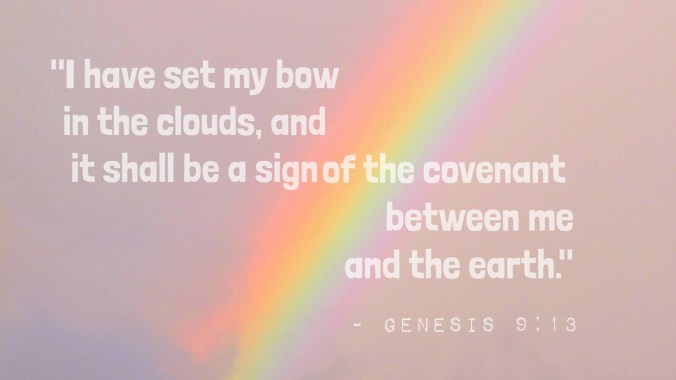
When the great flood ended, God made a covenant with Noah and his family never to drown the world again. He set his bow – the rainbow – in the sky to remind him of the covenant every time he gathered clouds. All who saw the rainbow were reminded of God’s promise not to destroy the world again.

Symbols are important to us. A simple image can evoke complex ideas, emotions, and memories. The most prominent Christian symbol is the cross. It reminds us of death and resurrection. It identifies fellow believers. It marks a spot where we can lay down our burdens. Like all effective symbols, it is easily recognized – two simple lines! – and is rich with meaning.

Corporations spend millions of dollars to develop recognizable logos that communicate the essence of their business and inspire loyalty. Who in America doesn’t immediately recognize the Golden Arches and what they stand for? We wear clothes with symbols to telegraph our status, cultural or counter-cultural affiliations, team loyalties, and peer groups. We exchange a lot of information in the shorthand of symbols.

How do we distinguish truly meaningful symbols from the visual noise bombarding us each day? Are religious symbols nothing more than a brand logo? Let’s consider the rainbow. It only appears in the rain, the very thing it is meant to protect us against. And what about the cross? It was an instrument of death, but it is now a symbol of new life. We revisit and ritualize these symbols because they are about transformation, and about movement from struggle to victory. The Nike swoosh can only aspire to such heights.

Let’s use our symbols wisely and appropriately. If the rainbow was in the sky 24/7, it wouldn’t be nearly as powerful. If we slap a Jesus fish or “John 3:16” on everything we own, its power to transport us to a deeper emotional or spiritual frame of mind is diluted, as is the message it sends to others. They are not like flags or team jerseys that define Team Jesus. The symbols of our faith should be like beacons inviting others home.

Comfort: The symbols of our faith can bring us comfort and help remind us of important things.

Challenge: Symbols can confuse or alienate people who don’t understand them. Be thoughtful about using them to welcome rather than to exclude.

Prayer: God of truth, help me to see beyond symbols to the truths behind them. Amen.

Discussion: What symbols are meaningful to you? Why?

Join the discussion! If you enjoyed this post, feel free to join an extended discussion as part of the C+C Facebook group. You’ll be notified of new posts through FB, and have the opportunity to share your thoughts with some lovely people. Or feel free to comment here on WordPress, or even re-blog – the more the merrier!
Born Again Identity

1453088855089

Today’s readings (click to open in a new window):
Psalms 135; 145, Genesis 8:6-22, Hebrews 4:14-5:6, John 2:23-3:15


“Born again Christian.” It’s a phrase we’ve all heard, but it can mean many different things depending on our religious background (or lack thereof). It has its origins in Today’s reading from John, when Jesus tells the sympathetic Pharisee Nicodemus: “Very truly, I tell you, no one can see the kingdom of God without being born again” (John 3:3). The Greek wording could also mean “born from above.” The idea of a second birth is confusing to Nicodemus, and Jesus doesn’t really clarify it. For many Christians, this one ambiguous phrase found in only one gospel has become an extremely subjective litmus test for “authentic” Christianity.

The gospels use several images to describe the new life that comes from a relationship with Jesus. Why is this one definitive for so many people? Maybe because it implies the reality of a a complete do-over. Human beings are helpless at birth and depend on their parents for everything. When we surrender ourselves to Jesus, we re-learn how to live and depend totally on God’s grace to carry us through that process. Throughout our lives we find new reasons and new ways to surrender. Our rebirth is not a one-time event occurring at the moment of conversion or baptism, but a constant spiritual renewal.

There is beauty in the image of rebirth, but also a danger of exclusion. Lifelong Christians may never have had a distinct moment of  rebirth, so insisting someone must be “born again” can quickly turn to judgment. It is God’s job – not ours – to judge whether someone is sufficiently Christian.

Whether or not being “born again” is part of our theological vocabulary, renewal is part of life in Christ. Just as the birth of an infant can be simultaneously joyous and scary, so can the changes in our new lives. At times we will need to celebrate, at other times we will need support, and sometimes we will need both. Fellow believers may need the same from us. Our new lives are meant to be shared, so let us be present for each other in all the ways we can.

Comfort: In Christ our life is made new every day.

Challenge: If you don’t have a “born again” story listen to someone who does. If you do have such a story, listen to how someone born into the church experiences their faith.

Prayer: Thank you, Lord, for giving me a fresh start every day. Amen.

Discussion: What do you mean when you say “born again?” If it’s not part of your faith vocabulary, what do you think when you hear it?

Join the discussion! If you enjoyed this post, feel free to join an extended discussion as part of the C+C Facebook group. You’ll be notified of new posts through FB, and have the opportunity to share your thoughts with some lovely people. Or feel free to comment here on WordPress, or even re-blog – the more the merrier!

The Fine Line

1452988121799

Today’s readings (click to open in a new window):
Psalms 19; 150, Genesis 7:1-10, 17-23, Ephesians 4:1-16, Mark 3:7-19


The line between faith an insanity can be hard to identify. When Noah heard the voice of God telling him to build an ark, he must have questioned which side of the line he was on. His neighbors, friends, and family – the ones who didn’t scoff at him outright – surely had questions as well. How must it have felt to explain the enormous construction project going on in his back yard? Following God’s orders very likely ruined his reputation as a stable individual. At least until the rains started.

Not everything God would have us do will make sense to the outside world – and maybe not even to ourselves. Showing generosity to people who haven’t earned it, granting mercy to those who have wronged us, taking in strangers – these things seem scandalous by worldly standards. When God “asks” us to do something – through intuition, conscience, or other means – are we strong enough to ignore the mocking, sometimes hostile voices discouraging us? We probably won’t be asked to accomplish something as huge as 1.5 million cubic feet of boat, but when we open ourselves to ridicule the burden may feel almost as enormous.

When Noah and his family closed the door of the ark, they had no idea how long they might be afloat or what their final fate might be. Following God often means the faith that we are doing the right thing must be sufficient to carry us through dark and confusing times. We want to be sure we are on the right side of that line between faithful and crazy, but we often don’t. When it comes to leaps of faith we can pray, discern, and hope … but we can never be 100% sure. If we turn out to be wrong, or if things just turn out differently than expected, listening to that voice the next time may be difficult.

Not every little whim is a calling from God, but sometimes we need to risk looking a little crazy. That’s OK. We may turn out to be the only one with the good sense to get out of the rain.

Comfort: Faith may ask crazy things of us, but God will see us through.

Challenge: Is anything you have left undone nagging at your conscience? If so, pray and meditate on what’s holding you back.

Prayer: All-knowing God, I will trust you even when I don’t understand you.

Discussion: What’s the most outlandish thing you’ve done on intuition? How did it work out?

Join the discussion! If you enjoyed this post, feel free to join an extended discussion as part of the C+C Facebook group. You’ll be notified of new posts through FB, and have the opportunity to share your thoughts with some lovely people. Or feel free to comment here on WordPress, or even re-blog – the more the merrier!

It Rolls Downhill

Rabies 010

Today’s readings (click to open in new window): 
Psalms 104; 149, Genesis 6:9-22, Hebrews 4:1-13, John 2:13-22


“Tourist prices” have been a problem for as long as people have traveled out of town. For example, non-Jewish currency was forbidden inside the temple at Jerusalem, so pilgrims needed to exchange it with money changers in the temple’s outer court before purchasing sacrificial animals. Doves, lambs, and other creatures are difficult to travel with, so livestock merchants also set up shop there. Both money changers and merchants took advantage of captive customers by demanding high prices. When Jesus arrived at the temple, he was so outraged to find “a den of thieves” where people traded faith for profit that he fashioned a whip out of cords and drove them all out. Not only had commerce defiled the temple, the institution that was supposed to protect the people was exploiting them.

The faithful are called to steward our resources justly. That means more than tithing and charity. Wealth does not buy us the privilege to shift social burdens onto the poor. In his encyclical on the environment, Pope Francis describes how the poor are disproportionately affected by climate change and pollution. The wealthy consume resources and produce waste at a much greater rate than the poor, but poor communities are where we dump trash, manufacture toxins, and  ignore contamination. This burden shift occurs down the road and around the globe. Industries with environmentally devastating activities forbidden under national policies exploit poorer, unregulated countries. Many economic and social forces impact the differences between wealthy and poor communities, but property values are not Christian values. Living in a nice neighborhood doesn’t mean we deserve more justice. Faith calls us to deploy our resources in a way that protects the most vulnerable among us.

Are we in the outer court exchanging profit for justice, or are we working to make sure the poor – whom Jesus told us to serve – are at the heart of God’s kingdom? Rock bottom prices have high human costs. Pollutants we vote or litigate out of our back yards are forced into someone else’s. When the choices we make to better our lives negatively impact others, we need to make better choices. Maybe we can start by treating the poor as we would treat our own family … because Christ has made them so.

Comfort: Rich, poor, or in between, God’s justice is meant for all of us equally.

Challenge: Read about how the poor have been unfairly impacted by pollution in Ringwood, New Jersey (also known as Sludge City), Horlivka, Ukraine, or Flint, Michigan.

Prayer: Lord, help me to live justly, not just for my own righteousness, but for the love of your creation. Amen.  

Discussion: Where in your own community do you see links between poverty and injustice?

Join the discussion! If you enjoyed this post, feel free to join an extended discussion as part of the C+C Facebook group. You’ll be notified of new posts through FB, and have the opportunity to share your thoughts with some lovely people. Or feel free to comment here on WordPress, or even re-blog – the more the merrier!


Jesus, Life of the Party

image
Today’s readings (click below to open in new tab/window):
Psalms 51; 148, Genesis 6:1-8, Hebrews 3:12-19, John 2:1-12


Christianity is serious business. The language of our faith uses words like sacrifice, atonement, sin, repentance, blood, and crucifixion with alarming regularity. We often speak of love as a demanding experience. We revere saints who deprived themselves of all earthly pleasures and martyrs who died in horrible ways. Suffering and death are undeniable parts of our collective story. If we are supposed to be willing to follow Christ to the cross, why do we ever sing songs like “I’ve Got the Joy, Joy, Joy, Joy Down in My Heart?”

Despite the bloody reality of the cross and the traditional fire and brimstone sermons we have heard, suffering is not the default position of the Kingdom of God. Christ did not suffer and die just so we could continue suffering and dying. In the book of John, his first public sign is turning water into wine at a wedding banquet. That’s right: he made his public debut at a party, and performed a miracle so the party wouldn’t have to stop. It wasn’t just any party though – it was a celebration of life recognizing a joyous bond between two people, and the bond between each of them and God.

The Cana story does not appear in other Gospels, but in Matthew Jesus describes the Kingdom of God as a wedding banquet where outcasts feast. In this life suffering may be inevitable, but we don’t need to wear it like a uniform to be good Christians. To the contrary, Jesus had little regard for people who put their suffering on display as a show of piety. We are to confront head on the suffering of the world and help where we can, and to rely on God when we ourselves suffer, but we are never to be resigned to misery. While suffering is sometimes the cost of staying the course on the way to the feast, it is not God’s desire for us. The ultimate purpose of the crucifixion was eternal life. Jesus came to heal us, to teach us to forgive, and to celebrate with us. Let’s not forget to RSVP.

Comfort: God wants us to be joyful.

Challenge: Best as you can, don’t run away from people’s suffering; confront it with them without being consumed by it.

Prayer: Lord, lead me to those whom I can help, and open my hearts and hands to them. Amen.

Discussion: Suffering is part of life. Is there a way to make it useful?

Join the discussion! If you enjoyed this post, feel free to join an extended discussion as part of the C+C Facebook group. You’ll be notified of new posts through FB, and have the opportunity to share your thoughts with some lovely people. Or feel free to comment here on WordPress, or even re-blog – the more the merrier!
God out of Nazareth

1452742030612

Today’s readings (click below to open in new tab or window):
Psalms 97; 147:12-20, Genesis 4:17-26, Hebrews 3:1-11, John 1:43-51


Soon after Philip the apostle met Jesus, he found his friend Nathanael and said:”We have found him about whom Moses in the law and also the prophets wrote, Jesus son of Joseph from Nazareth.” Nathanael replied: “Can anything good come out of Nazareth?” Of course he was swayed once he actually met Jesus, but his initial skepticism is noteworthy.

The village of Nazareth did not have much of a reputation. It was small and relatively obscure. Suggesting the Messiah could emerge from Nazareth seemed ridiculous even to its own citizens, who repeatedly rejected Jesus and his teachings. Yet a Nazarene he was, defying all doubt and eclipsing all expectations.

It’s not fair, but the world pigeonholes people based on the circumstances of their birth. Inner city kids are thugs. Immigrants from the middle east are suspected terrorists. Women are less capable than men and men are less nurturing than women. Pretty people are stupid and nerds are lonely. Stereotypes  are endless. Like Nathanael we sometimes encounter someone who demolishes one of our biases, but many of them remain unchallenged. One might think that being subjected to a stereotype would make a person less likely to do the same to others, but it isn’t so. We all justify our own biases and the world is poorer for it.

Where is your Nazareth? It may be an actual place, like Detroit or Syria. It may lie in an opposing political or religious ideology. It could be buried in the pigmentation of someone’s skin cells.You may not be able to locate it easily, because it doesn’t necessarily stand out as a place you actively dislike, but perhaps a place you can casually dismiss. Nazareth is any place or circumstance you use as an excuse to invalidate a person or their voice.

Jesus overcame all the obstacles of his birth. So can we, because we are children of God. And we need to give others the same chance. Let us each work to examine and dismantle our prejudices so we can look at each other and see the face of Christ, Nazarene and Messiah.

Comfort: You are more than any label. You are a child of God.

Challenge: Ask a friend you trust what your biases are. Don’t argue with them about what they say, just listen with an open mind and heart.

Prayer: Loving God, teach me to see you in all people, even when I don’t want to.

Discussion: What biases have you formerly held which you no longer hold?

Join the discussion! If you enjoyed this post, feel free to join an extended discussion as part of the C+C Facebook group. You’ll be notified of new posts through FB, and have the opportunity to share your thoughts with some lovely people. Or feel free to comment here on WordPress, or even re-blog – the more the merrier!
Blame Game

1452656920356

Today’s readings (click below to open in new tab/window):
Psalms 89:1-18; 147:1-11, Genesis 4:1-16, Hebrews 2:11-18, John (1:29-34) 35-42


The story of Cain and Abel is the original tale of sibling rivalry. Cain, the first child of Adam and Eve, was a “tiller of the ground” and made God an offering of his harvest. His brother Abel was a shepherd, and offered God the finest of his flock. God favored Abel’s offering but not Cain’s, and in jealous anger Cain slew Abel with a rock. Instead of killing Cain, God instead banished him east of Eden and placed a mark of protection on him so no one else would kill him either.

Stories of rivalry are seldom so extreme, but Cain made a common mistake: when things didn’t go his way, he assumed the role of victim.

When God noticed Cain was angry because his offering was not respected, he asked Cain: “Why are you angry, and why has your countenance fallen? If you do well, will you not be accepted?” Cain never stopped to ask himself (or God) what he might have done differently. Instead he directed his anger toward Abel. God had advised him: “And if you do not do well, sin is lurking at the door; its desire is for you, but you must master it.” As God predicted, blaming Abel for his failure led to an even bleaker fate.

Our reaction to failure determines the course of our future. Not being honest with ourselves about our own contributions to a failed effort can have disastrous results for ourselves and those around us. Even when we feel someone has taken advantage of us, we can ask whether and how we made it possible. This doesn’t excuse the other person, but restores our sense of control over the situation and prepares us for similar situations in the future.

We’ll never know why God  rejected Cain’s offer, because he didn’t ask. When we bungle a project at work or handle a family situation poorly, it’s tempting, easy, and human to blame the circumstances, a co-worker, or a spouse. Once that’s out of your system, you need to look inward. In any situation, you are the only person you can control.

Comfort: When you make mistakes, God is not waiting to condemn but to help.

Challenge: Reconsider a situation – from a time when you were an adult – where you blame someone else for failure or problems. Ask yourself what you might have done differently, and what could you do differently in the future.

Prayer: God, teach me to see myself as I am, not as I pretend to be. Amen.

Discussion: How often do you play the victim?

Join the discussion! If you enjoyed this post, feel free to join an extended discussion as part of the C+C Facebook group. You’ll be notified of new posts through FB, and have the opportunity to share your thoughts with some lovely people. Or feel free to comment here on WordPress, or even re-blog – the more the merrier!
Math Nerd Theology

1452489798883

Today’s readings (click below to open in new tab/window):
Psalms 5; 145, Genesis 2:4-9 (10-15) 16-25, Hebrews 1:1-14, John 1:1-18


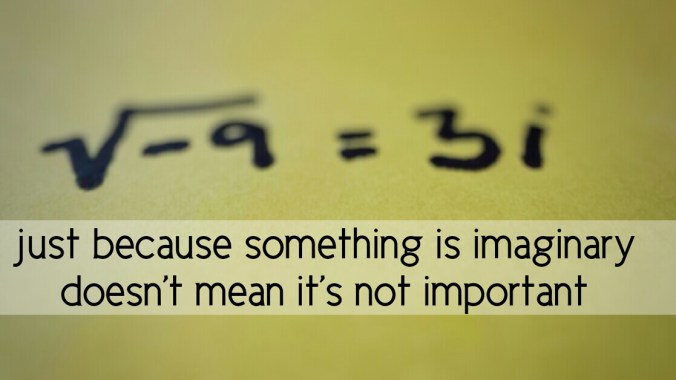
First, a short math lesson. When you square any number, positive or negative, the result is always a positive number: 3 x 3 = 9 and -3 x -3 = 9. Fairly straight forward, yes? (If not, don’t worry; there won’t be a quiz). However, some equations can’t be solved without finding the square root of a negative number. Since such a number does not exist, mathematicians invented an imaginary unit named i. Perhaps it’s more correct to say they discovered it; philosophers have debated for centuries whether mathematical concepts are invented or discovered. In either case, the square of i is -1. No one can hold up i fingers or charge $i for a pound of bananas, but i is necessary to calculate the square root of -9, which is 3i. 

End of math lesson. But what was the point?

The Gospel of John tells us that in the beginning, there was the Word, and the Word was with God, and the Word was God. In the original Greek, John uses the term logos, which means “word” but also means “reason.” John’s logos is Christ, so John is claiming Christ has been present and co-existent with God from before the beginning of the world. How can this be? Like i, faith in the logos solves an otherwise impossible problem. John has no direct evidence for it, but he invents/discovers it to make sense of God’s relationship with the world expressed through Christ. Some may call it imaginary, but it is also necessary.

Critics of faith often mock it for lacking reason. If your faith comes under fire for being unreasonable, think of i (but not too hard, or your brain may start to itch). Just because something can’t be pointed to or counted doesn’t mean it’s not essential to the fabric of the universe. We don’t call the entire field of mathematics a sham because it relies on an “imaginary” unit. The claim of Hebrews 11:1 that “faith is the evidence of things unseen” is our version of i, the necessary but unknowable solution for morality, eternity, and the soul.

And we thought algebra would never be good for anything.

Comfort: Faith isn’t about seeing, but believing.

Challenge: Call your algebra teacher and apologize for not paying more attention.

Prayer: All powerful Creator, I thank you for being present in the world, though your mystery is beyond my understanding. Amen.

Discussion: Have you ever found a use for something you thought would be useless when you learned it?

Join the discussion! If you enjoyed this post, feel free to join an extended discussion as part of the C+C Facebook group. You’ll be notified of new posts through FB, and have the opportunity to share your thoughts with some lovely people. Or feel free to comment here on WordPress, or even re-blog – the more the merrier!


Telescope or Kaleidoscope?

1452400078790

Today’s readings (click below to open in new tab/window):
Psalms 104; 150, Genesis 1:1-2:3, Ephesians 1:3-14, John 1:29-34


The first Biblical account of creation tells the story of God creating for six days and resting on the seventh. That story is immediately followed by a second one that differs in detail but still ends with the first human beings in a garden paradise. When we recall the stories, we often blur the lines between them, taking a six-day schedule from one, a borrowed rib from another. The Biblical creation accounts don’t stop with Genesis. Proverbs, Job, John, multiple Psalms – these and other passages provide widely varied accounts of how God went about creating the world. How is it they can be so different, yet part of a unified whole?

The Gospels are similar. Each tells the story of Jesus from a different viewpoint, so they are similar but not the same. Studies show that eyewitness accounts are notoriously unreliable, yet sometimes our legal system still depends on them. The more witnesses who can corroborate key details, the better. A telescope is accurate but limited by its singular field of vision; a kaleidoscope gives us many angles of the same view.

Let’s consider our own histories. When we and our siblings or friends reminisce about childhood, we don’t all recall it the same way. Ever listen to a married couple tell a story jointly? There is quite a bit of give and take, argument and correction as they navigate their way through the tale. Witnesses, friends, or partners, they are all working toward finding truths that can only be reconstructed by layering multiple perspectives and insights.

When we dive into the big questions – Who am I? Why am I here? What’s it all about? – no single story tells us all we need to know. The compilers of the Bible were not concerned that the creation stories “agree” because that’s not the point. Even the “conflict” between Genesis and science disappears when we consider facts and truth are not revealed in a single snapshot, but in multiple exposures over a long period of time. If we insist that only one story is factual, we’ll never know which ones are true.

Comfort: We don’t have to have all the answers.

Challenge: We have to keep asking the questions.

Prayer: God of Creation, help me to value your truth more than my own certainty. Amen.

Discussion: Every family has its own mythology. What’s one of your family’s most meaningful stories? If you don’t have a family, what makes a story meaningful to you?

Join the discussion! If you enjoyed this post, feel free to join an extended discussion as part of the C+C Facebook group. You’ll be notified of new posts through FB, and have the opportunity to share your thoughts with some lovely people. Or feel free to comment here on WordPress, or even re-blog – the more the merrier!