
Wishing You a Blessed Epiphany!

Today’s readings (click below to open in new tab/browser):
Psalms 72; 147:1-11, Isaiah 49:1-7, Revelation 21:22-27, Matthew 12:14-21
Epiphany readings:
Isaiah 60:1-6, Ephesians 3:1-12, Matthew 2:1-12
Today we celebrate Epiphany, the manifestation of Christ to the gentiles. Traditionally the gentiles are represented by the Magi. The gospel of Matthew tells us wise men followed a star from the east, paid tribute to the infant Christ, and returned home by a different route because a dream warned them King Herod was plotting against the newly-born messiah. Most nativity scenes depict them as three kings, though there is no scriptural basis for their rank or count other than the number of gifts.
Maybe they’re better off dropping the king bit and sticking to being just wise. Psalm 72 describes what it means for God’s presence to be felt throughout the gentile world, and kings don’t fare well. They bow before the presence, offer tribute, and oppressive ones are crushed. On the other hand the poor, needy, and oppressed are mentioned favorably ten times in this twenty-verse psalm. God judges them with justice; he defends, delivers, redeems, helps, pities, and saves them. Jesus’s message of the first being last and the last being first doesn’t originate with him; it is a natural evolution of the messages of the psalmists and the prophets. Jesus is the one who brought it home.
A mainstay of modern Roman Catholic social teaching is a preferential option for the poor. In other words, Christians are obligated to serve those who are impoverished financially and/or spiritually. Theologians of other denominations share similar teachings. Depending on our worldview, how we choose to meet that obligation can take many forms. Christ has trusted us with a duty, and also trusts us to determine the best means to execute that duty. Sometimes that means we can disagree about how we should serve. What it never means is starting from an attitude where the poor – of pocket or spirit – are a nuisance, morally lacking, or lesser than anyone else. Whatsoever we do for the least among us, we do also for Christ. We are to be kings bowing to babes.
The Magi’s gifts of gold, frankincense, and myrrh represented royalty, holiness, and death. Jesus re-gifted them to us as humility, grace, and life regardless of our worthiness. Let’s pay it forward.
Comfort: God’s love is for all, not just the privileged or perfect.
Challenge: What programs in your local community help the poor? How can you help them?
Prayer: Loving God, thank you for all I have. I will not forget that you ask me to share it with those who have less. Amen.
Discussion: We are often distrustful or uncomfortable with people who have significantly more or less material wealth than we do. Why do you think that is?
Join the discussion! If you enjoyed this post, feel free to join an extended discussion as part of the C+C Facebook group. You’ll be notified of new posts through FB, and have the opportunity to share your thoughts with some lovely people. Or feel free to comment here on WordPress, or even re-blog – the more the merrier!

Today’s readings (click below to open in new tab):
Psalms 34; 150, 1 Samuel 1:1-2; 7b-28, Colossians 1:9-20, Luke 2:22-40
Today’s reading from Samuel introduces Hannah, one of Elkanah’s two wives. Hannah had no children, but Elkanah’s other wife did. Like many women in her situation, Hannah was sorrowful about her inability to conceive. She went to the temple and prayed for a child. Because her lips moved but she made no sound, the priest Eli assumed she was drunk and reprimanded her, which was ironic because she had promised if God gave her a son she would dedicate him as a nazirite – a sect that abstained from strong drink. When God rewarded her faithfulness and she gave birth to a son, she followed through on that promise.
When we follow our faith, people may look at us like Eli looked at Hannah. Actions of faith may seem crazy even to other believers, especially if our actions disturb the status quo. The person who suggests displaying grace to those taking advantage of a congregation’s generosity is as likely to be mocked as thanked. Someone who quits a secure job to follow a risky calling will be judged favorably by critics only if the results are successful by standards the critics set. Any member of a denomination who decries its corruption or injustices – racism, sexism, clergy abuse, homophobia, fraud – risks rejection and attacks from both the leadership and the laity. Like Elkanah trying to comfort Hannah by saying “Am I not more to you than ten sons?” many people will pressure us toward quiet acceptance. And also like Elkanah, who already had children by another wife, people seldom understand the need for actions of faith against injustices which do not affect them directly.
As a childless wife, Hannah was distinctly disadvantaged in her culture. Our faith history, from Moses to Jesus to the Civil Rights Movement to today, is the story of God’s justice delivering the oppressed. It always seems crazy to those in power, because by worldly standards there’s nothing in it for them. For those of limited privilege, radical faith actions may be the only sane response. For those who enjoy privilege, some radical faith may be unexpectedly liberating.
Comfort: God desires the liberation of the oppressed.
Challenge: Ask yourself what injustices you tolerate – or possibly participate in – because they don’t affect you.
Prayer: Lord, help me to see the world as you do, especially the places I’m not prone to look. Amen.
Discussion: What convictions have you followed despite negative backlash?
Join the discussion! If you enjoyed this post, feel free to join an extended discussion as part of the C+C Facebook group. You’ll have the opportunity to share your thoughts with some lovely people. Or feel free to comment here on WordPress, or even re-blog – the more the merrier!

Readings: Psalms 90; 149, Haggai 2:1-9, Revelation 3:1-6, Matthew 24:1-14
Love hurts.
More than a pop song cliche, it’s a truth which is unpleasant and unavoidable – unless we opt out of love altogether. Whether we cause the pain or feel it, every relationship is eventually tested. Marriages struggle. Children leave home. Children fail to leave home. Friends let us down. The songs are usually about romantic love, but it’s true even of the agape love practiced by followers of Christ.
How many times heard someone say (or said ourselves), “I just don’t want to be hurt … again?” Maybe they were cheated on. Maybe they were taken advantage of. The reasons for hurt are endless but here’s the thing: we already hurt, because we are already broken people in a broken world. There is no “again;” there is only “still.”
The pain of love is different from the pain of brokenness. The pain of love is like a bone being set, a wound being drained, or the pain of pouring out our secrets to a therapist. It is a productive pain and if we choose to avoid it, healing eludes us.
When Christ asks us to love God and to love one another, he promises us a spiritual comfort but does not promise us a life free of pain or danger. To the contrary, he warns us our choice to follow him into a life of agape love will cause many to scorn us and possibly put us in harm’s way. That harm isn’t always physical. Sometimes it is an injury to the spirit that occurs precisely because we have chosen to help others. Loving leaves us vulnerable.
Like our bodies, our spirits have an instinct to recoil from that which hurts us. As the Great Physician, Jesus tells us the remedy often means taking a greater risk and putting ourselves in danger of more pain – not to become victims or masochists, but to improve our spiritual health. Eventually love mends the breaks and wounds in our spirit, but we must take risks.
Love hurts. Not loving hurts more, because improperly set spiritual bones leave us as hobbled as physical ones.
Comfort: It may take a long time, but loving others heals our own brokenness.
Challenge: For an example of love that valued risk over comfort, read this perspective on Mary, the mother of Jesus.
Prayer: Loving God, give me the courage to love, even when doing so is dangerous. Amen.
Discussion: Different people have different methods of expressing love and recognizing when they are loved. What are yours? (If you’re not sure, maybe take a look at the The 5 Love Languages site of Dr. Gary Chapman).
Join the discussion! If you enjoyed this post, feel free to join an extended discussion as part of the C+C Facebook group. You’ll be notified of new posts through FB, and have the opportunity to share your thoughts with some lovely people. Or feel free to comment here on WordPress, or even re-blog – the more the merrier!

Readings: Psalms 18:1-20; 147:12-20, Amos 9:1-10, Revelation 2:8-17, Matthew 23:13-26
Have you ever wondered why gold is such a valuable currency? It boils down to a few reasons: it doesn’t corrode or react easily with other substances; it’s rare but not too rare; it melts at a high enough temperature to be stable but not so high as to be unworkable; and it is an easily identifiable color. Most importantly, it is valuable because we agree it is.
When Jesus chastises the temple officials by calling them “blind guides” because they teach the faith without comprehending it, he says they value oaths made on the gold in the temple more than oaths made on the temple itself. He asks: “[W]hich is greater, the gold or the sanctuary that has made the gold sacred?” (Matt 23:17). Knowingly or not, these leaders had agreed on what they valued most, and they chose poorly.
Our time and energy are our most precious currency, each minute a coin we choose to spend in some way. What have we agreed deserves our investment? The treasures we gather up in life are only valuable if they are made sacred by the love and faith surrounding them. If our money doesn’t go toward helping those in need, if our home is not open to those seeking shelter, if our larders are locked away from the hungry … of what value are they? If their only value is in the having, then we are like dragons afraid to leave our cave because the world might sneak in and steal our hoard. Gold is nothing but a heavy, beautiful shackle until we bring our treasure to the temple where it can be converted to the limitless currency of love. We must spend it to make more.
True agape love does not corrode and is not eroded by circumstance. It is rare, but not so rare we can’t mine it within ourselves. It is malleable enough to suit many needs, but stable enough to be reliable. People know it when they see it. Perhaps the whole world does not agree on its value, but within the temple of Christ’s body, it ransoms the world.
Comfort: Our treasure is not measured by what we keep, but by what we give away.
Challenge: If you don’t already do so, consider pledging a small monthly amount to a charity of your choice (other than or in addition to your church).
Prayer: Loving God, I commit my treasures to your service. Amen.
Discussion: What types of investment do you consider to be wise ones?
Join the discussion! If you enjoyed this post, feel free to join an extended discussion as part of the C+C Facebook group. You’ll be notified of new posts through FB, and have the opportunity to share your thoughts with some lovely people. Or feel free to comment here on WordPress, or even re-blog – the more the merrier!

Readings: Psalms 50; 147:1-11, Amos 8:1-14, Revelation 1:17-2:7, Matthew 23:1-12
In the midst of adversity, we may find it difficult, almost impossible even, to practice love. Imagine being a widow or beggar during the time of Amos, when the religious leaders were “buying the poor for silver and the needy for a pair of sandals, and selling the sweepings of the wheat*” (Amos 8:6). Consider what it must have been like for the faithful of Israel when their leaders put heavy burdens on the people while never inconveniencing themselves (Matt 23:4). Why would the common people bother loving their enemies when their own leaders preached righteousness and practiced hypocrisy? Can we imagine? Or do we call that “the evening news?”
Yet in both eras (and may we assume today as well?) through his prophets and the messiah God cried for redemption through justice, mercy, and charity – the practices of agape love.
One stumbling block to practicing this type of love is the notion that the recipient should deserve it. We may understand on an intellectual level that all people are deserving because they are children of God, but part of us chafes at the idea that not only have some people not earned it, but they have squandered any right to it. Vindictive ex spouses. Violent criminals. Hate mongering racists. Duplicitous politicians. In human terms, none of these people may merit mercy, but the divine demands it.
It can seem so very unfair. But is it?
What if the command to love our enemies – foreign, domestic, and familial – isn’t just about the dignity of our enemies? What if it is also about the state of our own souls? In Beyond Good and Evil, Friedrich Nietzsche said “be careful when you fight monsters lest you become one.” Fred was no friend of Christianity, but he wasn’t wrong. When we allow feelings of fear or anger to override the convictions of our faith, and when we sacrifice those convictions of peace and love to protect our money, our homes, or even our lives, we have lost what God values most in us.
We love our enemies not only for their sake, but for our own.
* When the harvest was taken, the scraps were supposed to be left in the field to be gathered – or “gleaned” – by the poor and alien in the land.
Comfort: We are not burdened with determining who deserves our love.
Challenge: For an entire day, when you wish to complain about an enemy, instead say a silent prayer for them.
Prayer: O Lord, teach me to rely not on my limited capacity to love, but upon your unlimited promise of love. Amen.
Discussion: Do you pray for your enemies? If so, how? If not, why not?
Join the discussion! If you enjoyed this post, feel free to join an extended discussion as part of the C+C Facebook group. You’ll be notified of new posts through FB, and have the opportunity to share your thoughts with some lovely people. Or feel free to comment here on WordPress, or even re-blog – the more the merrier!
Readings: Psalms 33; 146, Amos 7:10-17, Revelation 1:9-16, Matthew 22:34-46
When a Pharisee lawyer asks Jesus which is the greatest commandment, he replies:
You shall love the Lord your God with all your heart, and with all your soul, and with all your mind.’ This is the greatest and first commandment. and a second is like it: ‘You shall love your neighbor as yourself.’ On these two commandments hang all the law and the prophets.
– Matthew 23:37-39
This famous passage is one of the most direct answers Jesus provides. These two commandments are simple, yet they lack specificity. Exactly how are we supposed to love our God and our neighbors? Or for that matter, ourselves? Is God commanding us to feel a certain way, and if so … is that even something we can control?
We like to say that nothing is impossible with God (Luke 1:37), but we can also be assured God does not ask us to do the impossible. In the case of these commandments, “love” is not expressed in feelings; rather it is demonstrated in attitudes and an actions. Loving a creator we can’t see or hear may be challenging, but we can maintain attitudes of praise, gratitude, and a healthy kind of fear.
Regarding neighbors, we can love someone in a Christian sense without feeling any affection for them at all. We demonstrate it by respecting all persons as beloved creatures of God, offering charity when needed in a manner that respects the dignity of the recipient, and doing the hard work of forgiving offense. Some people will say being nice to someone we don’t like – maybe the opinionated brother-in-law who sucks all the air out of the room on Christmas Eve – is a form of hypocrisy, but that’s only true if we speak of or do ill to them when they aren’t around. The agape love Jesus calls us to is indifferent to our actual feelings. Otherwise, it’s not sacrificial at all. We’re allowed not to like someone. We are called to love them anyway.
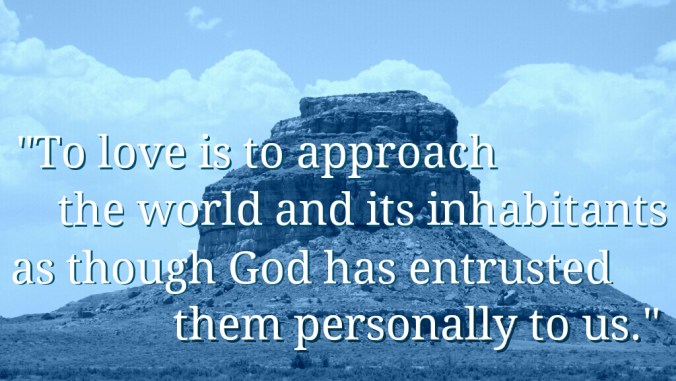
And the “ourselves” part? It is perfectly fine to have boundaries and expectations that we will also be respected. Sacrificial love is about the betterment of others, not the abasement of ourselves. Sometimes we suffer because we love, but we don’t love because we suffer. To love is to approach the world and its inhabitants as though God has entrusted their care personally to us … because God has.
Comfort: Our loving actions can heal our unloving hearts.
Challenge: Pay attention to whether your emotions are dictating your actions, or vice versa.
Prayer: Let your steadfast love, O LORD, be upon us, even as we hope in you. (Psalm 33:22)
Discussion: Do you feel you can love someone without liking them?
Join the discussion! If you enjoyed this post, feel free to join an extended discussion as part of the C+C Facebook group. You’ll be notified of new posts through FB, and have the opportunity to share your thoughts with some lovely people. Or feel free to comment here on WordPress, or even re-blog – the more the merrier!
Readings: Psalms 24; 150, Amos 6:1-14, 2 Thessalonians 1:5-12, Luke 1:57-68
Traditionally the theme of the second week of Advent is Love. Often “love” evokes warm feelings of family, friends, and romance. However, depending on a person’s life circumstances, those feelings may be mixed with longing, loneliness, hope, and other emotions.
Sorting out feelings about feelings? Well, love is complicated. Advent adds yet another wrinkle: love as the world falls apart.
The prophet Amos and the apostle Paul both share harsh words about the future. Amos tells the people of Israel they have offended God so mightily that He is “raising up against you a nation, O house of Israel, […] and they shall oppress you from Lebo-hamath to the Wadi Arabah.” Paul in his second letter to the church in Thessalonica tells them they who do not obey the Gospel “will suffer the punishment of eternal destruction, separated from the presence of the Lord and from the glory of his might.” While these passages definitely drive home the message that God desires righteousness, they don’t much describe a God who define Love as a gooey confection of simple affection.
Except in these examples, God’s anger exists because people are too focused on false righteousness and not enough on love. The people of Israel were making ritual sacrifices like clockwork, but ignoring and exploiting the poor. “Obeying the Gospel” wasn’t about rules but about loving God and loving our neighbors as ourselves. These prophets warned us separation from God occurs when we fail to love God and each other.
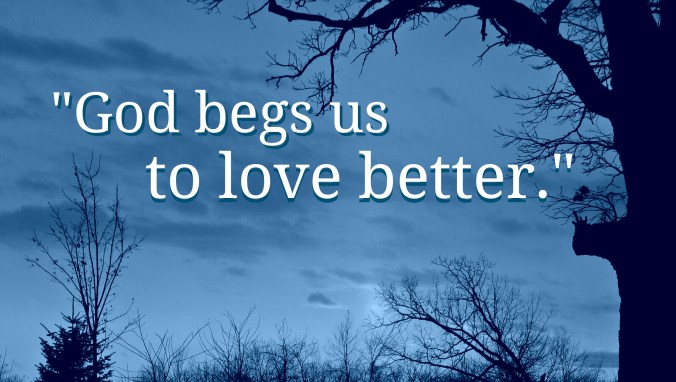
Throughout the Bible, God sends warning after warning about the consequences of failing to love. He sends us Jesus so we may be reconciled to him in love, and before that sends us John the Baptist to tell us Jesus is on the way. Love is complicated. Think about your own relationships where love has been broken: it’s rarely a sudden snap, but a slow dissolution with opportunities for one or both sides to repent. God begs us to love better.
Advent is a season for reflecting on how well we love God and each other. Before the world falls apart, God call us to love. Afterward, it is the only thing that saves us.
Comfort: God loves us even in anger.
Challenge: Work on a relationship where love has been broken.
Prayer: Make me to know your ways, O LORD; teach me your paths. Lead me in your truth, and teach me, for you are the God of my salvation; for you I wait all day long. (Psalm 25:4-5)
Discussion: How has your understanding of love changed over time?
Join the discussion! If you enjoyed this post, feel free to join an extended discussion as part of the C+C Facebook group. You’ll be notified of new posts through FB, and have the opportunity to share your thoughts with some lovely people. Or feel free to comment here on WordPress, or even re-blog – the more the merrier!

Readings: Psalms 90; 149, Amos 5:18-27, Jude 17-25, Matthew 22:15-22
Ever since the world began, people have been predicting its end. For many that “end” is not so much a final obliteration, as a renewal when the evil, violence, and injustice will be swept away to make room for something better. The prophet Amos speaks of the day when God will “let justice roll down like waters, and righteousness like an ever-flowing stream.” When we read headlines and watch the news, don’t we long for the same?
We can react to adversity with despair or with hope. While we may naturally tend toward one or the other, it is ultimately a choice. In the midst of suffering hope may seem futile or naive, but it has real consequences. Repeated studies show that a positive attitude promotes healing from illness and surgery. On a fundamental level, hope is essential to survival; hunger, thirst, and fear may seem like negatives, but they are hard-wired into us with an assumption that we will continue to live.
Though hope is more than a belief in continued existence. Despair also assumes existence but resigns us to inaction and victimhood, where hope spurs us to positive action. Hope makes charity possible, because it allows for positive change. Without the promise of hope could we even contemplate mercy?
In an age when tragedy around the world is broadcast into our homes 24 hours a day in high definition, hope can be hard to maintain. The truth is that on the whole violence in the world has been decreasing steadily for decades. Data and statistics are not necessarily comforting in the face of immediate crisis, so how do we work (and it is intentional work) to maintain hope? Minister and children’s television host Fred Rogers famously quotes his mother who told him the best thing to do in times of disaster is “look for the helpers” – people who move toward a tragedy to improve the situation. While it seems counterintuitive, could the Kingdom actually be ushered in when we move nearer to tragedy, where we are also nearer to mercy and charity? That is the end we hope for.
Comfort: We are closer to the promises of the God’s Kingdom every day.
Challenge: You can’t help everyone, but somewhere nearby there is a tragic situation waiting for you to inject hope into it. Find it and act.
Prayer: Restore us, O God of hosts; let your face shine, that we may be saved. (Psalm 80:7)
Discussion: Is hope something that comes naturally to you?
Join the discussion! If you enjoyed this post, feel free to join an extended discussion as part of the C+C Facebook group. You’ll be notified of new posts through FB, and have the opportunity to share your thoughts with some lovely people. Or feel free to comment here on WordPress, or even re-blog – the more the merrier!
And while we’re on the topic of foundations:
 Comfort & Challenge