. . .

sunset-1207326_1280

Today’s readings (click below to open in new tab/window):
Psalms 19; 150, 1 Kings 19:8-21, Acts 5:34-42, John 11:45-57


When we find ourselves in a verbal disagreement, most of us have a natural tendency to raise our voices. As the discussion becomes more heated, we try to convince each other through sheer volume. However, many communication experts tell us the best way to be heard – in an argument, or whenever we need to emphasize a point – is to speak more softly. Doing so decreases aggression in others, and compels them to focus and listen.

The prophet Elijah learned God did not always speak through mountain-cracking winds, rumbling earthquakes, or roaring fires … but was also present in the still silence that followed. When Jesus needed to rest in God’s presence, he often retreated to quiet isolation. Paul exhorted the faithful to speak only those words that build up, certainly not the sort of words that are loud or argumentative. In a world where even religious voices are often shrill, are we placing enough value on silence?

Saint Francis of Assisi is sometimes credited with saying: “Preach the Gospel at all times. Use words if necessary.” It’s not really his saying, but is very much in the spirit of his teachings. Our society emphasizes the persuasiveness of words (thus the steady appeal of talk radio and blogs), but relatively few people are “talked into” faith. We listen most eagerly to words that echo what we already believe. Attitudes and beliefs are changed most often by experiences. If we are to be the hands of Christ, perhaps those hands are most authentically experienced when they are offered silently in comfort or prayer.

Of course there is nothing inherently evil about words, even those spoken loudly if they are for a just cause, but we must remember they are merely symbols of the ideas they represent.  If they become a stumbling block, we can dispense with them. If our actions betray our words, we are better off not using them. If we want to teach someone about our faith, quiet, loving actions are a solid beginning. Jesus is the Logos – the Word made flesh: what other words could possibly serve us better?

Comfort: You can speak softly and still carry a big witness.

Challenge: In your prayer life, stop speaking long enough to listen.

Prayer: [Observe one full minute of silence] 

Discussion: What makes you raise your voice?

Join the discussion! If you enjoyed this post, feel free to join an extended discussion as part of the C+C Facebook group. You’ll be notified of new posts through FB, and have the opportunity to share your thoughts with some lovely people. Or feel free to comment here on WordPress, or even re-blog – the more the merrier!
Idols of Virtue

johnjesus

Today’s readings (click below to open in new tab/window):
Psalms 104; 149, 1 Kings 18:41-19:8, Philippians 3:17-4:7, Matthew 3:13-17


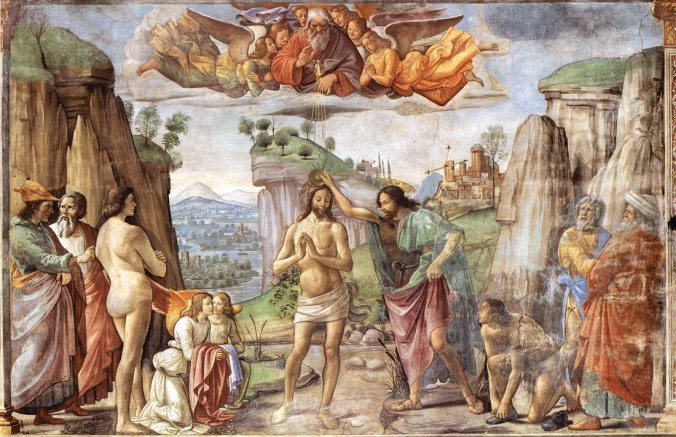
John the Baptist was the antithesis of the scribes and Pharisees in both his message and his appearance. Rather than the elaborate and expensive garments favored by the religious elite of his day, he wore a rough, inexpensive, and probably itchy garment made of camel’s hair. When he wasn’t fasting, he ate locusts and honey. His commitment to humility and simplicity was a physical representation of his message of baptism and repentance. It’s no surprise that when Jesus came to him and asked to be baptized, John humbly objected, saying “I need to be baptized by you, and do you come to me?” When Jesus said “Let it be so now; for it is proper for us in this way to fulfill all righteousness” he consented.

Though he briefly questioned Jesus’ instructions, John was more committed to Christ than to humility.

Can we always say the same? Maybe it’s not humility we turn into an idol. Maybe it’s tithing. Or virginity. Temperance. Or – in an oddly paradoxical progressive twist – moralizing against the foibles of Christian culture (guilty).

Such spiritual disciplines can be excellent means of exploring and expressing our faith – many of them are even direct commandments – but we must remember they are tools and not currency; they do not buy us God’s favor – rather, they help us build an understanding  of God’s goodness and our relationship with our creator. We must remember they are tools and not weapons; when Christ and Paul talk to us about what is right and wrong it is so we can change our own hearts, not so we can aim those words at others who fail to fall in line.  Currency and weapons, even in a spiritual sense, are seductive idols; they offer us a false sense of control and power when we should be seeking to surrender.

So are we free to do whatever we wish? Of course not. But our moral successes and failures do not save us; Christ already did that. We can accept or reject that redemption, but we can’t diminish or improve upon it. Be generous. Be chaste. Be sober. But be these things out of grateful obedience, not because you think they can save you.

Comfort: Jesus has already done the work of your redemption. 

Challenge: Meditate on whether your spiritual impulses are motivated by gratitude or fear.

Prayer: God of Mercy, thank you for Christ the Redeemer. Amen. 

Discussion: When do you feel like you let God down?

Join the discussion! If you enjoyed this post, feel free to join an extended discussion as part of the C+C Facebook group. You’ll be notified of new posts through FB, and have the opportunity to share your thoughts with some lovely people. Or feel free to comment here on WordPress, or even re-blog – the more the merrier!

Blood and Fire

elijah_baal

The Sacrifice of Elijah before the Priest of Baal, Domenico Fetti, c. 1622

Today’s readings (click below to open in new tab/window):
Psalms 51; 148, 1 Kings 18:20-40, Philippians 3:1-16, Matthew 3:1-12


Today’s readings from 1 Kings and Matthew give us two very different perspectives on sacrifice.

When after three years of exile, drought, and famine the prophet Elijah returned to confront the corrupt king Ahab, he had to get past the four hundred and fifty prophets of Baal with whom Ahab and his wife Jezebel had aligned themselves. Elijah challenged them to a contest: we’ll each sacrifice a bull, and whoever’s god manages to set it on fire is the winner. To attract their God’s attention and favor, the prophets of Baal marched around their bull until they were limping.  “They cut themselves with swords and lances until the blood gushed out over them.” If anything their bull only grew cooler as evening approached. Elijah was so confident in his God that he soaked the wood four times before offering his prayer. The fire of the Lord consumed the bull, the wood, and the stone and boiled off the water.

In the gospels, John the Baptist is closely associated with Elijah. Like Elijah he wore rough clothing of camel’s hair and a simple leather belt. John survived on a diet of locusts and honey. He was probably a little scary, living on the edge of his community and inviting the wrath of both the Jewish and Roman authorities by declaring the coming of the messiah. John, who would ultimately be imprisoned and executed, suffered for his faith.

Other than the fact that the prophets of Baal followed the wrong god, what differentiated their sacrifices of self-mutilation from John’s self-deprivation?

The prophets of Baal injured themselves in order to entice their god to do their bidding. John suffered because he wanted to do God’s bidding. With all our talk of Christ’s blood and the cross, we Christians sometimes seem to blur those lines. Our God is not one who demands sacrifice and suffering for the pleasure or cruelty of it. Needless suffering is something Christ asks us to remedy – not to perpetuate. Yet there are times we will suffer for staying true to our faith. The prophets of Baal limped and yelled and bled because they believed in a God who needed to be persuaded to want good things for them. We stay true to our God and find redemption in hardship because God’s love is a fire already burning within us.

Comfort: God doesn’t desire your suffering, but when you must God is with you. 

Challenge: Watch Paul Bloom’s video Against Empathy.

Prayer: Loving God, I turn my suffering over to you that you may transform it into redemption. Amen. 

Discussion: Do you think of your own suffering the same way you think of other people’s? Are you more likely to ask “Why me?” or “Why not me?”

Join the discussion! If you enjoyed this post, feel free to join an extended discussion as part of the C+C Facebook group. You’ll be notified of new posts through FB, and have the opportunity to share your thoughts with some lovely people. Or feel free to comment here on WordPress, or even re-blog – the more the merrier!

Collateral Mercy

people-692005_1920

Today’s readings (click below to open in new tab/window):
Psalms 97; 147:12-20, 1 Kings 18:1-19, Philippians 2:12-30, Matthew 2:13-23


Many action and suspense movies have something in common which, when you think about it, is pretty disturbing. As they follow the hero or heroine from one dangerous situation to the next – be it natural disaster, shootout, or car chase – the body count of disposable and background characters climbs. As long as our main character (and perhaps a love interest rendered increasingly inappropriate by the mounting death toll) survives to the end, we’re meant to feel good has triumphed. Granted these movies are fictional, but doesn’t entertainment reflect our cultural priorities?

Of course this trope was well established long ago. When God inflicts three years of drought and famine on the land to punish King Ahab, the story focuses on the prophet Elijah and the one widow who survives to shelter him while countless unnamed people (who neither married Jezebel nor worshipped foreign idols) die miserably. And after the magi decided not to tell Herod where the infant Jesus was, “he sent and killed all the children in and around Bethlehem who were two years old or under.” But Joseph has a dream to flee with his family to Egypt, so Jesus survives so … that ended well?

For the most part history remembers generals and not foot soldiers; sole survivors and not the unfortunate and numerous departed. You and I are probably going to die uncredited characters from central casting.

But the adult Jesus – the Jesus who ate with the drunks, the sinners, and the disreputable – had some good news for us extras: God loves us just as much as the featured players. Heck, he says it’s the least of us who will be first in the kingdom. The collateral damage and slaughtered innocents? God suffers along with every one of them. Does that make their suffering more fair? Not by human standards at least. But it does make it remarkable. Christ reveals (or possibly just reminds us of) a God whose mercy and compassion operate on both the largest and smallest of scales.

Whether we shape the fate of nations or barely survive day-to-day, God is with us.

Comfort: You and your suffering are not insignificant to God. 

Challenge: In entertainment and news, pay attention to who is affected but neglected.

Prayer: Lord, we thank you for loving the least of us as much as the greatest of us. Amen. 

Discussion: Most of the time do you feel like the hero/ine of your own story, or a player in someone else’s?

Join the discussion! If you enjoyed this post, feel free to join an extended discussion as part of the C+C Facebook group. You’ll be notified of new posts through FB, and have the opportunity to share your thoughts with some lovely people. Or feel free to comment here on WordPress, or even re-blog – the more the merrier!

Buzzkill

DCF 1.0

Today’s readings (click below to open in new tab/window):
Psalms 89:1-18; 147:1-11, 1 Kings 17:1-24, Philippians 2:1-11, Matthew 2:1-12


Jesus once said, “no prophet is accepted in his hometown.” If Elijah is any indicator, maybe that’s because they’re royal pains in the neck. And in Elijah’s case … a pain in the royal neck. God sent Elijah to tell King Ahab the land would be subject to famine and drought until Elijah said otherwise. After that Elijah went into hiding in the wilderness where he was fed by ravens and drank from a wadi (riverbed that is dry except in rainy seasons) until it dried up. After that he lived with a widow whom God had commanded to take him in. Her meager portions of grain and oil held out for as long as Elijah stayed with her, but living with the prophet took an emotional toll on her. When her son fell so ill he stopped breathing, she thought Elijah was punishing her sins, until through prayer he restored the boy to life.

Prophets never show up to tell you you’re doing a good job. They are single minded and obsessive. They threaten your sense of security and control no matter how powerful you may be. They keep you off balance. They don’t care if your feelings and desires are incompatible with their mission.

And they are absolutely necessary.

Not every prophet is on a mission like Elijah, challenging the blasphemy of a king. Some of them are more low key annoying. They’re pulling recyclables out of the trash when we’re trying to clean up after the potluck, and asking us to volunteer at the food pantry when they know we just did it last weekend, and interrupting our gossip sessions by suggesting we pray for those people instead. We want them to just lighten up once in a while. They don’t get invited to a lot of parties.

Yet by refusing to let us get too comfortable, these people further the work of the kingdom in a mostly thankless way. The courage of conviction may feel like a real buzzkill, but our reaction says more about us than about them. These prophets are the conscience of a community. If we lean into the discomfort they cause us, we just may find reasons to thank them.

Comfort: A call to repentance is sign of love. 

Challenge: Listen to the voices that remind you to better, even if they are annoying.

Prayer: Lord, teach me to listen well when you speak through others. Amen. 

Discussion: What do you think today’s prophets are saying?

Join the discussion! If you enjoyed this post, feel free to join an extended discussion as part of the C+C Facebook group. You’ll be notified of new posts through FB, and have the opportunity to share your thoughts with some lovely people. Or feel free to comment here on WordPress, or even re-blog – the more the merrier!

No Exceptions

hands-600497_1920

Today’s readings (click below to open in new tab/window):
Psalms 42; 146, 1 Kings 16:23-34, Philippians 1:12-30, Mark 16:1-8 (9-20)


American humorist Sam Levenson once said, “You must learn from the mistakes of others. You can’t possibly live long enough to make them all yourself.” Ahab, king of Israel, could have benefited from this advice. Like his predecessors Omri, Jeroboam, and Solomon, he allowed himself to be seduced by the lure of foreign gods. He built altars and other places of worship to the god Baal in part to please his wife Jezebel. We can blame Jezebel for corrupting him, but Ahab had plenty of bad examples to learn from. The author of 1 Kings even says Ahab did these things “as if it had been a light thing for him to walk in the sins of Jeroboam.”

Ahab doubtlessly though he was different. We like to think we – both in the sense of our individual selves and in the sense of whatever tribe we identify with – are somehow exceptional.  We explain away our own shortcomings and failings by blaming our circumstances (or even painting them as virtues), and vilify other people for the exact same flaws by blaming their character. While this tendency may just seem like relatively harmless hypocrisy, it can become dangerous if we really start to believe we are not capable of doing terrible things.

American exceptionalism is no exception. When we look at world history and current global events full of ethnic strife, civil unrest, economic injustice, and other ills but insist “that could never happen here,” who are we trying to convince? Not long ago – as recently as the early twentieth century – a eugenics movement based on ethnicity and perceived intelligence was a real issue in the United States. As a result, forced sterilization was still legal in some states into the last decade, but most people have forgotten all about what was once a hot topic of conversation everywhere from church luncheons to bridge clubs. Convincing ourselves racism, authoritarianism, and theocracy are beasts which could never breach our shores only tempts us to explain away the footprints they’ve already left on the beach. Every human being is as fallen as every other one, and under the right circumstances we are capable of justifying terrible things.

Our broken nature can be a difficult thing to face, not simply because it’s unpleasant, but also because some religious leaders have inflicted psychological damage by wielding it clumsily and without mercy. Yet only by dying to ourselves through an admission of that brokenness can we overcome it by finding new life in Christ. Admitting we – in both the individual and corporate senses – are as subject to human nature as anyone else keeps us honest and gives us empathy. Following the risen Christ teaches us the limits of human nature are no match for the redemptive power of the resurrection.

Comfort: Christ’s love and lessons help us rise above our baser instincts. 

Challenge: Read It Can’t Happen Here by Sinclair Lewis.

Prayer: God, I offer up my broken self, trusting you to make it whole. Amen. 

Discussion: Is it possible to love your tribe and still see its flaws?

Join the discussion! If you enjoyed this post, feel free to join an extended discussion as part of the C+C Facebook group. You’ll be notified of new posts through FB, and have the opportunity to share your thoughts with some lovely people. Or feel free to comment here on WordPress, or even re-blog – the more the merrier!

Reputation Matters

1505186881821

Today’s readings (click below to open in new tab/window):
Psalms 5; 145, 1 Kings 13:1-10, Philippians 1:1-11, Mark 15:40-47


Sometime in our lives, most of us have had the unfortunate experience of having to send a meal back to the restaurant kitchen. Maybe it’s under- or over-cooked, or not prepared the way we asked, or just plain bad. There’s nothing wrong with expecting what you’ve paid for and letting a business know when you didn’t get it. An apology is the minimum expectation for good customer service. Many times, to show they value your patronage, the manager comps part or all of the meal, or offers a discount for your next visit. How they handle the complaint often determines whether a customer returns in the future.

Is it also possible the seriousness of your complaint might be weighed against your insistence on getting something for free? Complaint scams for free food are not unheard of. Would you consider refusing the compensation to drive your point home?

When the Lord sent a prophet to tell King Jeroboam to stop building temples to idols, Jeroboam wanted to thank the man for interceding on his behalf. Jeroboam invited the prophet to his home for a meal and a gift. The prophet said he had received these instructions from God: “You must not eat bread or drink water or return by the way you came.”

Accepting a meal or a gift, no matter how innocently, might have compromised the prophet’s integrity. In many businesses, especially non-profits, employees are advised to avoid even the appearance of impropriety. Reputation has a real impact on how well we are trusted to conduct our personal and professional lives.

If we want to be taken seriously about our faith – especially by people who are looking for reasons to discredit us – we might also want to consider avoiding behavior that appears hypocritical or self-serving. That includes things like holding ourselves and our representatives to (minimally) the same standards as everyone else. For example, if we gleefully condemn and deride our political opponents for their perceived sins, yet make excuses or preach forgiveness when our political allies do as bad or worse, we can’t pretend our primary concern is justice. It also includes being involved in justice issues which don’t benefit us directly, or even cost us.

A reputation is far easier to keep than it is to restore. And when we claim to act on behalf of or as followers of Christ, it’s not just our own reputation on the line. Let’s be who we say we are.

Comfort: Christ shows us the way of integrity. 

Challenge: Try to be vigilant about your own hypocrisy and motives.

Prayer: God of Truth, help me live in the light. Amen. 

Discussion: Reputation can get tangled up with seeking worldly approval. How and why do we keep them separate?

Join the discussion! If you enjoyed this post, feel free to join an extended discussion as part of the C+C Facebook group. You’ll be notified of new posts through FB, and have the opportunity to share your thoughts with some lovely people. Or feel free to comment here on WordPress, or even re-blog – the more the merrier!

The Real Thing

coca-cola-2483259_1920

Today’s readings (click below to open in new tab/window):
Psalms 103; 150, 1 Kings 12:21-33, Acts 4:18-31, John 10:31-42


Do you remember New Coke? It has a reputation as a huge marketing miscalculation. In 1985, to address a decrease in market share, Coca-Cola rolled out New Coke, a product closer in taste to rival Pepsi. Consumer enthusiasm was lackluster. Within three months the company reintroduced the longstanding previous formula as Coca-Cola Classic. By the end of 2002 New Coke was off the market, and in 2009 the “Classic” tag was dropped. Essentially, Coca-Cola spent nearly 25 years reestablishing a product that didn’t need a change.

New Coke’s biggest problem wasn’t its taste – it was brand identification and loyalty. Unlike iPhone customers who expect innovation, Coke drinkers valued consistency. In other words, if it ain’t broke, don’t fix it.

Jeroboam, who became king of Israel after the Lord – and an army of dissidents – deposed  Solomon’s son Rehoboam, subscribed to the “fix it anyway” school of marketing. Jeroboam had support from ten of Israel’s twelve tribes. But because Rehoboam still ruled Judah, home of the temple, Jeroboam feared the people would abandon him. He commissioned two golden calves and established places of worship in competition with all the Lord had ordained.

Like New Coke, Rehoboam’s rebranding was an impulsive, fear-driven change no one – particularly the Lord – had asked for. Unsurprisingly, it ended poorly.

When we plan to change something people are used to – be it a product, worship style, family recipe, or tradition – we should make sure the change is necessary and, if possible, welcome. Change for the sake of change is confusing and even frightening to some people. Like the taste of New Coke, it doesn’t necessarily matter whether it’s a change they will like if the process itself puts them off.

Some traditions – like great hymns – are classic for a reason. Others – like excluding women from full participation in the church – are best retired. When we are called to lead change, let’s seek first the will of the Lord, and then seek to understand how best to help people accept it. When we are faced with change, the Lord’s will – not our own comfort – is still the first priority.


Comfort: During periods of change, the Lord remains constant. 

Challenge: Look at your daily routine. Pick one thing that needs to change, and make it happen.

Prayer: God of Life, I will follow where you lead. Amen. 

Discussion: Are you comfortable or uncomfortable with change? A mix of both? What helps you handle change?

Join the discussion! If you enjoyed this post, feel free to join an extended discussion as part of the C+C Facebook group. You’ll be notified of new posts through FB, and have the opportunity to share your thoughts with some lovely people. Or feel free to comment here on WordPress, or even re-blog – the more the merrier!

Will they follow?

ducks-in-a-row-1316756-1598x1062

Today’s readings (click below to open in new tab/window):
Psalms 63; 149, 1 Kings 12:1-20, James 5:7-20, Mark 15:33-39


Every leader, from a shift manager at a burger joint to the president of the United States, eventually faces the same problem: how to lead when your people are dissatisfied. Almost as soon as Solomon’s son Rehoboam became king, the people of Israel confronted him to lift the heavy burdens placed on them by his father. Rehoboam consulted the older men of his court, and they advised him: “If you will be a servant to this people today and serve them […] then they will be your servants forever.” Rehoboam didn’t like that answer so he asked his younger friends who told him to say: “My father disciplined you with whips, but I will discipline you with scorpions.” Rehoboam chose to double-down with the scorpions, and the House of David went out of the king business when his people killed his enforcers and drove him out of Israel.

Rehoboam clung to the mistaken belief that a show of power is the same as a show of strength. His fear of appearing weak overrode the wisdom of his senior advisors. Like an inexperienced horseman who tries to lead by force, a fearful leader grips the reins of power too tightly and the people buck. Many businesses, rather than operating on the classic model of imposing decisions and punishing those who disagree, have adopted a habit of asking their employees how to improve productivity, working conditions, and profits before making decisions. Employees (or citizens or congregations) are more invested in an organization and leader they believe values them.

The servant leader doesn’t capitulate to every whim of every person she or he leads. Jesus did not compromise his principles to make the disciples happy – otherwise he would have never ended up on the cross. Servant leaders set aside ego and fear to make the best decisions for their people, even when that means setting aside power and embracing vulnerability. As a result the leader may be loved or despised – usually both – but it does not affect the leadership. True leadership has authority because it displays the strength of sacrificial love.


Comfort: When you are called to lead, you aren’t called to control. 

Challenge: Pay attention to people’s leadership styles. What does it tell you about them?

Prayer: Merciful God, I am in  your service always. Amen. 

Discussion: Whose leadership have you respected, and why?

Join the discussion! If you enjoyed this post, feel free to join an extended discussion as part of the C+C Facebook group. You’ll be notified of new posts through FB, and have the opportunity to share your thoughts with some lovely people. Or feel free to comment here on WordPress, or even re-blog – the more the merrier!

… and the creeks don’t rise.

holding-hands-1308211-1599x1066

Today’s readings (click below to open in new tab/window):
Psalms 84; 148, 1 Kings 11:26-43, James 4:13-5:6, Mark 15:22-32


My paternal grandmother had a habit of concluding any talk about future plans with a “God willing.” As a kid I thought it seemed unnecessarily pessimistic and cast any life events more than a couple weeks out under the shadowy gloom of imminent death. At times it seemed almost superstitious, like tossing spilled salt over your shoulder – except it was a spill of hopes and dreams that needed protecting. Had I paid more attention to the Epistle of James, I might have felt differently:

Come now, you who say, “Today or tomorrow we will go to such and such a town and spend a year there, doing business and making money.” Yet you do not even know what tomorrow will bring. What is your life? For you are a mist that appears for a little while and then vanishes. Instead you ought to say, “If the Lord wishes, we will live and do this or that.”

Grandma didn’t have an easy childhood, and knew hardship well into adulthood. She had more than her share of disappointments and regrets, of dreams and hopes which evaporated like mist, many of which I didn’t appreciate or learn about until I was an adult. Using “God willing” like ending punctuation was more than a superstition; it was a reflection of her life experience. The negativity I associated with it? That was on me.

Today I understand “God willing” as a humble admission of our own limitations. A prayer even. Not a reflexive, superstitious prayer like knocking wood to stave off bad luck, or crossing yourself to ward off the malocchio. More a moment of deference to a God we love and trust whether or not our plans materialize – because our plans are frail things to stand on and our God is powerful and loving enough to catch us when they shred beneath our feet. A brief prayer approaching perfect contemplation when we are grateful and content with what we have in the present moment and expect nothing further.

As the future unfolds into the present, let us pray such prayers. God willing, of course.


Comfort: Whether or not your plans work out, God is with you. 

Challenge: Talk with a parent, grandparent, or other older relative about something they do which doesn’t make sense to you. Do this in a spirit of trying to understand.

Prayer: Thy will be done. Amen. 

Discussion: Are there any things about your family that make more sense to you now than they did when you were younger?

Join the discussion! If you enjoyed this post, feel free to join an extended discussion as part of the C+C Facebook group. You’ll be notified of new posts through FB, and have the opportunity to share your thoughts with some lovely people. Or feel free to comment here on WordPress, or even re-blog – the more the merrier!