Shifting Perspective

1460492849198.jpg

Today’s readings (click below to open in new tab/window):
Psalms 98; 146, Exodus 19:1-16, Colossians 1:1-14, Matthew 3:7-12


Many Christian seminaries require students to write a thesis demonstrating they have developed a consistent view of the nature of God and religious belief (systematic theology). This is an important part of preparing students for ordained ministry. Not too many people want to approach their minister with a pressing issue, only to hear: “Well I’ve never really thought about it…” Given the challenges of reading the Bible as a unified and consistent text, developing such a statement is a tall order.

In today’s scriptures we read about multiple understandings of God. In Exodus, God gives the nation of Israel three days to purify themselves for His arrival on Mount Sinai. He descends in a thick cloud and, under pain of death, permits neither man nor beast to approach the mountain while he remains. This God shows power and authority to a nation who doubts.

In Matthew, John the Baptist preparing the way for the coming Messiah. He speaks to the descendant priests of that same nation and tells them they have become like trees bearing rotten fruit and Jesus is on the way with an ax. This God shows his disappointment in a nation where the powerful exploit the weak.

In Corinthians, Paul congratulates the church and encourages them to keep bearing good fruit of the Spirit by holding fast to Christ. This God showers blessing and encouragement on a community of believers.

If we conclude the nature of God changes across time, theology is useless – God could be totally different tomorrow! Better perhaps to think our understanding of and expressions about God change with our personal and community evolution. God is constantly liberating us, and constantly correcting us (whether through supernatural intervention or natural consequences) when we misuse that liberation.

The average age of seminarians is creeping into the 30s and early 40s, an age where certainties from our 20s mature into more questions than answers. Our relationship with God is one we build throughout our lifetime – and beyond. As our vision of God ebbs and flows, we eventually realize God isn’t moving – our perspective changes because we are.

Comfort: God is constant and present to us wherever we may go.

Challenge:  Draw yourself a timeline of your ups and downs, and keep it handy for future updates.

Prayer: Immortal God, thank you for being present to me at all times. Please give me wisdom when I cast my own doubts and limitations on you.  Amen.

Discussion: How has your understanding of God changed over time? When has that been joyful, and when has that been painful?

Join the discussion! If you enjoyed this post, feel free to join an extended discussion as part of the C+C Facebook group. You’ll be notified of new posts through FB, and have the opportunity to share your thoughts with some lovely people.

Org Chart

wantjustice

Today’s readings (click below to open in new tab/window):
Psalms 97; 145, Exodus 18:13-27, 1 Peter 5:1-14, Matthew (1:1-17) 3:1-6


Did you know Moses had to develop an organizational chart? He was spending morning to evening serving as judge for the people. His father-in-law, Jethro, realized this situation was unsustainable; Moses would soon be exhausted and the people would suffer for it. Jethro suggested he select trustworthy men to share the burden, so Moses appointed judges “over thousands, hundreds, fifties, and tens.” Does this system of lower and higher courts sound familiar? Only the most difficult cases floated up to Moses, a “supreme court” of one, which was probably fine since he reported directly to God.

Lawyers get blamed for our lawsuit-happy culture, but people have been seeking compensation for wrongs for millenia. The preamble to the Code of Hammurabi, the oldest known recorded set of laws pre-dating Moses by 300 years, states the Code was created in part “so that the strong should not harm the weak” and to “[bring] about the well-being of the oppressed.” Some of the penalties required under both Hammurabi and Moses might make that difficult to believe (adultery was punishable by death), but it’s important to remember both represented tremendous advances. “An eye for an eye” is a vast improvement over an essentially lawless culture practicing “the lives of your children for my eye.”

Whatever structure our legal system takes, people of faith must remember God’s justice does not begin with “what do people deserve?” but with “what do people need?” After all, the hungry steal less bread if there are fewer of them, and a person who has to leap twice as many hurdles to reach the same opportunity as someone else is half as likely to get there honestly. If we are to reflect God’s grace, unearned but freely given, we must found our sense of justice on mercy, not revenge. By the time punishment needs to be applied, the “justice” system has already failed.

Tens of people seeking God’s justice together soon form fifties. Then hundreds. Then thousands. While we look higher on the org chart and seek mercy, let’s be sure to look lower to see those who hopes for the same from us.

Comfort: God’s grace is freely given. Your job is to accept it, not earn it.

Challenge: Seriously consider where your ideas of justice diverge from the ideas Christ describes.

Prayer: Loving God, forgive me my sins as I forgive those who sin against me. Amen. 

Discussion: In what areas are you more concerned with the satisfaction of revenge or punishment than establishing a truly just society? What changes can you make in yourself and the world?

Join the discussion! If you enjoyed this post, feel free to join an extended discussion as part of the C+C Facebook group. You’ll be notified of new posts through FB, and have the opportunity to share your thoughts with some lovely people.

Between Love and Hate

1460302740659.jpg

Today’s readings (click below to open in new window/tab):
Psalms 93; 150, Exodus 18:1-12, 1 John 2:7-17, Mark 16:9-20


One Sunday after church, my little brother began telling our dog Buffy that he hated her. Buffy was his best friend – what could have happened? When our mother asked why, he said the priest told us to love God and hate the things of this world. Imagine his relief when Mom reassured him it was perfectly OK to love the dog.

If, like my younger brother, we want to take scripture seriously, how are we to deal with texts like 1 John which tell us to love only God and hate the world?

When these passages were written, people thought Christ was returning any minute. All their focus was meant to be on that event. We’ve since realized we need to live in this world a bit longer; hating it is more difficult when you’re in it your whole life.

Are we really to hate it? After all, the Psalms glorify creation, and Christ instructed us to love our neighbors. He also told one young man to abandon all he owned. There’s a lot to sort through to figure out what we’re supposed to be loving and hating.

Maybe the lowest common denominator is this: love God above all else, with a love that makes all other affections seem insignificant – perhaps hateful? – by comparison. We love the beauty of creation because it glorifies God. We love other people because they are first beloved by God. We recognize anything we possess is a gift from God and valuable only in proportion to how we use it to glorify him. This perspective shifts our affection from the things themselves, and directs our love and gratitude where it truly belongs.

As we navigate the world and try to be “in it but not of it,” we find things to love because we are created to love. Specifically, we are created to love God and the things God loves. We will also find things worth hating, such as injustice and oppression. At all times, our benchmark should be love of God, and we can trust God will love the rest for us and through us.

Comfort: Loving God with all your heart, mind, and soul puts everything in perspective.

Challenge:  This week, abandon one thing that distracts you from your faith.

Prayer: God of love and mercy, thank you for the blessings and gifts of this world. Help me to remember they are reflections of your glory, so all my love may be directed toward you. Amen.

Discussion: What things might you “love” too much?

Join the discussion! If you enjoyed this post, feel free to join an extended discussion as part of the C+C Facebook group. You’ll be notified of new posts through FB, and have the opportunity to share your thoughts with some lovely people.

Impractically Possible

1460085491562.jpg

Today’s readings (click below to open in new tab/window):
Psalms 47; 147:12-20, Exodus 16:10-22, 1 Peter 2:11-3:12, John 15:12-27


After his resurrection, Jesus commanded his apostles to carry on his mission of love for the world and one another.He unflinchingly told these newly appointed bearers of love how the world would receive them: people who hated him would hate them; authorities who persecuted him would persecute them. Imagine similar words coming from a corporate recruiter looking for top talent, or a politician trying to build grassroots support: follow me and you’ll be hated and persecuted! Why would anyone sign up?

In the case of the apostles, they were motivated by love. Their leader had laid down his life for them – for the whole world – and in doing so overcame death. He wasn’t asking them to do anything he hadn’t done. Experiencing such love straight from the source left them unable to deny that the mission was worth any risk. The eternal life that Jesus promises doesn’t begin after our deaths, but in the moment we realize the willingness to lay down our lives down for one another frees us to love as Jesus loves.

Except for John, all the apostles died as martyrs. Most of us will not be tested to this extreme, but there are other ways of laying down our lives than death. Taking the smallest slice of cake or dropping spare change into a charity bucket is good but not enough. Following Jesus makes impractical and dangerous demands that may  require us to risk our finances, reputations, and livelihoods. Love that requires us to take in strangers and to decline striking back in revenge seems positively scandalous. In a culture where Christians are the default authority, we will be at odds with fellow believers who would cling to the dominance of Christendom so blindly they cannot recognize when we are no longer the light revealing the corruption of the empire, but the empire itself casting long shadows of injustice. We value security above faith at our own spiritual peril.

Jesus does not prioritize the safety of our bank account, good name, or physical person. He does call us to sacrifice all these things in service to each other.

Comfort: In the long run the sacrifices we make to follow Jesus do not deny us of anything, but help him give us everything.

Challenge: Almost all of us have a point where our desire to be safe impedes our desire to be faithful. Discuss this with some fellow believers.

Prayer: Loving God, give me strength to follow in the steps of Christ. Amen.

Discussion: When does your faith inconvenience you? Does it ever put you in harm’s way?

Join the discussion! If you enjoyed this post, feel free to join an extended discussion as part of the C+C Facebook group. You’ll be notified of new posts through FB, and have the opportunity to share your thoughts with some lovely people.

Whether to Wither

vinebranches

Today’s readings (click below to open in new tab/window):
Psalms 99; 147:1-11, Exodus 15:22-16:10, 1 Peter 2:1-10, John 15:1-11


A friend who is a lifelong gardener once said she was amused when people found peace in parables about sowing, tending and harvesting. Gardening, she said, is brutal. One is continually ripping living things from the ground to make room for other, more desirable living things. Foundering plants are removed to prevent the spread of rot and disease. As in today’s parable about the vine and branches, a gardener prunes away unproductive branches so they don’t drain resources from or contribute to the demise of healthy ones.

Sometimes parables like the vine are used to paint a picture of a God who’s waiting to damn us. It’s not difficult to take a story with actual burning in it as proof God is eagerly stoking the fires of hell for us right now. Preaching and teaching which use this fear of punishment to motivate us produce obedience that more resembles a hostage situation than worship. When Jesus says unfruitful branches will be trimmed and thrown into the fire, is he being a ruthless gardener and threatening us with eternal suffering?

Not quite. The difference between us and a withered branch on a grapevine is that we have a choice in whether we wither. Jesus knows the world is a hard place, a wild place overgrown with corruption and danger. He is not resigning us to the inferno, but extending an offer to shelter in his love, where our spirits can grow fruitful. Without the love of God, we are subject to everything that tries to choke out and nibble away at our spirits. Christ’s message about unhealthy branches is more lifeline than threat. He concludes by saying: “I have said these things to you so that my joy may be in you, and that your joy may be complete.”

God’s hope for us – and therefore Christ’s hope for us – is that we will know and flourish in his love. He wants us to know the natural consequences of ignoring or rejecting that love is a withering of the soul. Christ does not threaten us with death. He invites us to life.

Comfort: Christ provides nurturing shelter in a world overgrown with disorder.

Challenge: If you are a gardener, allow a small section of your garden to grow untended. If you are not a gardener, cultivate a small bed of flowers or herbs. What do you think you will learn?

Prayer: God of Life, thank you for tending my soul. I will seek shelter in your love. Amen.

Discussion: Do you relate to the images of a vine and branches? Why or why not?

Join the discussion! If you enjoyed this post, feel free to join an extended discussion as part of the C+C Facebook group. You’ll be notified of new posts through FB, and have the opportunity to share your thoughts with some lovely people.
Make a Joyful Noise

1459827947087.jpg

Today’s readings (click below to open in new tab/window):
Psalms 98; 146, Exodus 15:1-21, 1 Peter 1:13-25, Gospel Reading John 14:18-31


How do you express your joy in the Lord?

After the Red Sea closed up behind the nation of Israel, forever freeing from the slavery of Pharaoh and Egypt, Miriam (the older sister of Moses and Aaron) took up a tambourine and began to dance and sing the Lord’s praises. Other women soon joined her.

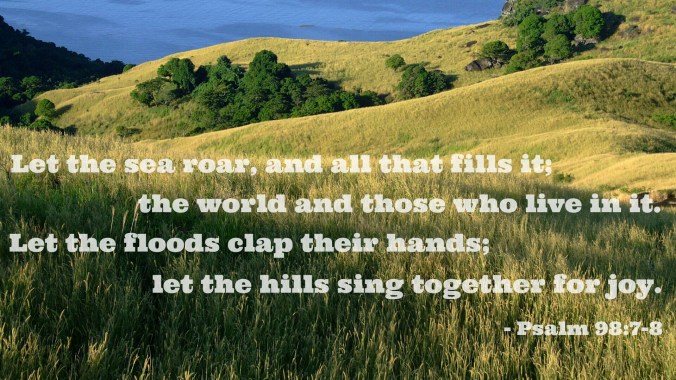
The Psalms speak of many ways to express our joy: with song and praise; with trumpets, horns and harps; with dancing and joyful noise. The Psalmist describes the earth herself praising the Lord through the roaring sea, clapping floods, and singing hills.

Can’t sing well? Sing joyfully anyway! Got two left feet? Dance joyfully anyway! Can’t play the harp or drum? Clap your hands, stomp your feet, hum a crooked tune … joyfully!

Spontaneous expressions of joy aren’t something we see a lot, at least not outside of church. And if we do see them, it’s often through a cynical lens. When a stranger at the gym greets us with: “Jesus wants to you have a blessed day!” (true story), do we mumble “Thanks…” or do we shout “Amen, sister! You too!”

Maybe you’re an introvert, and such overt expressions seem more stressful than joyous. Let your joy erupt through poetry, kind deeds, or deep whiffs of spring blossoms. Your joy is between you and God, so don’t let anyone tell you there’s a right or wrong way.

The important thing is to express it when you feel it. Let it settle into tapping fingers and swinging hips and smiling lips. Do this often, and when you don’t feel it – when reasons for praise seem far away – you’ll have the muscle and soul memories to draw on to help you get through tough times. The body, the spirit, and the mind can all influence each other. It’s no cure for clinical depression or anxiety, but choosing to act joyfully can often bring us closer to feeling actual joy.

We are joyful because Christ has redeemed us. We are joyful because God is still moving through the world. Every day there is a new song to sing.

Comfort: You aren’t just allowed to be joyful … it’s encouraged!

Challenge: Make time every day to express joy. See if it changes you.

Prayer: God of Joy, thank you for all you do and all you are. My joy is complete in you! Amen.

Discussion: How do you express joy?

Join the discussion! If you enjoyed this post, feel free to join an extended discussion as part of the C+C Facebook group. You’ll be notified of new posts through FB, and have the opportunity to share your thoughts with some lovely people.

No Turning Back

faithforsafety

Today’s readings (click below to open in new tab/window):
Psalms 93; 150, Exodus 14:5-22, 1 John 1:1-7, John 14:1-7


Pharaoh quickly regretted his decision to free Israel and sent his army to bring them back. When Israel saw the approaching army, the people were frightened and declared it was better to live in servitude than to die in the wilderness. Moses assured them the Lord would save them if they stood firm.The Lord parted the Red Sea so Israel could pass through it, then He closed it over the Egyptian army of soldiers and chariots.

We often choose servitude when we should be trusting the Lord to lead us  through the wilderness. Maybe it’s the servitude of acceptance; we hide our true selves – the people God created us to be – when we fear the wilderness of judgment. Then there’s the servitude of success. Our culture tells us bigger (homes, cars, etc) equals better quality of life. How many of us would seriously consider scaling back our standard of living to find peace – or follow Christ? Servitude to safety is also common. Maybe we would die for our right to be Christians, but would we put ourselves in danger to actually follow the teachings of Christ?

Most of us are comfortable briefly venturing into the wilderness of hunger, poverty, and sickness like tourists being led on a soup-kitchen safari, but – citing common sense and a need for security – we let others do the dangerous work of exploring that terrain and creating safe outposts for us to visit. We can strike a balance; because Jesus knew he was dispatching the apostles into unfriendly territory, he sent them in pairs … but he still sent them.

Facing an uncertain future, Israel quickly began to look back on centuries of slavery as “the good old days.” When we pine for the “simplicity” of the past, we tend to gloss over the bad parts like slavery, genocide, racism, sexism, disease, violence, and lack of indoor plumbing. Perhaps that’s because we are in the servitude of denial that all these things are still problems today.

Faith calls us to the wilderness. Fear tells us to turn back. Only one of those directions leads to the promised land.

Comfort: The future may seem uncertain to you, but it is all in God’s hands.

Challenge: God not promise us lives of ease or comfort.

Prayer: God of justice, help me embrace your freedom even when it frightens me. Thank you for leading me through the wilderness. Amen.

Discussion: Where do you feel drawn, but afraid, to serve?

Join the discussion! If you enjoyed this post, feel free to join an extended discussion as part of the C+C Facebook group. You’ll be notified of new posts through FB, and have the opportunity to share your thoughts with some lovely people.

Rod and Staff

1459594711536.jpg

Today’s readings (click below to open in new tab/window):
Psalms 23; 149, Exodus 13:17-14:4, 2 Corinthians 4:16-5:10, Mark 12:18-27


Psalm 23 is arguably the most recognized psalm in the psalter. It chronicles the typical day in the life of a shepherd and flock, through danger and safely home again. The metaphor of Christians as sheep may seem less than flattering; author Russell Banks once observed sheep were only slightly more intelligent than lawn furniture. Critics of the faith have said it accurately describes mindless followers, but the metaphor is not so much about following as about the relationship binding a shepherd and his flock.

At the end of the day, a shepherd uses a rod to count and inspect each sheep for injuries, a practice known as passing “under the rod.” The rod can also be thrown in front of a sheep to startle it back on course. Although other images of rods, such as “spare the rod and spoil the child” and Proverbs 13:24 (“He who withholds his rod hates his son,
But he who loves him disciplines him diligently.”) are more about discipline, the audience of this psalm knew the rod was not used to strike, but to tend.

Impulsive pursuits may leave us stranded in a spiritual bramble. We get caught up following other sheep and find ourselves in unfamiliar or even hostile territory. We tangle ourselves in gossip at work or church. We feel pressure to overspend in order to keep up appearances with friends and neighbors. As a result, we feel lost, overwhelmed, or out of control. At these times, depending on our relationship to our shepherd can literally save us.

To Jesus’ contemporaries the rod and staff were symbols of loving authority. When he called himself the Good Shepherd, Jesus was telling his listeners, “I have your best interests at heart, and often that will require a course correction.” Are we challenged when trying to integrate the ideas of “love” and “authority” into a unified whole? Have we learned to picture the rod in Jesus’ hand as an instrument of punishment or nurture?

We may not be immediately comfortable accepting the humility necessary to admit we need shepherding, but eventually we realize it is a true blessing that our God does not send us alone into the wilderness. Following Christ will always lead us home.

Comfort: Christ seeks to rescue every sheep, no matter how lost.

Challenge: If possible, visit a meditation labyrinth (or use a finger labyrinth). As you move to the center, meditate on a problem that has you feeling lost. On the way out, ask God to lead you home, and give thanks for Jesus, the Good Shepherd.

Prayer: Merciful and loving God, always lead me home to you.

Discussion: How do you feel about being disciplined? How do you react to it?

Join the discussion! If you enjoyed this post, feel free to join an extended discussion as part of the C+C Facebook group. You’ll be notified of new posts through FB, and have the opportunity to share your thoughts with some lovely people.

Idol Tales

1459543953388.jpg

Today’s readings (click below to open in new tab/window):
Psalms 96; 148, Exodus 13:1-2, 11-16, 1 Corinthians 15:51-58, Luke 24:1-12


In Luke’s telling of the story of the first Easter morning, several women who followed Jesus from Galilee – not just the two Marys – visit his tomb to finish preparing his body for burial with spices and perfume. Instead of Christ’s body they find two men dressed in dazzling clothes (presumably angels) who tell them Christ has risen. The women return to the remaining eleven disciples to deliver this astonishing news, “but these words seemed to them an idle tale, and they did not believe them.”

Huh?

Several recent studies have shown the male brain processes male and female voices differently – essentially tuning out the latter. Unfortunately, the preponderance of responses to this study are about how women can help men listen better by altering their voices. Few if any responses (full disclosure: didn’t find one) teach men how to listen better to women; on the contrary, it almost becomes an excuse. How often do we dismiss the firsthand experience of others because they don’t communicate in our preferred manner? In the case of the women disciples, their firsthand experience was dismissed until it was verified by a man (Peter). People with disabilities, transgender people, ethnic minorities, and many other groups outside the “norm” know what it’s like to have their stories ignored or declared lies until someone from the “right” social group corroborates them.

It’s easy to dismiss someone’s story if – like the eleven – your frame of reference is a bunch of people sharing your worldview and hiding away from facts which contradict their assumptions. If we treat someone who begs us to listen as weak or a victim, we may be denying a prophet. When someone has actually been in the trenches perfuming a corpse, deciding which restroom won’t get them beaten up, or navigating a wheelchair through city streets with no cut-ins … we need to listen to the truths they tell, not sweep them aside until we can find a reason to personally relate.

The faces of the poor and oppressed may change over time, but Christ calls to us through them in the same voice across the ages.

Comfort: Listening to people who have different experiences than yours helps you to better understand the diversity of God’s creation.

Challenge: Learn about the struggles of people who suffer from hidden disabilities.

Prayer: Grant me, O Lord, ears to hear and eyes to see the stories of your children who struggle unnoticed. Let me never ignore the voice of Christ calling for justice. Amen.

Discussion: Whom are you prone to ignore or dismiss because of their social group?

Join the discussion! If you enjoyed this post, feel free to join an extended discussion as part of the C+C Facebook group. You’ll be notified of new posts through FB, and have the opportunity to share your thoughts with some lovely people.

God of History

church-window-2294961_1920

Today’s readings (click below to open in new tab/window):
Psalms 47; 147:12-20, Exodus 13:3-10, 1 Corinthians 15:41-50, Matthew 28:16-20


God visited ten plagues upon Egypt before Pharaoh freed the Hebrews. Scholars estimate these plagues unfolded over a period anywhere from a month to a year, but even a week of boils, locusts, and other disasters must have felt unending. The last and worst one – the death of the firstborn of Egypt – was so terrible that God assured Moses Pharaoh would finally relent. It would be so effective the people would need to be ready on a moment’s notice, without even enough time to let bread rise. The Lord commanded them to prepare unleavened (yeast-free) dough, and they took it with them when Pharaoh ordered them to depart. Baked in the wilderness, this unleavened bread was literally their first taste of freedom in four centuries.

In Exodus, the Lord gives explicit and emphatic commandments about observing Passover properly. During the Passover Seder meal, Jews recount the story of their flight from Egypt. Maintaining such an observance has helped them preserve their identity across thousands of years. For all of us, remembering where we come from – both the good and bad parts – makes us wiser about where we are headed.

A workplace phenomenon called “drift” – which occurs when someone becomes overly comfortable with a duty and cuts corners – causes many avoidable errors. Many people who reach weight-loss goals find the pounds creeping back on because success has made them lax in their diet or exercise regimens. Western Christians leading comfortable lives can easily forget the Gospel should “comfort the afflicted and afflict the comfortable.” When we forget the past, we fail to understand the meaning of the present. Memories – personal, family, and cultural – need to be preserved lest we begin to think we are entirely self-made.

Edmund Burke said: “Those who don’t know history are destined to repeat it.” Living as if our present situation was inevitable will lead us to take it for granted. There’s no Passover without bondage in Egypt. We can’t be a resurrection people without a crucifixion. Let’s remember the bitter taste of our failures to stay on course, and our sweet successes to keep moving forward.

Comfort: Our pasts – overcoming the bad, benefiting from the good – inform who we are today. Your story is important.

Challenge: Read about the meaning of the Passover Seder.

Prayer: God of History, thank you for the lessons of our spiritual ancestors. May my words and deeds honor those who have gone before, especially Jesus the Christ. Amen.

Discussion: What important parts of history do you think get neglected?

Join the discussion! If you enjoyed this post, feel free to join an extended discussion as part of the C+C Facebook group. You’ll be notified of new posts through FB, and have the opportunity to share your thoughts with some lovely people.