
Let No One Despise Our Youth

hand-1549145_1920

Today’s readings (click below to open in new tab/window):
Psalms 108; 150, 1 Kings 8:22-30 (31-40), 1 Timothy 4:7b-16, John 8:47-59


Did you know millennials are responsible for social ills from the closing of chain restaurants to the end of free speech on college campuses? At least that’s what some pundits, questionable social critics, and click-baiting media sources would have us believe. Older generations have always lamented the lack of values, morals, and responsibilities of younger ones. They look back to the times in which they were at the height of their vigor and become nostalgic for them less for their reality and more for the feelings they revive.

In his first letter to Timothy, Paul advised his young protégé to “let no one despise your youth.” Paul understood people, so he understood we’ll use any flaw we find in a messenger to dismiss a message that causes us discomfort. In fairness young people often lack experience that they can’t understand they lack, but they can also have experiences their elders have not. In Timothy’s case, this was the experience of living the Gospel. If Timothy wanted to be successful, Paul suggested he would have to be nearly flawless in his example and teachings for people to take him seriously.

When we harp on the flaws of younger generations, what are we really commenting on? Each generation is a product of the ones which preceded it. Perhaps we don’t like being reminded we are in part responsible for what we perceive as deficiencies. And maybe some of our complaints – for instance, how kids today have it too easy (and what generation hasn’t said that about the next?) – come from a place of jealousy or resentment.

Does every generation have its quirks and flaws? Yes. But it also does some things better and smarter. Human rights, for instance, have a steady record of improvement with each generation. And though it may not feel so because of the seemingly inescapable 24-hour news cycle, the world is becoming a less violent place.

If we let them, young people have much to teach us about the world and ourselves. It won’t always be something we want to hear. But why miss something we need to?


Comfort: We don’t need to be young to learn. 

Challenge: Make a habit of getting to know and listen to younger people.

Prayer: Eternal God, help me to always teach and be willing to learn the eternal values taught to us by Christ. Amen. 

Discussion: What have you learned from people younger than yourself?

Join the discussion! If you enjoyed this post, feel free to join an extended discussion as part of the C+C Facebook group. You’ll be notified of new posts through FB, and have the opportunity to share your thoughts with some lovely people. Or feel free to comment here on WordPress, or even re-blog – the more the merrier!
Defenseless and Naked

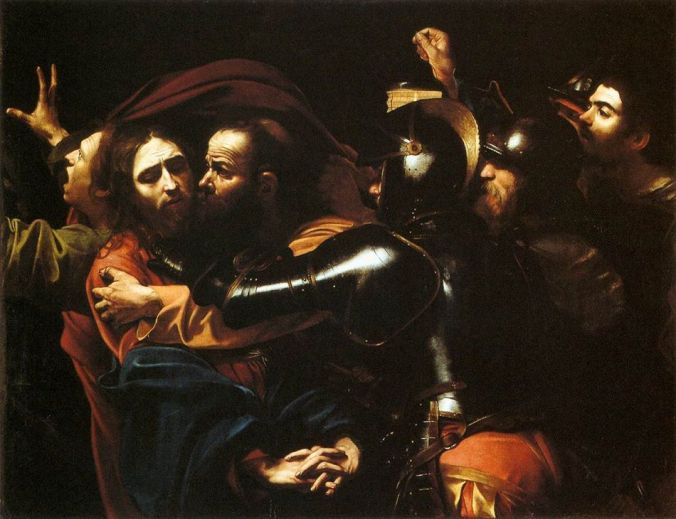
the-taking-of-christ-1602

The Taking of Christ (Judas’ Kiss), Caravaggio, 1602

Today’s readings (click below to open in new tab/window):
Psalms 122; 149, 1 Kings 7:51-8:21, Acts 28:17-31, Mark 14:43-52


The Garden of Gethsemane was a place Jesus often met with his disciples. It’s no surprise that Judas, leading a band of Jewish leaders and armed Roman soldiers,  knew to find him there. The kiss Judas placed on Christ’s cheek is the most obvious moment of betrayal in this famous scene, but betrayal was everywhere.

Beforehand the disciples had fallen asleep when Jesus needed company, and afterward Peter would deny knowing him – events that bookended a series of betrayals small and large. In a betrayal of Christ’s mission, as well as his lessons, one of the disciples struck the slave of the high priest with a sword and cut off his ear. All the disciples fled, and one young man in particular left behind the linen cloth that was all he’d been wearing.

None of us wants to think we would abandon or betray Jesus, but these were his closest friends and even they couldn’t follow him all the way to the cross.

We want to defend Christ, but following him means abandoning our weapons. Sometimes those are actual weapons, but sometimes they are weapons of anger, pride, and force we think we are using to attack his opponents without understanding attacking is not serving.

We don’t want to admit we’ve strayed – or even fled – from Christ, but that moment of spiritual nakedness, when our weakness or sin is uncovered and on display, eventually catches up to us. Often it’s revealed by our enemies who use it to expose our hypocrisy, and other times we sabotage ourselves; either way the shame is real.

Defenseless and naked. We can end up there through poor choices and weak excuses.

Or we can volunteer.

When we volunteer, when we follow Christ to the foot of the cross and humbly lay our betrayals there, when we lay down the weapons, armor, intellect, strength, or self-righteousness which we have called discipleship without understanding what that truly means … our new life begins.

We enter life defenseless and naked. It’s a kind of spiritual symmetry that’s how we and the apostles would be reborn in Christ.


Comfort: Christ is our strength and hope. 

Challenge: Be sure what you do in the name of Christ is what Christ would have you do.

Prayer: Merciful Lord, I seek to be born anew each day. Amen. 

Discussion: The apostles had chances to commit and re-commit to Christ. Have you ever felt the need to re-commit to your faith?

Join the discussion! If you enjoyed this post, feel free to join an extended discussion as part of the C+C Facebook group. You’ll be notified of new posts through FB, and have the opportunity to share your thoughts with some lovely people. Or feel free to comment here on WordPress, or even re-blog – the more the merrier!

Just five more minutes, Jesus…

20170901_232523

Today’s readings (click below to open in new tab/window):
Psalms 88; 148, 1 Kings 5:1-6:1, 6:7, Acts 28:1-16, Mark 14:27-42


Are you a fan of the snooze button? Do you crave those precious extra minutes under the covers after the alarm goes off? Or maybe you are the snooze alarm when your children or spouse make it your responsibility to get them moving by asking for “just five more minutes.” Perhaps you belong to that increasingly rare breed who wake up refreshed and – miracle of miracles – don’t need an alarm.

Whatever your situation, research shows that using the snooze alarm leaves you feeling less rested. Once you’ve been jolted awake, the sleep cycle doesn’t continue, it reboots.

At the Garden of Gethsemane, Peter, James, and John did some notorious snoozing. As Jesus remained resigned to God’s will but prayed desperately that the cup of the crucifixion might pass him by, his friends couldn’t manage to stay awake. Three times he woke them, and they didn’t know what to say to him.

Only hours earlier he had predicted that in the hour of his death they would desert him, and Peter declared “Not me!” Yet even in this matter of sleep the disciple’s weak flesh overrode his willing spirit, a foreshadowing of the greater desertion to come. Jesus, fatigued and frightened, had to rouse them to accompany him in his last moments of freedom.

The trick to avoiding the snooze button is to develop healthy sleep patterns. If you don’t have them, you have to work at retraining your body and mind – or flesh and spirit, if you will. Developing healthy spiritual patterns can be similar. If we don’t have them, when life’s alarms go off – alarms like death, illness, betrayal, and tragedy – leaning  on faith may seem more an effort than a comfort.

Despite Christ’s warnings, Peter wasn’t ready in the garden. He wasn’t ready at the crucifixion. But after Christ returned from death? Reboot. His flesh and spirit finally knew true rest in the embrace of Christ. We too can find that strength-building rest if our faith is not merely a series of reactions to alarms, but a healthy, regular pattern of renewal that helps us stay spiritually awake.


Comfort: You can find rest in Christ. 

Challenge: Read this article on improving your sleep, and see if you can make any changes that might help.

Prayer: Merciful God, let me rest in your arms and find strength for my days. Amen. 

Discussion: Do you get all the sleep you need? Why or why not?

Join the discussion! If you enjoyed this post, feel free to join an extended discussion as part of the C+C Facebook group. You’ll be notified of new posts through FB, and have the opportunity to share your thoughts with some lovely people. Or feel free to comment here on WordPress, or even re-blog – the more the merrier!

Baby Steps

game-figure-598036_1920

Today’s readings (click below to open in new tab/window):
Psalms 143; 147:12-20, 1 Kings 3:16-28, Acts 27:27-44, Mark 14:12-26


A famous story about King Solomon’s wisdom involves two women who bore sons within days of each other. After one of the sons died, one woman claimed the other had switched the infants while she slept. Each insisted the living child was her own. Solomon proposed to treat the matter like any other property dispute by physically dividing the infant in half. One woman immediately relinquished her claim so the child might live; the other agreed to his decision. Solomon declared the true mother to be the woman most concerned with the child’s survival.

There is a big difference between loving something, and loving to own it.

Is there anything we claim to love which we are willing to see destroyed rather than let it continue existing outside our control? Does the church come to mind? The innumerable denominations of the Christian church exist because people would rather divide over doctrine than live without control. When we sing “One Bread, One Body” is it more longing than truth?

Then there is public space – the civic and social realm in which we all interact. Americans say we value freedom of speech and religion, but our behavior doesn’t always align with those ideals. For most of our history, the default expectation of religion in the public space was Christian (and usually a homogeneous kind of Christian). As the public space grows more diverse – the inevitable outcome of the American experiment – some people find they don’t care to share it. From enacting laws that cross into theocracy to shutting down speech we find offensive, we seem determined to strangle freedoms rather than let them survive outside our control.

Like the grieving mother, we are more vulnerable to demanding control when we grieve. If we grieve the passing of a way of life we treasured, perhaps what we really grieve is not having our control challenged. If we grieve a past that left us voiceless, we can’t enforce silence and call it reconciliation.

Not everything we love, once let go, fully returns to us. If that stops us from loving it, maybe we never really did.


Comfort: You don’t have to control everything. 

Challenge: You don’t have to control everything.

Prayer: God of Mercy, unite your children in love. Amen. 

Discussion: Have you ever left a community over a disagreement? Have you ever been forced out because of a disagreement? How are they similar and how are they different?

Join the discussion! If you enjoyed this post, feel free to join an extended discussion as part of the C+C Facebook group. You’ll be notified of new posts through FB, and have the opportunity to share your thoughts with some lovely people. Or feel free to comment here on WordPress, or even re-blog – the more the merrier!

Decorate Your Own Cookie

gingerbread-650135_1920

Today’s readings (click below to open in new tab/window):
Psalms 65; 147:1-11, 1 Kings 3:1-15, Acts 27:9-26, Mark 14:1-11


One of the most powerful scenes in The Wizard of Oz takes place after Dorothy and her companions have destroyed the Wicked Witch of the West only to discover Oz is not so great and is terrible in all the wrong ways. He has no power to grant them what they asked for (courage, brains, and a heart) but in one of his few authentic moments he teaches them an important truth: they carried these things within them all along.

The Lord visited King Solomon in a dream and instructed him to ask for whatever he wanted. After words of gratitude and praise for all the Lord had done, Solomon asked for “a discerning heart to govern your people and to distinguish between right and wrong.” The Lord , pleased with this request, assured Solomon it would be so.

Solomon could have asked for riches, or long life, or military victory. In an Oz-like twist, his choice revealed the seeds of wisdom already planted in him. Unlike the fraudulent Oz, the Lord did have the power to grant Solomon’s request – in fact, it appears it was granted long before Solomon asked.

We can waste a lot of time longing for gifts we don’t possess, and failing to recognize the value of those we do. Whether a trait is a gift or a flaw may depend largely on how we use it. Solomon could have used his wisdom to scheme, but he chose to use it to serve his – and the Lord’s – people. When Paul refocused his single-mindedness from persecuting Christians to evangelizing Christ, he was unmatched.

Certainly we need to grow and learn all our lives, but twisting ourselves into a shape not meant for us perhaps isn’t the best approach. Once the cookie has been baked, you can’t force it back into a cutter – even the original one. When decorating that cookie, one person will see a flaw to cover up where another sees the opportunity for an unconventional feature. Instead of wasting time lamenting the gifts we haven’t been given, let’s direct and grow the ones we have.


Additional Reading:
For thoughts on today’s reading from Acts, see Crash Course.

Comfort: You have gifts that matter, because God gave them to you. 

Challenge: Appreciate and use the gifts you have. It’s the only way to grow them.

Prayer: Thank you, God of creation, for making me as I am. I will honor you by making the best of it. Amen. 

Discussion: How do you feel when people acknowledge your talents?

Join the discussion! If you enjoyed this post, feel free to join an extended discussion as part of the C+C Facebook group. You’ll be notified of new posts through FB, and have the opportunity to share your thoughts with some lovely people. Or feel free to comment here on WordPress, or even re-blog – the more the merrier!

Fresh Start

cocoon-2123742_1920

Today’s readings (click below to open in new tab/window):
Psalms 54; 146, 1 Kings 1:32-2:4 (5-46a) 46b, Acts 26:24-27:8, Mark 13:28-37


It’s not unusual for a new CEO to clean house and hire in a team better suited to their vision. Outgoing pastors traditionally steer clear of the congregation for months or years so the new minister can get as fresh a start as possible. There is often unfinished business the outgoing leader, for whatever reason, did not resolve. Sharp transitions open a psychological door for change to enter.

Like many leaders, David was entirely aware of what he’d left undone. Before he died, he advised his son and successor Solomon on the unfinished business of the kingdom. Most of it was in the form of disloyal advisors and rivals who had thus far been spared punishment. Solomon, in what could be considered a pretty hostile takeover, had them all executed within three years.

We can’t go around executing those who hold us back from a fresh start, but we may need to make some seemingly brutal decisions.

The biggest impediment to change is not a lack of will, but lack of understanding how change happens. Recovering addicts and paroled criminals who return to the environments where their troubles began are significantly more likely to relapse than those who find somewhere else to go. Those are extreme examples, but when we are ready to take the next step on a spiritual journey, we first need to identify what’s kept us from taking that step so far. Friends? Comfort? Habit? What rewards us for staying where we are instead of going where we want to be? We must change that first.

It’s important to remember that’s going to be different in tone and purpose than a typical career-minded change. We aren’t trying to promote or exalt ourselves, but rather to grow more humble, more servant-like. That may cost us relationships and status. It will certainly cost us comfort. These changes are difficult and scary, and therefore easy to avoid or backslide. We can set ourselves up for success by making it more difficult to remain or go back than to move forward. If you can’t get off the couch, give it away.


Comfort: Change is possible…

Challenge: … but you have to make it possible.

Prayer: Hear the voice of my supplication, as I cry to you for help, as I lift up my hands toward your most holy sanctuary. (Psalm 28:2)

Discussion: What’s the best change you’ve ever made? How did you do it?

Join the discussion! If you enjoyed this post, feel free to join an extended discussion as part of the C+C Facebook group. You’ll be notified of new posts through FB, and have the opportunity to share your thoughts with some lovely people. Or feel free to comment here on WordPress, or even re-blog – the more the merrier!

Succession

prepare_fail

Today’s readings (click below to open in new tab/window):
Psalms 57; 145, 1 Kings 1:(1-4) 5-31, Acts 26:1-23, Mark 13:14-27


Succession planning, long a concern of dynastic governments, has been adopted by business as well. No matter how successful someone is, they can’t lead forever. Term limits, promotions, retirement – many factors drive the continual demand for new leadership. If an enterprise has a clear vision of its mission, succession planning is easier to tackle. If its mission is undefined or murky, finding solid candidates for future leadership roles can be especially challenging.

When King David grew old and frail, his son Adonijah began a popular campaign to be the next king. David didn’t know about it, but it angered his wife Bathsheba, who reminded him of his promise to make their son Solomon his successor. Did that promise mean anything, she demanded to know, or was Adonijah for all intents and purposes already king? David affirmed in front of witnesses that Solomon was his choice. Had Bathsheba not been on the ball, things could have gone very differently. David had not planned and it had almost slipped from his control.

Adonijah made the same common assumptions as many people in politics or business: it’s my turn, so I should be next. Succession planning isn’t just about bumping up the next obvious choice. The person who demands advancement most loudly isn’t necessarily the most qualified. Nor is seniority a qualification in and of itself. The choice needs to reflect the mission, or the mission itself may flounder. Less obvious choices may need time for coaching and preparation.

Paul was far from the obvious choice to spread the gospel of Christ, yet his persecution of Christians may have given him a singular insight into communicating with people who weren’t inclined – or were outright hostile – to hearing it.

The truth is plans only get us so far, but how we plan can make a big difference. Do our gifts align with our goals? Do our goals align with the gospel? When the right opportunities to serve God come along, will we be prepared to recognize and nurture them? We succeed not by imposing our own plans, but by preparing to embrace God’s plans.


Comfort: God desires only good for you.

Challenge: Try to stay out of the way of God delivering that good.

Prayer: Let me hear what God the LORD will speak, for he will speak peace to his people, to his faithful, to those who turn to him in their hearts. (Psalm 85:8)

Discussion: In what ways do you think you could plan better?

Join the discussion! If you enjoyed this post, feel free to join an extended discussion as part of the C+C Facebook group. You’ll be notified of new posts through FB, and have the opportunity to share your thoughts with some lovely people. Or feel free to comment here on WordPress, or even re-blog – the more the merrier!

What We’ve Chosen

doors-1767564_1920.png

Today’s readings (click below to open in new tab/window):
Psalms 67; 150, 2 Samuel 24:1-2, 10-25, Galatians 3:23-4:7, John 8:12-20


“What you want is irrelevant. What you’ve chosen is at hand.”
– Captain Spock, to Lieutenant Valeris
Star Trek VI: The Undiscovered Country

In the sixth Star Trek film (from 1991, so don’t expect spoiler warnings), Spock discovers his protégé, a young Vulcan woman named Valeris, has conspired with representatives from other worlds to murder the chancellor of the Klingon empire – all in the name of keeping the peace. When Spock insists that logic dictates she must kill him to cover her tracks, she says she doesn’t want to and the conspiracy unravels. Peace unfolds anyway.

When we commit immoral acts in the service of a greater good, real or imagined, the eventual consequences are unavoidable. Unfortunately, we aren’t always the one to pay the price.

King David decided to take a census of all the men in Judah and Israel who were fit for military service. His counselors advised against it. The text is not specific about why this was a sinful decision, but common theories speculate he put his trust in military might instead of God, that it was an issue of pride, or that it was a precursor to taxation and military conscription. David regretted it almost immediately, but that did not stop God’s punishment. David had to choose between three years of famine, three months of being pursued by foes, or three days of pestilence (plague). He begged God not to let other people suffer for his sins, but 70,000 people died of plague.

Are we likely to make decisions resulting in the unintended deaths of tens of thousands? Not most of us. But no decision is made in a vacuum. Every day we have the opportunity to make multiple decisions – from what we buy to how we speak to who we include – which affect people’s lives for better or worse. When we come face to face with the results our poor choices in the form of violence, discord, neglect, or harm, regret can’t change anything.

The choices we make now determine the choices available to us – and others – in the future. When making them, will we trust ourselves or God?

Further Reading:
For more on today’s passage from John, see You Don’t Know Me.


Comfort: Making good choices now helps us make better ones in the future.

Challenge: Don’t choose what is hard, or what is easy; choose what is right.

Prayer: Lord of truth and life, guide my thoughts, guide my words, guide my deeds, guide my choices. Amen.

Discussion: When have you had to face unintended consequences?

Join the discussion! If you enjoyed this post, feel free to join an extended discussion as part of the C+C Facebook group. You’ll be notified of new posts through FB, and have the opportunity to share your thoughts with some lovely people. Or feel free to comment here on WordPress, or even re-blog – the more the merrier!

Buck Passing

dollar-1443244_1920

Today’s readings (click below to open in new tab/window):
Psalms 56; 149, 2 Samuel 23:1-7, 13-17, Acts 25:13-27, Mark 13:1-13


“The buck stops here.”
– Popularized by U.S. President Harry S. Truman

For two years Governor Felix let Paul languish in prison. On his way out he left him there as a favor to the Jews and as a problem for his successor, Festus. Festus didn’t know what to do with Paul. The charges against him were not Roman crimes, but Jewish conflicts.  To avoid an unfair trial in Jerusalem, Paul claimed his right as a Roman citizen to appeal his case to the Emperor. Yet, with no clear charges, Festus didn’t know how to explain to Rome why Paul had been sent for trial.

No one, it seems, was both willing and able to take ownership of this problem.

We see this kind of buck-passing in modern government as well. Lots of complaining, but few actual solutions – or proposed solutions which, while of questionable merit, conveniently don’t take effect until after the next election cycle. In our civic lives, we eagerly point fingers at those people who we believe (correctly or incorrectly) cause problems, but rarely do we look at ourselves to consider how we contribute to the very problems we condemn. For example, we don’t like the presence of illegal migrant farm workers, but our insistence on artificially low prices for produce makes them necessary for the agricultural industry. In our personal lives, we can be quick to blame others for our own shortcomings. Think of feuding siblings who blame each other for the years they’ve spent not speaking.

We need to stop passing the buck, and take ownership of our problems.

One of the first steps is realizing a solution often means moving past what seems “fair” to us and onto what makes things right.  If it seems unfair to be the sibling who offers an olive branch when we believe the other person has wronged us, maybe we could ask Jesus if he complained about fairness on the cross. Christ teaches us not to condemn or demand, but to love sacrificially. If we must pass a buck, let it be to someone who needs it more.


Comfort: With God’s help, you have more solutions inside you thank you think you do.

Challenge: Don’t complain about things you’re not willing to help change.

Prayer: Loving God, help me to be a healing presence in the world. Amen.

Discussion: Have you ever realized you were contributing to a problem you blamed on other people?

Join the discussion! If you enjoyed this post, feel free to join an extended discussion as part of the C+C Facebook group. You’ll be notified of new posts through FB, and have the opportunity to share your thoughts with some lovely people. Or feel free to comment here on WordPress, or even re-blog – the more the merrier!

A Convenient Time

interview-2211354_1920

Today’s readings (click below to open in new tab/window):
Psalms 130; 148, 2 Samuel 19:24-42, Acts 24:24-25:12, Mark 12:35-44


Governor Felix of Caesarea, where Paul stood trial for accusations made by Jewish leadership of Jerusalem, was familiar with and curious about the Way (an early name for Christianity). He invited Paul to speak with him about faith in Christ. Notoriously cruel and lusty, Felix grew afraid when Paul spoke of “righteousness, self-control and the judgment to come.” He dismissed Paul until a more convenient time. Two years later after Paul had failed to offer a bribe and Felix was replaced as governor, Paul remained in prison

Apparently a “convenient” time for faith never presented itself. Felix was neither ready nor willing to embrace the Way, and Paul suffered for it. Procrastination is a trait that not only harms the procrastinator, but can result in unfair, unpleasant consequences for others. Perhaps this is most apparent in a work environment, where one person’s procrastination causes delays, difficulties, and stress further down the line. But what of spiritual procrastination? Who does it harm?

Maybe we can think about it like cleaning a closet – a task most of us put off as long as we can. Findings things becomes increasingly difficult. Eventually the closet may cease to be useful, and becomes storage for things we vaguely recollect but never use again. The longer we put off following (or more fully following) the call of God, the less likely we are to answer it later. We tell ourselves we’ll get around to it after we put other lives in order, but we never quite do. When we’re desperate we might rummage around for that thing we need that we think is in there, but because we haven’t tended it properly, it’s just more frustrating mess. In the meantime, the hungry stay hungry, the lonely stay lonely, and we spiritually flounder.

Consider the widow whose offering of two small coins Jesus called “more […] than all the others.” She didn’t wait until she had enough money saved to make those two coins convenient, yet her gift was an enormous blessing. Let us do what we can right now, for the convenient time may never arrive.


Comfort: Today is exactly the right day to draw nearer to God.

Challenge: Start something you’ve been putting off. Don’t just plan to start; actually do it.

Prayer: God, I surrender myself to you today, and trust you will provide tomorrow. Amen.

Discussion: Felix was waiting for a bribe from Paul. When we effectively tell God “I’ll get around to that after [fill in the blank]…” is that like demanding an unearned favor before doing the right thing?

Join the discussion! If you enjoyed this post, feel free to join an extended discussion as part of the C+C Facebook group. You’ll be notified of new posts through FB, and have the opportunity to share your thoughts with some lovely people. Or feel free to comment here on WordPress, or even re-blog – the more the merrier!