It Takes a Village to Raise a Lazarus

community

Today’s readings (click below to open in new tab/window):
Psalms 99; 146, Jonah 2:2-9, Ephesians 6:10-20, John 11:17-27, 38-44
Eve of Epiphany Readings:
Isaiah 66:18-23, Romans 15:7-13 


Is  faith sufficient as an individual experience, or does it need to be shared among a community of believers? When Jesus returned to Bethany because his friend Lazarus had died, the grief of Mary and Martha, sisters of Lazarus, was certainly shared. Neither knew what to expect, but they shared faith in Jesus. They only knew that in their time of great grief, they needed to be with him. Even after he told them he was the resurrection and the life, the sisters didn’t imagine he would bring Lazarus back to them. When he asked the mourners to roll back the stone covering the tomb, Martha said four days had passed and there would be a stench. Yet moments later Jesus commanded Lazarus to walk out of the tomb, and he did.

Jesus was the source, but it was a community that made his final sign meaningful.
Mary and Martha, each with an imperfect but united faith, together believed that whatever Jesus thought fit to ask, God would deliver. At least a few mourners must have volunteered to move the stone, as it was large and heavy enough to cover the mouth of a cave. The gathered crowd  listened to Jesus loudly giving thanks to God for their benefit so they might believe. Finally, Lazarus arose and returned to his friends and family, restoring their community.

Experienced in isolation, faith may be a comfort to us but it’s of little use to the greater body of Christ. When a community shares its faith – when one person answers Christ’s call to dive into the stench and darkness of tombs like poverty and disease, and another person trusts God to provide even when a loved one is caught in the hopeless living death of addiction, and the rest of us are inspired by and act because of their belief, and therefore sisters and brothers we thought lost forever return to us – that community finds new life as no individual could.

Faith requires community to achieve its fullest expression. Our own imperfect faith is a gift because it reminds us to seek others.

Comfort: When you have faith you are never alone.

Challenge: Explore a faith community that is unfamiliar to you.  Perhaps a charity, or another congregation. If you can, spend some time helping them with their mission.

Prayer: Thank you God for easing my burden by making me only one member of a larger body in Christ. Amen.

Discussion: What do you find most rewarding about community? Most difficult?

Join the discussion! If you enjoyed this post, feel free to join an extended discussion as part of the C+C Facebook group. You’ll be notified of new posts through FB, and have the opportunity to share your thoughts with some lovely people. Or feel free to comment here on WordPress, or even re-blog – the more the merrier!
Spit, Mud, and Healing

brokenwhole

Today’s readings (click below to open in new window/tab):
Psalms 20; 145, Joshua 3:14-4:7, Ephesians 5:1-20, John 9:1-12, 35-38


All four gospels tell the story of Jesus healing a blind man on the Sabbath. The mechanics of it are simple: he spits on the ground, makes mud, and rubs it on the man’s eyes. Afterward the man rinses the mud off and can see. Mud and spittle were a common enough medical treatment in the Greco-Roman world of the period, so it’s very likely someone had tried this remedy before, maybe more than once. What was so different about Jesus? We could say “He was the magic son of God!” and be satisfied with that answer, but the story reveals more.

Jesus started from a different perspective than the people around him: they believed the man was blind because he had sinned, but Jesus told them that was not true. Instead, he saw an opportunity to reveal God’s glory by helping someone who hadn’t even asked for help.

How much dirt and spit have we wasted by pre-judging a situation? How could a different perspective help transform the most common, mundane elements in our lives into opportunities to reveal God’s love to the world? Residents of Cateura, Paraguay are a fine example. Their survival depends on harvesting recyclables from an enormous trash dump just outside one of the poorest slums in South America. But in this, they have found beauty: they have crafted a world-renowned children’s orchestra of instruments made from discarded articles pulled from the dump.

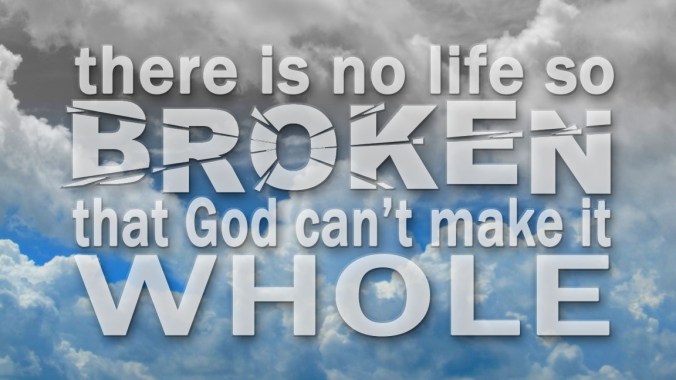
A blind beggar turned into a prophet. Broken pipes turned into flutes. The people and things in our lives that seem broken or useless transformed by the power of the Spirit into … what? We may not restore someone’s sight, but we can help restore hope, peace of mind, or the simple comfort of a hot meal and a warm bed. What if we have dirt or spittle (metaphorically speaking) but not both? Then we have an opportunity to combine our resources with another person’s, and the invitation for the working of the Spirit is doubled (or tripled, or…). Looking with Christ’s eyes, we see brokenness as only the first step toward wholeness.

Comfort: No matter how broken we may be, God can put us back together.

Challenge: What relationships or situations in your life have you written off as too broken to fix? Ask a friend or mentor how you might change your perspective on the situation to better resolve it.

Prayer: Gracious God, teach  me to see opportunities instead of problems. Amen.

Discussion: Have you ever witnessed or experienced healing where others had written off any such possibility?

Join the discussion! If you enjoyed this post, feel free to join an extended discussion as part of the C+C Facebook group. You’ll be notified of new posts through FB, and have the opportunity to share your thoughts with some lovely people. Or feel free to comment here on WordPress, or even re-blog – the more the merrier!

Dress for Spiritual Success

1451793751266

Today’s readings (click below to open in new window/tab):
Psalms 111; 150, 1 Kings 3:5-14, Colossians 3:12-17, John 6:41-47


Whether you leave your house dressed in a bathrobe, a suit and tie, or a wedding dress, it’s the same you underneath. Despite employer dress codes, you are no less competent on casual Friday than you are when dressed for a board meeting at 8:00 a.m. on Tuesday. However there are times when what you wear is crucial. A nurse treating infectious patients must wear protective clothing. Hikers need footwear to provide both comfort and stability. Dancers are hindered if their clothes do not allow freedom of movement.

In his letter to the Colossians, Paul says they should clothe themselves “with compassion, kindness, humility, meekness, and patience” and “love, which binds everything together in perfect harmony.” Some clothes communicate how we intend to interact with the world. Opposing teams and referees all wear different uniforms for a reason. Someone can say “I’m a professional football player” but until they’re suited up and on the field, they’re not playing professional ball. We can quote scripture and doctrine all day long, but if we haven’t put on a Christian attitude, why would anyone believe us?  Sure, meekness might itch a little and sometimes we can’t wait to slip out of that patience at the end of the day, but they are part of the dress code for the best job in the world.

The good news is, once you’ve broken them in, they are pretty comfortable. Kindness feels less like a tie choking off your breathing and more like a scarf keeping you warm. Humility changes from a girdle squeezing in your less virtuous bulges to a support that helps you keep your back straight and head high. None of us are able to display Paul’s list of virtues all the time, but the more conscious we are about putting them on, the more they become part of us, and the more prepared we feel.

These garments will protect you. They will provide comfort and stability. They will give you confidence to move freely in a world that doesn’t always understand what you’re doing. Dressing for success doesn’t have to cost a dime.

Comfort: Love of God and neighbor is the most beautiful thing you can wear.

Challenge: As you are getting dressed for the day, be intentional about putting on your garments of faith as well.

Prayer: Loving God, I will clothe myself in faith to please you and serve your world. Amen.

Discussion: What’s your favorite item of clothing and why?

Join the discussion! If you enjoyed this post, feel free to join an extended discussion as part of the C+C Facebook group. You’ll be notified of new posts through FB, and have the opportunity to share your thoughts with some lovely people. Or feel free to comment here on WordPress, or even re-blog – the more the merrier!

No Small Gifts

1451711286633

Today’s readings:  Psalms 48; 149, 1 Kings 19:1-8, Ephesians 4:1-16, John 6:1-14


The story of Jesus multiplying the loaves and fishes appears in all four Gospels, and in the book of Matthew he repeats the miracle a second time. Christians and non-Christians alike understand references to this story. Some theologians interpret the miracle as Jesus magically increasing the supply of bread and fish, while others claim the real miracle is that Jesus inspired people to share with each other what they’d been hoarding.

A pivotal figure in this story is Andrew, the brother of Peter. When Jesus asks where they might buy food to feed the thousands of people gathered around him, the disciple Phillip says they couldn’t buy enough food with six months wages. Andrew, on the other hand, points out that a boy in the crowd has five loaves and two fishes but asks what good they would be among so many people. Why would Andrew have bothered to point out such a measly offering?

It seems that on some level, Andrew trusted Jesus to make do with what was available. On his own he would have never expected what he had to be enough, yet in the end he and the other disciples collected twelve baskets of leftovers.

How often do we feel like Andrew, looking at a seemingly overwhelming problem and wondering if our meager talents and resources could possibly help? In the face of need throughout the world, our ability to draw, bake, shingle a roof, or lend an ear might seem like a raindrop falling on a forest fire … but we should trust God to make do with what we bring to the table – because we bring the gifts he gave us. When hungry people are fed or cold people are clothed, does it matter whether it was supernatural or sharing and division of labor? No, because God’s grace drives the results.

Jesus sends us, equipped just as we are, to feed the multitude. Instead of saying: “This is all I have to offer…” perhaps we could pray: “Thank you Lord for blessing this small gift so that it may accomplish great things in your name.”

Comfort: Even when your gifts seem small to you, God can make great use of them.

Challenge: What talents have you been holding back because you think they’re not good enough? Find a way to put them into service for your community.

Prayer: Thank you, God, for giving me the gifts that are right for me best serve you. Amen.

Discussion: What do you think your gifts are?

Join the discussion! If you enjoyed this post, feel free to join an extended discussion as part of the C+C Facebook group. You’ll  have the opportunity to share your thoughts with some lovely people. Or feel free to comment here on WordPress, or even re-blog – the more the merrier!

 

Character Roles

1451599167281

Today’s readings (click below to open in new window):
Psalms 96; 146, 2 Samuel 23:13-17b, 2 John 1:1-13, John 2:1-11


The gospel of Matthew tells us an angel appeared to Joseph in a dream and told him to stay with Mary because the child she was bearing, though not his, was conceived from the Holy Spirit.  Joseph has two more dreams in which angels tell him to flee to and later return from Egypt, and goes searching for a 12-year old Jesus who has wandered off to the temple. After that Joseph is absent except for a few passing references to Jesus’s parents. We don’t get to read much about Joseph, but we can infer a good deal about his character: he is kind, faithful, and trusts the Lord even under duress.

In cinematic terms we might think of Joseph as a supporting player. Joseph isn’t the quirky best friend or really even the love interest. He’s more than a sidekick, but after he fills his function in the story, he fades into the background. Like the movie industry, life often tells us we aren’t successful unless we get top billing. But there’s a reason supporting actors and actresses (and technical artists, costume designers, etc.) have their own award categories: they may not get all the glory but without them the story might not bet the same – or even possible. For every star with her or his name over the title, many others – sometimes numbering in the hundreds – had to perform their jobs well.

Maybe WWJD should stand for “What would Joseph do?” Jesus did whatever it took to fulfill his role as messiah. Only one of us gets that part. Joseph, on the other hand, had a much more attainable role. He humbly did as the Lord asked, and supported the mission of Jesus in a human but vital way. That we can do. That we must do.

Most working actors never land a starring role or command a seven-figure fee, but they are the bedrock of the industry. When we act with Joseph-like character, we are the bedrock of the ministry. We hone our craft of mercy, kindness, and justice not for the fame, but for the love of the work.

Comfort: God loves supporting players as much as stars.

Challenge: The next time you feel down about your contributions to the world, ask yourself whether you are judging by the world’s superficial standards, or by God’s eternal ones.

Prayer: Thank you, my creator, for whatever part you have built me to play. Amen.

Discussion: In group situations, are you more comfortable as a leader or a doer?

Join the discussion! If you enjoyed this post, feel free to join an extended discussion as part of the C+C Facebook group. You’ll  have the opportunity to share your thoughts with some lovely people. Or feel free to comment here on WordPress, or even re-blog – the more the merrier!

All Good Gifts

1451367926368

Today’s readings (click to open in new window):
Psalms 96; 146, 2 Samuel 23:13-17b, 2 John 1:1-13, John 2:1-11

In the Gospel of John, Jesus performs his first miracle (John calls them “signs”) at a wedding in the town of Cana. At his mother’s urging,  he reluctantly turns water into wine because the wedding has run out. The chief steward of the reception, upon tasting the wine that was formerly water, tells the bridegroom: “Everyone serves the good wine first, and then the inferior wine after the guests have become drunk. But you have kept the good wine until now.” This tells us a lot about the nature of generosity and giving.

It tells us God’s gifts are top quality – always! When a prayer isn’t answered how we want or expect, or when God calls us to do something difficult or unpleasant, the problem is not with the gift. When we feel like asking “Is this really what you meant to give me, Lord?” the problem may lie in our perception. Not that every hardship is a gift in disguise; God certainly doesn’t give us cancer or domestic violence. But if we approach life as though the Spirit is nudging us toward wholeness, invaluable life lessons and spiritual riches abound. When someone gifts us with lessons – music, tennis, foreign language – the gift is only valuable after we have put the work in.

What about gifts we give? Do we hold back the good wine? While we can’t give beyond our means, we shouldn’t cheap out because we are giving to charity. We’ve all heard: “They should be grateful to get anything at all” and we’ve all seen 10 year old cans of cocktail onions on food drive collection tables. The point is not to judge the giving of others, but to be faithful about our own. We don’t know when someone is giving despite their own need, and we should be wise about stewarding our funds, but when we are giving in Christ’s name let’s keep in mind that in God’s eyes the recipients are no more or less deserving than we are. The good wine – or at least the best wine we can afford to share – is for everyone.

Comfort: God’s gifts to us are never lacking.

Challenge: For one week, set aside a food bank donation (in cash or kind) equivalent to your own lunches. At the end of the week, note whether the donation came out of your excess, or whether you had to scale back a little to give an equal amount. If your present circumstances don’t permit for donations, try splitting your leisure time evenly between your own activities and helping others.

Prayer: Lord, teach me to be generous, and to give with a loving heart. Amen.

Discussion: We can have complex feelings around gift-giving, especially when they feel obligatory, such as during the holidays. How do you feel about gift giving?

Join the discussion! If you enjoyed this post, feel free to join an extended discussion as part of the C+C Facebook group. You’ll  have the opportunity to share your thoughts with some lovely people. Or feel free to comment here on WordPress, or even re-blog – the more the merrier!

Hands, Eyes, and Butterflies

wp-1451286837999.jpeg

Today’s readings (click to open in new window):
Psalms 2; 145, Isaiah 49:13-23, Isaiah 54:1-13, Matthew 18:1-14


If your hand caused you to sin, would you be able to cut it off, as Jesus suggests in today’s passage from Matthew? Would you be able to pluck out your own eye to avoid damnation? More importantly, does Jesus actually expect us to do these things? Certainly not. If we heard of someone who mutilated himself for religious reasons, we would consider that person to be deeply disturbed, and rightly so. Most of us are not physically capable of such acts. What then might Jesus mean to tell us with such harsh imagery?

Hyperbole and extreme examples are teaching methods common to Jesus’ time. He didn’t intend to create a flock of one-handed, half-blind followers, but he does want us to understand true commitment means cutting out the parts of our lives that undermine or overshadow our relationship with God. Becoming part of God’s kingdom is a transformational act, and like butterflies emerging from cocoons, we must leave behind all that would hold us back.

As caterpillars metamorphose into butterflies, their bodies break down into imaginal cells – undifferentiated and similar to stem cells – and reform into something entirely new. When we truly embrace faith, or feel the call to a deeper level of it, our spirits need to undergo a similar process. All we have to work with are our original materials, but surrendered to God’s hands they can be repurposed and reborn. We won’t welcome every change, and some will even be painful, but we must be willing to rigorously examine the difference between who we are and who we are meant to become, and abandon the parts that either don’t fit or can’t be re-shaped.

God loves and accepts us whether we are in the caterpillar or butterfly stage, but God’s hope is that we fulfill our potential. One advantage we have over butterflies is our ability to metamorphose again and again, throughout our whole lives, each time getting closer to becoming our best selves. We don’t need to lose our eyes or hands, but we may need to remake them into tools of love and grace.

Comfort: God loves us when we try, when we fail, and when we succeed.

Challenge: Metamorphosis requires both time and energy. Assess the gap between who you are and who you believe God wants you to be, and set aside the time and energy necessary to create that change.

Prayer: God of life and change, teach me to be the person you created me to be. Amen.

Discussion: What are some of the most important positive changes you’ve made over your lifetime?

Join the discussion! If you enjoyed this post, feel free to join an extended discussion as part of the C+C Facebook group. You’ll  have the opportunity to share your thoughts with some lovely people. Or feel free to comment here on WordPress, or even re-blog – the more the merrier!

Martyrs vs. Victims

1451115315395

Readings: Psalms 116; 149, 2 Chronicles 24:17-22, Acts 6:1-7, Acts 7:59-8:8

In Western Christian tradition, the day after Christmas is St. Stephen’s day. Stephen was the first deacon of the church, as well as its first martyr. False charges of blasphemy led to his death by stoning. Stephen’s story seems like an abrupt shift in tone from the Christmas story, but is it really?

The story of Christ’s birth has been sentimentalized and sanitized through centuries of carols, Christmas pageants, and whitewashed nativity scenes. Familiar and comforting now, the story was originally a radical one with unlikely characters and their equally unlikely circumstances. Christ’s birth heralded the beginning of a religious and political revolution, achieved through his own death.

When Stephen was appointed deacon, it was a risky endeavor. The Roman empire did not grant Christians the same religious latitudes as it did Jews. Like Christ, Stephen was falsely accused and was condemned by Jews rather than Romans. And like Christ, he asked for God’s mercy on his executioners.

We Western Christians can barely conceive the fear of being executed for our faith. Our squabbles with our culture occur because we fear losing our monopoly on power, not because we are being crushed by occupying forces. After Stephen’s execution the remaining apostles, though they were scattered and their homes were being ransacked, continued spreading the gospel. We boycott businesses that don’t meet our agenda and slap Jesus fish on our bumpers (without fear of persecution) and think we’ve served the Gospel.

We should give thanks we can freely exercise our faith, rather than exploit perceived slights to support our persecution narrative. In countries where Christianity dominates, the group we should be most critical of is ourselves. Christ, Paul, and the apostles preached to a church in danger of being wiped out before it began. Now we are more likely to do the stoning than to be stoned.

A strong faith understands the gospel is something to be proclaimed rather than something to be defended. Even when we are persecuted, we are victors not victims. The path we begin following at Christmas does not end with us assuming power, but confronting it.

Comfort: You are responsible for sharing the Gospel, but not for enforcing it.

Challenge: Pray for those who persecute you … but first be sure you’ve accurately identified them as persecutors.

Prayer: Deal bountifully with your servant, so that I may live and observe your word. (Psalm 119:17)

Discussion: Have you ever played the victim, only to realize later you were not?

Join the discussion! If you enjoyed this post, feel free to join an extended discussion as part of the C+C Facebook group. You’ll be notified of new posts through FB, and have the opportunity to share your thoughts with some lovely people. Or feel free to comment here on WordPress, or even re-blog – the more the merrier!

Christmas Every Day

1451071069675

Readings:  Psalms 2; 148, Micah 4:1-; 5:2-4, 1 John 4:7-16, John 3:31

Today is the day! The long-awaited Christ has come. We shout “Emmanuel!” because God is with us in the flesh. The spirit of this holiday is expansive enough to include many other traditions like brightly lit trees and gift exchanges which, while not uniquely Christian, reflect our joyous celebration.

Tomorrow, or maybe even as early as this evening, we will begin thinking about the clean-up. Most Christmas trees will be down before the new year begins; a few may make it until Epiphany – the day marking the end of the twelve day season of Christmastide. The annual “War on Christmas” will declare its annual 11-month cease-sire as merchants clear the way for Valentine’s Day and summer fashions. Many people who thought it was crucial for cashiers and baristas to say “Merry Christmas” during the entire season of Advent will stop caring on December 27th without realizing the irony.

The intense activity of Christmas – or at least the effort we invest in its more secular aspects – is not sustainable all year long. We may talk about keeping the spirit of Christmas in our hearts all year long, but we aren’t all that good at it. After the holidays, donations to food banks and other charities drop dramatically, but the needs they serve do not diminish. Christmas as a special day of celebration is wonderful, but Jesus did not remain an infant forever, and after Christmas the way we celebrate him must also mature.

We can bring light into dark places through acts of kindness and attitudes of love. We can offer gifts of time, talents, and money so we love people in need as children of God more than once a year. Instead of seeking meaningless offense at otherwise well-intended holiday greetings, we can speak loudly against words and actions of actual oppression and injustice. Like the infamous inn, our lives can become so full we turn away the arrival of Christ without realizing what we’ve done. We can create room by living as if Christmas is not the end of a season, but the beginning of a life where Christ dwells within and among us.

Comfort: Christmas is more than a day; it’s a life of hope, love, peace, and joy.

Challenge: Over the next 11 months, plan a monthly Christmas “celebration” to bring the light of Christ into places and lives that need it.

Prayer: [Read Psalm 96 or Psalm 98, aloud or to yourself].

Discussion: Do you have any Christmas traditions that you could revisit throughout the year?

Join the discussion! If you enjoyed this post, feel free to join an extended discussion as part of the C+C Facebook group. You’ll be notified of new posts through FB, and have the opportunity to share your thoughts with some lovely people. Or feel free to comment here on WordPress, or even re-blog – the more the merrier!

The Joy of the Unexpected

1450947693329

Readings: Psalms 18:1-20; 147:12-20, Isaiah 60:1-6, Galatians 3:23-4:7, Matthew 1:18-25

Every year at Christmas time we revisit the Nativity story in scripture readings and carols. The words and melodies bring us comfort and joy in part because they are so familiar and meet our expectations. This comfort in the familiar is kind of ironic considering the Nativity story itself is one of upended expectations and surprises.

First we have Mary, the mother of Jesus. Of everyone in the story, she has the most to be surprised about. No one expects a visit from an angel who announces God will create a child in your virgin womb. Then there’s Joseph, Mary’s betrothed. He doesn’t expect Mary to become pregnant, and he doesn’t expect divine intervention in the form of a dream telling him to stay with her. In an important subplot, we have Mary’s relatives Elizabeth and Zechariah. These two are both surprised by Elizabeth’s late-in-life pregnancy. All of these people have a trait in common (though Zechariah took a little while to come around): they all adapt to the unexpected. Every one of them had reasons to be doubtful, frightened, or resentful. Instead they chose to alter their plans to reflect their new circumstances, and thus ushered into life John the Baptist and Jesus the Christ.

The message of the Nativity is this: God enters the world in unexpected ways. If we insist on our own plans rather than God’s, we may never notice opportunities to share in the greater plan unfolding across history.

The unexpected can be frightening, but it is both inevitable and constant. When confronted with the choice to resist or embrace the unexpected, the former limits us, and the latter unlocks our potential. The quick decision to befriend a stranger we might have avoided may be where we both see Christ in action. An invitation to lead or serve in unfamiliar ways may reinvigorate a flagging ministry. An unplanned job termination may result in a meaningful vocation we never considered. It seems God rarely calls the prepared, but prepares the called. Let us joyfully meet Christ where he shows up, instead of missing him because we insist on looking only where planned for him to be.

Comfort: The unexpected is often a blessing waiting to be claimed.

Challenge: Ask yourself which of your plans are in conflict with God’s plans for you.

Prayer: God of mystery and grace, I will seek you wherever you lead. Amen.

Discussion: What unexpected event or encounter has influenced your life?

Join the discussion! If you enjoyed this post, feel free to join an extended discussion as part of the C+C Facebook group. You’ll be notified of new posts through FB, and have the opportunity to share your thoughts with some lovely people. Or feel free to comment here on WordPress, or even re-blog – the more the merrier!