Joy of the Ordinary

1450851188828

Readings: Psalms 50; 147:1-11, Jeremiah 31:10-14, Galatians 3:15-22, Matthew 1:1-17

What does “joy” mean? For many people the word conjures heightened emotions like euphoria or ecstasy. Such emotional intensity is not sustainable for very long. Eventually mundane concerns like bathing and eating will pull us back down to earth. Joy in the Lord, as described in the readings from Psalm 147 or Jeremiah 31, can certainly have its ecstatic moments, but it is more about a state of existence in which the Lord’s justice is a constant presence in our lives.

The world needs extraordinary people: thinkers, creators, and innovators who lead us forward … but it depends on ordinary people. Some would claim wealth, fame, and other worldly successes are the result of favor from the Lord. The psalmist teaches us the Lord does not delight in extraordinary speed or strength (and by extension wealth or power), but in those who fear him and hope in his love. The world claims to admire those who lead lives of humble service, but in practice we rarely aspire to be them, because they resemble what the world calls failure. Jesus tells us the world will be turned upside down, and the last will be first. The world constantly tempts us to measure ourselves against “the first” so that our sense of whether we are happy becomes comparative and competitive. If our joy instead rests in being a delight to the Lord, and that means hoping in his love, then joy is available to everyone regardless of status.

When Jeremiah talks about joy in the Lord, he speaks of gathering the outcasts, healing the brokenhearted, and lifting up the downtrodden. The Lord intends ordinary lives to be joyful. Unfortunately God’s justice  is not the standard of most of the world, so when we hear “ordinary” the implication is often “less than good.” Advent reminds us that, while the world is a fallen place, we look forward to the time when it is restored. When God’s justice finally becomes our standard, ordinary will no longer mean uneventful, boring, or miserable, but full of peace and plenty. You are built for joy; don’t let the world talk you out of it.

Comfort: The joy of the Lord is available to everyone, including you.

Challenge: If something blocks your joy, it usually also stands between you and God. This coming month, identify and work to remove one roadblock between you and God.

Prayer: In you alone, O Lord, will I seek my joy. Amen.

Discussion: Do you think there is a difference between happiness and joy?

Join the discussion! If you enjoyed this post, feel free to join an extended discussion as part of the C+C Facebook group. You’ll be notified of new posts through FB, and have the opportunity to share your thoughts with some lovely people. Or feel free to comment here on WordPress, or even re-blog – the more the merrier!

The Joy of Being Wrong

1450757422871

Readings: Psalms 33; 146, 2 Samuel 7:18-29, Galatians 3:1-14, Luke 1:57-66


Zechariah was a learned priest who kept God’s commandments. When an angel told him his elderly wife Elizabeth would have a baby, Zechariah was too smart to believe him. Displeased, the angel struck him mute. When the baby was born, Elizabeth named him John. This was a break from tradition, as there were no Johns in the family. The household looked to Zechariah to make the call. The “right” thing to do would have been to pick a family name, but Zechariah was no fool. He wrote down “John” and was once more able to speak. He had learned the pitfalls of having to be right.

Generally speaking, we are not rewarded for being wrong. To the contrary, we usually suffer some penalty, even if it’s just loss of face. Employers, children, friends, and church exert an enormous amount of pressure to be right. Of course “wrong” is never our goal, but being afraid to be wrong prevents us from taking chances – pretty much the opposite of faith.

In science, negative results provide good information, yet there is a bias against publishing them. Valuable lines of communication are cut off when we hide our mistakes. How much richer the world is when, instead of having to be right, we are open to learning! The need to be right – politically, morally, spiritually – closes us off from the insights of others, and those others are children of God with equally valid perspectives. We don’t always have to agree with them; abandoning the need to be right is not the same as always being wrong.

Perhaps the greatest downfall of having to be right is how it limits our vision to only the things we can conceive. Zechariah’s rejection of the unknown relegated him to the sidelines of the most important story in history. His decision to risk being wrong in the eyes of others put him back in the game. How many angels have we rejected? How many traditions have robbed us of faith? Sometimes being wrong is not an occasion for shame, but for joy!

Comfort: Only God is always right; the rest of us are allowed to be human.

Challenge: The next time someone offers an opinion you disagree with, listen to understand, rather than to argue.

Prayer: Loving God, I will seek to lean on your wisdom more than my own understanding.

Discussion: Have you ever been pleased to discover you were wrong about something?

The Joy of Community

1450680069719

Readings: Psalms 122; 145, 2 Samuel 7:1-17, Titus 2:11-3:8a, Luke 1:39-48a (48b-56)

After the angel Gabriel told Mary she would be mother to the messiah, she visited her relative Elizabeth. Older and childless, Elizabeth was also in the middle of an unexpected pregnancy. When Mary shared her news, Elizabeth’s baby (who would grow up to be John the Baptist) leaped in her womb for Joy (Luke 1:44).

After delivering her news, Mary spoke a prayer we now call the Magnificat. This prayer is an important hymn in the Christian church, particularly among Catholics. In the Magnificat, Mary humbly praises God for the favor he has shown her, and she also praises God for keeping his promises to the nation of Israel. The joy Mary and Elizabeth feel for their own situations is inseparable from the joy they feel for their community.

Throughout the Old Testament we read about how God is invested in the fate of his people as a whole. Individuals are shown favor for the purpose of serving the good of the community, not for individual glory. In the New Testament, the apostle Paul rejoices from his prison because God is blessing the greater church. Paul does acknowledge his personal suffering, but seeing himself as part of something greater allows him to do both simultaneously.

The current culture of the United States teaches us joy is to be found in personal pursuits. When we want to encourage people to act charitably we tell them how good it will make them feel. The faith language of best-selling books focuses on personal salvation and the prosperity gospel. We trade accountability for independence and talk about rights as though they are divorced from responsibilities. We don’t leap for joy if the salvation of the community depletes our wallets or makes demands of us. Mary’s sacrificial  joy  is revolutionary even today.

As our faith grows deeper, our concerns grow broader. If our joy relies only on personal satisfaction, it will be fleeting. We have access to so much more joy when we understand we are part of a community. When the Lord “fill[s] the hungry with good things,” (Luke 39:53) we are filled also.

Comfort: Our joy need not be limited by our personal circumstances.

Challenge: Read the Magnificat (Luke 1:46-55) aloud. Read it again with a friend – or better yet, a group.

Prayer: Thank you, oh Great God, for the community of your church. Deliver us from evils within and without. Mold us into an vessel of your love. Amen.

Discussion: Do you feel like part of a larger community? What is that community based on?

Join the discussion! If you enjoyed this post, feel free to join an extended discussion as part of the C+C Facebook group. You’ll be notified of new posts through FB, and have the opportunity to share your thoughts with some lovely people. Or feel free to comment here on WordPress, or even re-blog – the more the merrier!

The Joy of Possibility

1450592478761

Readings: Psalms 24; 150, 1 Samuel 2:1b-10, Titus 2:1-10, Luke 1:26-38


“For nothing is impossible with God.”

So concludes the angel Gabriel when he tells Mary she will be the mother of the long-awaited messiah, and that her cousin Elizabeth, thought to be barren, will give birth also.

Do we believe Gabriel’s claim?

It’s easy to doubt. We don’t always get what we pray for, even when those prayers are frequent and fervent. We are witnesses to terrible tragedy. People we love get sick and die. Addictions destroy lives. Anger destroys families.

And yet…

People forgive loved ones for doing terrible things. Submission to a higher power restores sobriety to the hopeless. Terminal diagnoses are defied. Survivors of terrible tragedies make peace with their enemies, rebuild their lives, and inspire others. Each of these things at some point seems like an impossibility, but they all happen. Certainly not every time, or even as often as we would like, but they do happen. And only through God’s grace.

Advent reminds us that in the darkest times, our God creates possibilities. Jerusalem had been under Roman occupation for over 60 years at the time of Christ’s birth. Several self-proclaimed messiahs had already died trying to win the freedom of the Jewish people. Then an angel appeared to a young girl of no significance, and announced the impossible. Even if we aren’t sure about the whole angel-virgin-manger story, the truth of a Messiah who upends expectations and continues to free us until this very moment seems impossible.

The impossible is not just the highly improbable. The impossible is something our minds and spirits can’t even conceive. A messiah who conquers his enemies by being crucified? Not on the radar. A kingdom where the last are first and the first are last? Not something we’d plan for.

Our God is a God of inconceivable possibility. He is with us in the midst of our suffering, which itself is a seeming impossibility. Mary did not wait to rejoice until God’s promise was fulfilled – she began when the possibility was revealed to her. Surely this joy was not without its own terrors for a young girl whose pregnancy would raise questions and even hostility. Even in the face of fear and suffering, let us rejoice because God is creating possibilities beyond our imaginations.

Comfort: Nothing is impossible with God.

Challenge: Watching the news and hearing about world events can be very disheartening. Try to spend as much time looking for news about possibilities as being fed news about tragedy.

Prayer: Hear a just cause, O LORD; attend to my cry; give ear to my prayer from lips free of deceit. From you let my vindication come; let your eyes see the right. (Psalm 17:1-2)

Discussion: Have you ever experienced something you would have thought impossible?

Join the discussion! If you enjoyed this post, feel free to join an extended discussion as part of the C+C Facebook group. You’ll be notified of new posts through FB, and have the opportunity to share your thoughts with some lovely people. Or feel free to comment here on WordPress, or even re-blog – the more the merrier!
Peace as Perspective

1450504704309

Readings: Psalms 90; 149, Zephaniah 3:14-20, Titus 1:1-16, Luke 1:1-25


Pondering the universe generally elicits two responses: awe at its grandeur, and a sense of insignificance. In Madeleine L’Engle’s novel A Wind in the Door, when human characters learn to let go of limited concepts of time and space they can converse with stars. In the scale of the infinite universe – and an infinite God – size and distance are irrelevant so humans and stars are equally important. If that’s not mind-bending enough, they meet within a mitochondrion, thousands of which can exist inside a single human cell, to formulate a plan to save the world. The novel teaches that none of us are insignificant, but none of us are solely responsible for history.

When an angel told Zechariah, the father of John the Baptist, that his elderly wife would conceive a child who would herald the messiah, Zechariah did not believe. As a result, he became mute until after John’s birth. Zechariah teaches us that insisting on our own limited view of things makes us powerless in the face of the future. Fortunately John believed in God’s long term plan, and trusted in something greater than himself until his death.

God plays a very long game. Martin Luther King Jr. may have said it best: “The arc of the moral universe is long but it bends toward justice.” Our efforts may seem to make little difference, but from an infinite perspective, a small kindness and a great accomplishment are not very different. It is the accumulation and interaction of these kindnesses and accomplishments that matters. To paraphrase Leo Tolstoy, we add our own light to the sum of all light. On a small scale light moves quickly, but across the galaxy it travels for many thousands of years and the star that generated it may have burned out before we ever see it. So it is with our contributions to the world: they may not be fully understood until long after we have burned out, but our light goes on.

Today’s struggles do not define us. Like mitochondria each of us is a tiny part adding life to the eternal body of Christ. Such perspective adds to the sum of our peace.

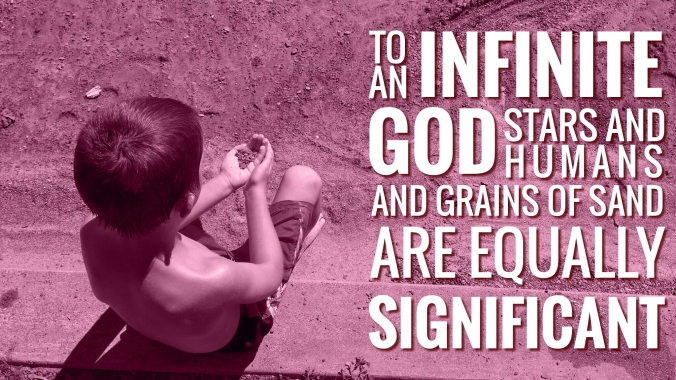
Comfort: To an eternal God, stars and humans and grains of sand are equally significant.

Challenge: Read Psalm 90, noting the eternal perspective of the psalmist.

Prayer: Let Your work appear to Your servants
And Your majesty to their children.
Let the favor of the Lord our God be upon us;
And confirm for us the work of our hands;
Yes, confirm the work of our hands. (Psalm 90:16-17)

Discussion: Have you ever been involved in a long-term project, perhaps one that continues long after you stopped (or will stop) being part of it? What did that feel like?

Join the discussion! If you enjoyed this post, feel free to join an extended discussion as part of the C+C Facebook group. You’ll be notified of new posts through FB, and have the opportunity to share your thoughts with some lovely people. Or feel free to comment here on WordPress, or even re-blog – the more the merrier!

Peace as Action

1449987646870

Readings: Psalms 24; 150, Amos 9:11-15, 2 Thessalonians 2:1-3, 13-17, John 5:30-47


In the musical Rent the character of Mark sings: “The opposite of war isn’t peace; it’s creation.” The narrow definition of peace as merely the absence of destruction is turned on its head in a story about art and artists, but it has more universal application.  True peace is not something we passively experience; it is something we do.

After World War II, the United States initiated the Marshall Plan to help a devastated Europe recover economically. This aid included former enemies Italy and Germany, as well as neutral countries like Iceland. At the same time the U.S. oversaw the reconstruction of Japan, including a security arrangement that still exists today. These decisions were not altruistic on the part of the U.S. Leaders understood simple withdrawal from conflict was not the same as peace, which requires an ongoing effort. They understood peace as doing justice.

If we want to have peace – personal, interpersonal, or international – in our own lives, we can’t rely on outside forces to retreat from conflict and leave us alone to our apathy. Acts of creation and generosity can transform enemies into allies, battlefields into sources of shared harvest. To have peace, we must do peace.

For all his message of doom, the prophet Amos does paint a picture of what the peaceful Kingdom will look like:

they shall rebuild the ruined cities and inhabit them;
they shall plant vineyards and drink their wine,
and they shall make gardens and eat their fruit. (Amos 9:14)

It is not that these activities are possible because we live in some conflict-free vacuum we label peace, but that these activities are peace and create the conditions for its survival.

We all have conflicts. What cities of friendship have we left in ruin? What vineyards of opportunity have we trampled? What refugees of family have we driven away? We can choose to simply retreat from these battles, but let’s not mistake indifference for peace. Rather, let’s regroup and prayerfully consider how we might do peace. When we do peace rather than wait for it, the harvest will be abundant.

Comfort: We are not helpless in the face of conflict. We can rely on God to show us how to live peace.

Challenge: Explore organizations in your local community which work toward peace. Look for ways you might contribute.

Prayer: Relieve the troubles of my heart, and bring me out of my distress. Consider my affliction and my trouble, and forgive all my sins. (Psalm 25:17-18)

Discussion: Where have you settled for indifference instead of peace? What can you do about it?

Join the discussion! If you enjoyed this post, feel free to join an extended discussion as part of the C+C Facebook group. You’ll be notified of new posts through FB, and have the opportunity to share your thoughts with some lovely people. Or feel free to comment here on WordPress, or even re-blog – the more the merrier!
Love Anyway

1449813512085

Readings: Psalms 102; 148, Haggai 1:1-15, Revelation 2:18-29, Matthew 23:27-39


Jesus told the Pharisees: “I send you prophets, sages, and scribes, some of whom you will kill and crucify, and some you will flog in your synagogues and pursue from town to town” (Matt 23:34). A little later he added: “How often have I desired to gather your children together as a hen gathers her brood under her wings, and you were not willing!” (v 37). Through his frustration, the underlying message is: love keeps trying until there is nothing left to do.

This is not so different from the frustration we feel when a child’s battle with substance abuse leads to repeated betrayal. When a friend’s mental illness seems determined to isolate her from others. When a sibling refuses to forgive family disputes.

To a lesser degree we may feel it when we do volunteer work and recipients seem less than grateful. Or when they seem to take advantage of our generosity. Or when sincere but fumbling attempts to support a disadvantaged group are met with suspicion or criticism.

One natural response to perceived rejections is to give up on loving, perhaps telling ourselves to save our love for where it is appreciated. Another response, one much more difficult and requiring sincere humility, is to examine whether we could try to love them differently. God extended all possible chances despite knowing the outcome. Should we do less?

We can’t cure another person’s addiction or illness. We can’t force people to express gratitude in a manner acceptable to us. We can keep reaching out in love to a person drowning in suffering, until he either accepts our hand or is pulled beneath the waves. God knew the Jewish people would not heed his cries until it was too late, but love compelled him to keep trying. If we love someone thinking we can save them, we will inevitably be disappointed. If we love someone with an agenda that serves our ego more than their need, we will burn out. When we love someone without expectation, we become a steady light in the darkness.

Comfort: We are not responsible for how others respond to our love; only to love them anyway.

Challenge: When you feel your love is rejected, consider doing something differently.

Prayer: I keep the LORD always before me; because he is at my right hand, I shall not be moved. (Psalm 16:8)

Discussion: When you feel your love is rejected, redirect it.

Join the discussion! If you enjoyed this post, feel free to join an extended discussion as part of the C+C Facebook group. You’ll be notified of new posts through FB, and have the opportunity to share your thoughts with some lovely people. Or feel free to comment here on WordPress, or even re-blog – the more the merrier!
Love Equally

1449488032749

Readings: Psalms 122; 145, Amos 7:1-9,  Revelation 1:1-8, Matthew 22:23-33


Mosaic law contained rules about marriage which we consider unusual today. If a man died childless, his brother had to marry his widow. The intent behind this law was to protect the widow from poverty and disgrace as she would have no means of support. In a modern society, where women hold jobs and own property equally with men, this is an outdated and rarely practiced idea.

The Sadducees were a Jewish sect who did not believe in the resurrection as Jesus taught. Fearing his influence on the people, they tried to trip him up to diminish public opinion of him. They thought the following scenario would do the trick.

A man with six brothers died childless. Per the law, his brother married his wife. The second brother also died childless, and she married the third brother, and so on until eventually she had married  all seven brothers. Who, the Sadducees asked, would be her husband in the resurrection?

Jesus told them they were asking the wrong questions, “For in the resurrection they neither marry nor are given in marriage, but are like angels in heaven.”

That must have been a showstopper. Until very recently most people did not marry for love, but there have been rules about fidelity and ownership for a long time. The concept of women who did not need to rely on men was almost unthinkable. Jesus was saying, “I know the rules, but the current social structures are not the equality God ultimately has in mind for you.” While not exactly a ringing endorsement of the Equal Rights Amendment, it sent the message that once the world was made anew, women would be independent.

Today in the western world, the equality shared legally (if not practically) by men and women makes love-based marriage the norm. Viewing others as equals – as fully human beings – makes other types of love possible as well. Empathy requires us to identify with another person, and if we don’t think of them as equal, that empathy is stunted. The church has traditionally promoted the values of faith, hope, and love as described in 1 Corinthians, but the Greek word (agape) for the type of sacrificial “love” intended can just as legitimately be translated as “charity.” English doesn’t really have an equivalent word. Maybe that’s why we struggle with understanding current social structures as anything other than vertical, with the “haves” obliged to show charity to the “have nots.”  When we realize we are no different, giving and receiving charity are no longer sources of obligation or shame, but acts of sharing between children of God as any loving family might perform.

Empathy and equality release us from the slavery of convention into the freedom of love.

Comfort: God loves you equally to kings and paupers, friends and enemies.

Challenge: What groups of people do you have trouble empathizing with? Make an effort to get to know them.

Prayer: The Lord is good to all, and his compassion is over all that he has made. (Psalm 145:9)

Discussion: What prejudices do you struggle with?

Join the discussion! If you enjoyed this post, feel free to join an extended discussion as part of the C+C Facebook group. You’ll be notified of new posts through FB, and have the opportunity to share your thoughts with some lovely people. Or feel free to comment here on WordPress, or even re-blog – the more the merrier!
 

Hope Astutely

1449236593541

Readings: Psalms 102; 148, Amos 5:1-17, Jude 1-16, Matthew 22:1-14


In the aftermath of Hurricane Katrina, thousands of volunteers arrived to help the residents of New Orleans recover. Among them were con artists who accepted large down payments for construction work then skipped town. Every year Americans with terminal and/or chronic diseases spend hundreds of millions of dollars on unproven and frequently dangerous “cures.” People who can barely afford to eat donate money they can’t afford to televangelists who teach a  fraudulent prosperity gospel. Politicians convince generation after generation to blame the latest wave of immigrants (Irish, Asians, Jews, Syrians, etc.) for societal ills because they know fear mongering is good campaign strategy.

When people are desperate or afraid, they are especially vulnerable to the false comforts of people who tell them what they want to hear. The author of Jude warned early Christians to be wary of people spreading false doctrine that taught self-glorification over submission to Christ: “These are grumblers and malcontents; they indulge their own lusts; they are bombastic in speech, flattering people to their own advantage.” Today we don’t worry much about the religious orgies contemporary with Jude’s audience, but we should be wary of leaders who conflate secular concerns like capitalism (and other economic systems), democracy (and other government systems),  or nationalism (and other tribalist systems) with Christianity in order to exploit our fears and insecurities.

In the parable of the wedding banquet, Jesus describes the wedding of a king’s son where many were invited but chose not to attend, and this lack of commitment resulted in their deaths as commanded by the king. The king’s slaves collected a second round of guests including everyone they found on the street, but even these guests were not all safe, “for many are called but few are chosen.” Those chosen few sought hard truths over a diluted and convenient message.

Our world can be scary. Our instincts can be base. Many will take advantage of that combination to spread beliefs that are not in our best spiritual interests. False comfort is the enemy of true hope. Let us be wise and make sure our hope is placed in Christ.

Comfort: We can identify true hope by comparing it to Christ’s example.

Challenge: Be wary of people who would exploit your faith for their own gain.

Prayer: I keep the LORD always before me; because he is at my right hand, I shall not be moved. (Psalm 16:8)

Discussion: Are there any parts of your life where your secular expectations are in conflict with your religious ones? If not … why not?

Join the discussion! If you enjoyed this post, feel free to join an extended discussion as part of the C+C Facebook group. You’ll be notified of new posts through FB, and have the opportunity to share your thoughts with some lovely people. Or feel free to comment here on WordPress, or even re-blog – the more the merrier!

The End Is Near

winter-83112_1280

Today’s readings (click below to open in new tab/window):
Psalms 63; 149, Micah 7:11-20, 1 Peter 4:7-19, Matthew 20:29-34


The world has been ending for a very long time.

When I was a child, priests and Sunday School teachers, caught up in the atmospheric dread of the Cold War, terrified me by preaching the imminent end of the world and the threat of Russia. I confided my fears to my mother, and it turned out when she had gone to Catholic school at the same parish, the priest and nuns gave the students a specific date to expect the end. She too was terrified until the date came and went. There was supposed to be some lesson in that about being prepared, but all she seemed to learn was a distrust of the clergy.

Peter, like many disciples, genuinely believed Christ would be returning in his lifetime or shortly after, but it didn’t happen. The hundreds of predictions of the end of the world since then have been miserably wrong. One of these more recent debacles was blamed on faulty decimal placement.

On this last day of the liturgical year, we look forward to the beginning of Advent and the new year. Except we don’t traditionally welcome it with parties and feasts. It doesn’t have an equivalent of Ash Wednesday which precedes Lent. Instead, our scripture readings turn to apocalyptic themes and prophets of doom. The stores may be full of twinkling lights and cheerful music, but they represent the false promise of satisfaction via worldly accumulation. Without the rich contemplation of Advent, they offer little more than a picture of a feast offers a starving family.

The world will end someday. Until it does, we are left to contemplate how to balance living both as if it will happen tomorrow, and as if it will happen millennia after we have passed.

But how different do those lives look?

In either case, our neighbor struggling with depression will still need a kind shoulder. The bellies of hungry children halfway around the world won’t stop rumbling. We still need to forgive that person who wronged us sooner rather than later. Our sacrifices and our love and our faith are neither more nor less meaningful, and always necessary. Advent is the time we set aside to remember that while we mourn the broken nature of the world, we are also waking to the promise of its new life in Christ.

The end is near. We need not fear it, for so is the beginning.

Comfort: Christ makes the world new for us each day.

Challenge: Remember the past, live the present, shape the future.

Prayer: Because your steadfast love is better than life, my lips will praise you.
So I will bless you as long as I live; I will lift up my hands and call on your name. (Psalm 63:3-4)

Discussion: Do you observe Advent in any way? If so, what does it mean to you? If not, do you see any value in it?

Join the discussion! If you enjoyed this post, feel free to join an extended discussion as part of the C+C Facebook group. You’ll be notified of new posts through FB, and have the opportunity to share your thoughts with some lovely people. Or feel free to comment here on WordPress, or even re-blog – the more the merrier!