Invitation: Prince of Peace, King of the Road

1453047848831

My grandparents were generous people. They didn’t have a lot, especially when they were a younger couple, but any family members or friends present at meal-time were fed. Actually it didn’t have to be meal-time: if you showed up, they offered you food. Somehow Grandma could transform half a pound of ground beef and a can of tomatoes into a meal for a dozen people gathered in their tiny four-room house.

The village where they lived had a nearby rail yard, so it was not infrequent for hobos to drop by asking for food. Today “hobo”can have an offensive connotation, but in the first half of the 20th century hobo culture thrived. Grampa would  tell me stories about how Grandma cooked up breakfast for them, and shared stories and conversation.

Because hobos were a community, they liked to help each other out. Often they would draw discreet symbols on fenceposts or the like to let each other know what they could expect from the owners of the home. One of the earliest symbols was a plus sign or cross (+). This indicated the people in the home were friendly and would be willing to feed you. Over the years these symbols evolved. The cross eventually came to mean: “these people will feed you, but you’ll have to listen to some bible-thumping first … and they might not get to the feeding.” Another sign like a small table (∏) gradually replaced the cross as a symbol for a generous home.

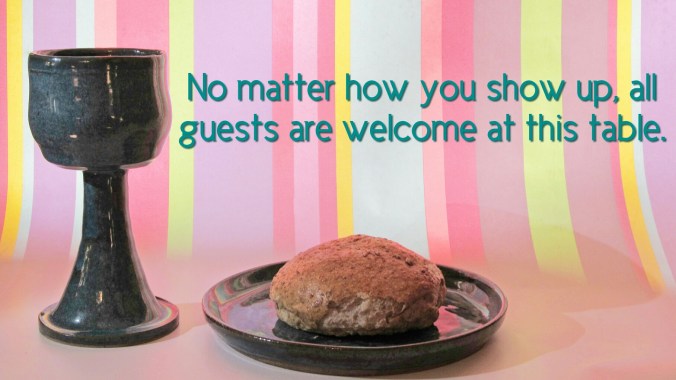
I was almost forty years old when I first heard the term “table theology.” It describes a type of worship that doesn’t focus as much on the crucifixion of Christ as his efforts to bring us together in loving community. Table theology doesn’t exclude the importance of crucifixion – the communion meal at the center of the table symbolizes Christ’s death! – but it promotes his message we are to love one another.

In secular society, the symbol of the cross has similarly evolved. Polls consistently show non-Christians no longer associate the faith and its most famous symbol with radical love and self-sacrifice, but with judgment and exclusion. Sadly that’s often true. Some churches are more concerned with who can’t come to the table (or enter the door, or lead the choir, or preach the sermon) than they are with sharing Christ’s unconditional love. James 2:16 tell us: “If one of you says to them, ‘Go in peace; keep warm and well fed,’ but does nothing about their physical needs, what good is it?” Being welcome to the table is not a reward, because none of us perfectly deserves it; welcome is a default position because we are all wandering children of God who are hungry, even when we don’t know what for. Sharing this sacred meal opens an ongoing, sacred conversation among a person, a community, and our God. Come in from the cold. Have your fill of the Bread of Life. Tell your friends.

May the peace of our Lord Jesus Christ be with you.
Invitation: Interlopers Welcome

1452436642538

A couple years ago, this little gray striped cat started hanging out on our back porch. If you sat on the steps, she would lie next to you and scoot closer until you petted her. She was pretty and friendly and maybe most importantly she didn’t trigger any of the allergies that prevented us from keeping a cat in the house.

One afternoon she was purring with a little more urgency than usual and looking into the kitchen. Both of us had Italian grandmothers, so naturally we fed her. We emptied a can of tuna into a bowl and set it out. She wolfed it down. After that, Miss Susan Moochie (yep that’s what we call her) was a  daily visitor. We started buying tuna and cat food to be ready for her visits. We even rotated brands and flavors when she seemed to lose interest.

After a while, a couple other cats started showing up. These two were a little more wild and had no interest in meeting us. One was white with gray markings. We called it The Nemesis. The other was almost all black and we just called it The Other One. Together they were… The Interlopers. Miss Susan Moochie didn’t like to eat when The Interlopers were around. We didn’t want them around harassing our Miss Susan, so we’d shoo them away. As soon as she was done eating we brought her leftovers into the house.

Little by little, Miss Susan started skipping a day here or there, or leaving more than half the food untouched. The Interlopers were persistent, and seemed hungry. When the weather started to turn cold, we felt a little bad for them, and stopped taking in the leftovers. The Nemesis and The Other One consistently finished off whatever was in the bowl. Gradually, Miss Susan weaned herself off our company and generosity. We can only assume it was because she didn’t care for the continuing presence of The Interlopers.

Now we feed the Interlopers when they show up. The Nemesis will let me pet it once in a while, but never for long. The Other One has never even been close enough to bite the hand that feeds it. They aren’t the cats we wanted, but they are faithful and in need. Probably they are faithful because they are in need.

I don’t particularly like The Interlopers, but that felt like a pretty darn hypocritical reason not to feed them. After all, in Matthew and Luke Jesus says: “If you love those who love you, what credit is that to you? Even sinners love those who love them.” That got me thinking about people and church and communities. We are sad when the “right” people move on because the “wrong” people — usually people who have less than we do or are unfamiliar to us — have invaded our church, or neighborhood, or country.

We are called to love the people who do not love us. Christ invites everyone to the table, and we’re not going to love them all. Some people may harass us and others may not speak to us. Some may seem like they’re only showing up to take and not to give. We don’t get to pick and choose who Christ feeds. Jesus is the host and whether we showed up to the party first or last, dressed to the nines or looking like we don’t care, we are his guests and arrive on equal terms. We are all interlopers to someone. How fortunate for us Jesus is the one with the can opener.

The Peace of Christ be with you.

Invitation: Eat up.

1451796766436

When I was around 14 years old, my dad brought home a friend from work. Let’s call him Walt. Walt had fallen on some hard times personally and financially. For several months Walt spent a lot of time at our house in the evenings and on weekends. He helped out with home improvement projects. He played games in the yard with us. He had dinner with us on many evenings. Most importantly, Walt was not alone.

One Saturday we installed paneling in the living room. I say “we” but I was only peripherally involved; my dad and Walt did almost all the work, though I did lend the occasional steadying third set of hands. It was a big project, and we worked well past our home’s normal supper time. When the project was done, we washed up and sat down to supper, which was already on the table.

“Eat up,” I said to Walt. “You sure earned it.”

That was a mistake. My dad shot me a look that I knew meant we were going to have a talk.

A few hours later, after good food (my mom is a great cook!) and plenty of conversation and laughter, Walt went home. I had forgotten all about my earlier misstep, but my dad hadn’t. As the front door shut he turned to me with a stern look.

“Don’t ever tell anyone they have to earn a meal here,” he said. “That’s not how we do things. You should know better.” I started to say it was a joke, but didn’t get to finish. “It wasn’t funny. Don’t do it again.”

My dad is not a particularly religious man, but that day he taught me a very Christ-like lesson. When Christ invites us to the table, it’s not because we’ve somehow earned it; it’s because he loves us. Christ offers us a grace freely given, and no one else around the table gets to judge who should partake. We don’t even get to judge how much. In the Parable of the Workers, laborers who work a partial shift get paid just as much as laborers who work a whole shift. If that seems unfair, take it up with Jesus. Until he says differently, we are all welcome at the table.

The Peace of Christ be with you.


This first invitation is dedicated with much love and thanks to my dad, who is so encouraging to me about the blog and has provided great feedback that has helped shape it. Love you, Dad!

Invitations to Communion

1451766966701

I was raised Roman Catholic and am now a member of the Disciples of Christ. In both traditions, though they have different understandings of the essential nature of communion, it is central to the liturgy. Several years ago I was honored to serve a term as one of the elders at a Disciples church. Among other duties, each week we issued an invitation before communion. We understood the table as Christ’s table, so the invitation needed to be inclusive of everyone present. Sometimes that included people we didn’t like or had active disagreements with, but we were called to be representatives of a nature higher than our own. Delivering the invitation was deeply meaningful and sacred to me.

On Sundays I will be adding an extra post reminiscent of those invitations. Of course I can’t follow up with an actual loaf of bread or cup of wine, but I hope they help you feel welcomed in the body of Christ.

You may have noticed that, in the devotionals, I don’t write in first person singular. That’s because there’s no “I” in Team Jesus.  Kidding …  and anyway there’s one in “Christ.” The devotionals are not about pushing my particular take on doctrine, theological specifics, conservative versus liberal views, or other personal agendas. Writing as “we” helps remind me of that. My invitational style is going to be a little different. When I was an elder I took an event from my life or something I’d learned that reminded me of the universal nature of Christ’s love, and adapted it to the purpose. The concept of open communion is not itself universal, and may come across as a theological statement if that’s not your belief. If you feel that way but otherwise enjoy the blog , maybe skip the invitations, and stick to reading the daily posts. I won’t be offended, though I’ll miss you. The invitation may be my words, but the nature of it is something I can only aspire to.

Peace!