Willful Ignorance

1489011278391-01.jpeg

Today’s readings:
Psalms 5; 147:1-11, Deuteronomy 9:13-21, Hebrews 3:12-19, John 2:23-3:15


In legal terms, “willful ignorance” describes an intention to remain unaware of facts to avoid prosecution for them (like not asking a friend why he suddenly has a Rolex to sell you). The term has expanded into more general use to describe anyone who refuses to learn something because they want to remain comfortable or blameless. As a defense it doesn’t hold up well in court, and as a choice it isn’t morally defensible.

When Jesus tried to explain being “born again” to the Pharisee Nicodemus, Nick kept claiming not to understand. Eventually Jesus grew exasperated and said: “Are you a teacher of Israel, and yet you do not understand these things?  Very truly, I tell you, we speak of what we know and testify to what we have seen; yet you do not receive our testimony.” It wasn’t a lack of testimony that vexed Jesus: it was a listener’s refusal to receive it.

In his letter to the Hebrews, Paul reminded them how their ancestors abandoned the God who led them out of Egypt and made an idol of a golden calf. When Moses didn’t return quickly enough for them from meeting the Lord on Mount Sinai, the people justified their actions by saying: “this Moses […], we do not know what has become of him.” Not “let us learn more” but “let us do what we already wanted to.” It only cost them forty years.

We practice willful ignorance when we stereotype. When we dismiss solid science. When we make excuses for unethical acts of a politician we happen to favor. Many harmful environmental and economic choices are made with willful ignorance so we can enjoy the present without being accountable for the future. We are susceptible whenever we don’t want to surrender the worldview we prefer.

Jesus said “I am the way, the truth, and the life.” If we aren’t willing to make friends with the truth, what kind of friend could Jesus have in us? God and faith survive facts, even unpleasant ones. If we’re going to be convicted of something, let it be the truth.

Comfort: Facts are not the enemy of faith.

Challenge: If you don’t like the facts, it’s not the facts that have to change.

Prayer: God of Truth, open my eyes. Amen.

Discussion: What facts do you have trouble accepting?

Join the discussion! If you enjoyed this post, feel free to join an extended discussion as part of the C+C Facebook group. You’ll  have the opportunity to share your thoughts with some lovely people. Or feel free to comment here on WordPress, or even re-blog – the more the merrier!

Knotted Up

knotted_up

Today’s readings:
Psalms 34; 146, Deuteronomy 9:(1-3) 4-12, Hebrews 3:1-11, John 2:13-22


All four gospels include the story of Jesus cleansing the temple of money-changers and merchants. That coin with Caesar’s likeness that Jesus was willing to render unto him? It wasn’t welcome in the temple. The money-changers charged exorbitant exchange rates to trade the currency of the empire for the currency of the temple. The merchants sold sacrificial livestock to travelers and charged typically inflated tourist prices.  Jesus was furious God’s house of worship had been turned into a center of exploitative commerce, so he drove out the animals and flipped the tables.

Only John’s gospel tells the part of the story about Jesus fashioning a whip from cords. Doing so would have taken some time, enough for people to notice what he was doing. With all the livestock nearby there were probably whips handy, yet he took the time to make one himself. As he knotted the cords in the crowded temple, somebody – probably several somebodies – must have noticed. Did they brush it off as business as usual? Did they take moment to wonder why it was happening? Did they think he couldn’t possibly be about to do what it seemed he would? Maybe there were even a few people thinking, “It’s about time.”

How many injustices being perpetrated right now, right in front of us, right in the hearts of our communities, do we ignore because business is booming? While we buy and sell, while we mingle our economy and empire with our faith, what retribution builds? While we fail or refuse to see the impending repercussions, the knots multiply. And our daily lives our casual attitudes towards “that’s just how business works” or “you can’t expect me to risk my security over someone else’s injustice” can’t be untangled from living our faith.

People might have left the temple peacefully had they stopped for a minute to ask if the man in the corner was the face of justice delayed. Let’s take some time this Lenten season to step back and look at how our own business as usual exploits our neighbors. The consequences of injustice are inevitable, but injustice itself is not. Perhaps Jesus doesn’t want to finish that whip any more than we want him to, and that’s why he gives us time to turn the tables before he turns them over.

Comfort: It’s not too late to do better.

Challenge: Pick one consumable item (coffee, chocolate, etc) and for the remainder of Lent buy it only from direct trade or fair trade sources.

Prayer: Open my eyes, Lord, to where I have been blind to injustice. Amen.

Discussion: What is the difference between feeling guilty and feeling accountable?

Join the discussion! If you enjoyed this post, feel free to join an extended discussion as part of the C+C Facebook group. You’ll  have the opportunity to share your thoughts with some lovely people. Or feel free to comment here on WordPress, or even re-blog – the more the merrier!

Has your hour come?

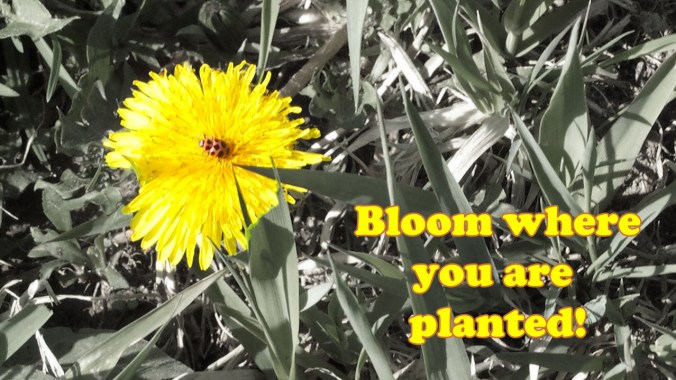
bloom

Today’s readings:
Psalms 119:73-80; 145, Deuteronomy 8:1-20, Hebrews 2:11-18, John 2:1-12


In the lyrics to “Beautiful Boy” John Lennon famously wrote: “Life is what happens to you while you’re busy making other plans” (though he borrowed it from comic strip author Allen Saunders). It seems this may have been true even for Jesus.

The first miracle in John’s gospel is the transformation of water into wine at a wedding in Cana which Jesus attended with his mother. When Mary told him that the wine had run out, Jesus brushed her off: “Woman, what concern is that to you and to me? My hour has not yet come.” Undeterred, Mary instructed the waiters to do whatever Jesus told them. In short order, they had about 150 gallons of high-quality wine.

This is kind of an odd miracle for a public debut. It was at a relatively private affair with only a few witnesses. It doesn’t have the same life-changing impact as a healing, or the grandeur of feeding multitudes with a few leftovers. It doesn’t seem to have an agreed-upon theological interpretation. Given Mary’s expectations, it likely wasn’t even his first one.

Here’s what we do know: there was a need in front of him, and he met it. If we are to follow in his footsteps, maybe we don’t need to know much more. Many of us have plans and goals, and there is absolutely nothing wrong with that. But if while we’re waiting for our hour to come we are so narrowly focused that we ignore the needs in front of us, whom exactly are we serving?

While we plan, let’s stay aware of the possibilities for service that at first blush may not seem to be of concern to us. Yes we all have demands on our time, but at the end of the day what will make that time matter? The lawn we need to mow won’t grow any taller during the five minutes it takes to check in with the ailing neighbor looking out her window. Our gesture does not need to be grand, nor our influence broad, to matter. Maybe we can’t all turn water into wine, but every one of us can turn time into love.

Comfort: Your small gifts can be enormous when given to someone else.

Challenge: Take regular pauses during your day to reflect on how you might serve someone in material or spiritual need.

Prayer: God of love, give me a servant’s heart. Amen.

Discussion: Have you ever let your determination to reach a goal crowd out important things in your life?

Join the discussion! If you enjoyed this post, feel free to join an extended discussion as part of the C+C Facebook group. You’ll  have the opportunity to share your thoughts with some lovely people. Or feel free to comment here on WordPress, or even re-blog – the more the merrier!

Everything new is old again.

revolution-establishment

Today’s readings:
Psalms 84; 150, Jeremiah 9:23-24, 1 Corinthians 1:18-31, Mark 2:18-22


Today’s readings are about a faith-driven revolution in thought and attitude. The prophet Jeremiah spoke of love, justice, and righteousness working in opposition to wisdom, might, and wealth. He said those who boast about wringing success and power from the lives of those who suffer defy God. In his letter to the Corinthians, Paul wrote about God in Christ working through the foolish, the weak, and the despised to bring low those who “might boast in the presence of God.”

Who are these boasters? People who insist their power and wealth demonstrate how God has chosen them above others. They work to conserve the status quo not because it is just, but because it benefits them. After all, it’s easy to convince oneself the present order is just when examining that order too closely might undermine our comfortable position.

When Jesus reminded the Pharisees we can’t put unshrunk patches on old cloth, or new wine in old wineskins, he was telling them the old ways of doing and being couldn’t survive the new things God would do. The salvation story is not one of preservation; it is an epic of assumptions broken open to let in new truths and people. Salvation has a forward momentum.

So why does Christianity work so hard to stay in the past?

Tension has always existed between Christians who – like the Pharisees – are convinced the faith has nothing new to learn, and those who embrace the momentum. As a result, we have an uneven record of being on the right side of history regarding justice and inclusion. The Bible (or our current understanding of it) is not an excuse for closing our ears and minds to new and challenging things God might have to say and the people who say them.

Every revolution – industrial, political, theological – eventually becomes the calcified establishment and the corrupted empire. We forget that even conservative modern churches have evolved beyond what the earliest Christians would have accepted. The people suffering under the present circumstances are the foolish, weak, and despised whom God will use to bring the mighty low. If we use the past to justify their oppression and exploitation –particularly oppression and exploitation at the hands of the church – we ignore the future God reveals at our own peril.

Comfort: God is working in the world right now.

Challenge: Meditate on whether you cling to ideas because they are right, or because they are comfortable.

Prayer: Loving God, I will listen for your voice. Amen.

Discussion: Where do you find it challenging to balance tradition and justice?

Join the discussion! If you enjoyed this post, feel free to join an extended discussion as part of the C+C Facebook group. You’ll have the opportunity to share your thoughts with some lovely people. Or feel free to comment here on WordPress, or even re-blog – the more the merrier!

Idle Hands

good-works

Today’s readings:
Psalms 43; 149, Deuteronomy 7:17-26, Titus 3:1-15, John 1:43-51


In his letter to his associate and friend Titus, Paul asks him to instruct the church in Crete on proper behavior for the faithful. He wants them to be obedient, courteous, and gentle, and wants them to avoid quarrels, gossip, and division. Regarding unbelievers – each of them a possible convert of course – he wants the faithful to be patient, “[f]or we ourselves were once foolish, disobedient, led astray, slaves to various passions and pleasures, passing our days in malice and envy, despicable, hating one another.”

See what he did there?

Paul was anything but naïve. He knew professing faith in Christ did not immediately transform a person into a saint. If it did, he wouldn’t have had to send instructions from afar. He was experienced enough to know his flock needed constant tending. By first appealing to the church’s better nature and describing the lives he hoped they would lead, he let them know he had faith in their potential. Though he attributed the less desirable behaviors to unbelievers, it was a subtle reminder to the church that they were not so different as they might like to pretend.

Throughout the letter, Paul suggests the “people learn to devote themselves to good works in order to meet urgent needs, so that they may not be unproductive.” The doing of good works is a benefit not just to the recipient of the work, but also to the giver. Our actions influence our attitudes, and one way to cultivate a spirit of charity is to act charitably. Even when our spirit resists – maybe especially then! – acting in ways that demonstrate a love for God and his creation will help nourish those feelings within us.

Proverbs 16:27 says: “Idle hands are the devil’s workshop; idle lips are his mouthpiece.” To be our best selves, we need to be intentional about how we spend our time. If we don’t fill our days with what is meaningful, we leave the gate open for the meaningless or harmful to creep in and take root. Being productive in the way Paul suggests helps grow God’s kingdom both within us and without.

Comfort: Faith is a journey. Learn from today and be better tomorrow.

Challenge: Do an informal time study of your week. Is your time going where you think it should?

Prayer: Gracious God, teach me to fill my days with what is good and pleasing to you. Amen.

Discussion: What is the difference between relaxation and idleness?

Join the discussion! If you enjoyed this post, feel free to join an extended discussion as part of the C+C Facebook group. You’ll  have the opportunity to share your thoughts with some lovely people. Or feel free to comment here on WordPress, or even re-blog – the more the merrier!

Meditation on Psalm 22

broken-clay-heart

Today’s readings:
Psalms 22; 148, Deuteronomy 7:12-16, Titus 2:1-15, John 1:35-42


I am poured out like water,
          and all my bones are out of joint; 

Great God without you my life has no shape; my soul meanders. Do not let me disappear into the ground, into nothingness. Gather me up, oh God. Scoop me into your palms. When you look upon me may you see your face reflected back. Let me rest in your cupped hands, held in your peace, until you see fit to pour my spirit into a vessel of your making.  Then will I stand tall and straight, for the Lord has given me form.

     my heart is like wax; 
          it is melted within my breast; 
          and my tongue sticks to my jaws;
          you lay me in the dust of death. 

Soothe my burning heart, oh Lord. It wilts from the heat of its own anger. It grows soft and weak as the flames of slander and gossip close in. But the breath of your Spirit soothes me, and the working of your hand sculpts my resolve. If my heart is wax, press your seal into it so all may know it is my God who has restored me.

     my mouth is dried up like a potsherd,

Without your living waters, words stick in my throat like bitter ash. Do not leave me to thirst, to parch like a broken, leaking pot discarded on the roadside. In the midst of life’s deserts, I pray you rain mercy on me, my loving God. May I catch your mercy on my tongue; may it wash the dust from my skin; may it pour all around me and water the seeds you would have me tend, until the deserts bloom with mercy.

I am water.
I am wax.
I am dust.

You are the vessel that contains.
You are the seal that promises.
You are the rain that refreshes.

In you my weakness are made strong,
and my strengths are multiplied.

 For he did not despise or abhor 
          the affliction of the afflicted; 
     he did not hide his face from me, 
          but heard when I cried to him. – v 24

Comfort: God will not hide his face from you.

Challenge: Slowly read through Psalm 22, paying attention to how it speaks to you.

Prayer: O LORD, do not be far away! Amen.

Discussion: The Psalms are ancient, but they speak to timeless conditions of the heart, mind, and soul. Do you find them helpful to read?

Join the discussion! If you enjoyed this post, feel free to join an extended discussion as part of the C+C Facebook group. You’ll  have the opportunity to share your thoughts with some lovely people. Or feel free to comment here on WordPress, or even re-blog – the more the merrier!

Sordid Gains

1488462941891-01.jpeg

Today’s readings:
Psalms 27; 147:12-20, Deuteronomy 7:6-11, Titus 1:1-16, John 1:29-34


Titus was a student of Paul who helped him evangelize on the island of Crete. After Paul left, he charged Titus with spreading the true Gospel among its people. This presented a challenge, because many Jews living in Crete wanted to stick with their laws and practices, such as dietary restrictions and mandated circumcision. Most of these people were understandably conflicted; for their whole lives they’d been taught to follow God in a very specific way, and now their devotion to Christ was not quite sufficient to convince them it was no longer necessary.

However, where some people experienced genuine struggle, others saw an opportunity to capitalize on that struggle. As Paul wrote, “they are upsetting whole families by teaching for sordid gain what it is not right to teach.” Much of the gain was financial, but influence and power were also up for grabs.

Paul cautioned Titus to appoint elders who exhibited self-control, humility, and trustworthiness. These qualities are important because they provide examples of spiritual commitment and maturity, but also because they are shared by people whose motivations are more likely to be genuine. Anyone put into a position of power – from the leaders of small congregations to the leaders of world powers – will be tempted to abuse that power. This tendency is indirectly enabled as their power grows and people become less willing to challenge them. That deference creates a void which is gradually filled by an inflated ego. Power corrupts not only by tempting us, but – once attained – by insulating us from factors that would normally keep us humble. Faith leaders must remain diligent to maintain a servant’s heart.

Leaders who have our best interests in mind will correct us, but not coerce us. They will explain, but not exploit. Appeal but not appease. We shouldn’t reject someone simply for having a ministry that has resulted in worldly success, but neither should we assume that success indicates they are good ministers. Are they helping us listen for God, or taking it upon themselves to speak for God? An insincere answer, supplied to maintain an illusion of wisdom, does far more damage than no answer.

We follow Christ. Anyone who encourages us to look to them before looking at Jesus is wandering in the dark.

Comfort: No one stands between you and God.

Challenge: Trust your instincts. Don’t be afraid to challenge leaders when you feel they have strayed, but also be open to correction yourself.

Prayer: Thank you Lord for being present to me always. Amen.

Discussion: In today’s reading from John, John the Baptist was willing to give up his very successful ministry when Jesus arrived on the scene. Have you ever held onto something – a job, a ministry, influence – because you felt threatened by someone else?

Join the discussion! If you enjoyed this post, feel free to join an extended discussion as part of the C+C Facebook group , visit comfortandchallenge.tumblr.com, or follow @comf_and_chall on Twitter. You’ll  have the opportunity to share your thoughts with some lovely people. Or feel free to comment here on WordPress, or even re-blog – the more the merrier!
Give It Up

1488341824024-01.jpeg

Daily readings:
Psalms 5; 147:1-11, Jonah 3:1-4:11, Hebrews 12:1-14, Luke 18:9-14

Ash Wednesday readings:
Isaiah 58:1-12, Psalm 51:1-17, 2 Corinthians 5:20b-6:10, Matthew 6:1-6, 16-21


“What are you giving up for Lent?”

Every year this is a hot topic among the Sunday School crowd. Many children (and some adults) give up candy or other treats. Lately the social media “fast” has been gaining popularity as people log out for forty days.

Other people, rather than (or in addition to) giving something up, add an activity they find meaningful. Some set aside extra time for prayer or other devotional pursuits.  Fans of efficiency might piggyback personal improvements they’ve been wanting to make, such as diet or exercise, onto the season.

Whether we’re subtracting or adding, Lent centers on discipline and sacrifice as a means of spiritual enrichment. However, it’s easy to let the means – skipping a chocolate bar or committing a daily charitable act – become the end. The purpose of Lenten activities is to prepare for Holy Week and Easter, when we re-commit ourselves to the mystery of Christ’s death and resurrection. Psalm 51 tells us: “The sacrifice acceptable to God is a broken spirit; a broken and contrite heart.”

Regarding sacrifice and fasting, Jesus tells us in the Gospel of Matthew: “whenever you fast, do not look dismal, like the hypocrites, for they disfigure their faces so as to show others that they are fasting […] put oil on your head and wash your face, so that your fasting may be seen not by others but by your Father who is in secret.”

It’s not so much what we give up, but how we do it. Lent is not goal-oriented; we aren’t meant to be “new and improved” at the end of it. Lent is an opportunity for sacrificial excavation – for clearing space in our lives meant to be re-occupied not by a sense of accomplishment but by the presence of Christ.

What are you giving up for Lent?

It may taste like chocolate or spend like a dollar, but it’s whatever takes up room where Christ could be. Ego. Pride. Self-righteousness. Anger. Fear. Greed. Christ emptied himself unto death for us. Let us sweep the ashes of death from our hearts to make room for the life he brings.

Comfort: Though it seems far, the day of the Lord is near.

Challenge: This Lenten season, make a meaningful sacrifice.

Prayer: Loving God, all that I have and all that I am is yours. Amen.

Discussion: What makes a sacrifice meaningful?

Join the discussion! If you enjoyed this post, feel free to join an extended discussion as part of the C+C Facebook group. You’ll  have the opportunity to share your thoughts with some lovely people. Or feel free to comment here on WordPress, or even re-blog – the more the merrier!

Inside Out

Untitled-1

Today’s readings (click below to open in new tab / window):
Psalms 43; 149, Lamentations 3:37-58, Hebrews 4:1-16, Romans 8:1-11


How do you go on?

After one of your closest companions betrays your beloved teacher …
After fear has driven you to deny your friend and savior …
After the messiah to whom you dedicated your life lies in a tomb…

… how do you go on?

The disciples would have begun observing the weekly Sabbath shortly before sundown on the day of Christ’s crucifixion. Candles would be lit. Prayers would be said. Songs sung. Meals eaten. Outward signs of mourning were forbidden on the Sabbath. Everything would have looked normal on the outside, but inside … grief and chaos.

Whatever activity or (this being the Sabbath) inactivity occupied their bodies, the disciples’ minds must have been on the tomb, not far away, with a body freshly lain and a stone newly rolled across it. From the outside it would have looked like any other tomb, but inside … incomprehensible injustice.

The scribes and Pharisees, Herod and Pilate, and everyone else who feared or hated Christ’s teachings were settling back into a sense of restored order, perhaps even contentment that they had successfully squelched this would-be king and prevented rebellion. The world looked the same as it had before, with the same people holding power, but deep inside … the rules of victory were being rewritten.

We spend a lot of time in this state, appearing one way to the world while, for better or worse, experiencing a wholly different inner life. Holy Saturday represents the tipping point of that experience. On that day, the disciples were resigned to the calm and ordered injustice of the flesh, while their souls were in torment. After that day, they were willing to sacrifice themselves on the altar of the Gospel, because nothing could shake the peace they had found in Christ. What a remarkable change!

What state are we in today? Is our world orderly but our faith easily shaken? Is our world in turmoil but our faith a rock? Or are we somewhere in-between, living an extended Holy Saturday moment, broken but hoping despite the evidence that justice will reign?

On the outside today may seem like any other day, but inside …

Comfort: The story isn’t over.

Challenge: Sometimes we have to give up exterior respectability to find interior peace.

Prayer: God of hope, today we mourn the injustice of the world. Send us peace. Send us love. Send us Christ. Amen.

Discussion: When has your outward stability masked inward change?

Join the discussion! If you enjoyed this post, feel free to join an extended discussion as part of the C+C Facebook group. You’ll be notified of new posts through FB, and have the opportunity to share your thoughts with some lovely people. Or feel free to comment here on WordPress, or even re-blog – the more the merrier!

Holy Friday

1458878752643.jpg

Today’s readings (click below to open in new tab/window):
Psalms 22; 148, Lamentations 3:1-9, 19-33, 1 Peter 1:10-20, John 13:36-38

Readings for Good Friday:
Isaiah 52:13-53:12, Psalm 22, Hebrews 10:16-25, John 18:1-19:42


If “Good Friday” seems like an odd name for a day commemorating a crucifixion, understand that good used to mean holy. All over the world, Christians re-enact Christ’s journey to Golgotha (also called Calvary) and his terrible execution. From congregations reading the passion together, to prayer groups walking the stations of the cross in troubled neighborhoods, to entire towns becoming Jerusalem for the day, Christians feel compelled to relive the story.

Because we know how the story turns out, we may find it easy to judge the crowds whose cheers turned to condemnation, or Peter, who – as Christ predicted – denied knowing him not not once, not twice, but three times. Certainly we would not have shouted “Crucify him!” We could never deny him … could we?

Let’s assume we could. Actually, let’s assume we have – because it’s true. None of us lives perfectly. That being the case, isn’t it comforting to know the person Jesus hand-picked to found the church was as flawed as we are? Maybe that’s why in passion stories most of us play the angry mob: to be reminded each of us is in need of forgiveness, and so don’t have the right to judge anyone. Christ later assured Peter he was still loved, but surely the knowledge of that moment of fear, weakness, and betrayal never left him. And almost as surely that memory helped forge the compassion and mercy for others that would have been necessary to speak for Christ.

When we feel like judging, let’s remember Peter – weak, frightened, impulsive, imperfect Peter. Then let’s remember Christ forgave him, as he forgives us, and calls us to forgive. It was the sin of the world that Christ forgave on that cross, including the sin of our own imperfect mercy and tarnished compassion.

From noon this day until Sunday morning, the disciples were without Christ. They thought the story was over, and despaired. This holy Friday and Saturday, let’s contemplate what it would mean to live without hope of forgiveness for ourselves and others. Today Christ hangs on the cross. We shouted “Crucify him!” Now we weep.

Comfort:

Challenge: Pray for forgiveness.

Prayer: Lord Jesus Christ, son of the living God, have mercy on me, a sinner.

Discussion: What does Good Friday mean to you?

Join the discussion! If you enjoyed this post, feel free to join an extended discussion as part of the C+C Facebook group. You’ll be notified of new posts through FB, and have the opportunity to share your thoughts with some lovely people. Or feel free to comment here on WordPress, or even re-blog – the more the merrier!