The Gospel Unleashed

20161031_152727-01.jpeg

Today’s readings (click below to open in new tab/window):
Psalms 89:1-18; 147:1-11, Zephaniah 2:1-15, Revelation 16:1-11, Luke 13:10-17


A woman, who for eighteen years had been crippled by a spirit, came to Jesus in the synagogue on the Sabbath. Of course he healed her, and of course – as with all his Sabbath healings – the leaders of the synagogue were angry with him. They also scolded the woman for not coming on one of the six other days of the week when such activity was permissible. Jesus replied:

You hypocrites! Does not each of you on the sabbath untie his ox or his donkey from the manger, and lead it away to give it water? And ought not this woman, a daughter of Abraham whom Satan bound for eighteen long years, be set free from this bondage on the sabbath day?

His opponents were shamed, and the crowd rejoiced.

Jesus nailed the hypocrisy. Enforcing laws against things you find sinful is easy when you aren’t affected by them. None of the synagogue leaders suffered a similar affliction, so it didn’t impact them a bit if she had to wait, but they would unlawfully untie a knot for a thirsty beast.

Still today many Christians demand civic laws against sins which don’t impact them. Unsurprisingly, they are less supportive of legislation enforcing Christ’s instructions like inviting the poor into our homes, giving away our second coats to those who have none, and doing good to those who wrong us. We want the government to prohibit gay marriage and abortion (though not all Christians agree on these issues) because we are a “Christian nation” … but when it comes to our money, the government has no business dictating the conscience of individuals. Now excuse me while I untie my ox.

If we need laws to behave, we are not faithful – we are fearful. When we prioritize rules over relationships, we have forgotten that at the end of each legalistic leash is a human being. If our witness for Christ is unpersuasive, the problem lies not in our government, or in our corrupted society, but in us. Let us live as Christ instructed, and the Gospel really will seem like good news.

Comfort: Faith exists regardless of circumstance.

Challenge: When watching or reading the news, be aware of people promoting a civic Christianity at the expense of Christ.

Prayer: Lord of the Gospel, perfect my witness to Christ until it shines like a beacon on a hill. Amen.

Discussion: What is a healthy level of overlap between our faith lives and civic lives?

Join the discussion! If you enjoyed this post, feel free to join an extended discussion as part of the C+C Facebook group or follow @comf_and_chall on Twitter. You’ll  have the opportunity to share your thoughts with some lovely people. Or feel free to comment here on WordPress, or even re-blog – the more the merrier!
Faith and Figs

1478054496561.jpg

Today’s readings (click below to open in new tab/window):
Psalms 42; 146, Zephaniah 1:14-18, Revelation 14:14-15:8, Luke 13:1-9


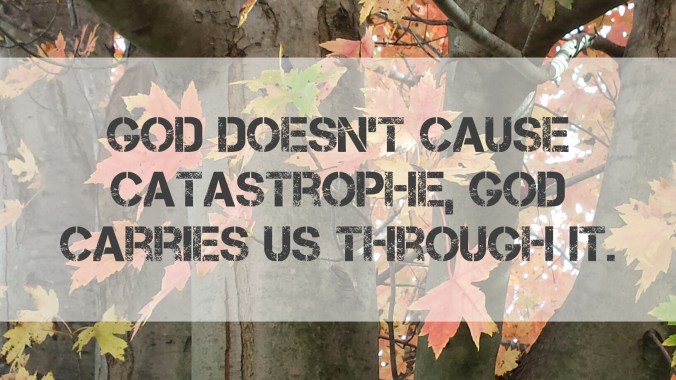
One of the most troubling clichés in Christianity is blaming someone’s misfortune on a lack of faith. Many an action contains the seed of its own consequences, and we want to avoid those tragedies, but catastrophes like illness and natural disasters happen to the faithful, the doubtful, and the indifferent in equal measure. We don’t know the details of why or how the tower of Siloam fell and killed eighteen people, but Jesus – unlike many of today’s televangelists – used the tragedy not to shame the victims, but to point out the need for everyone to repent:

Do you think that they were worse offenders than all the others living in Jerusalem? No, I tell you; but unless you repent, you will all perish just as they did.

In other words, don’t put off until tomorrow what could be prevented forever by a falling tower today.

Why are we eager to link tragedy with sin, especially when Jesus said otherwise (see also “it rains on the just and the unjust” in Matthew 5)? Maybe because we want the world to make sense. Maybe because the inverse proposition is that a lack of tragedy assures us we are doing faith “right.” Maybe because we trust the (imaginary) justice in front of us more than God’s eternal justice. Whatever the reason, Jesus tries to redirect our thinking away from externally-directed blame and inward toward repentance.

Jesus follows up with a parable about a vineyard owner with a fig tree that hasn’t produced fruit in three years (perhaps not coincidentally the length of Jesus’s active ministry). He wants to cut it down, but the gardener asks for one more year to tend and fertilize it. We never learn the fate of the tree.

Rather, it bends us toward God regardless of fortune. Like the fig tree we need to develop roots that dig deep and branches that stretch for the light so we can bear fruit through all kinds of weather. We repent joyfully because God loves us enough to offer a future regardless of our past.

Comfort: Whatever the question, faith is the answer.

Challenge: Think about something in your life you wish would change. Is there something you could change within instead?

Prayer: God of possibilities, do with my life as you will. Amen.

Discussion: How do you typically react to problems that are beyond your control?

Join the discussion! If you enjoyed this post, feel free to join an extended discussion as part of the C+C Facebook group or follow @comf_and_chall on Twitter. You’ll  have the opportunity to share your thoughts with some lovely people. Or feel free to comment here on WordPress, or even re-blog – the more the merrier!

The Multiplication of Division

1477942519638.jpg

Today’s readings (click below to open in new tab/window):
Psalms 5; 145, Zephaniah 1:7-13, Revelation 14:1-13, Luke 12:49-59


Jesus is known as the Prince of Peace, so why would he have told his disciples: “Do you think that I have come to bring peace to the earth? No, I tell you, but rather division! From now on five in one household will be divided, three against two and two against three; they will be divided.” He says sons, fathers, daughter, mothers, and in-laws will be set against each other. Is this the picture of Christianity we try to embrace and promote?

Fortunately, we have the entire Gospel to help us understand the broader context and character of Christ. His vision of love, mercy, and forgiveness was uncompromising. To follow him meant (and often still means) taking a stand against social and religious norms. For many people, such a challenge is unacceptably threatening; truth and mercy don’t always trump the desire to maintain the status quo. In families struggling with dysfunctions of alcoholism or abuse, family members who seek to regain emotional health through counseling and treatment, which necessitate exposing the problem, are often vilified by other family members who believe they benefit from keeping the situation under wraps. Dysfunctional religion involves similar behavior, and people confronting problems are often accused of creating them.

When you stand for what you believe in, you will create enemies, even out of family members. But Jesus tells us to love our enemies and do good to them. He tells us to forgive as many times as we have to. And in the midst of it all we must remain humble, because despite our best efforts to follow Christ, some of the stands we take in good faith … will be mistaken.

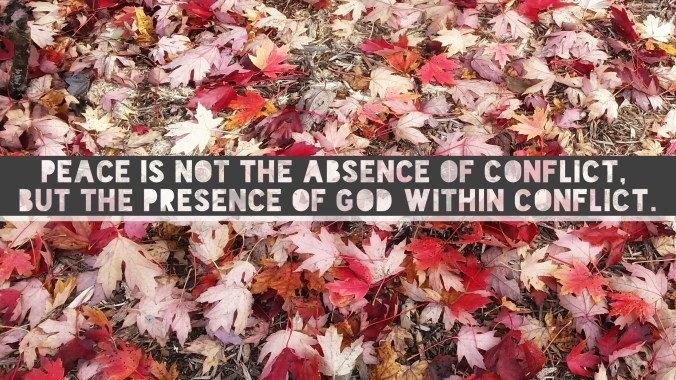
Have you heard of “cheap grace?” There’s also “cheap peace.” It’s the kind of peace defined by an absence of conflict. Cheap asks us to compromise our principles and values to achieve an imaginary state. Divisions will always exist. Real peace, the kind we find in Christ, exists in our hearts and relationships despite passionate arguments and harsh disagreements. We must decide whether to address them by building bridges or walls.

Comfort: Christ brings peace to the most difficult places.

Challenge: Grow your faith not by appeasing your enemies, but by finding ways of doing good to them while holding firm to your values.

Prayer: God of peace and love, I will look for your peace in all situations. Amen.

Discussion: When have you been forced to cooperate on a project at work, home, or church with someone you disagreed with? How did it go?

Join the discussion! If you enjoyed this post, feel free to join an extended discussion as part of the C+C Facebook group or follow @comf_and_chall on Twitter. You’ll  have the opportunity to share your thoughts with some lovely people. Or feel free to comment here on WordPress, or even re-blog – the more the merrier!

Love and Forgiveness

1477883595622-01.jpeg

Today’s readings (click below to open in new tab/window):
Psalms 103; 150, Zephaniah 1:1-6, 1 Corinthians 12:27-13:13, Matthew 18:21-35


Love and forgiveness are intertwined throughout the Gospel, and can’t be untangled. Both find their ultimate source in God: we love because we are loved, and we forgive because we have been forgiven. If we aren’t doing both, we are doing neither. Without both, all our other efforts are wasted. Paul told the Corinthian church:

If I speak in the tongues of mortals a nd of angels, but do not have love, I am a noisy gong or a clanging cymbal. And if I have prophetic powers, and understand all mysteries and all knowledge, and if I have all faith, so as to remove mountains, but do not have love, I am nothing. If I give away all my possessions, and if I hand over my body so that I may boast, but do not have love, I gain nothing.

In a response to a question about how often we need to forgive someone, Jesus told a parable about a slave who was forgiven a large amount of debt by his master, but refused to forgive a debt that was only one hundredth of that amount. The master was angered by this lack of mercy, and demanded both punishment and repayment of the entire original debt.

Through Christ, God forgives us everything. Ev-er-y-thing. What we are asked to forgive others in return is a mere fraction. When in the Lord’s Prayer we pray “forgive us our debts as we forgive our debtors,” we might want to remember both this parable and Paul’s teaching. If I have all faith, but do not have forgiveness … what do I have? I have nothing.

When we struggle to forgive, are we really struggling to believe we are forgiven? And when we struggle to love, is it because we can’t comprehend how much we are loved? Unlike money or time, love and forgiveness are in never-ending supply. There’s no reason to hoard them out of fear. God isn’t going to run out before we get our share. No matter how much love and forgiveness we give away, God promises to replenish our hearts with more.

Comfort: You are loved. You are forgiven.

Challenge: What offenses do you find difficult to forgive? Think about what they say about you.

Prayer: Holy God, forgive me my debts as I forgive my debtors. Amen.

Discussion: Has anyone ever had trouble forgiving you? Why do you think that is?

Join the discussion! If you enjoyed this post, feel free to join an extended discussion as part of the C+C Facebook group or follow @comf_and_chall on Twitter. You’ll  have the opportunity to share your thoughts with some lovely people. Or feel free to comment here on WordPress, or even re-blog – the more the merrier!

Big Rocks

1477795723284.jpg

Today’s readings (click below to open in new tab/window):
Psalms 63; 149, Nahum 3:8-19, Revelation 13:11-18, Luke 12:32-48


Dr. Stephen Covey tells a story about a professor trying to teach his students a life lesson. He puts some large rocks in a jar until no more will fit. Everyone agrees the jar looks full, but he pulls out some gravel and pours as much as he can to settle between the rocks. Everyone again agrees the jar looks full, so he pulls out some sand and pours it in to fill every last bit of space. The point of the story is not that you can always fit more in, but that you have to start with the big stuff.

Jesus beat Dr. Covey to the point by about two thousand years when he said, “For where your treasure is, there your heart will be also.”

Faith is a big rock, but because we know God is always going to be there, it’s easy to think we can drop it into the jar of life at any time. While we delay, the less important things fill our lives like sand pouring into an hourglass. We say, “I will have time for mission projects after work settles down” or “I will give to charity after my car is paid off.” Except work never settles down, and there’s always another bill to pay, so before we know it the jar is topped off and the big rocks never make it in.

Most of us aren’t prepared for how busy and difficult life can get, and in the heat of the moment we mistake the urgent for the important. Intentions mean nothing if we don’t prioritize them. When there’s a discrepancy between what we say is important, and what we devote our time and resources to, we better examine the contents of our jar or the content of our heart. If good intentions pave the proverbial road to hell, it’s a road paved in sand and gravel.

It’s not too late. Christ has a fresh, new jar waiting for you. Let go of the sand that filled the old one, and let him show you where to find the big rocks.

Comfort: Being intentional about the big things, and the small things will fall in place.

Challenge: Do a time study of your week. Are you spending time where you think you are? Where you think you should be?

Prayer: Lord of Heaven and Earth, I will honor you with the first fruits of my time, my talents, and my treasure. Amen.

Discussion: Is there a story – Biblical or otherwise – that leaves you wondering what happens next?

Join the discussion! If you enjoyed this post, feel free to join an extended discussion as part of the C+C Facebook group or follow @comf_and_chall on Twitter. You’ll  have the opportunity to share your thoughts with some lovely people. Or feel free to comment here on WordPress, or even re-blog – the more the merrier!

Worry: about that hour you’ll never get back…

1477680614272-01.jpeg

Today’s readings (click below to open in new tab/window):
Psalms 84; 148, Nahum 2:13-3:7, Revelation 13:1-10, Luke 12:13-31


Worry-mongering is a profitable business strategy – more profitable even than fear. Where fear is a reaction to something real and bad, worry anticipates something that might be bad. If the bad thing goes away, or turns out not to be so bad after all, fear ends. Worry is sustainable, a cash cow that never runs short of milk, and always ready for exploitation by media and marketers. Plant a seed of worry about national security or the inevitability of aging, and reap a harvest in sales of body scanners or anti-wrinkle serums.

Jesus asked his disciples: “Can any of you by worrying add a single hour to your span of life?” Ironically, not only does the stress of worry not add to our life, it decreases the quality, health, and length of that life. Jesus taught not to worry about food or clothing; if God provided for birds and the lilies of the field, how could he not do that and more for His children? Instead, he said, we should “strive for the kingdom” and everything else will fall into place.

We’d like to believe that, but modern life saps our confidence in those ideas.

Or not. Two thousand years ago Jesus was reminding people: “One’s life does not consist in the abundance of possessions” … and back then there was far less for the average person to possess. Could it be that life is not more stressful, but that we’ve always needed to hear the same message? We have access to more products than we could need in ten lifetimes, so as the forces of consumerism grow ever more sophisticated, they market less to our needs and more to a generalized sense of anxiety that demands to be fed but is never satisfied.

In many traditions, including the Christian one, enlightenment involves simplification and detachment. The biggest thing we have to give up, and what the world tries hardest to sell us, is the fear that God alone is not enough. It’s also the only thing, because once we’re rid of it the rest really does fall into place.

Comfort: You are not your stuff.

Challenge: Get rid of unnecessary stuff.

Prayer: Loving and merciful God, I will trust in you alone. Amen.

Discussion: Have you ever been relieved to let go of something you held onto for a long time?

Join the discussion! If you enjoyed this post, feel free to join an extended discussion as part of the C+C Facebook group or follow @comf_and_chall on Twitter. You’ll  have the opportunity to share your thoughts with some lovely people. Or feel free to comment here on WordPress, or even re-blog – the more the merrier!

Truth Will Out

1477626570532.jpg

Today’s readings (click below to open in new tab/window):
Psalms 116; 147:12-20, Nahum 1:15-2:12, Revelation 12:7-17, Luke 11:53-12:12


The next time someone wonders what a first century messiah has to say to a twenty-first century audience, haul out this passage from Luke:

Nothing is covered up that will not be uncovered, and nothing secret that will not become known. Therefore whatever you have said in the dark will be heard in the light, and what you have whispered behind closed doors will be proclaimed from the housetops.

We live in an age when secrets are practically extinct. Social media accounts get hacked. Classified information gets leaked. Omnipresent cameras record us without our knowledge or consent. And any of this information can be distributed around the globe with the click of a Send key. Yet many of us go about our business as though privacy still exists.

Ever heard of the New York Times Rule? In a nutshell it says: don’t say, do, or write anything you wouldn’t want to see on the front page of the newspaper. Not everything we prefer to keep private is shameful, but the NYT Rule can be a good benchmark for decision-making. More than any time in history, we should understand how quickly a whisper becomes a scream. Barely a day goes by without some celebrity, politician, or hapless schmuck getting caught in a scandal of exposed secrets.

ll of us have moments we’d rather not see in a headline, but the key to not crashing against the rocks of scandal is simple: integrity. If it seems too obvious, consider the endless parade of people exposed for hypocrisy and corruption. Now multiple that by a large number to understand how many people haven’t been caught (yet). In the two thousand years since Christ told us secrets would be uncovered, we don’t seem to have taken that message to heart.

Be the person you want people to think you are. And if you can’t be that person, don’t pretend to be what you’re not. Better to be a flawed witness to Christ’s love and forgiveness than a Pharisee who “clean[s] the outside of the cup […], but inside [is] full of greed and wickedness.”

Comfort: Integrity protects you from all kinds of trouble.

Challenge: In the evenings, reflect on your day. Ask yourself which parts you wouldn’t want to have exposed to the world, and how you can change for the better.

Prayer: Lord, help me to walk in my integrity and to trust You without wavering. Amen.

Discussion: What damage have you seen secrets cause?

Join the discussion! If you enjoyed this post, feel free to join an extended discussion as part of the C+C Facebook group or follow @comf_and_chall on Twitter. You’ll  have the opportunity to share your thoughts with some lovely people. Or feel free to comment here on WordPress, or even re-blog – the more the merrier!

In(ter)dependence Day

1477540532268.jpg

Today’s readings (click below to open in new tab/window):
Psalms 96; 147:1-11, Nahum 1:1-14, Revelation 12:1-6, Luke 11:37-52


We admire independence. We sing the praises of the self-sufficient, the self-made, and the independently wealthy. And yet … it is largely a myth. While relying on someone else is often portrayed as a weakness, the human condition is primarily one of interdependence. We rely on each other in ways large and small.

American Christians tend to speak of salvation in fairly independent terms – my personal relationship with Christ; the day I was saved; etc. Yet Jesus and the prophets spoke of salvation in terms of entire nations. Jesus said several times he came for the nation of Israel. He condemned the Pharisees and lawyers not just for their own misdeeds, but for hindering others from entering the kingdom. When the prophet Nahum spoke about God’s wrath falling on the city of Nineveh, the capital of Assyria, he spoke to them as a people; the righteous would also pay for the deeds of the unrighteous. Does this seem unfair? Unjust?

Whether we recognize it or not, others depend on us for salvation. Our witness is only as credible as our character. Many people have turned (or been driven) from the faith because of the misbehavior and hypocrisy they experience in Christian community. Must we be perfect? Of course not. We should, however, remain aware that once we call ourselves Christians, our example teaches people what to expect from Christ.

Perhaps we think people are responsible for their own salvation, and perhaps ultimately they are, but such thinking diminishes the faithful parents, teachers, mentors, and friends who introduced us to our beliefs and helped us through hard times. People who are swayed by bad examples are no weaker or less deserving than we who had the benefit of good ones. Of people who cause others to lose faith, Jesus says: “It would be best for that person to be thrown into the sea with a large stone hung around his neck.”

A community rises or falls together because its tangle of cause and effect can’t be teased apart. Whether our interdependence is a blessing or curse is entirely dependent on us.

Comfort: You don’t have to go it alone.

Challenge: As you go about your daily business, think about all the things other people do to make it possible for you to do the things you do.

Prayer: Holy and loving God, may I be a worthy witness for you. Amen.

Discussion: When have you been forced to depend on someone? How did it make you feel?

Join the discussion! If you enjoyed this post, feel free to join an extended discussion as part of the C+C Facebook group or follow @comf_and_chall on Twitter. You’ll  have the opportunity to share your thoughts with some lovely people. Or feel free to comment here on WordPress, or even re-blog – the more the merrier!
Good Losers

1477450551217.jpg

Today’s readings (click below to open in new tab/window):
Psalms 12; 146, Jonah 3:1-4:11, Revelation 11:14-19, Luke 11:27-36


Do you have to get your way to be happy? If so, brace yourself for a lot of disappointments.

God sent Jonah to Nineveh to warn the people there to repent or be destroyed. Jonah hated the Ninevites, so not only did he not want to be there in the first place, he really didn’t want them to be saved. Yet repent they did, and rather than be happy an entire city had turned to the Lord, Jonah went to the outskirts of town and pouted. The Lord caused a bush to grow to give him shade, and for a brief time Jonah was happy. Then the Lord “appointed a worm” to destroy the bush, and Jonah resumed his griping.

The Lord asked Jonah how he could be so upset about a day-old bush he hadn’t even grown himself, yet expect the Lord not to be concerned about a hundred and twenty thousand people who had lost their way.

We are going to be put in a lot of situations where we don’t get what we want. The new music director may go contemporary when we prefer classic. The presidential candidate we voted for could lose. The in-laws might insist on cooking the dressing inside the turkey when it is clearly safer not to. How do we react to these and the countless serious and trivial disappointments we will face?

When we are presented with a choice of resentment and sabotage, or working toward reconciliation, let’s remember that Jonah did not turn out to be the hero of his story. He hated the Ninevites because they had enslaved his people. Jonah’s bitterness prevented him from seeing that calling them to repentance was a victory which neither compromised him nor excused them, but vindicated the loving nature of the God of Israel.

How we behave in defeat says more about our character than winning ever will. We don’t have to betray our values to work for the greater good of a family, congregation, or nation. Dodging responsibility and sulking on the periphery serves no one well, least of all our God.

Comfort: Your happiness does not depend on getting your way.

Challenge: Do something nice for someone you don’t particularly like.

Prayer: God of reconciliation, may I be gracious and defeat and generous in victory. Amen.

Discussion: Do you prefer games that are competitive or cooperative?

Join the discussion! If you enjoyed this post, feel free to join an extended discussion as part of the C+C Facebook group or follow @comf_and_chall on Twitter. You’ll  have the opportunity to share your thoughts with some lovely people. Or feel free to comment here on WordPress, or even re-blog – the more the merrier!

Silenced

20161024_232624.png

Today’s readings (click below to open in new tab/window):
Psalms 62; 145, Jonah 1:17-2:10, Revelation 11:1-14, Luke 11:14-26


Along his travels, Jesus encountered a man who was rendered mute by a demon. Jesus cast the demon out and the man began to speak. The crowd was amazed, through some of them claimed Jesus cast out demons because he trafficked with demons. He rebuked them by saying a kingdom divided against itself could not stand.

Dark forces always prefer our silence. For centuries the demons of racism, sexism, poverty, homophobia, religious persecution, and other persuasions have silenced countless people. Fears of rejection and retaliation muffle our truths. From slavery through suffrage through the civil rights era through today, the Bible itself has been used to dismiss generations of cries for justice. We effectively silence each other by refusing to listen: if your candidate, doctrine, or experience differs significantly from mine, too often I reject it outright without considering what it has to say about mine.

When I am forced to listen, if your words make me uncomfortable, I will find excuses to discredit them. Maybe I can’t pin it on Beelzebub, but your party, nationality, education, income, or number of piercings conveniently justifies my suspicions.

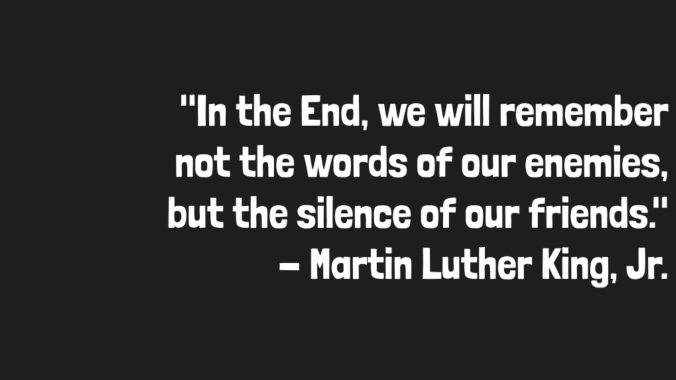
Fortunately, Christ’s power and love ultimately loose the tongues of the oppressed. God’s Kingdom is united around the language of justice. How do we make sure that kingdom is not divided? Martin Luther King, Jr may have summed it up best: “Injustice anywhere is a threat to justice everywhere.” We must recognize that the injustice which concerns us does not stop with the relief of our own oppression, or that of people like us, but extends to such relief for all God’s beloved children. The members of a united house speak truth to each other, especially when the house is in need of repair to keep it from collapsing under its own failings.

When Jesus restores our voice, let us use it wisely and compassionately. When others undermine and defame us, let us remember we are a kingdom united around justice. In the words of James Weldon Johnson:

Lift every voice and sing
Till earth and heaven ring,
Ring with the harmonies of Liberty.

Comfort: You have  a voice that deserves to be heard.

Challenge: Try to listen for voices you have been dismissing.

Prayer: Creator God, I lift my voice in praise and love to you. May I join with all of creation in singing your song of love. Amen.

Discussion: When have you felt like you weren’t heard?

Join the discussion! If you enjoyed this post, feel free to join an extended discussion as part of the C+C Facebook group or follow @comf_and_chall on Twitter. You’ll  have the opportunity to share your thoughts with some lovely people. Or feel free to comment here on WordPress, or even re-blog – the more the merrier!