Everything That Breathes

EVERYTHINGTHATBREATHES

Today’s readings (click below to open in new tab/window):
Psalms 103; 150, Joshua 1:1-18, Acts 21:3-15,Mark 1:21-27


Praise and worship are essential to our relationship with God. Psalm 150 exemplifies praise for its own sake – not because of what God has done for us, but simply because God is worthy of praise.

What do people value in a worship service? A majority of respondents to one survey claimed how it “made them feel” was most important. A close second was liking the musical style. Interesting results, considering the focus of our worship is supposed to be God, not ourselves and our preferences. It can be easy to confuse closeness to God with good feelings. Services crossing the line into entertainment (or even group therapy) facilitate such confusion. Emotions heightened through catchy music and enthusiastic crowds are a spiritual hit that fade quickly. Focus on God, rather than on how the experience makes us feel, provides a deeper connection.

Since worship services are often built around the attitudes and demands of the congregation, what is our responsibility? Well, we can set our hearts on God, regardless of whether a particular song choice “speaks to us” or drums up the warm fuzzies. We can set our minds on what we bring to worship, rather than what we take away. Many people stop attending services during times of personal crisis. Could this be because we associate worship with only good feelings, and feel pressure to put on a happy face? We can turn to many psalms as examples of praising through pain.

“Hold on,” we might say, “isn’t my church supposed to fulfill me in some way?” That’s an awful lot to expect from one hour-long service. We are more likely to find fulfillment through participation in the life of a church community. We often let feelings dictate our actions, though actions powerfully influence our feelings. Sharing community actions of justice, love and mercy is a natural extension of Sunday worship – a chance to open ourselves up to God working in our lives, and the lives of others. We don’t develop our spiritual muscles when the church hands us lightweight sentiment, but when we engage in genuine praise and worship and do the rest of the heavy lifting ourselves.

Comfort: Our faith is stronger than our feelings.

Challenge: At the next worship service you attend, be intentional in singing songs to God, and not just about God.

Prayer: Lord of Heaven and Earth, I praise you as creator of all. Amen.

Discussion: It’s entirely possible for a worship experience to be both emotionally moving and focused on God. Have you ever experienced a service or church that strikes this balance well?

Join the discussion! If you enjoyed this post, feel free to join an extended discussion as part of the C+C Facebook group. You’ll be notified of new posts through FB, and have the opportunity to share your thoughts with some lovely people. Or feel free to comment here on WordPress, or even re-blog – the more the merrier!

Vigilance

no_one_knows

Today’s readings (click below to open in new tab/window):
Psalms 63; 149, Deuteronomy 34:1-12, Romans 10:14-21, Matthew 24:32-51


vigilant (adj.): 1. keenly watchful to detect danger; wary; 2. ever awake and alert; sleeplessly watchful (dictionary.com).

Are we vigilant about our spiritual lives? What might such vigilance look like? Jesus offered various examples of vigilant (and non-vigilant) people. Regarding vigilance he was speaking specifically of the day of judgment, but the lesson is applicable to other important events that will occur at an unknown time – including our own deaths.

Two workers in a field, but only one taken at the end. Two women grinding grain, but one left behind. A homeowner unprotected against thieves in the night. Jesus gives no details about what separates the field workers and women who are taken from those who are not. The homeowner has no way of knowing which night to stay awake to catch the thief. These examples tell us why we need to be vigilant, but not how. In a longer parable, he tells us about a good slave who is performing his job admirably while awaiting his master’s return, and a bad one who is wasting time and money that do not belong to him.

In a nutshell, vigilance is doing what we’re supposed to be doing, every day. None of the vigilant people are making extraordinary “holy” efforts. None are busy trying to figure out when the big event is most likely to occur. None are in a worship service others neglect. They are working. Grinding. Living.

Perhaps this is how we are to exercise vigilance: do our best to discern how God wants us to live, and make it our daily practice to do so. Waiting for the “right day” to stop gossiping or to start caring for the poor is a dangerous gamble: like the bad slave, we don’t know when our time might be up.

Many of us assume (with either fear or hope) that God’s demands will require extraordinary effort, and therefore put off our attempts to fulfill those demands until everything is in place. Does a preoccupation with extraordinary efforts distract us from the true vigilance of daily living? Instead of being overwhelmed, let’s find comfort in Jesus’s use of common laborers, rather than prophets or priests, as his examples of the vigilant. We don’t need to be scholars, seers, or sages to be vigilant. We just need to be the people God created us to be.

Comfort: God has given us lives that prepare us for His presence.

Challenge: At the end of the day, make notes of when you were and were not spiritually vigilant.

Prayer: Gracious and Merciful God, thank you for your presence in my daily activities. Amen.

Discussion: When do you feel like you’re living as God would have you live? How do you struggle with that idea?

Join the discussion! If you enjoyed this post, feel free to join an extended discussion as part of the C+C Facebook group. You’ll be notified of new posts through FB, and have the opportunity to share your thoughts with some lovely people. Or feel free to comment here on WordPress, or even re-blog – the more the merrier!

For Better or Verse

1468018925028.jpg

Today’s readings (click below to open in new tab/window):
Psalms 84; 148,g Deuteronomy 31:7-13, 31:24-32:4, Romans 10:1-13, Matthew 24:15-31


What’s the number of your favorite New Testament verse? Only 500 years ago, that would have been a nonsense question. Before the 16th century, the New Testament was not divided into verses in any generally accepted manner. Before the 13th century, it wasn’t even divided into standard chapters! Today, we can scarcely imagine taking part in a Bible study without being able to flip to the proper chapters and verses on demand.

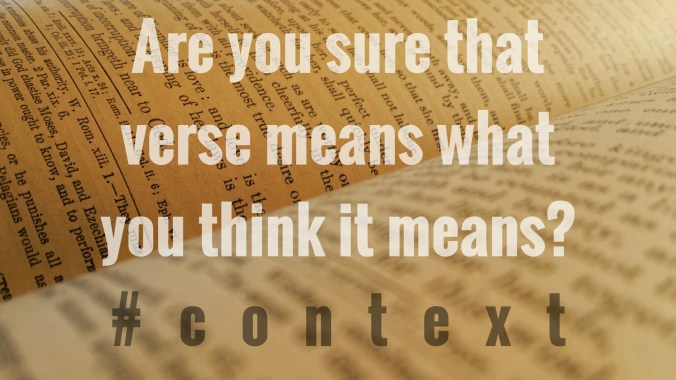
But do verses help or hinder our relationship with the text?

A devotional that depends on scheduled readings might seem like an odd place to bring up the dangers of versification, but today’s Epistle reading is a good example of the importance of context. Paul’s letter to the Romans is a rich and complex document. Each section builds upon the content of the previous sections. Today’s text continues Paul’s exploration of the continued role of the Jewish people in God’s plan for salvation. Out of context, it could be presented as an outright condemnation. As part of a larger document, it helps build an argument that God is the God of all people, whether Jewish or Gentile.

Beyond the immediate context of Romans itself, it helps to know Paul wrote this letter as Jews were returning to Rome after being expelled for five years by the Emperor Claudius. The church they returned to was increasingly Gentile in character. Part of Paul’s reason for the letter was to relieve tensions between clashing sects of Christianity.

Understanding the Bible involves more than memorizing verses and pulling out proof-texts. While verse identification is a helpful reference tool, it should not limit our study or – worse yet – reduce the Bible to a collection of favorite, context-free quotes. Reading the full text and exploring the historical context will provide a much deeper experience. Even lectionary readings might be enriched by looking back and reading ahead!

The New Testament was composed over decades by many authors, none of whom wrote their work in verses. When we try to read the text as they wrote it, our appreciation and comprehension can only grow.

Comfort: The Bible is greater than the sum of its verses!

Challenge: Before the end of the month, research the historical context of one of the New Testament books, and notice how it affects your understanding of the text.

Prayer: Gracious and Merciful God, we thank you for the living words of scripture. Amen.

Discussion: Do you have a favorite Bible verse?

Join the discussion! If you enjoyed this post, feel free to join an extended discussion as part of the C+C Facebook group. You’ll be notified of new posts through FB, and have the opportunity to share your thoughts with some lovely people. Or feel free to comment here on WordPress, or even re-blog – the more the merrier!

Give ’em a break…

singanewsong

Today’s readings (click below to open in new tab/window):
Psalms 96; 147:1-11, Deuteronomy 1:1-18, Romans 9:1-18, Matthew 23:27-39


The twenty-third chapter of Matthew contains some of Christ’s most scathing criticism of the scribes and Pharisees. He compares them to whitewashed tombs – spotless outside but full of decay. He calls them a brood of vipers. He accuses them of building tombs for prophets they had murdered while they claimed “If we had lived in the days of our ancestors, we would not have taken part with them in shedding the blood of the prophets” … on one hand denouncing a murderous tradition while enthusiastically embracing it with the other.

This is the part where we can sit back, think of all the vipers in our own lives, and enjoy Jesus really letting those hypocrites have it!

Or is it?

Maybe this is the part where give the Pharisees a break. Or if not a break, a little empathy. If we look at them and say “that would never have been me!” we make the same mistake they did. Of course we like to believe that even under identical circumstances we would be different – better – than people who have made bad choices. For a few noble souls it may even be true. But most of us are not exceptional; we are doing the best with what we have, and failing more often than we’d like.

If we can entertain the idea that we might have been pharisaical … that if we’d been less privileged by intelligence or class we might have found ourselves in prison … that we might have been in the crowd that loved Jesus right up until it began shouting “Crucify him!” … we may find it a little easier to show compassion and forgiveness.

Romans 3:23 tells us all have sinned and fall short of the glory of God. Short is short and all is all: since the scale of God’s glory is infinite, our relative distance from it is irrelevant. Thinking other people’s sins are greater than our own robs us of compassion. Believing our sins are greater than other people’s robs us of hope. To be heirs of the kingdom, rather than heirs to the murderous tradition, we only have to believe Jesus died for all of us equally.

Comfort: Jesus offers forgiveness to everyone, including you.

Challenge: Jesus asks us to offer forgiveness to everyone, including ourselves.

Prayer: God of mercy, help me to keep a humble and loving heart. Amen.

Discussion: How do you think our secular culture influences our ability to feel compassion?

Join the discussion! If you enjoyed this post, feel free to join an extended discussion as part of the C+C Facebook group. You’ll be notified of new posts through FB, and have the opportunity to share your thoughts with some lovely people. Or feel free to comment here on WordPress, or even re-blog – the more the merrier!

Gold or Sanctuary?

20160629_082105.jpg

Today’s readings (click below to open in new tab/window):
Psalms 12; 146, Numbers 35:1-3, 9-15, 30-34, Romans 8:31-39, Matthew 23:13-26


Jesus spoke harsh words against the hypocrisy of the scribes and Pharisees. He called them “blind guides” – people pretending to lead but actually walking the faithful and converts alike off a spiritual cliff. He had no patience for a temple where gold and gifts were revered more than the sanctuary and altar that made them holy, where tithes of spices were more important than justice, mercy and faith. He compared them to cups polished on the outside, but filthy inside.

Today Jesus might not find coffers of gold and cumin in our sanctuaries, but he could find plenty to criticize. While there’s nothing wrong with a beautiful sanctuary – God himself directed the creation of a beautiful temple in Jerusalem – there is a problem when the image outshines the substance. A church is holy because of its character, not because of its “success.” The scandal of some churches – regardless of denomination (or lack thereof) – is not that their leadership sins, but that they collude to cover it up.

Looking the other way when our house of worship bullies, excludes, discriminates, exploits, ignores, or otherwise abuses people is never acceptable. Teaching a prosperity gospel that impoverishes the congregation while filling the pockets and three-car garage of the pastor is a betrayal of the gospel. Yet people turn a blind eye to wrongdoing in a misguided attempt to preserve the dignity of the church. Making an idol of the reputation of a corrupt institution to attract and retain members is like handing out candy you know is poisoned.

Better to worship in an outhouse crowded with the shopworn meek than a cathedral packed with gleaming hypocrites.

Christians are often taught to be nice to each other, but nice is not the same as just. Nice transfers abusive clergy without causing a commotion; just disciplines them. Nice prevents us from calling someone out for discriminating; just knows embarrassment is not worse than discrimination. Nice makes sure the cup is polished, just makes sure the contents are safe. We don’t need the world to think we are nice; we need to show the world that even when we are flawed, we strive for the just.

Comfort: You are allowed to speak up.

Challenge: Sometimes speaking up is hard; do it anyway.

Prayer: God of Justice, help us build a health church body. Amen.

Discussion: When have you spoken up, even though it might have been unpopular?

Join the discussion! If you enjoyed this post, feel free to join an extended discussion as part of the C+C Facebook group. You’ll be notified of new posts through FB, and have the opportunity to share your thoughts with some lovely people. Or feel free to comment here on WordPress, or even re-blog – the more the merrier!

Sigh

sighstoodeep

Today’s readings (click below to open in new tab/window):
Psalms 62; 145, Numbers 32:1-6, 16-27, Romans 8:26-30, Matthew 23:1-12


We are a species driven by language. Some philosophers claim language is a necessary precedent to thought as we understand it. In Genesis, God speaks creation into existence. Is language also necessary for prayer? Paul would not seem to think so. He might even go so far as to suggest it could be an impediment to true prayer. He writes: “we do not know how to pray as we ought, but that very Spirit intercedes with sighs too deep for words.”

As much as we rely on words to express our feelings, many of the emotions we experience are beyond them. How do we express these things? Sometimes through poetry, which subverts the definition of words to uncover what they cannot say directly. Or maybe through music which has the power to communicate directly with the body and bypass words altogether. And of course there is art of all kinds which recombines the intent of the artist and the perception of the viewer into an ever more powerful third experience which is shared yet unique.

Then there is prayer. In some circumstances it’s a set of shared words; in others, a shared silence. Sometimes it’s not shared at all. Prayer is a tool which – usually gently, but forcefully when necessary – pries apart the seams of hardened ego to expose our inner, vulnerable selves to the God who gives us life, meaning, and comfort. It re-establishes that connection through a language with a single, inexpressible word for everything that is: horror and beauty; grief and joy; rage and peace; pain and bliss. When we need to share these things with our God and don’t know how, the sigh of the Spirit is that word.

Never beat yourself up over not knowing the “right” way to pray. Paul admitted he didn’t. The Spirit is also known as the Advocate, or one who pleads on behalf of another. Whether you are expressing gratitude or anger, using words or not, the Spirit sighs on your behalf. Prayer is a decision to be in the presence of God. It’s simplest form: Inhale. Exhale. Be. Repeat.

Comfort: God knows what is in your heart, always.

Challenge: Even when you are angry with God, take time to pray.

Prayer: God of all that is, I come to you naked and helpless as a babe, trusting in your goodness and love. Amen.

Discussion: When do you find it difficult to pray?

Join the discussion! If you enjoyed this post, feel free to join an extended discussion as part of the C+C Facebook group. You’ll be notified of new posts through FB, and have the opportunity to share your thoughts with some lovely people. Or feel free to comment here on WordPress, or even re-blog – the more the merrier!

Conviction

Today’s readings (click below to open in new tab/window):
Psalms 54, 146, Numbers 22:21-38, Romans 7:1-12, Matthew 21:23-32

Does a vision without a voice have any value? In the pre-civil rights era, many preachers in white churches personally believed in desegregation, but were reluctant to say so from the pulpit. They feared alienating their congregations and losing members. Not many years ago, during a panel discussion on whether to ordain gay clergy, several pastors said they personally supported it, but that taking such a stand would drive their congregations to either fire them or leave the denomination. Only one pastor in attendance had the courage to say: “Let them leave.” Personal convictions, especially regarding matters of justice, mean nothing if we remain silent about them

The difference between a pastor and a prophet is often their willingness to (pardon the language) piss people off. A pastor is beholden to an audience; if he or she drives members away, they will likely be fired or transferred. A prophet is beholden only to God and conscience. Telling people what they want to hear in order to remain in power is the purview of politicians, not clergy.

When the chief priests and elders asked Jesus by what authority he preached, he countered by asking them: “Did the baptism of John come from heaven, or was it of human origin?” They dithered among themselves, trying to determine which answer would cause the fewest problems: if they said “from heaven” they would have to admit they’d been hypocrites, but if they said “from man” the people who followed John might turn on them in anger. At no point in the conversation does it seem they asked themselves: “What do we believe is the truth?” They answered, “We do not know.”

No one can truly lead people they fear to displease. When our pastors and priests are willing to tell us something we won’t like – something that may even anger us – we are not obligated to agree with them, but it is an indicator of their integrity. And when we are called upon to lead, we must not equivocate, but instead be clear in our words and intentions. If we wait to take a stand until most of the danger of doing so has passed, we have done nothing at all.

Comfort: You can’t make everyone happy, so don’t try.

Challenge: If the just opinion is unpopular, speak it anyway.

Prayer: God of Justice, give me courage to serve you boldly. Amen.

Discussion: When do you regret not speaking up?

Join the discussion! If you enjoyed this post, feel free to join an extended discussion as part of the C+C Facebook group. You’ll be notified of new posts through FB, and have the opportunity to share your thoughts with some lovely people.

Hard Choices

choices

Today’s readings (click below to open in new tab/window):
Psalms 57; 145, Numbers 22:1-21, Romans 6:12-23, Matthew 21:12-22


According to the Gospel of Matthew, the first thing Jesus did after his triumphant entry into Jerusalem was drive merchants and customers out of the temple, and turn over the tables of the money changers. Matthew tells this story quickly and makes it clear Jesus is upset because: “It is written, ‘My house shall be called a house of prayer’; but you are making it a den of robbers.” Once the temple was cleared, blind and lame people came to Jesus there, and he healed them.

Notice that Jesus didn’t kick out just the sellers, but also the buyers. The sellers and money changers may have been exploiting religious pilgrims, but the buyers were also participating in the corruption of the temple. Surely many of the customers, if asked, would have said they had no choice; without offerings they could not enter the temple. But when their practices finally caught up with them, they were driven from the temple anyway.

Often when we say we don’t have a choice, what we really mean is we don’t have an attractive choice. “If I say something about this unethical practice, I’ll lose my job.” That’s a choice. “I know this business treats its employees more fairly, but their prices are too high so I shop elsewhere.” Also a choice. “I know this song-sharing site is illegal, but money is tight right now.” Choice (and theft). Principles are  not cheap. They can cost us money, respect, and friendships. If we aren’t willing to risk these things, we don’t have principles, we have preferences – and not even strong ones.

Of course these are examples of choices available to the reasonably comfortable. Sometimes our choices actually are restricted by circumstances such as poverty and ability.  Many of us are crowded out by the “buyers and sellers” going about their daily, unexamined business. It is on the shoulders of people who have many options to consider how they are impacting those with fewer options. Luke 12:48 tells us: “From everyone who has been given much, much will be required; and to whom they entrusted much, of him they will ask all the more.”

When a system is corrupt or unjust, we have the choice to opt out, even if it causes us inconvenience or harm. Jesus opted out all the way to the cross.

It’s never too late to start behaving more ethically. We might need to jump-start that change with a purging of our inner temple, a ruthless examination of our own participation in evils small and large. Clearing them out makes room for the healing spirit of God. There is nothing more valuable in the world.

Comfort: You will always have a choice.

Challenge: You won’t always like the choices you have.

Prayer: God of wisdom, grant me the discernment to make good choices, and the courage to follow through on them. Amen.

Discussion: Have you ever felt like you didn’t have a choice? Was that really the case?

Join the discussion! If you enjoyed this post, feel free to join an extended discussion as part of the C+C Facebook group. You’ll be notified of new posts through FB, and have the opportunity to share your thoughts with some lovely people.

The Promise of History

1466826170170.jpg

Today’s readings (click below to open in new tab/window):
Psalms 130; 148, Numbers 20:1-13, Romans 5:12-21, Matthew 20:29-34


Despite leading the Israelites through the desert for forty years, Moses was forbidden by God to enter the Promised Land. Why? At Meribah the people had quarreled with Moses because they lacked sufficient food and water. The Lord had commanded Moses to speak to a rock, and waters would gush forth. Once before God had produced waters from this rock and had instructed Moses to strike it. This time, instead of speaking, Moses struck the rock with his staff twice, and seemingly took credit for the miracle.

Some people believe this direct disobedience caused God’s rebuke, though all things considered this seems like a pretty minor infraction. God is entitled to do whatever He wants, but He is not petty. Thirty-eight years earlier the Israelites had balked at God’s orders to enter the Promised Land, and instead sent spies ahead to make sure it was worth the effort. In His anger God decreed none of the current generation – including Moses – would enter the Promised Land. Their children would see it after their deaths.

Our sense of history can be short. When we experience a painful event – a revolution, a shooting, a divorce, a riot – we tend to look to recent circumstances to explain it. We find comfort in assigning blame to the easiest – and usually closest – targets, but we frequently do so hastily, lazily, and mistakenly. The roots of our troubles often run deep in time: generational poverty, unredressed discrimination, legacies of domestic abuse, complicated political histories, etc. Understanding the world is difficult work, but willful ignorance leads to yet more difficulty. Even if we can’t solve these problems in our lifetimes, we should reject quick-fixes and easy answers and provide thoughtful, faithful leadership to deliver the next generation into the Promised Land.

Comfort: The world is a complicated place. You don’t have to form quick opinions about it.

Challenge: Few answers are both easy and correct. Don’t settle.

Prayer: Eternal God, grant me wisdom and patience to be a steady, healing presence in a sometimes thoughtless, broken world. Amen.

Discussion: What opinions about the world have you had to revise based on more evidence or better understanding of history?

Join the discussion! If you enjoyed this post, feel free to join an extended discussion as part of the C+C Facebook group. You’ll be notified of new posts through FB, and have the opportunity to share your thoughts with some lovely people.

Ask? Away!

HearAnswer

Today’s readings (click below to open in new tab/window):
Psalms 36; 147:12-20, Numbers 17:1-11, Romans 5:1-11, Matthew 20:17-28


James and John were brothers and apostles. One day their mother asked Jesus: might her sons sit at his left and right hands in heaven? Jesus said the favor their mother asked was beyond his power to grant. The other ten apostles were outraged when they learned of the request, but Jesus assured them that in God’s kingdom, leaders were not masters but servants. They were upset not that the favor had been granted, but that it was asked.

A church that was active in resettling refugees, particularly people fleeing the violence of the Congo with nothing but the clothes on their backs, sometimes posted lists of needed household items. One woman – who was not ungenerous and frequently delivered baskets of groceries to the food pantry – would look at the lists and mutter, “Always looking for a hand out.”

We get offended when people ask for things the “wrong” way. One of the first lessons I learned on missions trips is that what we are prepared to give may not be what people need. Someone who arrives with the skills to replace a damaged roof can be taken aback when instead they they are asked to scrub floors, as if that task is somehow beneath them. We can talk a good game about being servants, but unless we are willing to surrender control and serve under someone else’s terms, it’s just talk.

Most adults don’t like to ask for things because we fear being characterized as weak or lazy. We resent what people ask of us when they are things we are ashamed to ask for ourselves. John and James were devoted. Refugees are in need. Hurricane survivors are perfectly capable of prioritizing tasks. To be able to ask, to lovingly consider what is asked … these are signs of servant leadership.

Comfort: It’s OK to ask for what you need.

Challenge: Watch this TED Talk on the Art of Asking by Amanda Palmer. It’s been criticized for being class- and context-blind, but pay careful attention to your own reactions.

Prayer: God of generosity, give me the courage to ask for what I need, and the loving heart to respond graciously to the needs of others. Amen.

Discussion: What are you afraid to ask for? Why?

Join the discussion! If you enjoyed this post, feel free to join an extended discussion as part of the C+C Facebook group. You’ll be notified of new posts through FB, and have the opportunity to share your thoughts with some lovely people.