For Prophet

for_prophet

Today’s readings (click below to open in new tab/window):
Psalms 15; 147:1-11, Numbers 16:36-50, Romans 4:13-25, Matthew 20:1-16


Several years ago my boss asked me to implement a survey of our board members and executives. When the due date for responses had passed, and only eight percent of the people had responded, he extended the due date. This happened twice more, and each time I grew increasingly frustrated and felt we were coddling the late respondents. When I asked why we were rewarding bad behavior, my boss explained: “The goal of this project is not to hold people to a schedule. It is to maximize participation so we have the best and most complete result.” His explanation changed my whole perception of the project.

One imagines people might have felt much the same way after Jesus told the parable of the workers in the vineyard. In that story, the owner of a vineyard hired men at various times of day, from early morning until just before evening, to work the remainder of the day. Regardless of when they started, all the men agreed to work for a denarius, roughly a day’s wages. The men who worked all day cried “unfair!” when the men who worked for an hour received the same compensation. The vineyard owner reminded them they’d all been paid what they’d agreed to and it was his money to distribute as he saw fit.

The full day’s wages represent the grace of God, which is available to us in full no matter when we receive it. Those who receive it later in the day – or in life – receive the same as those who arrive early.

The goal of this divine project is not to hold people to a schedule, but to maximize participation for the best and most complete result.

In a kingdom where the last are first, we may need to adjust our concepts of “fair” and “just.” Christ seems less concerned with efficiently doling out wages, than with extravagantly meeting needs. Having that vineyard owner for a boss might chafe our sense of fairness, but the business of the Kingdom is not business. Grace and mercy are not limited currency for us to earn and divide, but infinite light for us to reflect and multiply.

Comfort: We don’t have to keep track of each other’s spiritual debits and credits.

Challenge: We are asked to keep track of each other’s needs.

Prayer: God of grace and mercy, teach me to love abundantly and generously. Amen.

Discussion: In what situations does a seeming lack of fairness bother you most?

Join the discussion! If you enjoyed this post, feel free to join an extended discussion as part of the C+C Facebook group. You’ll be notified of new posts through FB, and have the opportunity to share your thoughts with some lovely people.

Camels and Needles

1466551318092.jpg

Today’s readings (click below to open in new tab/window):
Psalms 123; 146, Numbers 16:20-35, Romans 4:1-12, Matthew 19:23-30


Few of Jesus’s teachings conflict more with our desires than his teachings about money. When he told his disciples “it is easier for a camel to go through the eye of a needle than for someone who is rich to enter the kingdom of God” they were flummoxed, and asked who then could be saved. Jesus assured them all things are possible through God, so if the simple fact of possessing wealth does not disqualify us from salvation, what’s the problem with being rich?

Wealth is not just a privilege, it is a burden. We are reluctant to part with it, and spend many resources maintaining and growing it. Few of us, unless forced, intentionally downsize our homes, cars, or lifestyles – yet that is exactly what Jesus told his original followers they needed to be prepared to do.

People of a certain age and temperament will refer to youth as naive and idealistic; while this may be somewhat true, it’s not just our bodies that grow inflexible with age. Once we have something to lose, taking chances becomes far less attractive. Our four-bedroom condos and five-figure bank accounts are not problems – unless we are unwilling to part with them when Christ calls us to. Justice movements are almost always spearheaded by the young, poor, disenfranchised, or monastic … who have nothing to lose.

Some people, especially prosperity preachers, have tried to explain away the camel and needle in order to feel more comfortable about holding wealth, but comfort is a step toward apathy. At the very least, we need to be prayerfully wrestling with the tension between the “practical” approach toward life, and the reckless generosity to which Christ calls us.

Wealth buys access, but it also builds walls. We work hard to live in “good” neighborhoods, but Christ demonstrated a clear affinity for the poor of spirit and pocket. Time and again he told the disciples “many who are first will be last, and the last will be first.” If in our comfortable lives our relationship with the poor becomes one of charity but not kinship, our place in line will be very far back indeed.

Comfort: Your wealth is not a sign of your success.

Challenge: We tend to think of the “wealthy” as people who have more than us. If you have a roof, a full belly, and a dollar … you are wealthy to somebody. Meditate on what Christ might want you to do with what you have.

Prayer: God of generosity, help me to remember that wealth is not the ability to acquire, but the ability to give away. Help me be a worthy steward of all you have entrusted to me. Amen.

Discussion: When faced with global poverty, it’s tempting to claim wealth is always relative in order to feel less guilty about what we have, and to feel less helpless about what others don’t. In what moments, if any, have you realized a desire to maintain a certain standard of living conflicts with your faith?

Join the discussion! If you enjoyed this post, feel free to join an extended discussion as part of the C+C Facebook group. You’ll be notified of new posts through FB, and have the opportunity to share your thoughts with some lovely people. Or feel free to comment here on WordPress or to re-blog these devotionals.

Speechless

speechless

Today’s readings (click below to open in new tab/window):
Psalms 89:1-18; 147:1-11, Numbers 11:24-33 (34-35), Romans 1:28-2:11, Matthew 18:1-9


“If any of you put a stumbling block before one of these little ones who believe in me, it would be better for you if a great millstone were fastened around your neck and you were drowned in the depth of the sea.”

Jesus followed up these words with his famous teaching of tearing out an eye or removing a hand if it causes us to stumble away from him. He doesn’t mention the tongue, but it seems logical if our tongue causes us to stumble, we should tear that out also. The tongue may be doubly dangerous, as it can cause others to stumble also.

When our tongues tell people the church hates them (even when we’ve convinced ourselves we’re acting in love), they may find it impossible to believe Christ loves them. Too often the church focuses on a particular subset of sins (usually sexual in nature) and targets the people who commit them until they feel driven from the rest of the community. Paul warns us in Romans that by casting judgment on others, while we ourselves remain sinful, we condemn ourselves. Effectively we say: “Your visible sin is too terrible to tolerate, but my personal sin (which flies under the local radar) is more acceptable.”

Don’t think that’s true? Well, the church hasn’t developed a conversion therapy industry around unrepentant greed, and we don’t distribute scarlet J’s for judgment. Yet the greedy and judgmental can feel perfectly safe in a church that creates a climate hostile toward gay people and unwed mothers.

We are all sinners working toward transformation through Christ. We don’t always agree on what is sinful; that has been true for the entire history of the church, but the church survives because we work it out together. Scripture directs us to hold one another accountable, but the gossip-monger is as accountable as the murderer.

Repentance is a journey we take together. If we oust everyone who doesn’t meet someone else’s standards, soon the church will be empty. Better to enter the kingdom speechless than to have talked one of God’s children out of salvation.

Comfort: God loves you.

Challenge: God loves everyone else, too.

Prayer: Loving God, make me an instrument of your peace. Amen.

Discussion: How has your understanding of sin evolved as your faith has matured?

Join the discussion! If you enjoyed this post, feel free to join an extended discussion as part of the C+C Facebook group. You’ll be notified of new posts through FB, and have the opportunity to share your thoughts with some lovely people.

Gleaning Compassion

OLYMPUS DIGITAL CAMERA


Today’s readings (click below to open in new tab/window):
Psalms 99; 147:1-11, Leviticus 19:1-18, 1 Thessalonians 5:12-28, Matthew 6:19-24


Sometimes it can feel difficult to reconcile the God of the Old Testament with the God of the New Testament. Even if we consider Christ’s sacrifice a watershed event (the moment when we were freed from the law and its harsh demands), the God who wiped out entire nations to make room for the Israelites seems very far from the God of Christ who wants us to love our enemies. But even in the hundreds of laws laid out in Leviticus and Deuteronomy we see glimpses of Christ’s teachings.

Amid rules like being cast out for eating sacrificed food after three days, God commands his people not to harvest to the edge of their fields, and not to pick up the fallen crops and grapes. This is so the poor and alien among them – those whom Jesus might call “the least of these” – can find food. This practice, called gleaning, was a mandate to the nation. God tells his people to render justice impartially, without regard to poverty or wealth, foreshadowing Paul’s message that in Christ there is no slave or free. Perhaps most tellingly, God instructs them to “love your neighbor as yourself.” When most people use that phrase they’re thinking of the Gospels, not rule-laden Leviticus.

In 1 Thessalonians Paul advises: “test everything; hold fast to what is good.” When tackling difficult portions of the Old Testament, the standard against which we can test them is Christ’s message of love. Even though Christ tells us to refrain from judgment, we must be careful not to set the standard as “all is forgiven so anything goes.” The Old Testament, even the parts that seem barbaric by modern standards, contains many valuable lessons and we do ourselves a disservice if we dismiss or ignore them. At the very least, they help us understand how our perception of and relationship to God has evolved over the years.

Paul also tells them “to admonish the idlers, encourage the faint hearted, help the weak, be patient with all of them.” From gleaners to Thessalonians, in every age God teaches us to love and care for all his children.

Comfort: God always loves us.

Challenge: Be open-minded about weakness, whether yours or another’s.

Prayer: Loving God, thank you for allowing me to test all things. Teach me what is good, that I may hold fast to it. Amen.

Discussion: Are you patient with people you see as weak, idle, or fearful? What weaknesses do you have that you wish you could hide from others?

Join the discussion! If you enjoyed this post, feel free to join an extended discussion as part of the C+C Facebook group. You’ll be notified of new posts through FB, and have the opportunity to share your thoughts with some lovely people.
The Nitty Gritty

ourappeal

Today’s readings (click below to open in new tab/window):
Psalms 99; 147:1-11, Exodus 33:1-23, 1 Thessalonians 2:1-12, Matthew 5:17-20


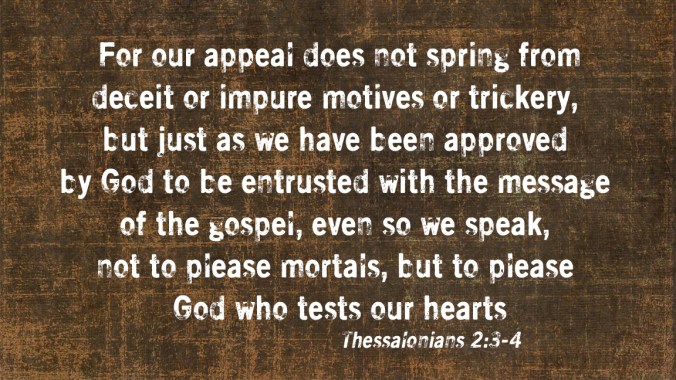
In many ways, our culture teaches us to win at all costs. From underhanded but effective political tactics to reality television featuring treacherous alliances and double-crosses, we can easily find ourselves celebrating victory more than integrity. For Paul it was not so: he trusted the integrity of his message was itself enough to bring people to Christ. Yet even the church can succumb to a little bait and switch, exaggerating joys and minimizing challenges to get people in the doors.

When we try to make ourselves seem better than we are, ironically we undermine the Good News. “Sunday Best” doesn’t refer only to our attire – we bring our best attitudes, best behavior, and best versions of our lives. We often assume that everyone else’s “best” presentation of their lives is the whole truth when in reality they may be struggling as badly or worse than we are. Together we perpetuate the myth that Christians must be eternally cheerful and optimistic. The danger in all this window dressing is the subtle message that Jesus Club is meant for those who have it together, or who can get it together. Not only do we miss opportunities to support one another, we intimidate others from trying to join the body. Eventually the false front crumbles under the weight of our collective repression, and the world sees us as hypocrites.

What a relief it would be to share the gospel as Paul did! He admitted to being exhausted, mistreated, and quarrelsome. He bore his sufferings and flaws as a testament to Christ’s presence in his life. His message spoke to broken people who needed to know Christ … because he admitted he was broken and needed Christ. And not simply past-tense broken, but presently broken and constantly being saved. That friend undergoing an ugly divorce just might be more interested in hearing about how Jesus is with you as you battle depression than about the Jesus who blessed the congregation with the best bake sale turnout ever. When we stop showing people the Jesus we think they want to see, and show them the real Jesus in the trenches with us, the message is more than enough.

Comfort: God already knows your true self, so there’s no sense in hiding it from anyone else.

Challenge: Share your authentic self with your church family or faith community. In what ways does it help you, and in what ways does it help them?

Prayer: God of truth, I present my authentic self to you, knowing you are the answer to all my brokenness, and ask you to use it for your glory. Amen.

Discussion: In what ways does being honest about your life help you, and in what ways does it help others?

Join the discussion! If you enjoyed this post, feel free to join an extended discussion as part of the C+C Facebook group. You’ll be notified of new posts through FB, and have the opportunity to share your thoughts with some lovely people.

Risen and Recognized

1459099239295.jpg

Easter readings (click below to open in new tab/window):
Acts 10:34-43, Psalm 118:1-2, 14-24, Acts 10:34-43, Luke 24:1-12

Today’s daily readings:
Psalms 93; 150, Exodus 12:1-14, John 1:1-18, Luke 24:13-35


Jesus Christ is risen today! Alleluia!

Where will we encounter him? Cleopas and another disciple (possibly his wife, who was present at the crucifixion) were on the road to Emmaus when they met him. Surprised that he didn’t seem to know about recent events in Jerusalem, they spoke of the crucifixion and the empty tomb. Though he interpreted for them the meaning of everything that had happened, they still did not know who he was. When he sat down to eat with them and blessed bread and broke it, “their eyes were opened” and they knew the risen Christ. “He had been made known to them in the breaking of the bread.”

Like the disciples who met him on the road, or the boat full of disciples who later saw him on the shore but didn’t recognize him, our vision of Christ can be limited by our expectations.

When we limit Christ to what we already know of him, we are not following the living Christ, but worshiping a lifeless photograph. Christ didn’t rise so we could wrap ourselves in a shroud-like faith that preserves but does not reveal.

To find the living Christ we often have to take time away from the safe and familiar worship at the foot of the cross – because he is no longer there!

The risen Christ may seem like a stranger, but we will recognize him by his love. When he breaks bread with our enemies. When he stands on a cold street corner protesting injustice. When he holds the hand of a lonely friend with a terminal diagnosis. When he digs a well on a desert reservation so people don’t have to drive two hours for water every day. When he welcomes refugees fleeing violence into his home for weeks at a time. Christ does all these things when we, as his only body here on earth, do these things. It is then when others who do not know him may see his nature revealed in us. It is then we can declare our redeemer lives.

Jesus Christ is risen today! Alleluia!

Comfort: Our savior lives, and he lives in us!

Challenge: Today of all days, greet everyone with love.

Prayer: Dear LORD I give thanks for the Risen Christ! May I live ever more deeply into the love you have shown us through his sacrifice and resurrection. Your grace and mercy are endless. May my praise be endless as well. Amen.

Discussion: Despite being a resurrection people, we often entomb our faith by confining it to church. How can you let yours free in the world?


Inside Out

Untitled-1

Today’s readings (click below to open in new tab / window):
Psalms 43; 149, Lamentations 3:37-58, Hebrews 4:1-16, Romans 8:1-11


How do you go on?

After one of your closest companions betrays your beloved teacher …
After fear has driven you to deny your friend and savior …
After the messiah to whom you dedicated your life lies in a tomb…

… how do you go on?

The disciples would have begun observing the weekly Sabbath shortly before sundown on the day of Christ’s crucifixion. Candles would be lit. Prayers would be said. Songs sung. Meals eaten. Outward signs of mourning were forbidden on the Sabbath. Everything would have looked normal on the outside, but inside … grief and chaos.

Whatever activity or (this being the Sabbath) inactivity occupied their bodies, the disciples’ minds must have been on the tomb, not far away, with a body freshly lain and a stone newly rolled across it. From the outside it would have looked like any other tomb, but inside … incomprehensible injustice.

The scribes and Pharisees, Herod and Pilate, and everyone else who feared or hated Christ’s teachings were settling back into a sense of restored order, perhaps even contentment that they had successfully squelched this would-be king and prevented rebellion. The world looked the same as it had before, with the same people holding power, but deep inside … the rules of victory were being rewritten.

We spend a lot of time in this state, appearing one way to the world while, for better or worse, experiencing a wholly different inner life. Holy Saturday represents the tipping point of that experience. On that day, the disciples were resigned to the calm and ordered injustice of the flesh, while their souls were in torment. After that day, they were willing to sacrifice themselves on the altar of the Gospel, because nothing could shake the peace they had found in Christ. What a remarkable change!

What state are we in today? Is our world orderly but our faith easily shaken? Is our world in turmoil but our faith a rock? Or are we somewhere in-between, living an extended Holy Saturday moment, broken but hoping despite the evidence that justice will reign?

On the outside today may seem like any other day, but inside …

Comfort: The story isn’t over.

Challenge: Sometimes we have to give up exterior respectability to find interior peace.

Prayer: God of hope, today we mourn the injustice of the world. Send us peace. Send us love. Send us Christ. Amen.

Discussion: When has your outward stability masked inward change?

Join the discussion! If you enjoyed this post, feel free to join an extended discussion as part of the C+C Facebook group. You’ll be notified of new posts through FB, and have the opportunity to share your thoughts with some lovely people. Or feel free to comment here on WordPress, or even re-blog – the more the merrier!
Holy Friday

1458878752643.jpg

Today’s readings (click below to open in new tab/window):
Psalms 22; 148, Lamentations 3:1-9, 19-33, 1 Peter 1:10-20, John 13:36-38

Readings for Good Friday:
Isaiah 52:13-53:12, Psalm 22, Hebrews 10:16-25, John 18:1-19:42


If “Good Friday” seems like an odd name for a day commemorating a crucifixion, understand that good used to mean holy. All over the world, Christians re-enact Christ’s journey to Golgotha (also called Calvary) and his terrible execution. From congregations reading the passion together, to prayer groups walking the stations of the cross in troubled neighborhoods, to entire towns becoming Jerusalem for the day, Christians feel compelled to relive the story.

Because we know how the story turns out, we may find it easy to judge the crowds whose cheers turned to condemnation, or Peter, who – as Christ predicted – denied knowing him not not once, not twice, but three times. Certainly we would not have shouted “Crucify him!” We could never deny him … could we?

Let’s assume we could. Actually, let’s assume we have – because it’s true. None of us lives perfectly. That being the case, isn’t it comforting to know the person Jesus hand-picked to found the church was as flawed as we are? Maybe that’s why in passion stories most of us play the angry mob: to be reminded each of us is in need of forgiveness, and so don’t have the right to judge anyone. Christ later assured Peter he was still loved, but surely the knowledge of that moment of fear, weakness, and betrayal never left him. And almost as surely that memory helped forge the compassion and mercy for others that would have been necessary to speak for Christ.

When we feel like judging, let’s remember Peter – weak, frightened, impulsive, imperfect Peter. Then let’s remember Christ forgave him, as he forgives us, and calls us to forgive. It was the sin of the world that Christ forgave on that cross, including the sin of our own imperfect mercy and tarnished compassion.

From noon this day until Sunday morning, the disciples were without Christ. They thought the story was over, and despaired. This holy Friday and Saturday, let’s contemplate what it would mean to live without hope of forgiveness for ourselves and others. Today Christ hangs on the cross. We shouted “Crucify him!” Now we weep.

Comfort:

Challenge: Pray for forgiveness.

Prayer: Lord Jesus Christ, son of the living God, have mercy on me, a sinner.

Discussion: What does Good Friday mean to you?

Join the discussion! If you enjoyed this post, feel free to join an extended discussion as part of the C+C Facebook group. You’ll be notified of new posts through FB, and have the opportunity to share your thoughts with some lovely people. Or feel free to comment here on WordPress, or even re-blog – the more the merrier!

Where is bread and wine?

1451766966701

Today’s readings (click below to open in new tab / window):
Psalms 27; 147:12-20, Lamentations 2:10-18, 1 Corinthians 10:14-17; 11:27-32, Mark 14:12-25


Maundy Thursday is the day Christians traditionally observe The Last Supper, when we received the gift of communion from Christ. No matter our particular practices and beliefs around communion, all Christians can recognize it unites us across time and place. The significance of celebrating a salvation accomplished through a broken body and shed blood has been contemplated for lifetimes, yet its power and mystery are undiminished.

The book of Lamentations speaks of infants crying “Where is bread and wine?”as they faint weakly on their mothers’ bosom. These elements have been staples throughout recorded history. Their presence represents abundance, and their absence despair. The author, who was referring to physical bread and wine,  probably could not have imagined a crucified messiah. Yet in Christ’s sacrifice abundance and despair are united in a way that assures us the divine is present in all things, even the worst life has to offer. Even sitting at a meal with a friend you know will betray you to excruciating death.

Some days we can’t see the bread and wine.

Where are they when disease robs us of our comfort and dignity?
Where are they when senseless accidents rob us of our loved ones?
Where are they when the world burns at the hands of madmen?
Where are they when children are abused, abandoned, and sold into slavery?
Where are they when depression shrouds our souls in darkness?

They are at the communion table. The Lord’s Supper is powerful because it gives us a taste of bread and wine when we can’t find them on our own. It acknowledges that – right now – life is hard and tragic and seemingly senseless … but because that bread is Christ’s broken body, and that cup is filled with Christ’s shed blood, it reminds us God is present among us – and revealed – in life’s tragedy. Our pain is as real to God as it is to us.

We have been wandering the wilderness for so long we can’t see our way out. For now the bread may taste like ash and the wine like tears, but Lent always surrenders to Easter.

Comfort: God is present with you right now.

Challenge: Today, allow yourself to grieve.

Prayer: God, my creator, make known to me your presence. Amen.

Discussion: What does communion mean to you?

Join the discussion! If you enjoyed this post, feel free to join an extended discussion as part of the C+C Facebook group. You’ll be notified of new posts through FB, and have the opportunity to share your thoughts with some lovely people. Or feel free to comment here on WordPress, or even re-blog – the more the merrier!

Only Tenants

1458765638560.jpg

Today’s readings (click below to open in new tab / window):
Psalms 5; 147:1-11, Lamentations 2:1-9, 2 Corinthians 1:23-2:11, Mark 12:1-11


The Parable of the Tenants is a difficult story, which forces us to confront our unwillingness to put God’s desires above our own. A landowner entrusts his vineyard to tenants while he travels abroad. After the harvest the landowner dispatches servants to collect his share, but the tenants greet the servants with violence that ranges from beatings to murder. Finally the landowner sends his son, and they kill him too.

In the common interpretation of this story the landowner is God, the tenants are the appointed religious leaders, the vineyard is Israel, the servants are prophets of the past, and the son is Jesus. The leaders hold the people captive and forget the true head of the vineyard is God. They destroy any and all who oppose their claim to power, even those sent by the true owner. The death of the son foretells the crucifixion.

Contrast this parable with the second chapter of 2 Corinthians. The Biblical narrative tells us Paul visited Corinth three times. The first visit was to establish the church. The second one – which he refers to in his letter as “the painful visit” – was to reprimand church leadership for acting immorally. One man seems to have been particularly troublesome. In this letter, Paul says he is not going to visit again at this time precisely because he feels his corrections had been too harsh and wants to avoid causing any more pain for the church or himself. He asks the Corinthians to forgive the troublesome man and punish him no longer.

When Paul realized his approach was not true to his mission … he gave it back to God. A more stubborn man might have dug in his heels and justified his actions, maybe even returned to Corinth to double down. Paul knew spreading the Gospel was more important than defending himself. Refusing to surrender his plot of land might have broken the Corinthian church. Whether our plot is a ministry, a family, or an actual vineyard, we are all only tenants tending it best we can until the time comes to give it back to God.

Comfort: You don’t have to tend the whole world…

Challenge: … but tend your plot well and surrender it timely.

Prayer: Generous and loving God, teach me to care for your world as you have called me to do, and grant me the humility to change and grow with your seasons. Amen.

Discussion: When does your urge to punish endanger your willingness to forgive?

Join the discussion! If you enjoyed this post, feel free to join an extended discussion as part of the C+C Facebook group. You’ll be notified of new posts through FB, and have the opportunity to share your thoughts with some lovely people. Or feel free to comment here on WordPress, or even re-blog – the more the merrier!