Line by Line

20161220_203504-01.jpeg

Today’s readings:

Psalms 33; 146, Isaiah 28:9-22, Revelation 20:11-21:8, Luke 1:5-25


Not everyone loves the Christmas story. After forty, fifty, or more years of listening to it, some people feel it has nothing new to say to them. There’s never a twist, and while it speaks to children, adults – especially those who have moved on to a contemplation of theology more sophisticated than The Baby Jesus – are dealing with weightier issues. Where you are on your own journey is your business, but if you’re at a point where the Christmas story is little more than nostalgic, maybe think about the words of Isaiah – or more specifically, his critics.

When Isaiah and other prophets warned religious leaders they had strayed from God’s teachings, the reply of many of them was essentially: “We get it. You repeat it over and over. But we’re not children; we’re experienced leaders. You have nothing to teach us.” Or as Isaiah put it:

Therefore the word of the LORD will be to them,

Precept upon precept, precept upon precept,

line upon line, line upon line,

here a little, there a little.

They were insulted by the repetition, but the truth was they had corrupted the Law by turning it into something so complicated and burdensome that the widows, orphans, ailing, and aliens it was meant to protect were now its victims.

There’s a lot of theology out there, and those of us  who enjoy studying it can bury ourselves in denominational nuance and doctrinal detail … but those things can distract us from actually living our faith. Theory is not more important than reality. Talking about grace is not the same as receiving it.

So when we hear the Christmas story, let’s focus on whether we’ve actually listened to the messages it has for us today:

Finding God in humble places.

Making room for desperate strangers.

Looking beyond social stigma.

Mourning children sacrificed to political expediency.

Trusting God to see us through.

If these are merely theory to us, and not daily practice, we have yet to really master the basics. So at Advent and soon Christmas, as the story unfolds before us again, we are blessed precept upon precept, line upon line, here a little, there a little.

Comfort: It’s OK to still be mastering the basics of faith; simple is not the same as easy.

Challenge: This holiday season, make time to read the Nativity story from Matthew or Luke.

Prayer: Glorious and merciful God, I humble myself before Your wisdom. Amen.

Discussion: This year, what will you have to learn from the story of Christmas?

Join the discussion! If you enjoyed this post, feel free to join an extended discussion as part of the C+C Facebook group. You’ll  have the opportunity to share your thoughts with some lovely people. Or feel free to comment here on WordPress, or even re-blog – the more the merrier!

Two Point Perspective

1482204216683.jpg

Today’s readings:
Psalms 122; 145, Isaiah 11:10-16, Revelation 20:1-10, John 5:30-47


According to Mosaic Law, a lone witness was not sufficient to condemn someone of wrongdoing. Though two witnesses might still seem like a low threshold, it discouraged false accusations unless one could find a co-conspirator. That might be difficult, since a person condemned of false witness would have to suffer whatever fate they intended for the wrongly accused.

Thus when Jesus found himself before Jewish officials who demanded he validate his claim to be the Son of God, he declined to testify on his own behalf, but presented two witnesses – of a sort. He claimed both his own miracles and the testimony of John the Baptist as witnesses to his status. Had this been a formal proceeding his reasoning may not have stood up in court, but for the time it allowed him to continue his ministry.

Part of the beauty of Christian community is sharing our stories of how Christ works in our lives. When we struggle with doubt, the stories of a couple faithful friends can bring us hope. And if not hope, a line pointing toward hope. In geometry, a line is defined by passing through two points. Along that line there are an infinite number of other points, but only two are necessary to make it known. Once that line of faith is established, we can keep following it for as long as we need to.

If you were called to witness on behalf of Christ, to help create that through-line for someone, could you find a second witness to support you? Together, you and the second person define a line pointing toward Christ. We can be part of countless lines. The more stories we hear, and the more times we share our own stories, the more lines of testimony we create. And the more directions those lines run, the greater chance someone has of seizing onto one.

Our testimony not only honors our God, but creates a vast, intertwined safety net of hope. Let us speak often and joyfully of the love of God. Let us pray we may provide a safe landing for those fallen into despair.

Comfort: Your story is important.

Challenge: Make a point of talking with fellow believers about your story.

Prayer: Infinite God, author of all stories, thank you for mine. Amen.

Discussion: How do you feel about sharing your faith story with friends?  With acquaintances? With strangers?

Join the discussion! If you enjoyed this post, feel free to join an extended discussion as part of the C+C Facebook group. You’ll  have the opportunity to share your thoughts with some lovely people. Or feel free to comment here on WordPress, or even re-blog – the more the merrier!

Ambassadors in Chains

1482116872408.jpg

Today’s readings:
Psalms 24; 150, Isaiah 11:1-9, Ephesians 6:10-20, John 3:16-21


Today we enter the fourth and final week of Advent. We look forward to celebrating the end our period of waiting. The date is on our calendars this and every year. And yet …

Does it feel like we live more in an ongoing Advent world than in a post-Christmas world? Yes, Christ has come and yes, we sing hymns of triumph but does the world seem like it’s been redeemed? Does it act like it?  God’s justice, while undeniable, seems to unfurl not so much from “glory to glory” as with “fits and starts.” The expansion of the Kingdom is a long, irregular process revealed in God’s time, which only on rare and happy occasions – perhaps we call them miracles – happens to coincide with our time. Yet Advent always concludes with Christmas.

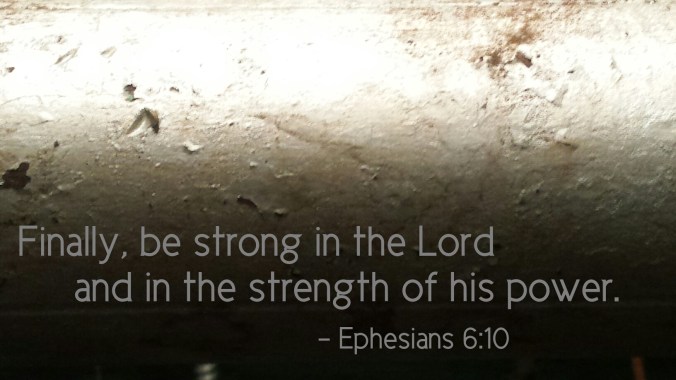
When Paul wrote to the Ephesians from his imprisonment, he called himself as “an ambassador in chains.” Though he no longer considered himself under the Law, Paul still did not see himself as above the rules – the rules of decency, fairness, and love. The revolution he helped lead was one of peace and mercy. The body count was decidedly one-sided. While the powers-that-be were not constrained by love, Paul preached nothing but. Though playing by the rules – accepting our chains – puts us at a distinct disadvantage in the short term, the Kingdom for which we are also ambassadors demands a solid foundation. Force, coercion, and deceit are sand; even the Gospel crumbles when built upon them.

In our zeal to spread the Kingdom everywhere, Christianity has too often assumed the language and tactics of the empire we once confronted. We attempt to impose that which can’t even exist unless it is freely accepted. Winning people to Christ is not the same thing as using overwhelming force to make them act like “Christians.” Perhaps those chains exist because without them, we are dangerous to ourselves and others.

In many traditions, the fourth candle of the Advent wreath symbolizes love. Since Christ’s victory is already complete, we don’t need to worry about more victory. The best way to honor it is to share his love.

Comfort: Christ’s victory has already been won.

Challenge: Meditate on how you represent your faith to others. Is it an invitation or a demand?

Prayer: God of mercies, I seek to serve your Kingdom. Amen.

Discussion: Can you think of any modern examples of the church acting like the empire?

Join the discussion! If you enjoyed this post, feel free to join an extended discussion as part of the C+C Facebook group. You’ll  have the opportunity to share your thoughts with some lovely people. Or feel free to comment here on WordPress, or even re-blog – the more the merrier!
Oops!

1481594055819.jpg

Today’s readings:
Psalms 122; 145, Isaiah 8:16-9:1, 2 Peter 1:1-11, Luke 22:39-53


Shortly before Jesus was handed over to the authorities by Judas, he went to his customary place of prayer on the Mount of Olives.  The disciples joined him, but he prayed “about a stone’s throw” away from them. Luke says Jesus prayed so earnestly “his sweat became like great drops of blood falling down.” When he returned to the disciples, they were exhausted from grief and therefore sleeping. He woke them and mildly chastised them.

As he was speaking, a crowd led by Judas appeared. When the disciples realized this was the moment of betrayal, one of them attacked a slave of the high priest and severed his ear. Jesus cried “No more of this!” and healed the man.

After three years of commitment to Jesus’s message, mission, and ministry, the disciples were still something of a disappointment: they couldn’t stay awake to provide moral support and didn’t understand Jesus intended to surrender himself. The entire length of their tour with Jesus had been punctuated by misunderstanding and error.

Would we have done better?  We may like to believe so, but if Jesus could have drafted better disciples, don’t we think he would have? Yet these people – who had plenty of disappointment yet to deliver – spread the gospel and founded the church. Like the disciples, let’s take heart in knowing our limitations are not God’s limitations. Grief, fear, and other factors may lead us to misstep, but we are still part of the body of Christ.

Just as importantly – maybe more so – let’s remember the shortcomings of the disciples and ourselves when we’re tempted to judge the mistakes of others. If we think we’d do better in their shoes, let’s remember Peter denied Christ three times but was suitable to be the Rock of the Church. Our biggest mistake may be operating as if we ourselves have no mistakes left to make!

When one of our sisters or brothers in Christ stumbles through sin or error, it’s not our place to write them off, for Jesus has already redeemed them. Rather, we can offer encouragement, support, and – when necessary – gentle correction. As the author of 2 Peter writes, let us bear one another’s burdens with endurance, self-control, and mutual affection.

Comfort: You’re going to make mistakes, and God is going to love and work through you anyway.

Challenge: Do an internet search on techniques for learning to withhold judgment.

Prayer: Thank you, Lord, for your patience with me, and bless me with patience for your beloved people. Amen.

Discussion: Have you ever disappointed someone who gave you another chance? Or is there someone who has disappointed you that could use a second chance?

Join the discussion! If you enjoyed this post, feel free to join an extended discussion as part of the C+C Facebook group. You’ll  have the opportunity to share your thoughts with some lovely people. Or feel free to comment here on WordPress, or even re-blog – the more the merrier!

Be Prepared

1481498107756.jpg

Today’s readings:
Psalms 24; 150, Isaiah 13:1-13, Hebrews 12:18-29, John 3:22-30


As we reach the mid-way point in our season of Advent, today’s scripture readings appropriately focus on preparation.

Psalm 24, written a thousand years before Christ’s birth, uses the metaphor of a king returning victorious from battle to describe the Lord assuming his place among his people. Not written about Jesus specifically, this psalm sets the stage for the hoped-for Day of the Lord.

Isaiah also describes the Day of the Lord (prophetically speaking, there were several such days), but from a differing viewpoint. Rather than describing a glorious victory, Isaiah warned the Babylonians of the destruction awaiting them for turning away from God and oppressing God’s people.

The letter to the Hebrews, written after Christ’s death, warned its audience to listen for the word of God so they would be prepared for Christ’s return. Its author claims that on the Day of the Lord his voice will shake heaven and earth, and he will return like a “consuming fire” burning away unrighteousness.

Our passage from John is more gentle. It tells us how John the Baptist willingly stepped aside when Jesus – the one for whom he had been preparing the way – began his ministry in earnest. John was content to have played his role faithfully, and sought no further adulation. Unfortunately, retirement would not be kind to John; because he had angered too many powerful people by telling the truth, he would soon be executed.

As common-sense as “failing to plan is planning to fail” may sound, we also have to accept that events of our lives, community, and globe are frequently unpredictable. The Jews and Babylonians, despite prophecy, weren’t ready for what happened. The audience of Hebrews was preparing for Christ’s literal return, but had to keep going when that didn’t happen. Like John the Baptist, we must be content with having faithfully done our part. We can’t control whether the world responds accordingly. When the Day of the Lord seems distant and unrighteousness all too near, our best preparation occurs in our own hearts, where God provides us the faith and strength to face what we must.

Comfort: Relying on God is the best preparation …

Challenge: … but be ready for God to ask you to do some challenging things.

Prayer: Loving God, I have prepared for you a room in my heart; may you dwell within me always . Amen.

Discussion: Isaiah and Hebrews both mention mount Zion – Isaiah as a spot of military-like victory, and Hebrews as a place triumphant through grace and mercy. How do you think about these contrasting visions of the Day of the Lord?

Join the discussion! If you enjoyed this post, feel free to join an extended discussion as part of the C+C Facebook group. You’ll  have the opportunity to share your thoughts with some lovely people. Or feel free to comment here on WordPress, or even re-blog – the more the merrier!

What is Love Actually?

1481405690505.jpg

Today’s readings:
Psalms 90; 149, Isaiah 8:1-15, 2 Thessalonians 3:6-18, Luke 22:31-38


As the second week of advent draws to a close, let’s reflect on its traditional theme of love. We throw the word “love” around a lot, and muddy its meaning in the process. A single word describes a range of feelings, actions and attitudes. “I love pizza.” “I love God.” “I love Blazing Saddles.” “I love making love.” More sophisticated users of language may choose different words to better express nuance, but for us common folk, love is love is love.

If you reflect on different types of love – romantic, divine, fraternal, charitable – what questions does it raise for you? Over time, how have your own experiences and studies changed your working definition of love? Do you experience love primarily as a feeling, an attitude, an action, some combination of the three, or something else entirely?

If we actively engage the world, our understanding of love evolves endlessly. Take marriage, for example. The intensity of feeling of a new love can’t sustain twenty, forty, or sixty years of marriage; as time passes, the landscape of the relationship changes. Self-help books that teach us our relationship will flounder unless we hold onto or rekindle that early passion have it all wrong. Stubborn insistence that love must look and feel the same five, ten, or thirty years down the road is deadly to a marriage. Movies, television, and books tell us a relationship that loses its youthful character is somehow lacking, but the opposite is often true: just as mature people gain depth, gravity, and patience … so do mature relationships.

Our love for God and people must be allowed to follow a similar path if it is to mature. Sometimes we need to let go of what we think love is before we can reach that next level of depth. That can be scary, or feel like a loss, especially if the letting go is forced on us. At the close of this second week of Advent, can we commit to bravely exploring a deeper understanding of love over the coming year? We might find God in the most surprising places!

Comfort: Love matures as you do.

Challenge: Try using words other than “love” – such as like, adore, admire, or enjoy – in your daily conversations.

Prayer: God of love, teach me to love. Amen.

Discussion: How has your understanding of love – romantic or otherwise – changed over time?

Join the discussion! If you enjoyed this post, feel free to join an extended discussion as part of the C+C Facebook group. You’ll  have the opportunity to share your thoughts with some lovely people. Or feel free to comment here on WordPress, or even re-blog – the more the merrier!

Continental Divide

1481319842686.jpg

Today’s readings:
Psalms 102; 148, Isaiah 7:10-25, 2 Thessalonians 2:13-3:5, Luke 22:14-30


A continental divide is a geological boundary which, simply put, separates rivers and streams draining toward one body of water from those draining into another. For example, the North American Great Continental Divide roughly marks the border between rivers flowing east toward the Atlantic Ocean and rivers flowing west toward the Pacific Ocean. “Going with the flow” has a different meaning on each side of the divide. If you want to navigate waterways successfully, you need to know where the divide lies.

To successfully navigate a spiritual life upstream we might want to think of it as having a similar divide, but instead of East versus West, it’s more internal versus external. When facing the internal – that is, ourselves and the things we can control – we should try to be objective critics of our own attitudes and behaviors. We progress by identifying where and how we can change, and accepting God’s grace and mercy to help us work toward that change. When we are facing the external – that is, other people and the world beyond our control – we instead need to reflect God’s grace and mercy, and withhold judgment.

Upstream isn’t always the easiest path. Isn’t it more pleasant to let the current carry us downstream? It’s less work. We can go with the flow and let our natural inclinations to excuses ourselves and to condemn others carry us downstream. But that’s the wrong direction.

Even at the Last Supper, Christ’s followers tended toward the easier, backward route.

After Jesus revealed that the one who would betray him was at the table with the disciples, he didn’t name a name. Did any of them (other than his actual betrayer, Judas) focus inward and ask “Could it possibly be me? Why or why not?”  No, each immediately denied the possibility it could be him and started trying to figure where to point the finger. This curiosity is natural, but if Jesus didn’t identify Judas, why did the disciples seek the right to condemn him?

After only a short time, the conversation devolved into an argument over who among them was the greatest.  We don’t get details, but judging from Jesus’s reaction, it was a lot of self-promotion. Nobody was arguing “No, I’m nothing; you’re the greatest.” The external focus was on dominating others rather than elevating them.

Jesus offers us rivers of living water (John 7:38). We need to learn to navigate them with inward humility and outward mercy to carry our faith where it needs to be.

Comfort: You are both the recipient of grace, and its reflection in the world.

Challenge: Though it’s almost cliched, be the change you want to see in the world.

Prayer: God of grace and mercy, I rely on you for all things in my life, and will share all things from you in the lives of others. Amen.

Discussion: Do you have any tendency to impose your faith on others when you should be asking questions of yourself?

Join the discussion! If you enjoyed this post, feel free to join an extended discussion as part of the C+C Facebook group. You’ll  have the opportunity to share your thoughts with some lovely people. Or feel free to comment here on WordPress, or even re-blog – the more the merrier!

Nuggets

1481223453616.jpg

Today’s readings:
Psalms 18:1-20; 147:12-20, Isaiah 7:1-9, 2 Thessalonians 2:1-12, Luke 22:1-13


A popular nugget of folk-wisdom circulates among us. Wording varies, but the message boils down to: “People come into your life for a reason” or “to teach you lessons.” Maybe it’s true. It’s certainly comforting. But we want to be careful how we use it. If we look at people through a lens of “what purpose do you serve in my life?” they can stop looking like people with their own lives and agency and start looking like props in our personal story.

Another nugget suggests distancing ourselves from people who bring negative energy into our lives. If that energy manifests as abuse or manipulation, follow that advice. Flee. But for Christians to live lives of service … some negative energy is part of the package. Expecting people in genuine need – people living with serious physical, economic, social, or mental disadvantages – to meet our expectations of “positivity” doesn’t resonate with the Beatitudes blessing the poor and grieving. Many people are working so hard to physically or emotionally survive they can’t muster any more strength for our standards of positive – or sometimes even tolerable – attitudes. We serve them anyway, because they suffer and Jesus calls us to solidarity with the suffering.

When Jesus arrived in Jerusalem, he sent Peter and John ahead to arrange a place for the Passover meal. He told them they would meet a man carrying a jar of water, and to follow him to a house where they would find a room available and furnished for their needs. We never learn the name of the man carrying water, or the man who owned the house, but both their lives were touched by Christ. They are not mere plot devices. The mission of Peter and John – of Jesus – was about just such people … people like us.

Isaiah and Paul are separated by about 700 years, but both address the need for communities to go through difficulty together, rather than going around it separately. God’s justice is bigger than any individual life. We experience it most fully when we share it with those who experience it the least.

Comfort: You are part of something bigger, in many small ways.

Challenge: Find ways to replenish your strength for when others may need it.

Prayer: Thank you, Loving God, for the gift of Community. Grant me the wisdom to feel blessed by both its benefits and its responsibilities. Amen.

Discussion: When do you find it most difficult to be charitable? What do you think that says about you?

Join the discussion! If you enjoyed this post, feel free to join an extended discussion as part of the C+C Facebook group. You’ll  have the opportunity to share your thoughts with some lovely people. Or feel free to comment here on WordPress, or even re-blog – the more the merrier!

Thud!

20161205_154950-01.jpeg

Today’s readings:
Psalms 50; 147:1-11, Isaiah 6:1-13, 2 Thessalonians 1:1-12, John 7:53-8:11


“Let he who is without sin cast the first stone.”

So Jesus said to a group of scribes and Pharisees ready to stone a woman caught in the act of adultery. Before saying it, he bent to write in the dirt with his finger. One tradition says he was writing a list of the secret sins of her accusers. Whatever he wrote, one by one the crowd members dropped their stones and walked away. When all were gone, he sent the woman away without condemning her, but advising her to sin no more.

We probably prefer to identify with the woman in need of mercy, but we also all potentially have a rock in our hand ready to hurl. There’s an adage that what we dislike about others is a reflection of what we dislike about ourselves. We clench that private guilt or shame until its weight becomes so unbearable that we are compelled to fling it at others if only to find some relief from the burden.

We think of the woman as the one who finds forgiveness, but what if those stones dropped because the crowd realized that if this woman could be forgiven, they could too?  What if they no longer felt the need to hurt someone else to soothe their own feelings of guilt?

Imagine the sound of all those stones dropping to the ground.

Thud! My own infidelity is forgiven. Thud! My anger at my brother is forgiven. Thud! My thieving ways are forgiven.

Thud! … Thud! … Thud! Thud! Thud! like the slow, building thunder of a cleansing storm.

The prophet Isaiah describes a vision in which a seraph (a type of angel) places a live coal on his lips. The seraph tells him: “Now that this has touched your lips, your guilt has departed and your sin is blotted out.” The phrase “live coal” might be better translated as “glowing stone.” By trusting God to deliver him through the pain, Isaiah found forgiveness. We must find the courage to name and face the glowing stone of our own sin before we can ask forgiveness, but afterward we can drop it to cool in the dirt. When we no longer burn, we no longer desire to burn others.

Comfort: If you ask and repent, you are forgiven.

Challenge: When you are angry with someone’s mistakes or transgressions, ask yourself what that says about you.

Prayer: Merciful God, thank you for the abundant forgiveness of your love. Amen.

Discussion: What flaw in yourself most irritates you when you see it in others?

Join the discussion! If you enjoyed this post, feel free to join an extended discussion as part of the C+C Facebook group. You’ll  have the opportunity to share your thoughts with some lovely people. Or feel free to comment here on WordPress, or even re-blog – the more the merrier!

More Than A Feeling

20161205_155011-01.jpeg

Today’s readings:
Psalms 33; 146, Isaiah 5:18-25, 1 Thessalonians 5:12-28, Luke 21:29-38


Yesterday we looked at the relationship between God and humanity as a love story cycling from estrangement to reunion. Today’s reading from Paul’s first letter to the Thessalonians also addresses love, but more how to express the practical sort of love we are called to implement in our community. This type of love, also known as agape or charitable love, is not about affection, but about action. When Paul advises his audience not to repay evil with evil but to do kindness always, note he does not add “and you have to like each other while you do it.” One of the attributes of Christian love is that we strive do right by others no matter how we feel in the moment.

Our pop psychology culture emphasizes the preeminence of feelings. Reality shows and bad therapy model a brand of emotional purging that may be cathartic for us, but which may also leave many floundering in our emotional wake. Rising above our emotions may even earn us the title of “hypocrite.” We should be careful not to buy into the notion that our emotions define us or should define our actions. Good therapists and wise spiritual leaders teach us there is a deeper self that lies beneath our emotions. When Paul asks us to repay evil with kindness (and he asks us this because Jesus asked first), he is encouraging us to engage that deeper, truer self. The love of God that is the foundation of the deeper self may sometimes be experienced through emotions, but it precedes and follows any emotional expression, and it never promotes the self at the expense of others.

We act in love toward others because they are beloved of God, not because we are fond of them, or because charitable actions “feel” good. However, we can reap spiritual benefits from these actions, especially if our actions are loving when our gut is not. In a culture that encourages us to let feelings guide our choices, it’s easy to forget that our choices also mold our feelings. Acting in love transforms us into loving people who reflect the love of God. What more could we aspire to?

Comfort: You are stronger than a collection of feelings.

Challenge: Read some books or articles on managing emotions.

Prayer: Thank you, God, for giving me the ability to be better than I feel I am. Amen.

Discussion: What emotions do you have the most trouble controlling?

Join the discussion! If you enjoyed this post, feel free to join an extended discussion as part of the C+C Facebook group. You’ll  have the opportunity to share your thoughts with some lovely people. Or feel free to comment here on WordPress, or even re-blog – the more the merrier!