Who Gives Speech to Mortals?

1457912343122.jpg

Today’s readings (click below to open in new tab / window):
Psalms 84; 150, Exodus 3:16-4:12, Romans 12:1-21, John 8:46-59


When God appeared to Moses from a burning bush and asked him to confront Pharaoh about freeing the Israelites, Moses was understandably hesitant. After all, the Egyptian king already wanted him dead, and Moses had spent the last forty years as a humble shepherd. How could he effectively present himself as God’s messenger? He wanted assurance the Egyptians would believe him.

To convince Moses that Pharaoh would listen, God commanded him to throw his staff to the ground. It became a serpent, and then a staff again when Moses grabbed it by the tail. The Lord then commanded Moses to tuck his hand inside his robe. When he drew it out again, it was white with leprosy. At God’s command he repeated the actions, and it was healed. Armed with these signs and more, Moses still resisted, insisting he was slow of speech and tongue. God, seeming almost exasperated by the this point, replied: “Who gives speech to mortals? Who makes them mute or deaf, seeing or blind? Is it not I, the LORD? Now go, and I will be with your mouth and teach you what you are to speak.”

Let’s consider for a moment the assurances God gave Moses. He didn’t arm Moses with magical amulets or enchanted weapons. Instead he said: show them your staff; show them your hands. God was telling Moses: “You are already equipped to do my work. Trust me.”

We often feel unwilling and ill equipped to do what God asks. Excuses come fast and easily. We lack finances. We lack time. We lack talent. But who gives us talent? Who makes us smart or senseless, rich or poor? When we answer the Lord’s call, he will equip us. This isn’t to say things will be easy. Moses experienced many trials both before and after his people left Egypt, and never entered the promised land himself, but God equipped him each step of the way.

Our gifts may seem completely ordinary until we trust God to use them, but when we do … who knows what miracles may happen and souls may be freed?

Comfort: You have been created with everything you need.

Challenge: Meditate on what you have to offer, no matter how small, that God could use.

Prayer: God of Creation, thank you for the many gifts you have given me. Teach me to see myself as you do: a child with limitless potential inspired by your love. Amen.

Discussion: What excuses do you use to avoid what’s asked of you?

Join the discussion! If you enjoyed this post, feel free to join an extended discussion as part of the C+C Facebook group. You’ll be notified of new posts through FB, and have the opportunity to share your thoughts with some lovely people. Or feel free to comment here on WordPress, or even re-blog – the more the merrier!

Love Never Ends

1457843031539.jpg

Today’s readings (click below to open in new tab / window):
Psalms 43; 149, Exodus 2:23-3:15, 1 Corinthians 13:1-13, Mark 9:14-29


Today’s reading from Paul’s first letter to the Corinthians is frequently read at weddings because it beautifully describes the characteristics of love:

Love is patient; love is kind; love is not envious or boastful or arrogant or rude. It does not insist on its own way; it is not irritable or resentful; it does not rejoice in wrongdoing, but rejoices in the truth. It bears all things, believes all things, hopes all things, endures all things.

This passage is actually not about romantic love at all, but about the type of love we as Christians are to practice at all times. It is the type of love Christ had for us, and which we are called to reflect into the world.

We are going to fail.

But Paul also assures us: “Love never ends.”

True Christian love is not a feeling we generate and maintain. We are not its source. Rather, this love comes from God and moves through us. It does not require us to feel affection. It does require us to treat others as Christ would have us do… even when we’d rather be doing anything else.

There is no patience without agitation. No peacemaking without strife. Kindness to our loved ones is no great virtue, but offering kindness when it doesn’t come easily – that is love. The love Paul describes does not require us to be emotionally perfected robots, but recognizes we are naturally irritable, resentful beings who can overcome our lesser impulses by relying on God.

The heart of love is humility. Not a humility which debases or degrades us, but one which trusts God more than our own feelings, intellect, and desires. A humility which bears and endures all things, because it is grounded in God’s love for us, as demonstrated by Jesus on the cross.

When our attempts to love are less than perfect, let’s remember there is always a chance to do better. Let’s be as patient and kind with ourselves as God is. Accepting God’s love is how we learn to love others.

Faith, hope, and love abide, these three; and the greatest of these is love.

Comfort: Love is always available for you to give and receive.

Challenge:  Find ways to love people you do not like.

Prayer: Gracious and merciful God, thank you for loving me and teaching me to love. May I follow Christ at all times, and follow his loving example. Amen.

Discussion: Does your ability to express Christian love depend on your feelings? When have you been able to express love in spite of your emotions?

Join the discussion! If you enjoyed this post, feel free to join an extended discussion as part of the C+C Facebook group. You’ll be notified of new posts through FB, and have the opportunity to share your thoughts with some lovely people. Or feel free to comment here on WordPress, or even re-blog – the more the merrier!
My Own Worst Enemy

1457734984355.jpg

Today’s readings (click below to open in new tab/window):
Psalms 22; 148, Exodus 2:1-22, 1 Corinthians 12:27-13:3, Mark 9:2-13


Identity is a funny thing. We think of it as an internally generated sense of self, but in large part it is externally imposed upon us. The world’s opinion of us does not change who we are, but it does change who we are allowed to be. Take Moses, for example. As a male Hebrew infant, he was considered a potential enemy and targeted for death by the king of Egypt. When the king’s daughter pulled him from the river where his mother had set him afloat in a basket, he became part of the royal household. Scripture doesn’t say how or when he learned he was Hebrew, but by adulthood he was sympathetic to the plight of his people. After he killed an Egyptian taskmaster for beating a Hebrew, his position in Pharaoh’s house no longer mattered, and the king wanted him dead again.

Moses fled to Midian, where he met his wife Zipporah. Upon their first meeting she assumed he was Egyptian. His accent and clothes told the world he was one thing. Inside he was another … but what exactly? Never a Hebrew slave under the Egyptian whip, never a fully privileged Egyptian, always conflicted. How long was it – if ever – before he felt like a Midianite? Moses had to do the hard work of being an authentic person with no real example to follow.

To some degree, outside expectations limit us all. Culture, economic status, and other forces categorize us without regard to our true selves and needs. It’s easy to internalize those expectations and never challenge them, but there’s more power in growing from the inside out. Able to see both Hebrew and Egyptian culture up close but with an outsider’s critical eye, Moses was uniquely qualified for the service God would soon call him to. Unable to conform to any labels, he was able to transcend all of them.

Your life experiences – especially those that don’t meet expectations – prepare you for a unique role. Moses was the key God turned to free the Hebrews. What blessings are locked behind a door only you can open?

Comfort: Your differences are a gift to the world.

Challenge: When you feel like an outsider, find a constructive way to use that perspective.

Prayer: God of creation, thank you for the good and bad times that have shaped me. Help me to understand my gifts so I may use them in service to your kingdom. Amen.

Discussion: Have you suppressed any of your natural traits and tendencies to fit in better with a group?

Join the discussion! If you enjoyed this post, feel free to join an extended discussion as part of the C+C Facebook group. You’ll be notified of new posts through FB, and have the opportunity to share your thoughts with some lovely people. Or feel free to comment here on WordPress, or even re-blog – the more the merrier!

 

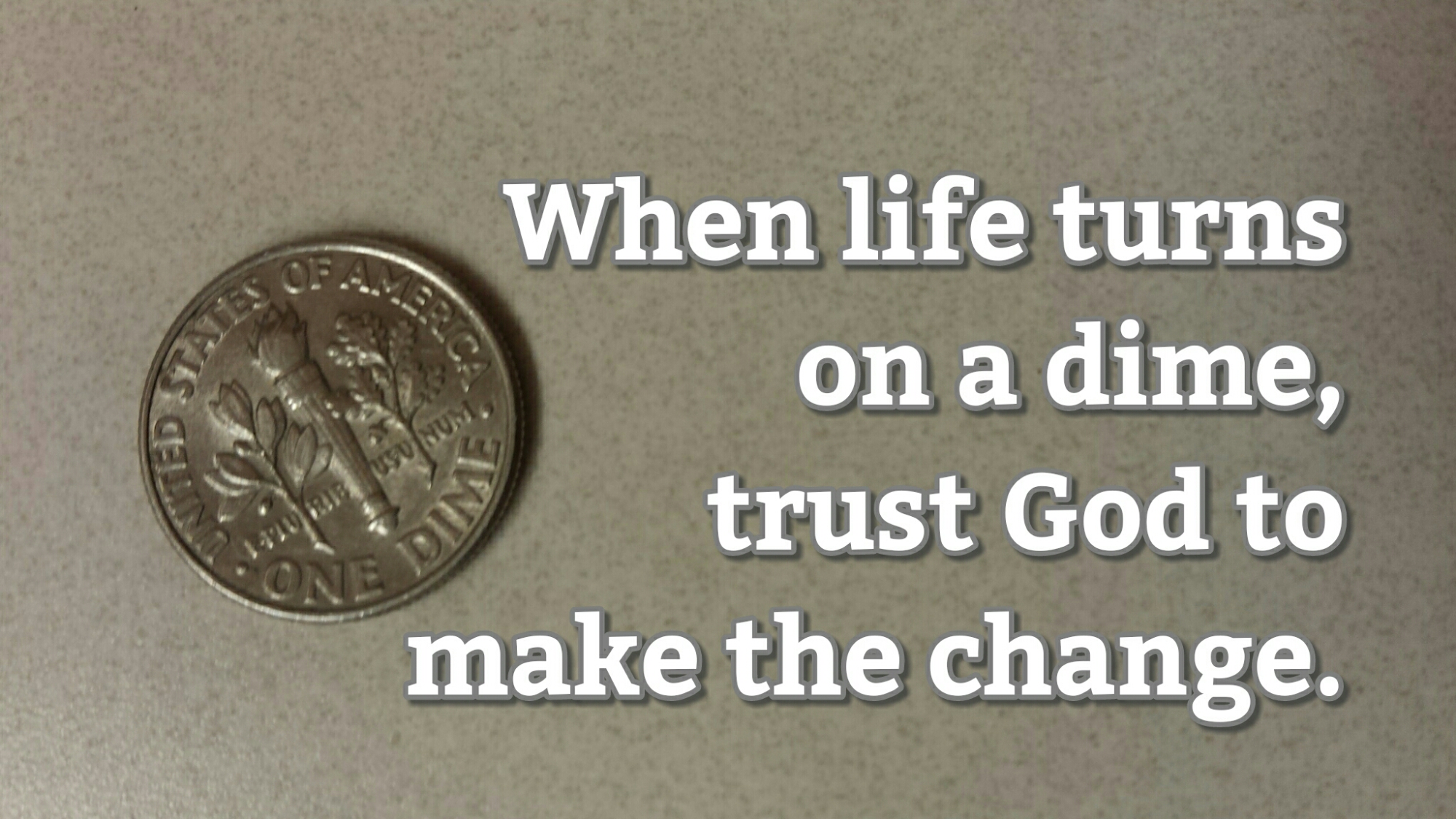
On The Dime

image


Today’s readings (click below to open in new tab/window):
Psalms 27; 147:12-20, Exodus 1:6-22, 1 Corinthians 12:12-26, Mark 8:27-9:1


Have you ever heard the expression “life turns on a dime?” It refers to the way our fortunes can change with little to no warning. When a new king who did not know Joseph or Joseph’s family rose over Egypt, he did not look kindly on the Hebrews. This new king viewed them as a potential threat, should they decide to align with his enemies. To preempt any uprising, he put harsh taskmasters over them and turned them into a nation of slaves. He went so far as to tell the Hebrew midwives to kill any male children at birth. The midwives were clever, and said Hebrew women were strong and gave birth on their own before a midwife could arrive. In a generation, the Israelites went from famine to favor to fetters.

In what must have felt like a mid-stream change of course to the disciples, Jesus began to teach them he would have to undergo great suffering, die, and rise again to fulfill his mission as Messiah. After all the miraculous healing, multiplication of loaves and fishes, and adoration of the crowds, Peter couldn’t believe his ears. He tried to tell Jesus it didn’t need to be so, and Jesus famously responded: “Get behind me, Satan!”

Psychologists tell us change –– good or bad – is an enormous source of stress, and sudden change even more so. In truth, life is nothing but change. Our bodies are machines of change, transforming food and air into blood and thoughts. As we sleep, our planet moves around the sun and our sun turns with galaxies and we wake unimaginable distances from where we laid our head. Change is unceasing; only our awareness of it flickers.

At the center of it all is God. He is the fixed point on which all else pivots. No matter our fortune, no matter where in the universe we stand, Jesus is the north star of our faith, guiding us toward the loving creator at its heart. Whether we are showered with riches or stripped of dignity, focusing on the center keeps us from spinning out of control.

Comfort: Focusing on God keeps everything in perspective.

Challenge:  Talk with a friend about their perceptions of your ability to handle change.

Prayer: God of creation, you are my center and my focus. Thank you for your constant love. Teach me to keep your ways in focus. Amen.

Discussion: What changes do you find especially difficult? What makes you dig in your heels and say: “Enough!”

Join the discussion! If you enjoyed this post, feel free to join an extended discussion as part of the C+C Facebook group. You’ll be notified of new posts through FB, and have the opportunity to share your thoughts with some lovely people. Or feel free to comment here on WordPress, or even re-blog – the more the merrier!

Curveballs

1457561126801

Today’s readings (click below to open in new tab/window):

Psalms 5; 147:1-11, Genesis 50:15-26, 1 Corinthians 12:1-11, Mark 8:11-26


Imagine you are Jesus. You’ve just miraculously fed four thousand people with no more than a few loaves and fishes. Not long before that you fed a greater crowd with fewer resources. Now you are in a boat with your disciples trying to use a parable about yeast to warn them about the pharisees and Herod. After a few minutes of pondering what you mean, they decide you are upset because … there is only one loaf of bread in the boat. If you were Jesus, would you have been a little frustrated that no one could seem to get past the lack of bread?

Are we wiser than the disciples? Do we treat every challenge like it’s the first one, or do we learn from our faith journey? No matter how many difficulties we’ve experienced, when new ones arise it can be hard to remember what we’ve survived. If God has seen us through illness, addiction, or betrayal are we able to trust He will see us through the newest crisis on the horizon? It’s not always easy, especially when we face the unfamiliar. Our first reaction is usually fear. But as the disciples eventually learned, trust in God can displace the fear. Trust may not completely eliminate the fear – we are only human! – but it changes our understanding of it. The trick is to remember that to God, this struggle is no worse than the ones that have come before.

Even the “best” lives are not free of challenges. As our faith matures, we begin to recognize huge challenges that didn’t register as important before. Issues of injustice, for example, become more obvious and less acceptable to us. If we can accept that life will never stop throwing us curveballs, that we have not failed because our lives aren’t perfected, maybe we can stop being surprised and devastated by them. If we are more in control of our reactions, we can surrender our troubles to God that much sooner. Some days we may ask how the bread could possibly be enough, but God is leading us to the bigger questions.

Comfort: You are not going through anything that God can’t see you through.

Challenge: When you are frightened by challenges, say prayers of thanks for all the situations God has already brought you through.

Prayer: Loving God, thank you for being with me in all situations. Forgive me when my fear interrupts my faith. Teach me to trust in you always. Amen.

Discussion: What things upset or frighten you because you can’t control them? Are you able to turn them over to God?

Join the discussion! If you enjoyed this post, feel free to join an extended discussion as part of the C+C Facebook group. You’ll be notified of new posts through FB, and have the opportunity to share your thoughts with some lovely people. Or feel free to comment here on WordPress, or even re-blog – the more the merrier!

24/7 Church

calendar-1192688-1599x1227Today’s readings (click below to open in new tab/window):
Psalms 34; 146, Genesis 49:29-50:14, 1 Corinthians 11:2-34, Mark 8:1-10


First century Christians had a different experience of church than altars, organs, choirs, and pews. For safety and other reasons, they gathered in private homes and spaces. Before celebrating The Lord’s Supper, they often had a full meal called a love (agape) feast. Everyone brought food and wine according to their means, and the bread for the Lord’s Supper was taken from the remnants of the earlier meal. The potluck may be one of the earliest Christian traditions.

Paul was disturbed by what he heard was happening at these gatherings in Corinth. Some wealthier members brought a lot of food, but didn’t share it with those who could bring little or nothing. Others were drunk by the time the real purpose of the gathering – celebrating the Lord’s Supper as a community in Christ – could begin. Paul told them whatever these people were celebrating, it certainly wasn’t the Lord’s Supper, because they were in no way honoring the Lord with their mindset or behavior.

Today the agape meal is a far less common form of church gathering, but we are vulnerable to the same types of problems. Participating in communion and worship while we are indifferent to the needs of our neighbors undermines the message of Christ. We may not be drinking wine during Sunday services, but if while we are gathered we indulge our excesses of gossip, vanity, and judgment we are no more focused on Christ than the drunk Corinthians were.

Church is the body we live in constantly. We can’t neglect or abuse the body and expect it to remain healthy. The Sabbath is meant to be a day of rest and worship. Waiting to exercise our faith one day a week is doing exactly the reverse – like sitting on the couch all day Monday through Saturday then trying to run sprints on Sundays – not only aren’t we prepared, we’re doing the body more harm than good. Our week should prepare us for Sunday as much as Sunday prepares us for the week.

Comfort: Jesus is with you all week long.

Challenge: Try to approach every person and situation as if it is a test of your faithfulness. It is.

Prayer: Merciful God, make me ever-mindful of your presence, grace, and will. May my every act be one of worship and gratitude. Amen.

Discussion: When are you on your “best behavior?” When are you not? Why not?

Join the discussion! If you enjoyed this post, feel free to join an extended discussion as part of the C+C Facebook group. You’ll be notified of new posts through FB, and have the opportunity to share your thoughts with some lovely people. Or feel free to comment here on WordPress, or even re-blog – the more the merrier!

The Truth about Crumbs and Dogs

1457351532294

Today’s readings (click below to open in new tab/window):
Psalms 119:73-80; 145, Genesis 49:1-28, 1 Corinthians 10:14-11:1, Mark 7:24-37


Not many people win an argument with Jesus. In Mark’s gospel there is only one example. She was both a Gentile and a woman, neither of which Mark’s audience would normally find persuasive. Yet she manages to change Jesus’ mind. When she asks him to rid her daughter of an unclean spirit, he tells her the food he offers should go to the children (of Israel) and not the dogs (a slur on her people). When she replies even the dogs get the children’s crumbs, her words stir him to help her daughter. What does it tell us that Jesus not only changed his mind, but was convinced to do so by someone considered a lowly outsider?

For one thing, it tells us we ought to be cautious about being overly sure of ourselves. If Jesus can change his mind, we can too. Closing our minds, especially when we are called to be merciful, betrays both the ministry of Jesus and what we ourselves are called to do. The moment we declare boundaries around the realm of God’s grace, we have placed our own wisdom above that of Christ.

It also tells us outsiders can be insightful critics. Individuals and communities often dismiss valid criticisms because they come from “outsiders” who couldn’t possibly understand, or perceive objective yet unflattering observations as attacks. Instead of absorbing facts and asking ourselves hard questions, we dig in our heels and counter-attack. And it doesn’t take much for us to tag someone as other: Christian communities do this both with non-Christians, and fellow believers who are in different denominations or understand scripture differently. Not so with Jesus. When an outsider presented a valid perspective, he responded not with defense or attack, but reconciliation and healing. That must be our model as well.

We don’t want to change our beliefs or practices like a reed swaying in the breeze of every opinion, but if continuing those beliefs and practices requires us to ignore or reject challenging truths … they were never very strong anyway. Weak faith shrinks by rejecting truth; strong faith expands by accepting it.

Comfort: Truth will only make your faith stronger.

Challenge: Consider how do you deal with challenges to your beliefs? Do you calmly consider other opinions, or do you immediately seek to dismiss or refute them?

Prayer: God, you alone know all truth. Help me to love the world as you have truly created it, and not as my limited human understanding has tried to define it. Amen.

Discussion: Some might argue Jesus already knew he was going to reconcile with the woman. If this is the case, why might he have at first denied her? Does it change our understanding of the lessons in the story?

Join the discussion! If you enjoyed this post, feel free to join an extended discussion as part of the C+C Facebook group. You’ll be notified of new posts through FB, and have the opportunity to share your thoughts with some lovely people. Or feel free to comment here on WordPress, or even re-blog – the more the merrier!


Expectation Management

detour-sign-1141114-1920x1272

Today’s readings (click below to open in new tab/window): 
Psalms 84; 150, Reading Genesis 48:8-22, Romans 8:11-25, John 6:27-40


How often does life unfold the way we expect? It’s a question without a truly quantifiable answer, but one suspects: far less than we’d like.

Jacob was a very old man when he met his grandsons Ephraim and Manasseh. The lives of Jacob and his family, particularly his son Joseph, were full of twists and turns, deception and separation. Many of these familial wounds were self-inflicted, such as when Joseph’s brothers sold him into slavery and faked his death. They didn’t like his predictions that one day he – the youngest – would rule over them, and ironically their actions set him on a convoluted path to power over not only themselves but all of Egypt.

When Joseph presented his two sons to Jacob for a blessing, the surprises continued. Joseph had positioned them so the older boy, Manasseh, was at Jacob’s right hand, traditionally the hand of greater blessing reserved for the oldest son. Jacob crossed his hands and – despite Joseph’s protests – instead gave the greater blessing to Ephraim, who was destined to father a “multitude of nations.”

Hard to believe the prophetic Joseph didn’t see it coming. After all, he was the youngest when his brothers betrayed him. And Jacob was a younger son who’d stolen the blessing of his older brother by deceiving his blind father. Down the line, Jacob’s great-great-grandson Moses survived to lead the Israelites back out of Egypt and slavery because of deception surrounding his birth. The nation of Israel survived and thrived because God isn’t limited by human expectation.

Christ upended expectations as a messiah of peaceful submission rather than bloody revolt. He taught us God loves and forgives all the “wrong” people. Could it be that the thing standing between us and the fully realized kingdom of God is our own expectations? Perhaps God waits to meet us around those twists and turns we fear and avoid. Those apparent flaws we condemn in ourselves and others could be keys to grace. Some days the map of faith is nothing but detours. When we stop placing expectations on God, we learn to expect God everywhere.

Comfort: You don’t have to know God’s plan.

Challenge: You just have to be open to it.

Prayer: God of creation, I seek to meet you where you are, and not where I would demand you be. Give me eyes to see and ears to hear your presence wherever you would have me encounter you. Thank you for the wonder of life, and its countless unexpected blessings. Amen.

Discussion: What expectations are frustrating you right now? Are they necessary expectations? Is anything but ego making you hold onto them? If you let go of them, would your life be better?

Join the discussion! If you enjoyed this post, feel free to join an extended discussion as part of the C+C Facebook group. You’ll be notified of new posts through FB, and have the opportunity to share your thoughts with some lovely people. Or feel free to comment here on WordPress, or even re-blog – the more the merrier!

“Not the heart, but the stomach”

1457189838895

Today’s readings (click below to open in new tab/window): 
Psalms 43; 149, Genesis 47:27-48:7, 1 Corinthians 10:1-13, Mark 7:1-23


Most of us identify the “self” with the brain or head. Our physical voice resonates inside our skull, so we assign that same voice to our mental life. Hearing our own recorded voice can be shocking; because it differs so greatly from what we expect, the experience can border on identity crisis. However, this sense of identity belonging to the head is not universal. Cultures have placed the self in the heart, the kidneys, and elsewhere. Helen Keller wrote of her pre-lingual existence: “If I had made a man, I should certainly have put the brain and soul in his finger-tips.”

What organs best describe our faith experience?

Do we rely on our gut? Instinct is a fine survival tool, but doesn’t always align with faith. The instinct to fit into our tribe is so strong that we can elevate tribal traditions to immutable laws and ostracize those who don’t follow along. For example, the Jewish people practiced ceremonial hand-washing before meals. It was not a religious law, but a human one. When the Pharisees and scribes accused the disciples of disrespecting tradition by not washing their hands, Jesus pointed out how the religious leaders truly disrespected God by rationalizing away his commands.

The Pharisees relied on brainpower to the detriment of their souls. They allowed some Jews to dodge financial support of their parents – part of God’s command to honor them – by pledging money or property to the temple, thereby making it unavailable for other use. This clever ploy – benefiting both the pledger and the temple – was within the letter of the law, but far from its spirit. The brain may love a faith full of loopholes, but Jesus doesn’t.

Jesus taught faith comes from the heart. Regarding Jewish dietary laws, he said everything that enters the body is destined for the sewer, so it can not defile us, but if our heart generates wickedness, we are defiled from within. Our physical hearts have tremendous influence on our brain function. Our spiritual hearts should similarly influence our minds and guts away from defilement toward true faith and love.

Comfort: Christ’s law is love.

Challenge: It can be easy to vilify the Pharisees and distance ourselves from them. Like us, they were products of their culture. Try reading today’s passage from Mark with some sympathy for the Pharisees and ask yourself what cultural traditions are more important to you than they need to be.

Prayer: Create in me a clean heart, O God. May my mind and will always be in your service. Amen.

Discussion: Have you ever been surprised to learn something you thought had religious roots was only a local tradition?

Join the discussion! If you enjoyed this post, feel free to join an extended discussion as part of the C+C Facebook group. You’ll be notified of new posts through FB, and have the opportunity to share your thoughts with some lovely people. Or feel free to comment here on WordPress, or even re-blog – the more the merrier!

No Excuses

1456963310560

Today’s readings (click below to open in new tab/window):
Psalms 27; 147:12-20, Genesis 46:1-7, 28-34, 1 Corinthians 9:1-15, Mark 6:30-46


In what ways are we humans responsible to each other? This question produces heated debates about public policy for everything from healthcare to school lunches to seat belt laws to immigration. While one side cries “nanny state” and the other cries “class warfare” both seem less interested in compassion than in domination. People of faith can not look to secular leaders – even Christian ones – for answers about how to respond to God’s call to compassion. Fortunately, we have Christ as our guide.

When Jesus led his disciples to what he hoped would be a place of rest, and instead found a great crowd already waiting, he didn’t complain or look for a different place. Rather, “he had compassion for them, because they were like sheep without a shepherd; and he began to teach them many things.” Compassion drove him even when he sought rest. Does our own compassion take precedence over our immediate fears and desires, or is it a slave to budgets, calendars, and convenience? It is tempting to make excuses when compassion asks for more than we want to give, especially to strangers. Compassion can be inconvenient, and may make demands of us when we are tired, hungry, or poor ourselves.

When the disciples asked Jesus to send that same crowd into town so they could find dinner, his response was: “You give them something to eat.” The disciples’ first reaction was to claim they couldn’t afford food for everyone. How often have we answered the call to compassion with similar excuses? Yet Jesus only asked them to give what was at hand, which turned out to be more than enough. He didn’t ask them to evaluate who was truly deserving, or to run a stewardship campaign to determine what resources were available. He trusted that God would use the gifts of the people to provide what was needed.

We can try to instill fairness, wisdom and compassion into secular society and government, but in the end Jesus is telling each of us: “you feed them” (or clothe them, or heal them, or help them). Will we respond with compassion or an excuse?

Comfort: The gifts you already possess are enough to make an important difference to someone.

Challenge: Of course you can’t be all things to all people at all times, but also try not to let yourself off the hook by dismissing what you have to offer.

Prayer: Gracious God, thank you for the gifts you have entrusted to me. Please bless me with the strength and will to use them in your service. Amen.

Discussion: In what ways are you stingy with your compassion? What excuses do you make for not using your gifts?

Join the discussion! If you enjoyed this post, feel free to join an extended discussion as part of the C+C Facebook group. You’ll be notified of new posts through FB, and have the opportunity to share your thoughts with some lovely people. Or feel free to comment here on WordPress, or even re-blog – the more the merrier!