The Great Author

happy trust

Today’s readings (click below to open in new tab/window):
Psalms 84; 150, Genesis 41:14-45, Romans 6:3-14, John 5:19-24


Joseph was a pivotal figure in the history of Israel. His brothers – angered by their father Jacob’s preferential treatment and by Joseph’s visions predicting his rise to power over them – sold Joseph into slavery and told Jacob he was dead. Though Joseph was respected by his master and made head of the household, the master’s wife framed him for assault and he was jailed. After years of imprisonment – where his talents  again put him in an unlikely position of leadership – Joseph’s ability to interpret dreams landed him a role as Pharaoh’s chief adviser. When a famine fell over Egypt and the surrounding lands, Joseph’s foresight kept the people from starving and he was able to save his long-estranged family by welcoming them into Egypt.

The story of Joseph is full of ironic turns.

The beautiful coat his father gives him to express love becomes falsified evidence of Joseph’s death.  When he refuses the advances of his master’s wife, Joseph’s integrity lands him in jail. Dreaming causes his family to cast him out, but eventually allows him to save them – and ultimately all of Israel. After his death, the Isralites fall out of favor with the Egyptians and become slaves, setting the stage for Moses and the Exodus.

Ferdinand Sabino said: “Everything will be fine in the end; if it’s not fine, it’s not the end.” Joseph’s story has a slightly different message: there is no end. What works against us today may work for us tomorrow. Yesterday’s triumph may be next year’s tragedy … and the following year’s triumph again. We never know how things will work out, and the end of our individual story is not the end of the greater story. Tying it all together is the presence of God inviting dreamers and kings, slaves and kidnappers to open themselves up to possibility and move the story of God’s kingdom forward. Whatever your situation is today, it will eventually change. Like Joseph, we do best in good times and bad when we hold tight to our faith while we wait for whatever unfolds in the Great Author’s next chapter.

Comfort: Change is inevitable, but God’s love is constant.

Challenge: God’s love is constant, but change is inevitable.

Prayer: Loving God, I will trust you always to see me through hardships and joys. May I be open to playing my part well in the endless story of your love and your kingdom. Amen.

Discussion: What have been some of the unexpected twists in your part of the great story?

Join the discussion! If you enjoyed this post, feel free to join an extended discussion as part of the C+C Facebook group. You’ll be notified of new posts through FB, and have the opportunity to share your thoughts with some lovely people. Or feel free to comment here on WordPress, or even re-blog – the more the merrier!

A Responsible Sabbath

DCP_0298

Today’s readings (click below to open in new tab/window):
Psalms 43; 149, Genesis 41:1-13, 1 Corinthians 4:1-7, Mark 2:23-3:6


When Jesus picked and ate a handful of grain on the Sabbath, the pharisees accused him of violating the law. He replied: “The Sabbath was made for humankind, not humankind for the Sabbath” and reminded them a starving King David once ate the bread in the temple. This is only one of many time Jesus taught them God’s foremost priority is the people, not the law. Picking a handful of grain for the moment’s enjoyment is qualitatively different than working a day in the field, but the Pharisees made no such distinction between the letter and spirit of the law.

On the other hand, as Jesus tried to put the law into perspective, he at no time dismissed it wholesale. He never claimed the Sabbath was made for humankind… to ignore. We are eager to hear the message we are not slaves to the law. Are we just as eager to receive Christ’s words about our responsibilities to justice and mercy? American culture is all about establishing rights, but how would we react to any proposed Bill of Responsibilities? Freedom is only one side of the coin. Jesus clearly has expectations we are to use our freedom to make the right choices: feed the hungry, clothe the naked, and visit the sick and imprisoned. Instead of a simple checklist, we have an obligation to love our neighbor. Freedom can be a wild creature; fortunately God gave each of us a brain we can use to rein in our freedom toward his service.

Like the Sabbath or the law, Jesus’ teachings were tools given to humankind. We depend on them to do our job as Christians. As with any good tools, we must learn to use them properly. To master them, not only do we have to read the manual, we have to apply them in the real world, and gain experience to know how they handle in action. A plumber isn’t a slave to his wrenches, but he isn’t much of a plumber without them.

Freedom from the law is a gift, but it is a gift we must use responsibly.

Comfort: You don’t need to win God’s love through good deeds.

Challenge: Review the past week. If you find you have squandered your freedom, make a commitment to using it more responsibly next week.

Prayer: Loving God, thank you for freeing me from sin and fear. Use my time and talents toward your great purpose, that may love for my neighbor may be even the palest reflection of your great love for humankind. Amen.

Discussion: How do you use your freedom? What sense of responsibility do you have toward your neighbor?

Join the discussion! If you enjoyed this post, feel free to join an extended discussion as part of the C+C Facebook group. You’ll be notified of new posts through FB, and have the opportunity to share your thoughts with some lovely people. Or feel free to comment here on WordPress, or even re-blog – the more the merrier!

Gimme Some Skin

1455847277967

Today’s readings (click below to open in new tab/window):
Psalms 22; 148, Genesis 40:1-23, Corinthians 3:16-23, Mark 2:13-22


Skin.

It is our largest organ and one of our primary tools for interacting with the world. Through sensations like temperature, pressure and texture it tells us about our environment. Most of us recognize each other by the skin on our faces. Some of us mark it in ink to tell our stories. Others work against the story our skin tells, by hiding it under makeup, slathering it in moisturizers, bleaching it chemically, baking it under lamps, or cutting parts of it away. It is so essential to our identity that skin diseases and disfigurements can be socially crippling, whether through our own insecurities or the rejection of others.

We identify it with personality traits. We may be thick- or thin-skinned; things can “get under our skin”; we all want to be comfortable in our own skin; our attitudes may grow callused. It can reveal our inner state – sometimes to our dismay – through blushing, goosebumps and sweating. It is intimately connected to our physical and mental health: studies show that skin-to-skin contact reduces stress, promotes healing, and is vital for an infant’s emotional development.

Skin is so much more than a container. When Jesus says we can’t pour new wine into old wineskins (lest they split under pressure), his message isn’t just about storage methods or the need for religious institutions to be more flexible to contain larger truths. It’s about our need to redefine our spiritual identities so they can contain the new life God pours into us. Recreated in Christ, our new skin perceives the world in new ways. It is a new face to the world, who sees us differently in demeanor and action. The story our new skin tells does not need to be adorned or denied – it grows more beautiful with time. Our blemishes and imperfections remain part of our story, but they no longer hold us back, or allow others to; rather they become evidence of the transformative power of God’s love and forgiveness. Our inner and outer lives are in harmony.

Are we wearing our fresh skins? The new wine is ready …

Comfort: Your identity in Christ renews you from the inside out.

Challenge: In what ways are you spiritually inflexible? Ask yourself whether that’s due to conviction or obstinacy.

Prayer: God of renewal, prepare me to receive the new life you are waiting to pour into me. Amen.

Discussion: How do you feel about the skin you’ve been given? What role has it played in your identity?

Join the discussion! If you enjoyed this post, feel free to join an extended discussion as part of the C+C Facebook group. You’ll be notified of new posts through FB, and have the opportunity to share your thoughts with some lovely people. Or feel free to comment here on WordPress, or even re-blog – the more the merrier!

Forgiveness First

image

Today’s readings (click below to open in new tab/window):
Psalms 27; 147:12-20, Genesis 39:1-23, 1 Corinthians 2:14-3:15, Mark 2:1-12


Jesus was speaking to a large crowd gathered in and around his home. “[S]ome people came, bringing to him a paralyzed man, carried by four of them. And when they could not bring him to Jesus because of the crowd, they removed the roof above him; and […] let down the mat on which the paralytic lay. When Jesus saw their faith, he said to the paralytic, ‘Son, your sins are forgiven.'” The scribes present were offended that Jesus felt he had the authority to forgive sins. The man lowered through the roof may have been disappointed his faith was rewarded with forgiveness and not healing. His friends were probably not looking forward to carrying him back.

As he always seems to do, Jesus turns the situation on its head.

To demonstrate to the scribes the level of his authority, Jesus commands the man to pick up his mat and walk. What’s a little forgiveness compared to a miracle? While we have a suspicion Jesus intended to heal the man all along, his decision to first emphasize forgiveness is a powerful statement. In the text leading to this moment, Jesus seems increasingly frustrated the people follow him only for healings and miracles. While these are signs of his authority, they are only signs – which exist to point to something more important, something beyond our own satisfaction.

The most important healing Jesus offers is not of our mortal bodies, but of our eternal relationship with God. Some of us are convinced we are irredeemable (even though we hail Christ as our Redeemer!), and live our whole lives as if that was true. Others place blame on everyone else and live lives of petty grudges. Both situations demonstrate a lack of faith in forgiveness. These mindsets can be nearly impossible to shake. When we can fully accept that love and forgiveness are at the core of our beings and the center of our relationship with God, well … there’s the miracle.

Healing is not the end of the story, but the beginning. Once we accept God’s love and forgiveness, we can in turn love and forgive ourselves and each other. We heal the world. We are resurrected.

Comfort: The only thing standing between you and forgiveness … is you.

Challenge: Forgive someone. Don’t confuse it with excusing or justifying them. Forgive them as many times as you need to until it sticks.

Prayer: God of forgiveness, I step into your welcoming embrace. Thank you for loving me when I can’t forgive myself. I will accept your love even when I feel unworthy, because only your love heals me so I may forgive others. Amen.

Discussion: What do you need to forgive yourself for? Are you able to ask God to forgive you before you can forgive yourself?

Join the discussion! If you enjoyed this post, feel free to join an extended discussion as part of the C+C Facebook group. You’ll be notified of new posts through FB, and have the opportunity to share your thoughts with some lovely people. Or feel free to comment here on WordPress, or even re-blog – the more the merrier!
Celebrity Gossip

1455685376642

Today’s readings (click below to open in new tab/window):
Psalms 5; 147:1-11, Genesis 37:25-36, 1 Corinthians 2:1-13, Mark 1:29-45


The fastest form of communication known to humankind may be … gossip. The most mundane fact becomes interesting if someone tries to keep it a secret. Celebrities and publicists take advantage of this quirk of human nature all the time by “leaking” information to stoke curiosity about a project or event that otherwise might have garnered little notice. Both giving and receiving such information produce a thrill of being part of an inner circle.

So why would Jesus – with his incisive understanding of human nature – bother to tell a man he had healed of leprosy to “say nothing to anyone?”

Maybe it was because he knew that the wrong kind of fame would attract the attention of his enemies sooner rather than later. Even for Jesus, fame was a difficult beast to tame. Like many modern “superstars,” he quickly became a victim of his own success. He wanted to control the spread of his message, but the more famous he became, the less he was able to travel and teach freely, or to find solitude to renew himself. Eventually he stayed put while the crowds came to him.

If the healed man is any indication, it seems that while God invites us to cooperate with “the plan,” its eventual success doesn’t hinge on our individual compliance. Our disregard may even be turned to an advantage. Jay Bakker, son of controversial televangelists Jim and Tammy Bakker, abandoned the church and turned to substance abuse as a reaction to scandals plaguing his family. Surely substance abuse is not part of God’s plan for anyone, but his experiences equipped him to co-found Revolution Church, a successful ministry reaching many people neglected or feared by more traditional churches.

It can be comforting to believe everything happens for a reason. Could it be even more comforting to believe that, no matter why something happens, even if it initially seems to go against the plan, God can turn it toward his purpose? From loose-lipped lepers to prodigal sons, we can all be instruments of the divine will. Who are you going to let in on the secret?

Comfort: You can be part of God’s plan, but it won’t be derailed when you are.

Challenge: Be sure information you pass along is true and necessary.

Prayer: Loving God, please help me to discern your will, and to trust you when I can’t. Amen.

Discussion: When have you seen seeming disaster turned around for good?

Join the discussion! If you enjoyed this post, feel free to join an extended discussion as part of the C+C Facebook group. You’ll be notified of new posts through FB, and have the opportunity to share your thoughts with some lovely people. Or feel free to comment here on WordPress, or even re-blog – the more the merrier!

Fool Me

1455593850320

Today’s readings (click below to open in new tab/window):
Psalms 34; 146, Genesis 37:12-24, 1 Corinthians 1:20-31, Mark 1:14-28


We train our children not to trust strangers, especially ones promising treats. As adults we try to follow our own advice. We are skeptical of offers that sound “too good to be true.” Most of us don’t hitchhike or pick up hitchhikers. We lock up our homes, cars, and jewelry. Given the nature of the world, all these precautions are wise.

On the other hand, we still like our quick fixes and easy assurances. Proof lies in the bank accounts and hypocrisy of televangelists, politicians, snake oil salesmen, and home shopping gurus. Headline after headline reminds us we entrust them with far too much of our faith and money.

What then are we to make of fishermen who “immediately” dropped everything to follow Jesus, as Mark tells us, simply because he asked them to? In hindsight we support the decision, but what about anyone who abandoned her or his life today to follow someone promising to make them “day traders of men?” Do the words “cult” and “deprogram” come to mind? Were the first disciples wise people or lucky fools?

The difference between wisdom and foolishness is a tough call. Because God’s values are upside down compared to the world’s values, we are constantly called to evaluate our decisions, and sometimes to act in ways others would consider foolish. For example, how many of use are willing to decrease our standard of living – move into a smaller house, drive a cheaper car, or take a lower paying job – to spend more money or time on the poor? Very few, and they are often judged with humor at best and cynicism at worst. The world tells us this is foolishness, yet it is freedom.

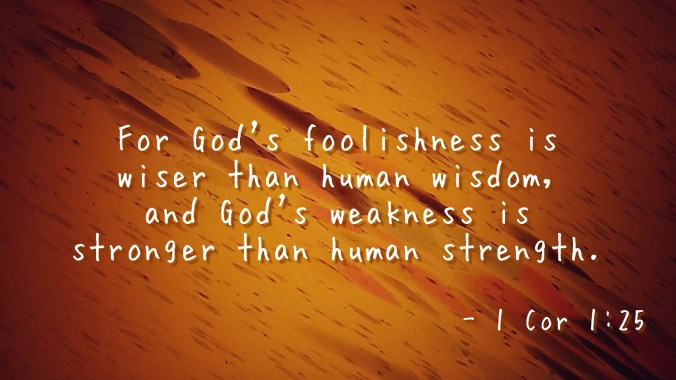
In 1 Corinthians, Paul tells us God makes the foolish wise and the wise foolish. Let’s not get cocky about which side of that equation we land on. Determining whether a path is right or merely attractive can take serious discernment. We want to follow Jesus urgently, but we want to be sure the path we choose truly leads to him. Let’s choose our guides with Godly wisdom and worldly foolishness.

Comfort: Your choices are between you and God.

Challenge: “Foolishly” critique your own opinion on a controversial issue.

Prayer: God of wisdom, bless me with your foolishness.

Discussion: Have you ever felt like a fool for Christ? When and why?

Join the discussion! If you enjoyed this post, feel free to join an extended discussion as part of the C+C Facebook group. You’ll be notified of new posts through FB, and have the opportunity to share your thoughts with some lovely people. Or feel free to comment here on WordPress, or even re-blog – the more the merrier!

Reading the Room

1455538193481

Today’s readings (click below to open in new window/tab):
Psalms 119:73-80; 145, Genesis 37:1-11, 1 Corinthians 1:1-19, Mark 1:1-13


Have you heard the expression “read the the room?” It refers to someone’s ability to gauge an audience’s mood and response. Comedians learn to read a room because every crowd responds differently. Executives read a room to determine the level of support for a proposal. Comedians can change the content of the message to please an audience, but a good leader with an important message can adjust only the style, never the meaning.

Jacob and his son Joseph were not skilled at reading a room.

Jacob’s obvious favoritism toward Joseph left his other eleven sons bitter. When he gave Joseph a special robe with long sleeves, it might as well have had a target embroidered on the back. At the age of seventeen Joseph began having prophetic dreams. In these dreams, his brothers – represented by sheaves of wheat or stars – bowed down to him. Whether he was simply oblivious to his brothers’ scorn, or wanted to spite them because of it, sharing his dreams made them more jealous than ever and they began to plot against him.

As Christians, we will be called to say unpopular things. We can adjust our style (even Paul adapted to local audiences) but we don’t have the option of altering the core message, because it originates with Christ. We want his message about God’s love and justice to be taken seriously and understood clearly.Therefore we should think before we speak, and try to anticipate how we will be perceived. Dressing our message in flamboyant, self-important language and attitude will cause people to react favorably or unfavorably more because of the style than the content. Giving the impression that we believe we are somehow superior to our listeners will give them an excuse stop listening. We want to be confident but not cocky; we are the trusted bearers of the message, not its source. A little humility goes a long way.

Humility will not always prevent others from criticizing, demeaning, or persecuting us for sharing the Gospel. In the end we want to be the best ambassadors for Christ we can be, regardless of the cost.

Comfort: You can have confidence in the Gospel.

Challenge: Work on striking a balance between knowing your audience and remaining true to your message.

Prayer: Loving God, thank you for the Gospel message of love and justice. Lend me strength and wisdom to share it with others. Amen.

Discussion: Have you ever changed your message because it was unpopular? What were the consequences?

Join the discussion! If you enjoyed this post, feel free to join an extended discussion as part of the C+C Facebook group. You’ll be notified of new posts through FB, and have the opportunity to share your thoughts with some lovely people. Or feel free to comment here on WordPress, or even re-blog – the more the merrier!
Good for the Soul

IMG_0322

Today’s readings (click below to open in new tab/window):
Psalms 42; 32, Daniel 9:3-10, Hebrews 2:10-18, John 12:44-50


Alcoholics Anonymous teaches us: “You are only as sick as your secrets.” The author of Psalm 32 knew this well. He wrote of his formerly deceitful spirit:

While I kept silence, my body wasted away
through my groaning all day long.
For day and night your hand was heavy upon me;
my strength was dried up as by the heat of summer.

Today we might describe a secret as eating away at us or causing us to lose sleep. The longer we convince ourselves to keep our sins secret, the larger the role they play in our lives, yet somehow we convince ourselves an admission of guilt would be worse than the physical and psychological destruction we inflict upon ourselves. We fear the consequences of revealing our truths – often for good reason – but until we face them, we will not know peace. We want relief from our pain, but we turn to the bad medicine of substance abuse, anger, self-righteousness, or self-harm rather than swallow the bitter yet effective pill of confession.

Whether it is a one-on-one sacrament as observed by Roman Catholics and Lutherans or a community prayer and assurance of pardon during other Protestant liturgies, most Christian denominations practice some form of confession and absolution. Corporate confession is a valuable reminder of our ongoing need to evaluate and improve our behaviors and attitudes, but it is rarely a catalyst for deep change. Individual confession – to a priest, pastor, counselor, friend, or support group – forces us to confront truths in a personally meaningful way. Sometimes we have to admit them to others before we can really believe them. God’s forgiveness is always available to us, but first we must recognize what it is we need forgiveness for.

Guilt is a great weight. We can shift its useless burden from shoulder to shoulder, desperately growing weaker while trying to convince others we are strong … or we can confess our weakness. God’s forgiveness is not about shaming our weakness or balancing the load, but about teaching us to drop it entirely.  Each secret we speak is a weight we no longer carry.

Comfort: God’s forgiveness is always available, because He is more interested in loving us than damning us.

Challenge: Unburden yourself a little this week. Pick a sin or secret that troubles you and confess it to a trusted friend, minister, or counselor.

Prayer: Lord Jesus Christ, have mercy on me, a sinner.

Discussion: Has anyone confessed a secret to you? How did it make you feel?

Join the discussion! If you enjoyed this post, feel free to join an extended discussion as part of the C+C Facebook group. You’ll be notified of new posts through FB, and have the opportunity to share your thoughts with some lovely people. Or feel free to comment here on WordPress, or even re-blog – the more the merrier!

Just Deserts and Just Desserts

1455376584499

Today’s readings (click below to open in new tab/window):
Psalms 43; 149, Ezekiel 39:21-29, Philippians 4:10-20, John 17:20-26


Have you heard the term “food desert?” A food desert is generally understood as an area – usually urban, usually economically distressed – where circumstances limit people’s access to affordable, nutritious food. Picture an inner city neighborhood loaded with overpriced convenience store snacks, but no groceries with fresh produce. Because the available food is junk, people living in food deserts are commonly both overweight and undernourished.

Paul had never heard of food deserts when he told the Philippians he had “learned the secret of being well-fed and of going hungry, of having plenty and of being in need” (Phil 4:12).  He did recognize that we never have so much abundance that we don’t still need Jesus. We can grow fat on the riches of the world, but they will never give us true life. Yet even a small taste of the Bread of Life will leave us satisfied. Like Paul, we will “[learn] to be content with whatever [we] have” (v 11).

We’re all familiar with the practice of giving something up for Lent, a symbolic fast demonstrating our solidarity with Christ’s forty days in the desert. An equally important but less frequently observed tradition is almsgiving, or giving to people in need. Our Lenten sacrifice has more meaning when these practices go hand-in-hand. It’s not our business to judge anyone’s sacrifice, but there is a qualitative difference between giving up chocolate because it dovetails with weight loss goals, and giving up a daily five-dollar latte and donating the money to a food bank instead.

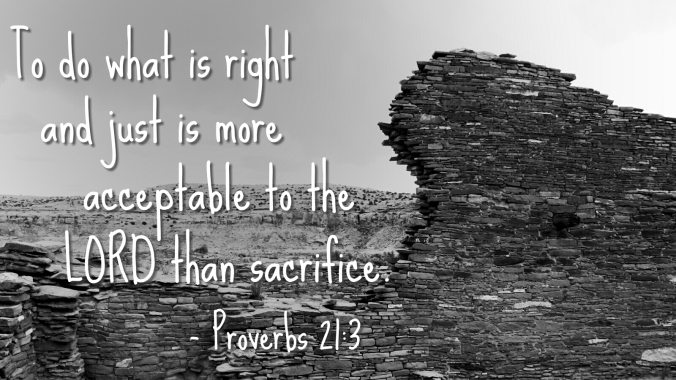
Our wilderness fast with Christ is a time of spiritual growth. The deeper we sink our roots into that desert, the more Living Water we will find.  Desert plants are biologically efficient and waste little energy on unnecessary processes, yet when resources allow they produce stunning blooms. Which of our resources could be put to better use in deserts both spiritual and nutritional? What sacrifices can we make so others might blossom in the love Christ calls us to share? Time and again the prophets remind us God loves mercy above sacrifice, but sometimes we must sow sacrifice to reap mercy.

Comfort: Like Paul, you can learn to be content under all circumstances.

Challenge: Learn more about food deserts and how you can help. What sacrifices of time and money might you be able to make to help people with little access to nutritional food?

Prayer: Gracious and merciful God, I thank you for all things you have given me. Help me understand which are mine to use, and which you have entrusted me to share with others in need. When my hunger for food is satisfied, may I feel even more strongly a hunger to share the Bread of Life with the world. Amen.

Discussion: On what do you spend a lot of time and energy which gives you little to no nourishment in return? Do you think it would be possible to reprioritize that time and energy?

Join the discussion! If you enjoyed this post, feel free to join an extended discussion as part of the C+C Facebook group. You’ll be notified of new posts through FB, and have the opportunity to share your thoughts with some lovely people. Or feel free to comment here on WordPress, or even re-blog – the more the merrier!

Sour Grapes

Turnthenandlive

Today’s readings (click below to open in new tab/window):
Psalms 22; 148, Ezekiel 18:1-4, 25-32, Philippians 4:1-9, John 17:9-19


It’s a prophet’s job to tell us what we don’t want to hear. The more righteous or justified we think we are, the less we’re going to want to hear it … but the more we need to. The prophet Ezekiel told the Israelites in exile that God was banishing a particular expression: “The parents have eaten sour grapes, and the children’s teeth are set on edge.” In other words: stop blaming your past for your current problems.

The Israelites liked to blame their exile on the sins of the previous generation. Ezekiel told them to stop making excuses and get right with God. Like children who d on’t want to be responsible for themselves, they replied: “It’s not fair!” God brushed off their protests. Maybe their parents had made terrible mistakes, but now these children were all grown up and needed to control the one thing they could: their own behavior.

Some people undergo years of therapy to unlearn the toxic habits of an unhealthy past. Others with less traumatic experiences grow on their own. Understanding the root of our problems is only ever a starting point. Unfortunately, many people who identify the origin of their unhealthy behaviors use it as an excuse to justify the poor choices they continue to make in the present. According to Ezekiel, God’s not having it.

As we live through Lent, let’s be honest with ourselves and God about our own shortcomings. After all, there’s nothing about us God doesn’t already know. He loves us anyway, and too much to let us keep fooling ourselves. When He tells the Israelites: “Get yourselves a new heart and a new spirit!” He could be talking to us. Sometimes our hearts and spirits are like homes cluttered with junk we’ve inherited. Because we fear loss we cling to it long after it’s useful (if it ever was) when we need to be clearing out the old to make room for the new, or maybe just for some light and air. We must repent of it to follow Christ. In the words of Ezekiel: “Turn, then, and live.”

Comfort: With Christ’s help, you can clean your spiritual house and let in the light of God.

Challenge: Clean out a closet. As you decide which things to discard, also think about what things from your past you are allowing to hold you back.

Prayer: Gracious and merciful God, show me how to turn and live. As I face the dark corners of my soul, fill them with your light and make them new. Teach me to set my sights not on where I regret having been, but on where you would have me go. Amen.

Discussion: What changes you have already made give you confidence about the making the changes you still need to face?

Join the discussion! If you enjoyed this post, feel free to join an extended discussion as part of the C+C Facebook group. You’ll be notified of new posts through FB, and have the opportunity to share your thoughts with some lovely people. Or feel free to comment here on WordPress, or even re-blog – the more the merrier!