Peace as Action

1449987646870

Readings: Psalms 24; 150, Amos 9:11-15, 2 Thessalonians 2:1-3, 13-17, John 5:30-47


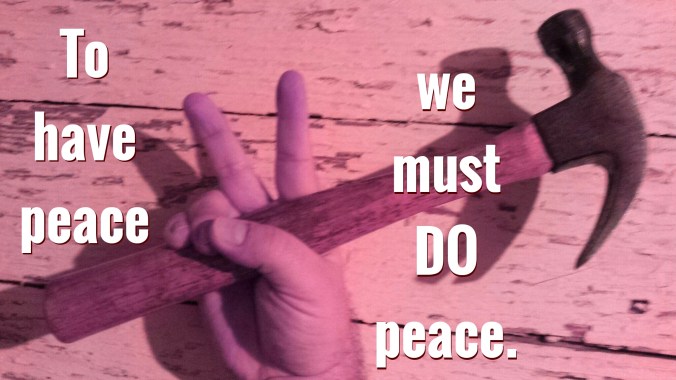
In the musical Rent the character of Mark sings: “The opposite of war isn’t peace; it’s creation.” The narrow definition of peace as merely the absence of destruction is turned on its head in a story about art and artists, but it has more universal application.  True peace is not something we passively experience; it is something we do.

After World War II, the United States initiated the Marshall Plan to help a devastated Europe recover economically. This aid included former enemies Italy and Germany, as well as neutral countries like Iceland. At the same time the U.S. oversaw the reconstruction of Japan, including a security arrangement that still exists today. These decisions were not altruistic on the part of the U.S. Leaders understood simple withdrawal from conflict was not the same as peace, which requires an ongoing effort. They understood peace as doing justice.

If we want to have peace – personal, interpersonal, or international – in our own lives, we can’t rely on outside forces to retreat from conflict and leave us alone to our apathy. Acts of creation and generosity can transform enemies into allies, battlefields into sources of shared harvest. To have peace, we must do peace.

For all his message of doom, the prophet Amos does paint a picture of what the peaceful Kingdom will look like:

they shall rebuild the ruined cities and inhabit them;
they shall plant vineyards and drink their wine,
and they shall make gardens and eat their fruit. (Amos 9:14)

It is not that these activities are possible because we live in some conflict-free vacuum we label peace, but that these activities are peace and create the conditions for its survival.

We all have conflicts. What cities of friendship have we left in ruin? What vineyards of opportunity have we trampled? What refugees of family have we driven away? We can choose to simply retreat from these battles, but let’s not mistake indifference for peace. Rather, let’s regroup and prayerfully consider how we might do peace. When we do peace rather than wait for it, the harvest will be abundant.

Comfort: We are not helpless in the face of conflict. We can rely on God to show us how to live peace.

Challenge: Explore organizations in your local community which work toward peace. Look for ways you might contribute.

Prayer: Relieve the troubles of my heart, and bring me out of my distress. Consider my affliction and my trouble, and forgive all my sins. (Psalm 25:17-18)

Discussion: Where have you settled for indifference instead of peace? What can you do about it?

Join the discussion! If you enjoyed this post, feel free to join an extended discussion as part of the C+C Facebook group. You’ll be notified of new posts through FB, and have the opportunity to share your thoughts with some lovely people. Or feel free to comment here on WordPress, or even re-blog – the more the merrier!

Love Dangerously

1449898213207

Readings: Psalms 90; 149, Haggai 2:1-9, Revelation 3:1-6, Matthew 24:1-14


Love hurts.

More than a pop song cliche, it’s a truth which is unpleasant and unavoidable – unless we opt out of love altogether. Whether we cause the pain or feel it, every relationship is eventually tested. Marriages struggle. Children leave home. Children fail to leave home. Friends let us down. The songs are usually about romantic love, but it’s true even of the agape love practiced by followers of Christ.

How many times heard someone say (or said ourselves), “I just don’t want to be hurt … again?”  Maybe they were cheated on. Maybe they were taken advantage of. The reasons for hurt are endless but here’s the thing: we already hurt, because we are already broken people in a broken world. There is no “again;” there is only “still.”

The pain of love is different from the pain of brokenness. The pain of love is like a bone being set, a wound being drained, or the pain of pouring out our secrets to a therapist. It is a productive pain and if we choose to avoid it, healing eludes us.

When Christ asks us to love God and to love one another, he promises us a spiritual comfort but does not promise us a life free of pain or danger. To the contrary, he warns us our choice to follow him into a life of agape love will cause many to scorn us and possibly put us in harm’s way. That harm isn’t always physical. Sometimes it is an injury to the spirit that occurs precisely because we have chosen to help others. Loving leaves us vulnerable.

Like our bodies, our spirits have an instinct to recoil from that which hurts us. As the Great Physician, Jesus tells us the remedy often means taking a greater risk and putting ourselves in danger of more pain – not to become victims or masochists, but to improve our spiritual health. Eventually love mends the breaks and wounds in our spirit, but we must take risks.

Love hurts. Not loving hurts more, because improperly set spiritual bones leave us as hobbled as physical ones.

Comfort: It may take a long time, but loving others heals our own brokenness.

Challenge: For an example of love that valued risk over comfort, read this perspective on Mary, the mother of Jesus.

Prayer: Loving God, give me the courage to love, even when doing so is dangerous. Amen.

Discussion: Different people have different methods of expressing love and recognizing when they are loved. What are yours? (If you’re not sure, maybe take a look at the The 5 Love Languages site of Dr. Gary Chapman).

Join the discussion! If you enjoyed this post, feel free to join an extended discussion as part of the C+C Facebook group. You’ll be notified of new posts through FB, and have the opportunity to share your thoughts with some lovely people. Or feel free to comment here on WordPress, or even re-blog – the more the merrier!

Love Anyway

1449813512085

Readings: Psalms 102; 148, Haggai 1:1-15, Revelation 2:18-29, Matthew 23:27-39


Jesus told the Pharisees: “I send you prophets, sages, and scribes, some of whom you will kill and crucify, and some you will flog in your synagogues and pursue from town to town” (Matt 23:34). A little later he added: “How often have I desired to gather your children together as a hen gathers her brood under her wings, and you were not willing!” (v 37). Through his frustration, the underlying message is: love keeps trying until there is nothing left to do.

This is not so different from the frustration we feel when a child’s battle with substance abuse leads to repeated betrayal. When a friend’s mental illness seems determined to isolate her from others. When a sibling refuses to forgive family disputes.

To a lesser degree we may feel it when we do volunteer work and recipients seem less than grateful. Or when they seem to take advantage of our generosity. Or when sincere but fumbling attempts to support a disadvantaged group are met with suspicion or criticism.

One natural response to perceived rejections is to give up on loving, perhaps telling ourselves to save our love for where it is appreciated. Another response, one much more difficult and requiring sincere humility, is to examine whether we could try to love them differently. God extended all possible chances despite knowing the outcome. Should we do less?

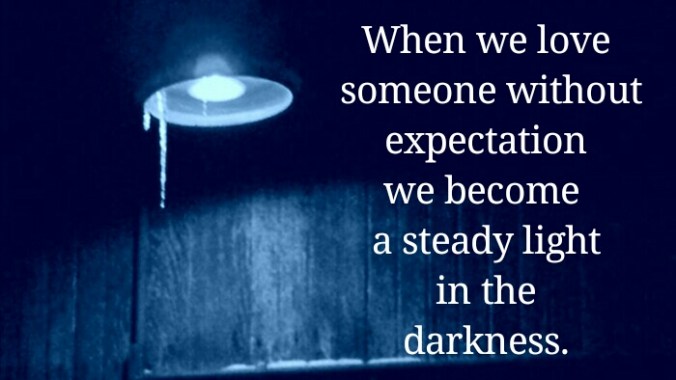
We can’t cure another person’s addiction or illness. We can’t force people to express gratitude in a manner acceptable to us. We can keep reaching out in love to a person drowning in suffering, until he either accepts our hand or is pulled beneath the waves. God knew the Jewish people would not heed his cries until it was too late, but love compelled him to keep trying. If we love someone thinking we can save them, we will inevitably be disappointed. If we love someone with an agenda that serves our ego more than their need, we will burn out. When we love someone without expectation, we become a steady light in the darkness.

Comfort: We are not responsible for how others respond to our love; only to love them anyway.

Challenge: When you feel your love is rejected, consider doing something differently.

Prayer: I keep the LORD always before me; because he is at my right hand, I shall not be moved. (Psalm 16:8)

Discussion: When you feel your love is rejected, redirect it.

Join the discussion! If you enjoyed this post, feel free to join an extended discussion as part of the C+C Facebook group. You’ll be notified of new posts through FB, and have the opportunity to share your thoughts with some lovely people. Or feel free to comment here on WordPress, or even re-blog – the more the merrier!

Love Generously

1449724358670

Readings: Psalms 18:1-20; 147:12-20, Amos 9:1-10, Revelation 2:8-17, Matthew 23:13-26

Have you ever wondered why gold is such a valuable currency? It boils down to a few reasons: it doesn’t corrode or react easily with other substances; it’s rare but not too rare; it melts at a high enough temperature to be stable but not so high as to be unworkable; and it is an easily identifiable color. Most importantly, it is valuable because we agree it is.

When Jesus chastises the temple officials by calling them “blind guides” because they teach the faith without comprehending it, he says they value oaths made on the gold in the temple more than oaths made on the temple itself. He asks: “[W]hich is greater, the gold or the sanctuary that has made the gold sacred?” (Matt 23:17). Knowingly or not, these leaders had agreed on what they valued most, and they chose poorly.

Our time and energy are our most precious currency, each minute a coin we choose to spend in some way. What have we agreed deserves our investment? The treasures we gather up in life are only valuable if they are made sacred by the love and faith surrounding them. If our money doesn’t go toward helping those in need, if our home is not open to those seeking shelter, if our larders are locked away from the hungry … of what value are they? If their only value is in the having, then we are like dragons afraid to leave our cave because the world might sneak in and steal our hoard. Gold is nothing but a heavy, beautiful shackle until we bring our treasure to the temple where it can be converted to the limitless currency of love. We must spend it to make more.

True agape love does not corrode and is not eroded by circumstance. It is rare, but not so rare we can’t mine it within ourselves. It is malleable enough to suit many needs, but stable enough to be reliable. People know it when they see it. Perhaps the whole world does not agree on its value, but within the temple of Christ’s body,  it ransoms the world.

Comfort: Our treasure is not measured by what we keep, but by what we give away.

Challenge: If you don’t already do so, consider pledging a small monthly amount to a charity of your choice (other than or in addition to your church).

Prayer: Loving God, I commit my treasures to your service. Amen.

Discussion: What types of investment do you consider to be wise ones?

Join the discussion! If you enjoyed this post, feel free to join an extended discussion as part of the C+C Facebook group. You’ll be notified of new posts through FB, and have the opportunity to share your thoughts with some lovely people. Or feel free to comment here on WordPress, or even re-blog – the more the merrier!
Love Selfishly

1449631034908

Readings: Psalms 50; 147:1-11, Amos 8:1-14, Revelation 1:17-2:7, Matthew 23:1-12


In the midst of adversity, we may find it difficult, almost impossible even, to practice love. Imagine being a widow or beggar during the time of Amos, when the religious leaders were “buying the poor for silver and the needy for a pair of sandals, and selling the sweepings of the wheat*” (Amos 8:6). Consider what it must have been like for the faithful of Israel when their leaders put heavy burdens on the people while never inconveniencing themselves (Matt 23:4). Why would the common people bother loving their enemies when their own leaders preached righteousness and practiced hypocrisy? Can we imagine? Or do we call that “the evening news?”

Yet in both eras (and may we assume today as well?) through his prophets and the messiah God cried for redemption through justice, mercy, and charity – the practices of agape love.

One stumbling block to practicing this type of love is the notion that the recipient should deserve it. We may understand on an intellectual level that all people are deserving because they are children of God, but part of us chafes at the idea that not only have some people not earned it, but they have squandered any right to it. Vindictive ex spouses. Violent criminals. Hate mongering racists. Duplicitous politicians. In human terms, none of these people may merit mercy, but the divine demands it.

It can seem so very unfair. But is it?

What if the command to love our enemies – foreign, domestic, and familial – isn’t just about the dignity of our enemies? What if it is also about the state of our own souls? In Beyond Good and Evil, Friedrich Nietzsche said “be careful when you fight monsters lest you become one.” Fred was no friend of Christianity, but he wasn’t wrong. When we allow feelings of fear or anger to override the convictions of our faith, and when we sacrifice those convictions of peace and love to protect our money, our homes, or even our lives, we have lost what God values most in us.

We love our enemies not only for their sake, but for our own.


* When the harvest was taken, the scraps were supposed to be left in the field to be gathered – or “gleaned” – by the poor and alien in the land.

Comfort: We are not burdened with determining who deserves our love.

Challenge: For an entire day, when you wish to complain about an enemy, instead say a silent prayer for them.

Prayer: O Lord, teach me to rely not on my limited capacity to love, but upon your unlimited promise of love. Amen.

Discussion: Do you pray for your enemies? If so, how? If not, why not?

Join the discussion! If you enjoyed this post, feel free to join an extended discussion as part of the C+C Facebook group. You’ll be notified of new posts through FB, and have the opportunity to share your thoughts with some lovely people. Or feel free to comment here on WordPress, or even re-blog – the more the merrier!
 

Love Obediently

1449555465030

Readings: Psalms 33; 146,  Amos 7:10-17,  Revelation 1:9-16,  Matthew 22:34-46


When a Pharisee lawyer asks Jesus which is the greatest commandment, he replies:

You shall love the Lord your God with all your heart, and with all your soul, and with all your mind.’ This is the greatest and first commandment. and a second is like it: ‘You shall love your neighbor as yourself.’ On these two commandments hang all the law and the prophets.

– Matthew 23:37-39

This famous passage is one of the most direct answers Jesus provides. These two commandments are simple, yet they lack specificity. Exactly how are we supposed to love our God and our neighbors? Or for that matter, ourselves? Is God commanding us to feel a certain way, and if so … is that even something we can control?

We like to say that nothing is impossible with God (Luke 1:37), but we can also be assured God does not ask us to do the impossible. In the case of these commandments, “love” is not expressed in feelings; rather it is demonstrated in attitudes and an actions. Loving a creator we can’t see or hear may be challenging, but we can maintain attitudes of praise, gratitude, and a healthy kind of fear.

Regarding neighbors, we can love someone in a Christian sense without feeling any affection for them at all. We demonstrate it by respecting all persons as beloved creatures of God, offering charity when needed in a manner that respects the dignity of the recipient, and doing the hard work of forgiving offense. Some people will say being nice to someone we don’t like – maybe the opinionated brother-in-law who sucks all the air out of the room on Christmas Eve – is a form of hypocrisy, but that’s only true if we speak of or do ill to them when they aren’t around. The agape love Jesus calls us to is indifferent to our actual feelings. Otherwise, it’s not sacrificial at all. We’re allowed not to like someone. We are called to love them anyway.

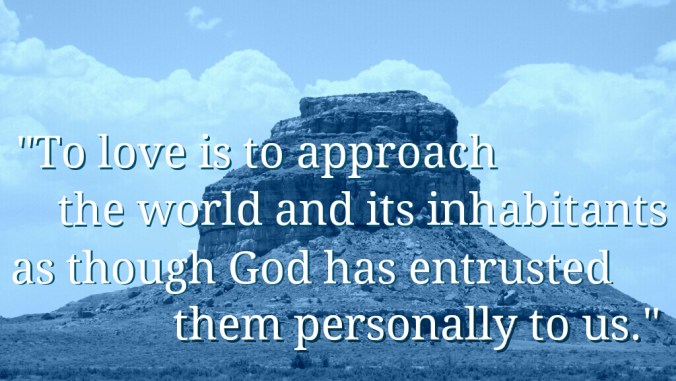
And the “ourselves” part? It is perfectly fine to have boundaries and expectations that we will also be respected. Sacrificial love is about the betterment of others, not the abasement of ourselves. Sometimes we suffer because we love, but we don’t love because we suffer. To love is to approach the world and its inhabitants as though God has entrusted their care personally to us … because God has.

Comfort: Our loving actions can heal our unloving hearts.

Challenge: Pay attention to whether your emotions are dictating your actions, or vice versa.

Prayer: Let your steadfast love, O LORD, be upon us, even as we hope in you. (Psalm 33:22)

Discussion: Do you feel you can love someone without liking them?

Join the discussion! If you enjoyed this post, feel free to join an extended discussion as part of the C+C Facebook group. You’ll be notified of new posts through FB, and have the opportunity to share your thoughts with some lovely people. Or feel free to comment here on WordPress, or even re-blog – the more the merrier!
Love Equally

1449488032749

Readings: Psalms 122; 145, Amos 7:1-9,  Revelation 1:1-8, Matthew 22:23-33


Mosaic law contained rules about marriage which we consider unusual today. If a man died childless, his brother had to marry his widow. The intent behind this law was to protect the widow from poverty and disgrace as she would have no means of support. In a modern society, where women hold jobs and own property equally with men, this is an outdated and rarely practiced idea.

The Sadducees were a Jewish sect who did not believe in the resurrection as Jesus taught. Fearing his influence on the people, they tried to trip him up to diminish public opinion of him. They thought the following scenario would do the trick.

A man with six brothers died childless. Per the law, his brother married his wife. The second brother also died childless, and she married the third brother, and so on until eventually she had married  all seven brothers. Who, the Sadducees asked, would be her husband in the resurrection?

Jesus told them they were asking the wrong questions, “For in the resurrection they neither marry nor are given in marriage, but are like angels in heaven.”

That must have been a showstopper. Until very recently most people did not marry for love, but there have been rules about fidelity and ownership for a long time. The concept of women who did not need to rely on men was almost unthinkable. Jesus was saying, “I know the rules, but the current social structures are not the equality God ultimately has in mind for you.” While not exactly a ringing endorsement of the Equal Rights Amendment, it sent the message that once the world was made anew, women would be independent.

Today in the western world, the equality shared legally (if not practically) by men and women makes love-based marriage the norm. Viewing others as equals – as fully human beings – makes other types of love possible as well. Empathy requires us to identify with another person, and if we don’t think of them as equal, that empathy is stunted. The church has traditionally promoted the values of faith, hope, and love as described in 1 Corinthians, but the Greek word (agape) for the type of sacrificial “love” intended can just as legitimately be translated as “charity.” English doesn’t really have an equivalent word. Maybe that’s why we struggle with understanding current social structures as anything other than vertical, with the “haves” obliged to show charity to the “have nots.”  When we realize we are no different, giving and receiving charity are no longer sources of obligation or shame, but acts of sharing between children of God as any loving family might perform.

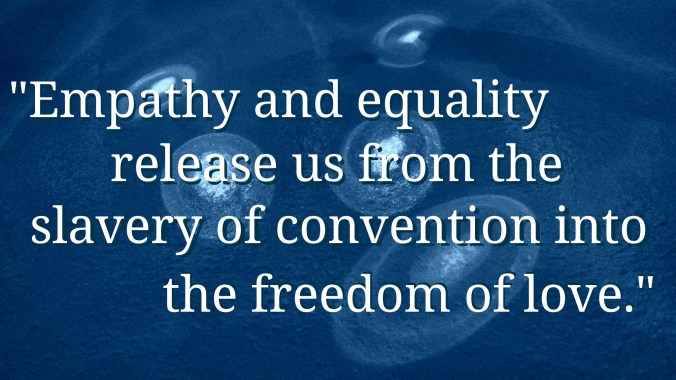
Empathy and equality release us from the slavery of convention into the freedom of love.

Comfort: God loves you equally to kings and paupers, friends and enemies.

Challenge: What groups of people do you have trouble empathizing with? Make an effort to get to know them.

Prayer: The Lord is good to all, and his compassion is over all that he has made. (Psalm 145:9)

Discussion: What prejudices do you struggle with?

Join the discussion! If you enjoyed this post, feel free to join an extended discussion as part of the C+C Facebook group. You’ll be notified of new posts through FB, and have the opportunity to share your thoughts with some lovely people. Or feel free to comment here on WordPress, or even re-blog – the more the merrier!

 

Love Better

1449419762969

Readings: Psalms 24; 150, Amos 6:1-14, 2 Thessalonians 1:5-12, Luke 1:57-68


Traditionally the theme of the second week of Advent is Love. Often “love” evokes warm feelings of family, friends, and romance. However, depending on a person’s life circumstances, those feelings may be mixed with longing, loneliness, hope, and other emotions.

Sorting out feelings about feelings? Well, love is complicated. Advent adds yet another wrinkle: love as the world falls apart.

The prophet Amos and the apostle Paul both share harsh words about the future. Amos tells the people of Israel they have offended God so mightily that He is “raising up against you a nation, O house of Israel, […] and they shall oppress you from Lebo-hamath to the Wadi Arabah.” Paul in his second letter to the church in Thessalonica tells them they who do not obey the Gospel “will suffer the punishment of eternal destruction, separated from the presence of the Lord and from the glory of his might.” While these passages definitely drive home the message that God desires righteousness, they don’t much describe a God who define Love as a gooey confection of simple affection.

Except in these examples, God’s anger exists because people are too focused on false righteousness and not enough on love. The people of Israel were making ritual sacrifices like clockwork, but ignoring and exploiting the poor. “Obeying the Gospel” wasn’t about rules but about loving God and loving our neighbors as ourselves. These prophets warned us separation from God occurs when we fail to love God and each other.

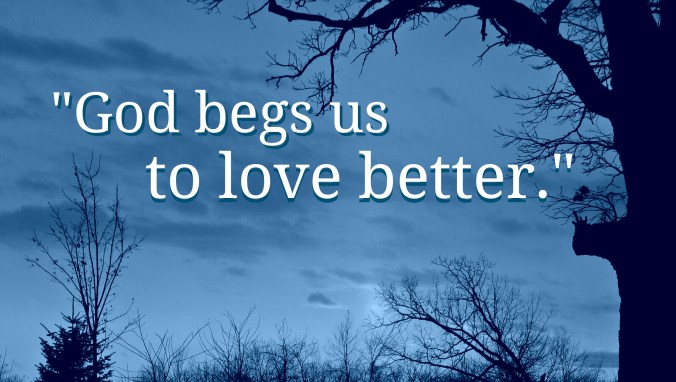
Throughout the Bible, God sends warning after warning about the consequences of failing to love. He sends us Jesus so we may be reconciled to him in love, and before that sends us John the Baptist to tell us Jesus is on the way. Love is complicated. Think about your own relationships where love has been broken: it’s rarely a sudden snap, but a slow dissolution with opportunities for one or both sides to repent. God begs us to love better.

Advent is a season for reflecting on how well we love God and each other. Before the world falls apart, God call us to love. Afterward, it is the only thing that saves us.

Comfort: God loves us even in anger.

Challenge: Work on a relationship where love has been broken.

Prayer: Make me to know your ways, O LORD; teach me your paths. Lead me in your truth, and teach me, for you are the God of my salvation; for you I wait all day long. (Psalm 25:4-5)

Discussion: How has your understanding of love changed over time?

Join the discussion! If you enjoyed this post, feel free to join an extended discussion as part of the C+C Facebook group. You’ll be notified of new posts through FB, and have the opportunity to share your thoughts with some lovely people. Or feel free to comment here on WordPress, or even re-blog – the more the merrier!

The Jumble

20171208_123910-01.jpeg

Celebrating Christmas without observing Advent is like taking a victory lap before the race starts.

At least, that’s how I’ve felt about it for many years.

Most of the rest of the world – both secular and Christian – begs to differ. On the Friday after Thanksgiving, the whole country seems to flip a switch that turns on  the Christmas twinkle and bustle with Advent getting barely a nod from those chocolate-laced calendars which start on December 1st whether that’s the actual beginning of the season or not. Maybe we feel we’ve done enough Advent-ing when we hold off on dropping the Baby Jesus into the nativity scene until the morning of. Our Christmas expectations have grown so extravagant that we spend a liturgical season of solemnity with decorating, shopping, wrapping, baking, and singing when we could be mourning a broken world. Okay, not a great selling point, but it is why Jesus showed up.

I’ve been a lot more concerned with the War on Advent than the War on Christmas (which by the way was  decisively won by retailers decades ago – you might be glad to know Christmas won). I find a certain perverse glee in reminding people Christmas Day wasn’t a federally recognized holiday until 1870, and that in the 17th century Christians campaigned to keep Christmas celebrations illegal in several of the original colonies and in England.

For all their faults, Puritans really understood the importance of observing a Bleak Midwinter.

And yet ironically … I find being a prophet of doom about Advent does little to advance the pro-Advent agenda. So instead, I have come to realize – reluctantly at first and more gratefully these days – that in the midst of all that inappropriately-timed caroling (hey, I’m working on it!), people are indeed facing the brokenness in our communities and our world. They’re just not putting as somber a face on it as my narrow vision demands.

Charities of all kinds depend on the generosity that wells forth in the Advent/Christmas season for their very survival. In places of employment, colleagues take collections and pool resources to make Christmas day special for the less fortunate (whose wish lists often include household supplies and other things many of us can take for granted). The Marines deploy their Toys for Tots campaign to bring joy to children, and civilians make extra efforts to remember those deployed around the world under unthinkable conditions.

Are these kindnesses a bit of Advent-like awareness? Yes. Do they address the larger injustices that prophets like Amos and Isaiah – perennial Advent favorites – warn us about? Not as much as they could.

But it’s all a start. Despite my affection for a neatly structured liturgical calendar, Advent and Christmas and all those other seasons are not how life plays out in the real world. In the real world, every day – every hour – is a jumble of hope, joy, expectation, repentance, mercy and all the other things that make up existence. Advent preparation isn’t just for Christmas. And Christmas celebration isn’t just for December 25th.

That saying about having Christmas in our hearts all year around? It’s also true for the lessons of Advent, Easter, Pentecost, and every other season and holiday of our faith.

May the peace of our Lord Jesus Christ be with you all.

Hope. Always.

1449326142133

Readings: Psalms 90; 149, Amos 5:18-27, Jude 17-25, Matthew 22:15-22


Ever since the world began, people have been predicting its end. For many that “end” is not so much a final obliteration, as a renewal when the evil, violence, and injustice will be swept away to make room for something better. The prophet Amos speaks of the day when God will “let justice roll down like waters, and righteousness like an ever-flowing stream.” When we read headlines and watch the news, don’t we long for the same?

We can react to adversity with despair or with hope. While we may naturally tend toward one or the other, it is ultimately a choice. In the midst of suffering hope may seem futile or naive, but it has real consequences. Repeated studies show that a positive attitude promotes healing from illness and surgery. On a fundamental level, hope is essential to survival; hunger, thirst, and fear may seem like negatives, but they are hard-wired into us with an assumption that we will continue to live.

Though hope is more than a belief in continued existence. Despair also assumes existence but resigns us to inaction and victimhood, where hope spurs us to positive action. Hope makes charity possible, because it allows for positive change. Without the promise of hope could we even contemplate mercy?

In an age when tragedy around the world is broadcast into our homes 24 hours a day in high definition, hope can be hard to maintain. The truth is that on the whole violence in the world has been decreasing steadily for decades. Data and statistics are not necessarily comforting in the face of immediate crisis, so how do we work (and it is intentional work) to maintain hope? Minister and children’s television host Fred Rogers famously quotes his mother who told him the best thing to do in times of disaster is “look for the helpers” – people who move toward a tragedy to improve the situation. While it seems counterintuitive, could the Kingdom actually be ushered in when we move nearer to tragedy, where we are also nearer to mercy and charity? That is the end we hope for.

Comfort: We are closer to the promises of the God’s Kingdom every day.

Challenge: You can’t help everyone, but somewhere nearby there is a tragic situation waiting for you to inject hope into it. Find it and act.

Prayer: Restore us, O God of hosts; let your face shine, that we may be saved. (Psalm 80:7)

Discussion: Is hope something that comes naturally to you?

Join the discussion! If you enjoyed this post, feel free to join an extended discussion as part of the C+C Facebook group. You’ll be notified of new posts through FB, and have the opportunity to share your thoughts with some lovely people. Or feel free to comment here on WordPress, or even re-blog – the more the merrier!