Truth will set you free

the-truth-shall-make-you-free-1201069

Today’s readings:
Psalms 27; 147:12-20, Jeremiah 10:11-24, Romans 5:12-21, John 8:21-32


Where do we find truth? Do we know it when we hear it?

We’d like to believe most people are truthful, but from earliest recorded history through up-to-the-minute reporting, deception runs rampant. Journalism has become propaganda. History has been revised and textbooks politicized. Facts are reduced to opinions then dismissed. Opinions and conjecture are elevated to facts and published as news. No ideology seems immune to these distortions. Information is more widely available than ever, yet it is notoriously faulty. If, as Jesus says in the Gospel of John, “the truth will make you free”… what is the state of our freedom?

In this age of moral relativism and political correctness, it is important to know what we believe and why. Our own memory and understanding are possibly the sources we rely on most for truth, and while for most of us they are thoroughly convincing, they can be surprisingly deceptive. We need reliable sources of truth, but they can seem few and far between.

Luckily – or perhaps providentially – some truths are eternal and immutable. Chief among them is God’s love for his creation. As we sift through the information overload that threatens to bury us, that love can be our barometer for evaluating many kinds of truth, such as matters of justice or compassion. Truth will move people toward freedom, love, and inclusion, not away from it.

Sometimes truth is not something that can be expressed directly. We may need poets and composers and other artists to point us toward it. Rationalism and materialism, while vital for revealing truths about the physical world, are not the only paths to truth. What is right and good may not make empirical sense. Sacrificing ourselves for others is quite counter-intuitive, yet the person who spoke the most important truths to us believed in it with all his being. The truth of the cross and resurrection exist somewhere beyond facts and historical accuracy, somewhere within our hearts. Truth is never manufactured, but unearthed by those with ears to hear and eyes to see. It makes us free when it is free.

Comfort: The truth is on your side.

Challenge: Be on the side of truth.

Prayer: God of truth and love, I seek you and your ways. Guide me to freedom. Amen.

Discussion: Has accepting a difficult truth ever set you free in some way?

Join the discussion! If you enjoyed this post, feel free to join an extended discussion as part of the C+C Facebook group. You’ll  have the opportunity to share your thoughts with some lovely people. Or feel free to comment here on WordPress, or even re-blog – the more the merrier!


Endurance Training

Runners

Today’s readings:
Psalms 5; 147:1-11, Jeremiah 8:4-7, 18-9:6, Romans 5:1-11, John 8:12-20


And not only that, but we also boast in our sufferings, knowing that suffering produces endurance, and endurance produces character, and character produces hope, and hope does not disappoint us…
– Romans 5:3-4

I did not put you here to suffer. I did not put you here to whine.
I put you here to love another and to get out and have a good time.
– The Rainmakers, “Let My People Go-Go”

Suffering, while an inevitable part of the Christian journey, is never meant to be the destination. We are assured that, through the glory of God, all suffering can be transformed for good. We don’t need to seek pointless suffering just for the sake of enduring it, but when we need to exercise self-discipline or find suffering inescapable, we can turn that suffering over to God. But let’s not for a minute assume this is a passive process which requires nothing of us but curling up into a cocoon of self-pity and waiting for divine metamorphosis. It takes intention.

The steps in this process all require conscious choices on our part. Endurance training is something we take for granted in athletics, but not as often in other parts of life. Can we teach ourselves to view suffering as a form of spiritual training which develops our spiritual muscles? What about character? We romanticize the idea of sports building character, but not every top athlete is an upstanding citizen. Our spiritual training needs to be tempered with humility and mercy, a desire to serve rather than conquer.

The best coaches – and their best players – embrace being part of a greater story. It’s that type of character – the type that recognizes our greatest glory does not begin and end with our personal achievements and failures – which opens us up to hope. Hope is only present when we can see the big picture, the picture that tells the story of God’s kingdom becoming reality.

Athletes build endurance through difficulty. Butterflies nearly die before leaving the cocoon. Neither of them are victims of suffering; they use it to transform themselves into something miraculous.

Comfort: Suffering is not inflicted on us by God…

Challenge: … but God can help us through it.

Prayer: God of holy mystery, I trust you above anything. Amen.

Discussion: How have you dealt with suffering?

Join the discussion! If you enjoyed this post, feel free to join an extended discussion as part of the C+C Facebook group. You’ll  have the opportunity to share your thoughts with some lovely people. Or feel free to comment here on WordPress, or even re-blog – the more the merrier!
Here’s your sign.

signs-1444874-1920x1440

Today’s readings:
Psalms 84; 150, Jeremiah 14:1-9 (10-16) 17-22, Galatians 4:21-5:1, Mark 8:11-21


For Jesus, signs were a double-edged sword. They demonstrated his authenticity, his power, and his priorities. However, for some people, the signs themselves became more important than his message. When the Pharisees asked him for a sign to test him, “he sighed deeply in his spirit and said, ‘Why does this generation ask for a sign? Truly I tell you, no sign will be given to this generation.’”

Just a little while later, when he tried to make a point about the influence of the Pharisees and Herod by comparing it to the contaminating properties of yeast, the disciples fixated on literal bread. Jesus asked why they were still talking about bread – had they forgotten all about how he fed not one but two multitudes with few resources but plenty of faith?

Aggravating circumstances often accompany his miracles: before he wants to reveal himself his mother goads him into changing water into wine at a wedding; the disciples are shocked he can feed a multitude with a few loaves and fishes … the second time; his closest friends doubt him even as he raises Lazarus from the dead; Peter begins to sink beneath the waves when he doubts the Christ who helps him walk across the water. Christ hopes for faith that doesn’t depend on miracles, yet sometimes he resigns himself to the “necessary evil” of providing a sign.

Many of us have hoped for signs. Who couldn’t use a little reassurance now and then? For some of us they provide a kick start to spiritual experience. But the real measure of faith is what we do in the absence of signs. How pleasing must it have been for Christ when peopled followed him not because of what he could do for them, but because of who he was and what he taught?

The second time the disciples presented him with loaves and fishes, he commanded them to feed the crowd themselves, and they were successful. Faith is not just believing in what Christ can do for us, but in trusting that he will accomplish miraculous things through us.

Comfort: God is with us regardless of whether we see signs.

Challenge: The next time you want to ask for a sign, try instead to pray for faithful discernment.

Prayer: Lord of all things, I will trust you always. Amen.

Discussion: How do you feel about signs?

Join the discussion! If you enjoyed this post, feel free to join an extended discussion as part of the C+C Facebook group. You’ll  have the opportunity to share your thoughts with some lovely people. Or feel free to comment here on WordPress, or even re-blog – the more the merrier!
Bibliophilia

img_20170321_062149_490.jpg

Today’s readings:
Psalms 34; 146, Jeremiah 7:21-34, Romans 4:13-25, John 7:37-52


Here’s a question loaded with potential paradox: can the Bible, which warns us against idolatry, itself become an object of idolatry?

Let’s consider the Pharisees in today’s reading from John. As they tried to determine who this Jesus person was and what he meant to the Jews, they consulted their scriptures. We tend to peg the Pharisees as villains, but in truth they resembled some of today’s Christians, struggling to obey every jot and tittle of their sacred texts. The Pharisees knew Jesus as a Galilean, and therefore dismissed him as a messianic candidate since their sources said the Messiah would come from Bethlehem. No prophet at all was expected from Galilee. Yes, they were ignorant of the facts surrounding Jesus’ birth, but weren’t they also guilty of ignoring the evidence in front of them, evidence the less pious correctly accepted? The Pharisees idolized their scriptures over the Truth before them. Those same scriptures we revere today.

Ever seen the bumper sticker that reads: “The Bible says it. I believe it. That settles it”? We like to believe we would have seen things differently than the Pharisees, but our bumper stickers say otherwise. Perhaps it’s not the Bible itself we idolize, but our confidence in our own understanding of it. This tendency is not limited to either conservative or liberal readers of the Bible. While the former may forego nuance and context, the latter can deconstruct it to the point of meaninglessness. Exaggerated self-confidence wears no particular political stripe. Sometimes we all prefer certainty to mystery.

If we close our minds to new understanding of scripture, we may miss the Truth in front of us. We do not trust God because the Bible says to—we trust the Bible because we trust God. Many life experiences will not fit our understanding of scripture. At these times we do not abandon scripture for ease or convenience, but would be wise to humbly heed the advice of Proverbs 3:5-6: “Trust in the LORD with all your heart and lean not on your own understanding; in all your ways submit to him, and he will make your paths straight.”

Comfort: We are meant to wrestle with scripture.

Challenge: Meditate on how experience defies your expectations.

Prayer: God of holy mystery, I trust you above anything. Amen.

Discussion: How has your relationship with the Bible evolved over time?

Join the discussion! If you enjoyed this post, feel free to join an extended discussion as part of the C+C Facebook group. You’ll  have the opportunity to share your thoughts with some lovely people. Or feel free to comment here on WordPress, or even re-blog – the more the merrier!

Sorry, not sorry.

lovesorry

Today’s readings (click below to open in new tab/window):
Psalms 119:73-80; 145, Jeremiah 7:1-15, Romans 4:1-12, John 7:14-36


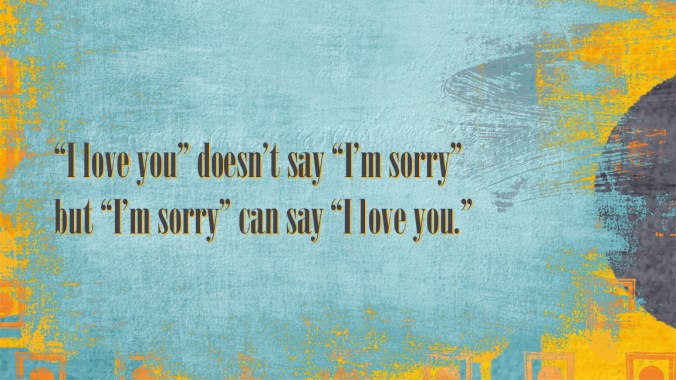
Have you ever tried to apologize by telling someone: “I love you?” Has anyone ever tried that with you? It’s a terrible way to end a dispute, because it resolves nothing. “I love you” is not an apology. It is not an admission of guilt. It is not a promise to change one’s ways. At best it is an attempt to appease someone by exploiting their emotional vulnerability in order to avoid conflict. “I love you” may precede or follow an apology; it does not replace it. Trying to do so is merely lip service.

The prophet Jeremiah addresses the Israelites about how they have been paying spiritual lip service to God. They have been profaning the Lord’s name and committing all kinds of crimes and sin, but on the Sabbath they enter the temple and proclaim “This is the temple of the Lord, the temple of the Lord, the temple of the Lord.” Like a lover who has had enough of hearing all the right words but observing all the wrong deeds, the Lord declares the words deceptive. They are not sincere enough to wipe clean the offenses of a people who utter faithful words to cover their bases, but live otherwise unfaithful lives.

Love, whether of God or of a person, requires sincerity. When we betray that relationship repeatedly, declarations of “I love you” or “This is the temple of the Lord” do nothing but undermine and cheapen the meaning of those words. They are like pretty paper wrapped around a gift of yesterday’s moldering trash. Eventually the contents leak through and the paper itself is fouled by contamination; the pretty words become an ugly stench. Only when we have demonstrably repented – when we no longer try to excuse our wrongdoing with hollow sentiment – can we expect the relationship to mend. Over time we have to rebuild the trust that our words reflect the state of our heart.

Actions really do speak louder than words. If the only proof of our love and devotion is a bouquet of desperate words which have already begun to stink, we must repent until words are unnecessary.

Comfort: God’s love for you does not change.

Challenge: When you apologize, mean it.

Prayer: My God, I am heartily sorry for all my sins. Amen.

Discussion: What is the worst or best apology you’ve received or given?

Join the discussion! If you enjoyed this post, feel free to join an extended discussion as part of the C+C Facebook group. You’ll  have the opportunity to share your thoughts with some lovely people. Or feel free to comment here on WordPress, or even re-blog – the more the merrier!

Jesus who?

Boy & the Bench

Today’s readings:
Psalms 43; 149, Jeremiah 5:20-31, Romans 3:19-31, John 7:1-13


Anonymity and privacy are quickly becoming obsolete. We carry identification for many purposes; our online activity is tracked and traded; our purchasing data allows marketers to target us directly; cameras and surveillance equipment feed the nightly news; and we voluntarily document almost limitless information about our lives on social media.

Life in the first century was very different. Because there were no photographs or even binoculars, many (if not most) of the people who followed Jesus wouldn’t know him if they met him. Thus, when the annual Festival of Booths arrived, he was able to wander it unnoticed and listen freely to what people were saying about him. Even his close friends didn’t know he was there. When they tried to convince him to go so he could increase his fame and reputation, he said “my time has not yet fully come” and told them he was remaining behind. What they didn’t fully understand was that he was referring to his time to die; the authorities were already plotting to kill him, and public appearances would only hasten that time.

Jesus knew how to pick his battles. He was focused on his mission and avoided distractions. However, that focus didn’t always translate into action; sometimes it meant working out the timing. It was no accident he turned over the money-changer tables in the temple just before Passover when it would have had maximum impact. The Festival of Booths (or Sukkot) was about six months later, and his crucifixion occurred at the following Passover. In one carefully orchestrated year he planted the seeds and tended the fruits that would be harvested at the resurrection.

As we move through life, we don’t have to constantly announce the minutia of our every intention and action, particularly for personal and important matters. Sometimes we need to hang back and weigh the available information (minus distracting if well-intentioned commentary) before deciding how best to live out our own calling. That way, when the time for action arrives, we are clear-headed and committed. Let’s try to recognize when things are best kept between us and God.

Comfort: You don’t have to be answerable to everyone all the time.

Challenge: Spend some time each week in a setting where no one knows you.

Prayer: Loving God, teach me when to reap, when to sow, and when to lie fallow. Amen.

Discussion: Have you ever shared too much information about yourself?

Join the discussion! If you enjoyed this post, feel free to join an extended discussion as part of the C+C Facebook group. You’ll  have the opportunity to share your thoughts with some lovely people. Or feel free to comment here on WordPress, or even re-blog – the more the merrier!

My Love is Your Love

donotbefar

Today’s readings:
Psalms 22; 148, Jeremiah 5:1-9, Romans 2:25-3:18, John 5:30-47


My God, my God, why have you forsaken me?
Why are you so far from helping me, from the words of my groaning?
O my God, I cry by day, but you do not answer;
and by night, but find no rest.

These opening verses from Psalm 22 don’t inspire many feel-good sermons, yet they contain the essence of faith. The psalmist who wrote these words had a very realistic view of the world. He saw that evildoers often have the upper hand, and that the faithful suffer unfairly. He felt like a worm, like prey hunted by lions and trampled by oxen. Yet in his pain and despair, he continued to cry out to God. He continued to believe God would ultimately deliver him, as so many before him had been delivered.

The psalmist, despite his misfortune and persecution, refused to believe God was anything but just.

Many people believe personal wealth and comfort are signs of God’s favor, and that poverty and illness are signs of disfavor. If this was the case, why is it that God always seemed to be sending prophets to defend the widow and orphan against the abuses of the wealthy? Why is it the hypocrisy of the powerful elicits God’s wrath? The psalmist endures his troubles by trusting that God will ultimately prevail; his current status is not the barometer of a capricious creator’s mood swings, but of the corruption of the society around him.

When we cry for justice, do we think of it as something to be delivered to us or something delivered through us? It can be either or both, but if our cry for justice ends when our own bellies are filled while others remain empty, what we’re seeking isn’t justice. The psalmist’s hope for himself is inseparable from his hope for his community. He prays to belong to a kingdom that expects is citizens to feed the poor rather than despise them.

When we believe God is just, we behave justly. If we want to be the recipients of God’s justice; we must also be the instruments of it.

Comfort: God is always the source of justice.

Challenge: When you feel you are the victim of injustice, ask yourself how you are also part of changing that.

Prayer: God of justice, I seek your way for myself and my neighbor. Amen.

Discussion: What do you think is the relationship between sin and suffering?

Join the discussion! If you enjoyed this post, feel free to join an extended discussion as part of the C+C Facebook group , visit comfortandchallenge.tumblr.com, or follow @comf_and_chall on Twitter. You’ll  have the opportunity to share your thoughts with some lovely people. Or feel free to comment here on WordPress, or even re-blog – the more the merrier!

Never on a Sunday

calendar

Today’s readings (click below to open in new tab/window):
Psalms 5; 147:1-11, Jeremiah 3:6-18, Romans 1:(26-27) 28-2:11, John 5:1-18


Do you play by the rules?

In theory we’re all expected to, but in practice they seem to apply to some of us more than others. How frustrating it is when people with wealth or influence can buy their way around the rules or the consequences of breaking them.

Still, most of us try to follow the rules.  Maybe not the same rules, but generally speaking our behaviors fall into patterns that we apply consciously and subconsciously. Some rules are taught to us by our families, some by society, and some by simple observation. Most are created for good reasons, but over time circumstances change and the rationale for many rules—including religious ones—grows distorted.

Rules can become so integral to our identities that breaking them, even when they cease to have meaning, threatens our sense of self. If that happens, we may find ourselves existing to serve the rules, rather than the other way around. When this happens, we begin to observe the technicalities of the rules rather than their spirit. Sometimes this looks like doing the bare minimum, and sometimes it looks like obsessive behavior.

The Sabbath healings of Jesus presented just such a threat to the Pharisees, whose identity depended on rules.

Since Sabbath healings – which were against the rules – appear in all four Gospels, we can assume the message of these stories is important. Rather than judge the Pharisees, let’s learn from their example.

Our expectations of other people’s behavior are often based on the rules we’ve imposed on ourselves. We may become offended when such expectations are not met, regardless of whether or not we’ve made said expectations clear. When this happens, we choose how to react: we can dig in our heels, or we can examine the reason for our offense. We needn’t automatically assume we are wrong, but self-examination never hurt anyone. Like Jesus, we need to consider when rules are appropriate, and when they should be superseded by compassion, justice, or love. In Christ we are a people of love, and not a people of law—even self-imposed law. Is the Sabbath made holier by offering mercy or withholding it?

But Christianity is not a free-for-all! Christ has expectations of his followers. Determining these expectations can be hard work, because “love your neighbor” is not nearly as explicit as a list of forbidden activities. Loving someone doesn’t absolve them – or us – of accountability. Christ didn’t offer formulas for faith, but principles for relationships with our God and our neighbor. Our rule is love, and its accompanying expectations can change with each person we encounter.

Comfort: You are more than the rules you follow.

Challenge: When someone doesn’t meet your expectations, ask yourself whether you made that person aware of them.

Prayer: Merciful God, teach me when to be merciful, and when to stand strong. Amen.

Discussion: Has assuming someone should “just know” something ever caused trouble for you?

Join the discussion! If you enjoyed this post, feel free to join an extended discussion as part of the C+C Facebook group. You’ll  have the opportunity to share your thoughts with some lovely people. Or feel free to comment here on WordPress, or even re-blog – the more the merrier!

Not For Prophet

notforprophet

Today’s readings:
Psalms 34; 146, Jeremiah 2:1-13, 29-32, Romans 1:16-25, John 4:43-54


Popular culture, and even some corners of Christian culture, portray prophets as a breed of mysterious oracles revealing the future through puzzle-like symbols and coded language. Modern self-styled prophets are famous for predicting the end of the world, and infamous for batting zero while collecting millions. We lump this distorted image of prophets in with psychics, clairvoyants, and fortune tellers.

The Biblical prophet, however, was not on a road to popularity and wealth. Prophesying was dangerous work; some prophets paid with their lives for confronting a community that had lost its way to idols and injustice.

Prophets like Jeremiah used language and symbols that may need clarification today, but would have been familiar to their audience. Their ultimate goal was not to mystify and condemn, but to convict and save. The warning of a harsh future came with a promise: God loved his people too much to abandon them, and when once again the people learned to properly love him back there would be reconciliation. It was never about God leaving the people, but about the people leaving God.

Consider these words of the Lord delivered by Jeremiah:

          They have forsaken me,
the fountain of living water,
and dug out cisterns for themselves,
cracked cisterns
that can hold no water.

These words were about more than disobedience; they addressed how the people brought ruin upon themselves. When we substitute our own values and plans for those God has given us, they will ultimately fail us. Like cracked cisterns, they may seem to hold water for a while, but eventually we will find them to be empty and we will be desperate for the real thing.

Jesus also referred to himself as the living water. His message echoed the messages of the prophets who preceded him, and he knew “a prophet has no honor in the prophet’s own country.” When a prophet tells us what we don’t want to hear, it’s not time to get defensive: it’s time to seek hope through repentance. Christ’s message of radical justice and inclusion was most difficult for those who believed they had a lock on God and religion. When listening for prophetic voices, humility serves us well.

Comfort: God would rather forgive us than condemn us.

Challenge: We have to seek forgiveness before it can be granted.

Prayer: Merciful God, I will listen for your authentic voice. Teach me to hear it. Amen.

Discussion: When have you benefited from hearing something you didn’t want to?

Join the discussion! If you enjoyed this post, feel free to join an extended discussion as part of the C+C Facebook group. You’ll  have the opportunity to share your thoughts with some lovely people. Or feel free to comment here on WordPress, or even re-blog – the more the merrier!

The Gospel Dance

dancing-art-1423697-1920x1440.jpg

Today’s readings:
Psalms 119:73-80; 145, Jeremiah 1:11-19, Romans 1:1-15, John 4:27-42


Paul had been evangelizing for almost twenty years before he set his sights on Rome. Several Christian communities were established there, and he intended to visit with them on his way to Spain.  Since the early church was not in agreement on all matters, Paul wrote them a letter to make sure they understood his stance in advance of his arrival. We don’t know for certain whether he ever made it to Spain, but the epistle he wrote to the church in Rome is considered by many to be his masterwork. More than a mere introduction, it builds a rich and complex theology of salvation through Christ.

But Paul knew he didn’t know everything. Near the beginning of the epistle he writes:

For I am longing to see you so that I may share with you some spiritual gift to strengthen you — or rather so that we may be mutually encouraged by each other’s faith, both yours and mine.

When we share the gospel, we receive as well as give. Left to our own devices, we can make only so much spiritual progress. Despite our best intentions and discipline, in spiritual isolation our own biases eventually overtake us. Like a self-taught musician or artist, we won’t know what we don’t know. As part of a Christian community, we can challenge and be challenged, grow and foster growth. Reaching across Christian communities only multiplies that growth.

Not everything we have to learn will necessarily come from other Christians. When we share our personal stories and the Gospel story with non-Christians, we learn something from their responses, and also from our reactions to those responses. If someone reacts unexpectedly, negatively, or even violently to our efforts, our commitment to sharing the gospel may be revealed. Do we try to understand why? Do we insist on our own way? Do we examine our approach and motives? Do we resort to force?

The gospel is not a solitary endeavor. Sharing it is not the same as delivering a monologue about it. Letting it unfold between us and someone else is like laying out a dance floor where we move together under the light of Christ to the rhythm of the Spirit.

Comfort: You don’t have to know everything.

Challenge: Don’t be afraid to talk about the gospel with people who differ in good faith.

Prayer: Loving God, let me find the right words and steps to share the Gospel. Amen.

Discussion: Where do you find opportunities to grow your faith by sharing it?

Join the discussion! If you enjoyed this post, feel free to join an extended discussion as part of the C+C Facebook group. You’ll  have the opportunity to share your thoughts with some lovely people. Or feel free to comment here on WordPress, or even re-blog – the more the merrier!