Because it’s a day of celebration and Ella Fitzgerald is proof God loves us!
Last Day of Christmas
Today is the last day of Christmas. I’m closing out the celebration by posting a classic and classy version of one of my favorite Christmas carols. Enjoy and peace to you all!
Invitation: Eat up.

When I was around 14 years old, my dad brought home a friend from work. Let’s call him Walt. Walt had fallen on some hard times personally and financially. For several months Walt spent a lot of time at our house in the evenings and on weekends. He helped out with home improvement projects. He played games in the yard with us. He had dinner with us on many evenings. Most importantly, Walt was not alone.
One Saturday we installed paneling in the living room. I say “we” but I was only peripherally involved; my dad and Walt did almost all the work, though I did lend the occasional steadying third set of hands. It was a big project, and we worked well past our home’s normal supper time. When the project was done, we washed up and sat down to supper, which was already on the table.
“Eat up,” I said to Walt. “You sure earned it.”
That was a mistake. My dad shot me a look that I knew meant we were going to have a talk.
A few hours later, after good food (my mom is a great cook!) and plenty of conversation and laughter, Walt went home. I had forgotten all about my earlier misstep, but my dad hadn’t. As the front door shut he turned to me with a stern look.
“Don’t ever tell anyone they have to earn a meal here,” he said. “That’s not how we do things. You should know better.” I started to say it was a joke, but didn’t get to finish. “It wasn’t funny. Don’t do it again.”
My dad is not a particularly religious man, but that day he taught me a very Christ-like lesson. When Christ invites us to the table, it’s not because we’ve somehow earned it; it’s because he loves us. Christ offers us a grace freely given, and no one else around the table gets to judge who should partake. We don’t even get to judge how much. In the Parable of the Workers, laborers who work a partial shift get paid just as much as laborers who work a whole shift. If that seems unfair, take it up with Jesus. Until he says differently, we are all welcome at the table.
The Peace of Christ be with you.
This first invitation is dedicated with much love and thanks to my dad, who is so encouraging to me about the blog and has provided great feedback that has helped shape it. Love you, Dad!
Invitations to Communion

I was raised Roman Catholic and am now a member of the Disciples of Christ. In both traditions, though they have different understandings of the essential nature of communion, it is central to the liturgy. Several years ago I was honored to serve a term as one of the elders at a Disciples church. Among other duties, each week we issued an invitation before communion. We understood the table as Christ’s table, so the invitation needed to be inclusive of everyone present. Sometimes that included people we didn’t like or had active disagreements with, but we were called to be representatives of a nature higher than our own. Delivering the invitation was deeply meaningful and sacred to me.
On Sundays I will be adding an extra post reminiscent of those invitations. Of course I can’t follow up with an actual loaf of bread or cup of wine, but I hope they help you feel welcomed in the body of Christ.
You may have noticed that, in the devotionals, I don’t write in first person singular. That’s because there’s no “I” in Team Jesus. Kidding … and anyway there’s one in “Christ.” The devotionals are not about pushing my particular take on doctrine, theological specifics, conservative versus liberal views, or other personal agendas. Writing as “we” helps remind me of that. My invitational style is going to be a little different. When I was an elder I took an event from my life or something I’d learned that reminded me of the universal nature of Christ’s love, and adapted it to the purpose. The concept of open communion is not itself universal, and may come across as a theological statement if that’s not your belief. If you feel that way but otherwise enjoy the blog , maybe skip the invitations, and stick to reading the daily posts. I won’t be offended, though I’ll miss you. The invitation may be my words, but the nature of it is something I can only aspire to.
Peace!

Happy New Year!
Stepping Stone
Today’s readings: Psalms 98; 147:12-20, 1 Kings 3:5-14, James 4:13-17, 5:7-11, John 5:1-15
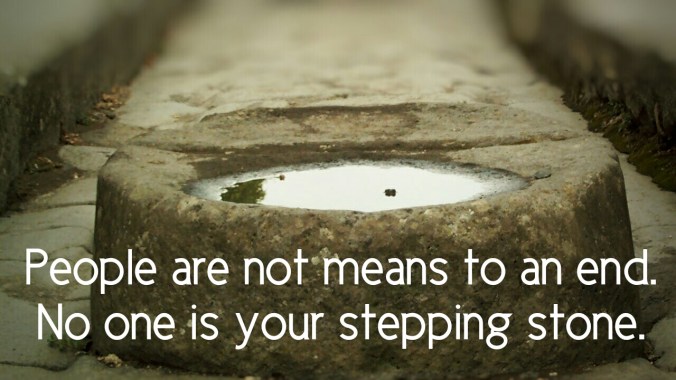
Faith is, among other things, a path to wholeness. We may feel we walk it alone, but fellow travelers always accompany us. Therefore we need to be mindful of both the destination and our conduct along the way. On his path Jesus encounters a sick man who has been waiting 38 years to get into a pool with alleged healing properties. When Jesus asks if he wants to be made well, the man replies: “Sir, I have no one to put me into the pool when the water is stirred up; and while I am making my way, someone else steps down ahead of me.” In 38 years not one person headed to the same destination for the same purpose had offered to help him. Worse, they had stopped him. These people were probably not malicious, but in their desperation and single-mindedness paid him no regard. Instead, he became their stepping stone.
How do we treat our fellow travelers? What goals are we so focused on that we can’t see the need around us? Perhaps we give others what we want them to need, instead of what they really do. Or maybe our need for a perfectly executed church service results in a less meaningful one. Our best intentions to create an inclusive, mission-centered, welcoming community will be short-sighted and potentially hurtful if we can’t place our personal goals in the context of the gathered faithful. Maybe we’ll make it to the pool, but what will we leave in our wake?
On the other side of this equation, today’s story teaches us our wholeness does not ultimately depend on our fellow travelers, but on God’s endless mercy. When Jesus tells the sick man to take up his mat and walk, the lack of mercy from everyone else becomes irrelevant. The beauty of the healing is lost on his fellow travelers who are more concerned he is carrying his mat in violation of Jewish sabbath law. Eyes set upon their own ritual holiness, they attack the uncontrollable divinity in their midst. Sometimes the most important part of our faith journey is the detour.
Comfort: We are never alone in our faith journey.
Challenge: We are never alone in our faith journey.
Out of Thin Air
Today’s readings: Psalms 93; 147:1-11, 1 Kings 17:17-24, 3 John 1-15, John 4:46-54

Why do miracles happen? American Christianity often portrays them as rewards for diligent prayer and great faith. The Gospel of John tells a different story. Jesus performed seven miracles – John called them “signs”- before he was crucified. The second was the healing of a royal official’s son. The official met Jesus in Cana, about 25 miles southwest from where his son lay dying in Capernaum, and asked Jesus to save him. While Jesus did heal the official’s son, his initial response seems almost perturbed: “Unless you see signs and wonders you will not believe.” Jesus was coerced by his mother into the first sign at the wedding in Cana, grumbled about the second, and things didn’t improve much for the next five. When he raised Lazarus, he wept over his friends’ lack of faith. According to John, signs were performed for the unfaithful.
For some people, faith in God rests on miracles. Jesus, on the other hand, treated miracles as necessary disturbances to the natural order used to persuade people. God’s presence is not extraordinary, but an ongoing relationship during ordinary life. Like air, it is a life-sustaining presence constantly surrounding us and within us. We don’t normally think about air unless we can’t breathe. John’s Jesus delivers miracles like he’s performing spiritual CPR on those who can no longer inhale God’s presence on their own.
Isn’t it better not to need it in the first place? Like air or water, our spiritual environment can become polluted. Sometimes we trash it ourselves, and sometimes we are downwind from the spiritually toxic. When our faith feels choked off, it may be time to start cleaning up and preventing more damage. This could be a slow process: anger, hate, greed, fear, and poisons like them take time to remove. They are dangerous and unpleasant to handle, but with God’s help handle them we must. The alternative is spiritual suffocation.
Still prefer to wait on a miracle? Neither miracles nor CPR are a permanent fix: if our habits don’t change, our old problems will return. God is always present; live clean and breathe deep.
Comfort: God is as close as the air we breathe.
Challenge: Take an inventory of what’s polluting your spiritual environment.
Holly and Ivy
One of my favorite Christmas carols (still eight days left!) is The Holly and the Ivy, and Natalie Cole does a beautiful version. While I was searching for a version to share, I noticed many comments about the pagan symbolism of holly and ivy. Some were informative and some, from both Christians and non-Christians, were less than kind. As with all things, each person approached the conversation with a personal bias. I like to think of this song as an example of how our different experiences can inform each other, rather than shout over each other, especially in a season where so many cultures celebrate holidays.
O’ Night Divine…
The last few years, as I’ve fallen more in love with Advent, I’ve had a personal rule about Christmas carols: I don’t play them until the 25th, but I’ll enjoy them if you put them on in the car, or they’re playing somewhere I happen to be. After all it’s my “rule” not yours.
A few weeks back I heard a vocal performance of “O Holy Night” that really moved me, and I’ve been humming it ever since. One particular phrase from it keeps coming back to me: “O’ night divine, o’ night when Christ was born.” We don’t really know what date Christ was born. December 25th is liturgically convenient, not historically accurate. So really… Christ could have been born any night of the year. Wouldn’t it be nice if we could commemorate Christ’s life every day… just in case?
We interrupt our regularly scheduled Advent broadcast … or do we?

As we embark on the the fourth and final week, I want to acknowledge I’ve received some questions about the Advent themes and the “traditional” order they’ve fallen in. For some people and traditions the themes of Hope, Love, Peace, and Joy are familiar, but the expected order is different. For others the actual themes themselves may vary.
It’s all OK.
Traditions like Advent wreaths, candles, and the season itself don’t exist for our slavish dedication. They are rituals we have created to periodically remind ourselves of certain aspects of our faith. The point of them is not whether the pink candle is for Joy or the fourth week is for Peace, but to help us reflect on our need for Christ to enter our lives and the world.
Maybe mixing it up is a good thing. When people ask whether I get tired of reading the same scriptures every year, of hearing the same story of Jesus being born, or of celebrating them same seasons over and over, my answer is always: “No, I don’t, because even though the stories don’t change, I’m in a different place in my life and faith journey, so I am always hearing and learning something different.” Mixing up the weeks of Advent provides another opportunity for fresh perspective, while at the same time providing a familiar and comforting framework.
In a couple days our readings will include the Magnificat, the words of Mary as she praises God for using her as a vessel to redeem her people. Mary’s prayer speaks new messages to me every time I read it. It doesn’t change, but I do. For some people though, it will be the same every time, and that’s fine. They made need a slight change to hear new meaning, and an unexpected difference in the order of themes or a fresh Biblical interpretation like The Message may provide the catalyst.
So if your regular broadcast of Advent has been interrupted, I hope that has helped you see, hear, feel, consider, and learn new things. Christ enters the world in unexpected ways. Expect that.
 Comfort & Challenge