Speaking of preparation, here’s a flashback that always makes me feel joyous.
Peace as Preparation
Today’s readings: Psalms 18:1-20; 147:12-20, Zechariah 4:1-14, Revelation 4:9-5:5, Matthew 25:1-13

In the Gospel of Matthew, Jesus relates a parable about ten bridesmaids – five foolish and five wise. They all take lamps to meet the bridegroom, but only the wise ones take supplies to keep the lamps burning when the bridegroom is delayed. The foolish bridesmaids ask the other for oil, but the wise ones are wise enough to say no because they’d all be unprepared. The foolish bridesmaids leave to buy oil and return to find the bridegroom and wise bridesmaids have left them behind.
It’s not difficult to imagine the foolish bridesmaids thought of themselves as unlucky, or victims of the wise bridesmaids’ stingy nature. Very often what we call poor luck or unfairness is our own lack of preparation. How do we properly prepare for the kingdom of God?
By not giving away more oil than we can spare. That doesn’t mean a lack of generosity; we should be generous of spirit and wallet. The oil we need to keep topped off is the energy to stay vigilant for the presence of Christ in the world. Many things conspire to steal this energy if we allow them: demanding jobs, busy social schedules, housekeeping, and so on. None of these things is inherently problematic – they are mostly good! – but neither is any of them our true purpose. If we don’t learn to say “no more oil for you, foolish bridesmaid” the energy left over for worship, charity, and our relationship with God can quickly dwindle to nothing. And by the way, if we think of those as “left overs” the reserves are already below acceptable levels. “What does it profit a man to gain the whole world and forfeit his soul?” (Mark 8:36)
Preparation means laying the groundwork for our whole lives, not just our spare time, to serve God. When we carefully steward our resources, we have enough energy to seek Christ and our peace in him. We must fill and refill our own lamps through prayer, service, rest, and worship.The wise will not save us from ourselves. Have you checked your oil lately? Tomorrow could be too late.
Comfort: It’s okay to do less so you can be more.
Challenge: Take an inventory of your obligations and eliminate the ones that drain your oil.
Peace as Silence
Today’s readings: Psalms 50; 147:1-11, Zechariah 3:1-10, Revelation 4:1-8, Matthew 24:45-51

A popular acronym advises us to THINK before we speak – to ask ourselves whether what we are about to say is true, helpful, inspirational, necessary, and/or kind. THINK may seem cliched, but it’s still excellent advice. Psalms 50:19-20 speaks to us today when it says:
“You give your mouth free rein for evil,
and your tongue frames deceit.
You sit and speak against your kin;
you slander your own mother’s child.”
Our current cultural mix of traditional and social media pushes us to opine on the latest news before it’s fully reported, to become outraged over (non?) events we really know nothing about, and to offer our often uninformed commentary in formats that remove the social buffers normally keeping us civil. The rapid-fire sarcasm and verbal slugfests that pass for dialogue and entertainment frequently have no purpose but shouting our own opinions and displaying our own cleverness.
Fortunately we do have the ability to turn it off. Simply deciding not to respond to every opinion we hear or read can be a solid start. Many people never quite get that concept: they will continue to respond as long as someone else continues to antagonize them. Withdrawal from a contentious non-productive exchange of spoken words, texts, or comment sections is not some admission of defeat. Consciously moving away from violent noise and into silence is an affirmation of peace.
At other times the conversation we need to end is the one we’re having with ourselves. Negative self-talk damages our spirits, and we may need a great deal of counseling to learn to stop it. Wordy prayers that run on and on are not a conversation with God – they are a monologue of doubt and desperation.
Silence, both external and internal, makes space for Elijah’s “still small voice” of God. It gives our thoughts room to expand and mature. It teaches us what is important and what is fleeting. When we regularly seek the peace of silence, we are better prepared when it is time to speak up for matters of justice, mercy, and love.
Comfort: God waits for us in the silence.
Challenge: Find time each day to meditate, unplug, or make whatever arrangements you need to enjoy a period of auditory and mental silence.
Peace as Surrender
Today’s readings: Psalms 33; 146, Zechariah 2:1-13, Revelation 3:14-22, Matthew 24:32-44
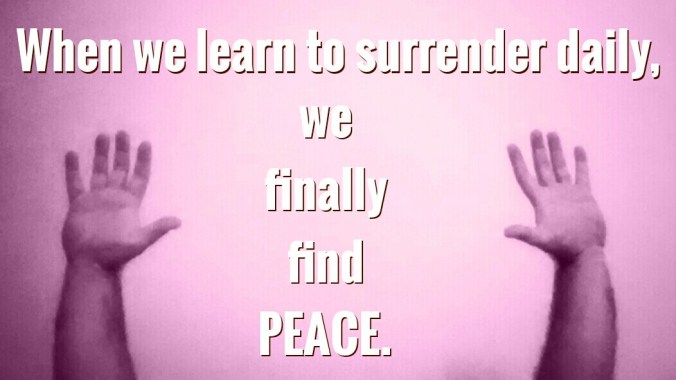
We are not generally fond of the term “surrender” unless it is preceded by “never.” Surrender implies loss, weakness, and cowardice. We lionize those who fight to the death rather than wave the white flag. Our concept of surrender is almost exclusively military, understood in terms of victory or defeat … and ignoble defeat at that.
Maybe that is why we struggle to surrender to God. When we end a prayer for a new job or a good health report with “if it’s God’s will” … doesn’t a small part of us hope God is taking the hint? Truly surrendering to God’s will is a terrifying prospect. One critique of Christians is that we show weakness of character by claiming everything is God’s will to dodge responsibility. Might it be closer to the truth to say we are good at paying lip service to God’s will, but not so good at actually accepting it? Can we really even claim to understand what “God’s will” means? In reality, it takes much courage to surrender ourselves to God; to do so is to risk total annihilation of our own identities.
Except it never seems to turn out that way. When we truly make the effort to surrender ourselves – or even one tiny problem – to God, we find our burdens lightened and our real selves rising to the surface. Does “the effort to surrender” sound like an oxymoron? Isn’t surrender the opposite of doing something? If you’ve tried it, you know it’s not just an effort but an ongoing effort. When we learn to surrender daily, we finally find peace.
Psalm 33 tells us great armies, superior strength, and the mightiest resources ultimately do not save us. Our victory – our peace – lies in trusting the Lord. It’s so easy to convince ourselves our own plans must be God’s plans, and then because we can’t tell the difference, our disappointment robs us of our peace. C.S. Lewis said of prayer: “It doesn’t change God – it changes me.” Let us pray with an attitude of surrender, and trust God to reveal to us our best and most peaceful selves.
Comfort: We can trust that God accepts our surrender with our best interests at heart.
Challenge: What is one problem you need to surrender to God? Put in the work to let it go.
Come Thou Long Expected Jesus
This is my favorite type of Advent music, simple and reflective.
Peace as Renovation
Today’s readings: Psalms 122; 145, Zechariah 1:7-17, Revelation 3:7-13, Matthew 24:15-31
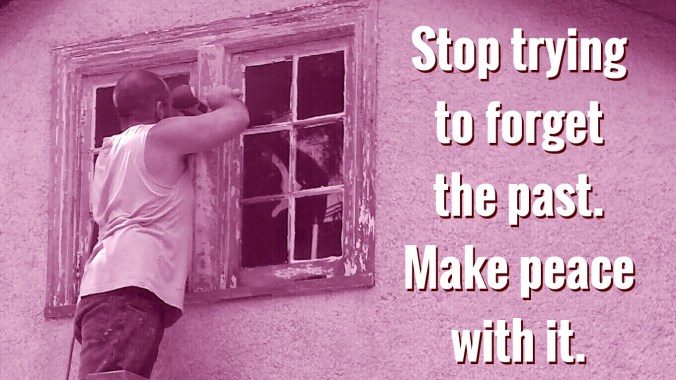
We’ve all heard the phrase “forgive and forget.” We can achieve the first part but is the second part possible? What we usually mean by “forget” is “don’t bring it up again.” Our past is always with us, and while we don’t have to be defined by it, we can’t pretend it never occurred.
Our lives are like old houses we can neither sell nor tear down. We may choose to preserve them, but that can lead to being saddled with old features that no longer serve us. Who wants an outhouse when the world offers indoor plumbing? Another option is restoration, but then we are faced with picking which period of our past was the best one to stick with, and sometimes there are no good options. That leaves us with renovation. We get to choose what to keep and what to rebuild, but sometimes we need to live with some load bearing elements which can’t be torn out without the whole thing falling down.
Participants in recovery programs like Alcoholics Anonymous learn to renovate their lives: to honestly acknowledge and deal with hurts done to them, and to make amends for wrongs they’ve done to others. It’s an ongoing process necessary to maintaining sobriety, and new acknowledgments and amendments may arise throughout their lives. They stop trying to forget the past and make peace with it.
The prophet Zechariah taught the Israelites to make peace with their past. They’d once fallen out of favor with God, but that period was over and it was time to rebuild. They couldn’t recreate the same society which had displeased God, but time in exile had taught them what was essential and what needed remodeling. They had been forgiven, but they were wise not to forget.
When creating peace in our own lives, we can’t start from the ground up, and ignoring bad foundations leads to disaster. A good renovation involves an honest assessment of the materials available, thoughtful planning, and hard work. In the end, a life rebuilt for peace is a shelter of love and security for ourselves and others.
Comfort: Our past does not define us but we can re-define our pasts.
Challenge: What about your past is rotting your foundation? Work to renovate it, calling in experts if necessary.
Love These Christmas Drums!
Alex Boye and The Little Drummer Boy are two of my favorite things. Enjoy!
Some Children See Him
Speaking of equality and empathy …
New twist on an Advent favorite
 Comfort & Challenge