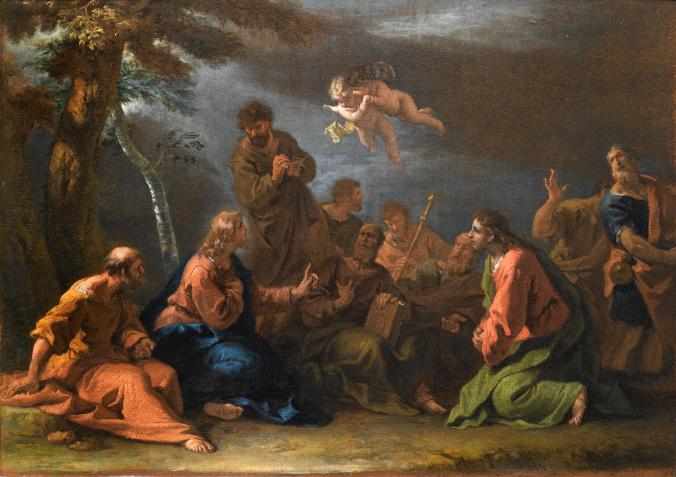
The Sermon on the Mount, Sebastiano Ricci
Today’s readings (click below to open in new tab/window):
Psalms 36; 147:12-20, 1 Kings 22:29-45, 1 Corinthians 2:14-3:15, Matthew 5:1-10
One of the challenges of resolving petty disagreements is we disagree on what’s petty. What seems like a harmless, off-the-cuff remark to me may feel like a biting comment to you. What seems like a minor annoyance to you may legitimately irritate me to tears. If we come from different parts of the world, something as simple as ordering five hot dogs with a palm facing outward instead of inward might be the insult that sets the lifelong tone of our relationship.
Paul knew petty squabbles could tear apart the early church. When the faithful in Corinth began to divide along lines of who had been converted by Paul and who by Apollos, he knew he needed to push them back together. He told the church that he had planted the seed of faith and Apollos had watered it, but both were only servants of God – the source of the seed and the actual growth.
After a couple thousand years of growth, we are still responsible for tending it, and sometimes we still need to be reminded we are not its source. The nature of the God we serve is deeper and more vast than we can possibly comprehend individually or collectively. Paul describes his role as the builder of a solid foundation upon which many others will build. Everything that people add to that foundation will eventually be tested, and what is not worthy will burn away.
Are we focused on adding things that will endure?
The church has outlasted bad doctrine, power struggles waged on a global scale and in the choir loft, corruption, and schism. What endures? The peacemaking. The mercy. The meek and poor in spirit. Those things, as Jesus preached in the Beatitudes, which are not about leaving our own bold though impermanent mark like graffiti across the face of the foundation, but about serving God by serving others.
We will, accidentally and intentionally, hurt each other. It is in the extending and accepting of olive branches – specifically when we would rather not – that we water and tend the growth. Better to set one small stone of mercy wisely and firmly in place than a great boulder which crumbles because we’ve carved our name too deeply into it.
Comfort: Even if only in a small way, you are adding to the foundation.
Challenge: Think about what you are adding and whether it serves you or God.
Prayer: Restore us, O God; let your face shine, that we may be saved. (Psalm 80:3)
Discussion: Has God ever used you or someone you know to turn a petty squabble into a moment of grace?
Join the discussion! If you enjoyed this post, feel free to join an extended discussion as part of the C+C Facebook group. You’ll be notified of new posts through FB, and have the opportunity to share your thoughts with some lovely people. Or feel free to comment here on WordPress, or even re-blog – the more the merrier!

 Comfort & Challenge