The Fine Line

1452988121799

Today’s readings (click to open in a new window):
Psalms 19; 150, Genesis 7:1-10, 17-23, Ephesians 4:1-16, Mark 3:7-19


The line between faith an insanity can be hard to identify. When Noah heard the voice of God telling him to build an ark, he must have questioned which side of the line he was on. His neighbors, friends, and family – the ones who didn’t scoff at him outright – surely had questions as well. How must it have felt to explain the enormous construction project going on in his back yard? Following God’s orders very likely ruined his reputation as a stable individual. At least until the rains started.

Not everything God would have us do will make sense to the outside world – and maybe not even to ourselves. Showing generosity to people who haven’t earned it, granting mercy to those who have wronged us, taking in strangers – these things seem scandalous by worldly standards. When God “asks” us to do something – through intuition, conscience, or other means – are we strong enough to ignore the mocking, sometimes hostile voices discouraging us? We probably won’t be asked to accomplish something as huge as 1.5 million cubic feet of boat, but when we open ourselves to ridicule the burden may feel almost as enormous.

When Noah and his family closed the door of the ark, they had no idea how long they might be afloat or what their final fate might be. Following God often means the faith that we are doing the right thing must be sufficient to carry us through dark and confusing times. We want to be sure we are on the right side of that line between faithful and crazy, but we often don’t. When it comes to leaps of faith we can pray, discern, and hope … but we can never be 100% sure. If we turn out to be wrong, or if things just turn out differently than expected, listening to that voice the next time may be difficult.

Not every little whim is a calling from God, but sometimes we need to risk looking a little crazy. That’s OK. We may turn out to be the only one with the good sense to get out of the rain.

Comfort: Faith may ask crazy things of us, but God will see us through.

Challenge: Is anything you have left undone nagging at your conscience? If so, pray and meditate on what’s holding you back.

Prayer: All-knowing God, I will trust you even when I don’t understand you.

Discussion: What’s the most outlandish thing you’ve done on intuition? How did it work out?

Join the discussion! If you enjoyed this post, feel free to join an extended discussion as part of the C+C Facebook group. You’ll be notified of new posts through FB, and have the opportunity to share your thoughts with some lovely people. Or feel free to comment here on WordPress, or even re-blog – the more the merrier!

It Rolls Downhill

Rabies 010

Today’s readings (click to open in new window): 
Psalms 104; 149, Genesis 6:9-22, Hebrews 4:1-13, John 2:13-22


“Tourist prices” have been a problem for as long as people have traveled out of town. For example, non-Jewish currency was forbidden inside the temple at Jerusalem, so pilgrims needed to exchange it with money changers in the temple’s outer court before purchasing sacrificial animals. Doves, lambs, and other creatures are difficult to travel with, so livestock merchants also set up shop there. Both money changers and merchants took advantage of captive customers by demanding high prices. When Jesus arrived at the temple, he was so outraged to find “a den of thieves” where people traded faith for profit that he fashioned a whip out of cords and drove them all out. Not only had commerce defiled the temple, the institution that was supposed to protect the people was exploiting them.

The faithful are called to steward our resources justly. That means more than tithing and charity. Wealth does not buy us the privilege to shift social burdens onto the poor. In his encyclical on the environment, Pope Francis describes how the poor are disproportionately affected by climate change and pollution. The wealthy consume resources and produce waste at a much greater rate than the poor, but poor communities are where we dump trash, manufacture toxins, and  ignore contamination. This burden shift occurs down the road and around the globe. Industries with environmentally devastating activities forbidden under national policies exploit poorer, unregulated countries. Many economic and social forces impact the differences between wealthy and poor communities, but property values are not Christian values. Living in a nice neighborhood doesn’t mean we deserve more justice. Faith calls us to deploy our resources in a way that protects the most vulnerable among us.

Are we in the outer court exchanging profit for justice, or are we working to make sure the poor – whom Jesus told us to serve – are at the heart of God’s kingdom? Rock bottom prices have high human costs. Pollutants we vote or litigate out of our back yards are forced into someone else’s. When the choices we make to better our lives negatively impact others, we need to make better choices. Maybe we can start by treating the poor as we would treat our own family … because Christ has made them so.

Comfort: Rich, poor, or in between, God’s justice is meant for all of us equally.

Challenge: Read about how the poor have been unfairly impacted by pollution in Ringwood, New Jersey (also known as Sludge City), Horlivka, Ukraine, or Flint, Michigan.

Prayer: Lord, help me to live justly, not just for my own righteousness, but for the love of your creation. Amen.  

Discussion: Where in your own community do you see links between poverty and injustice?

Join the discussion! If you enjoyed this post, feel free to join an extended discussion as part of the C+C Facebook group. You’ll be notified of new posts through FB, and have the opportunity to share your thoughts with some lovely people. Or feel free to comment here on WordPress, or even re-blog – the more the merrier!
 

Naked and Unashamed

apple-1122537_1920

Today’s readings (click below to open in new tab/window):
Psalms 42; 146, Genesis 3:1-24, Hebrews 2:1-10, John 1:19-28


“Who told you that you were naked?”

That’s the question God asks Adam and Eve when He finds they have covered themselves in fig leaves because they are ashamed. No one had to tell them; they knew as soon as they ate the fruit from the Tree of Knowledge of Good and Evil. What exactly about their nakedness was shameful? Minutes earlier it hadn’t bothered them – or God – at all. Perhaps it wasn’t the physical nakedness that shamed them, but the spiritual nakedness. That’s a lot harder to cover up.

Was there really anything special about the fruit? If God had commanded them not to sit in the Lawn Chair of the Knowledge of Good and Evil, the serpent would have reminded them how tired their legs were. It was inevitable.

Our reason for desiring “forbidden fruit” always seems solid … right up until we begin to pay the consequences. Like every human being, Adam and Eve already had the capacity for good and evil, but because they had not been disobedient, they did not have the knowledge of it. Immediately upon disobeying God they became aware of how deeply flawed they actually were. Like any one of us, they didn’t want those flaws exposed to the world or to God. Fumbling to conceal themselves only made mistakes more apparent. Whether or not we believe in a literal Eden, the story teaches us that as soon as we are aware of our disobedience, we feel separated from God.  The knowledge is not contained in the fruit, but in the bite.

It took a Christ who was willing to die on our behalf to reveal to us that God loves and forgives us despite our flaws. Our vain and impossible attempts at perfecting ourselves – our fig leaves – only further separate us from God, because we inevitably fall short and condemn ourselves. We’d be better off never having covered up at all. Christ invites us to drop the fig leaves and return to God on God’s terms – spiritually naked and humbly dependent. Christ uncovers our shame, and covers us in love.

Comfort: God loves you just as you are.

Challenge: In what ways are you still trying to prove yourself to God? How can you let go of these “fig leaves?”

Prayer: Loving Creator, I present myself humbly before you. I trust that you love me despite my sins and failures. I thank you for Christ who strengthens and redeems me. Amen.

Discussion: What tempts you? How do you feel after you give in?

Join the discussion! If you enjoyed this post, feel free to join an extended discussion as part of the C+C Facebook group. You’ll be notified of new posts through FB, and have the opportunity to share your thoughts with some lovely people. Or feel free to comment here on WordPress, or even re-blog – the more the merrier!
Math Nerd Theology

1452489798883

Today’s readings (click below to open in new tab/window):
Psalms 5; 145, Genesis 2:4-9 (10-15) 16-25, Hebrews 1:1-14, John 1:1-18


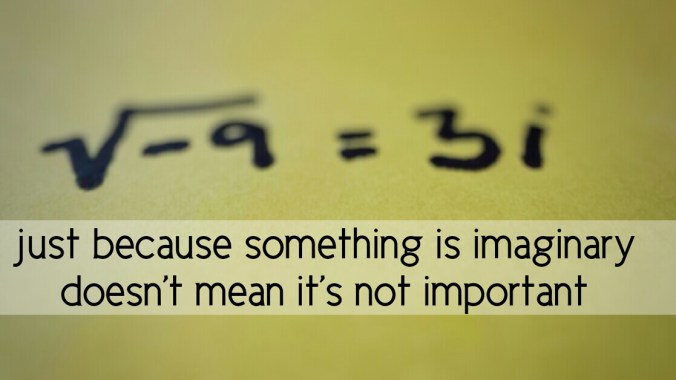
First, a short math lesson. When you square any number, positive or negative, the result is always a positive number: 3 x 3 = 9 and -3 x -3 = 9. Fairly straight forward, yes? (If not, don’t worry; there won’t be a quiz). However, some equations can’t be solved without finding the square root of a negative number. Since such a number does not exist, mathematicians invented an imaginary unit named i. Perhaps it’s more correct to say they discovered it; philosophers have debated for centuries whether mathematical concepts are invented or discovered. In either case, the square of i is -1. No one can hold up i fingers or charge $i for a pound of bananas, but i is necessary to calculate the square root of -9, which is 3i. 

End of math lesson. But what was the point?

The Gospel of John tells us that in the beginning, there was the Word, and the Word was with God, and the Word was God. In the original Greek, John uses the term logos, which means “word” but also means “reason.” John’s logos is Christ, so John is claiming Christ has been present and co-existent with God from before the beginning of the world. How can this be? Like i, faith in the logos solves an otherwise impossible problem. John has no direct evidence for it, but he invents/discovers it to make sense of God’s relationship with the world expressed through Christ. Some may call it imaginary, but it is also necessary.

Critics of faith often mock it for lacking reason. If your faith comes under fire for being unreasonable, think of i (but not too hard, or your brain may start to itch). Just because something can’t be pointed to or counted doesn’t mean it’s not essential to the fabric of the universe. We don’t call the entire field of mathematics a sham because it relies on an “imaginary” unit. The claim of Hebrews 11:1 that “faith is the evidence of things unseen” is our version of i, the necessary but unknowable solution for morality, eternity, and the soul.

And we thought algebra would never be good for anything.

Comfort: Faith isn’t about seeing, but believing.

Challenge: Call your algebra teacher and apologize for not paying more attention.

Prayer: All powerful Creator, I thank you for being present in the world, though your mystery is beyond my understanding. Amen.

Discussion: Have you ever found a use for something you thought would be useless when you learned it?

Join the discussion! If you enjoyed this post, feel free to join an extended discussion as part of the C+C Facebook group. You’ll be notified of new posts through FB, and have the opportunity to share your thoughts with some lovely people. Or feel free to comment here on WordPress, or even re-blog – the more the merrier!
 

Telescope or Kaleidoscope?

1452400078790

Today’s readings (click below to open in new tab/window):
Psalms 104; 150, Genesis 1:1-2:3, Ephesians 1:3-14, John 1:29-34


The first Biblical account of creation tells the story of God creating for six days and resting on the seventh. That story is immediately followed by a second one that differs in detail but still ends with the first human beings in a garden paradise. When we recall the stories, we often blur the lines between them, taking a six-day schedule from one, a borrowed rib from another. The Biblical creation accounts don’t stop with Genesis. Proverbs, Job, John, multiple Psalms – these and other passages provide widely varied accounts of how God went about creating the world. How is it they can be so different, yet part of a unified whole?

The Gospels are similar. Each tells the story of Jesus from a different viewpoint, so they are similar but not the same. Studies show that eyewitness accounts are notoriously unreliable, yet sometimes our legal system still depends on them. The more witnesses who can corroborate key details, the better. A telescope is accurate but limited by its singular field of vision; a kaleidoscope gives us many angles of the same view.

Let’s consider our own histories. When we and our siblings or friends reminisce about childhood, we don’t all recall it the same way. Ever listen to a married couple tell a story jointly? There is quite a bit of give and take, argument and correction as they navigate their way through the tale. Witnesses, friends, or partners, they are all working toward finding truths that can only be reconstructed by layering multiple perspectives and insights.

When we dive into the big questions – Who am I? Why am I here? What’s it all about? – no single story tells us all we need to know. The compilers of the Bible were not concerned that the creation stories “agree” because that’s not the point. Even the “conflict” between Genesis and science disappears when we consider facts and truth are not revealed in a single snapshot, but in multiple exposures over a long period of time. If we insist that only one story is factual, we’ll never know which ones are true.

Comfort: We don’t have to have all the answers.

Challenge: We have to keep asking the questions.

Prayer: God of Creation, help me to value your truth more than my own certainty. Amen.

Discussion: Every family has its own mythology. What’s one of your family’s most meaningful stories? If you don’t have a family, what makes a story meaningful to you?

Join the discussion! If you enjoyed this post, feel free to join an extended discussion as part of the C+C Facebook group. You’ll be notified of new posts through FB, and have the opportunity to share your thoughts with some lovely people. Or feel free to comment here on WordPress, or even re-blog – the more the merrier!

You Don’t Know Me

Today’s readings: Psalms 46 or 47; 149, Isaiah 45:14-19, Colossians 1:24-2:7, John 8:12-19

1452316370492

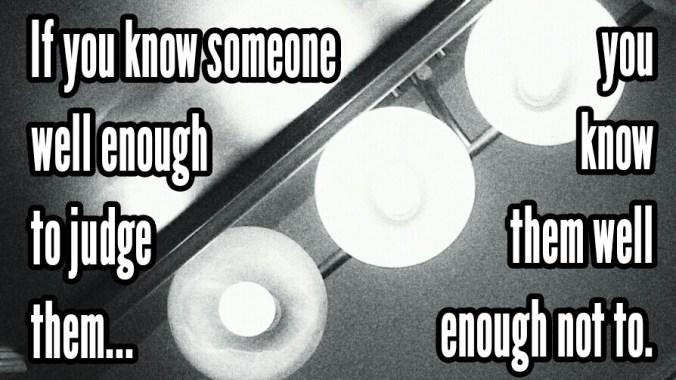
Judgment: to some degree, we’re all guilty of of it. At our best we can take a mental step back and move beyond it. At our less-than-best, we’re capable of doling out some pretty shabby treatment. Why do we judge? Sometimes it’s out of fear. Other times it’s because we see traits reflected in others that we don’t like in ourselves. Once in a while it’s because we need to believe someone did something wrong — usually defining “wrong” as something we haven’t done or been caught doing — that caused their illness, death, poverty, unemployment, public shame, prison sentence, or other problem. After all, the unacceptable alternative would be to admit that under the same circumstances we might have the same outcome, rather than convince ourselves we are saved by our virtue. Continue reading