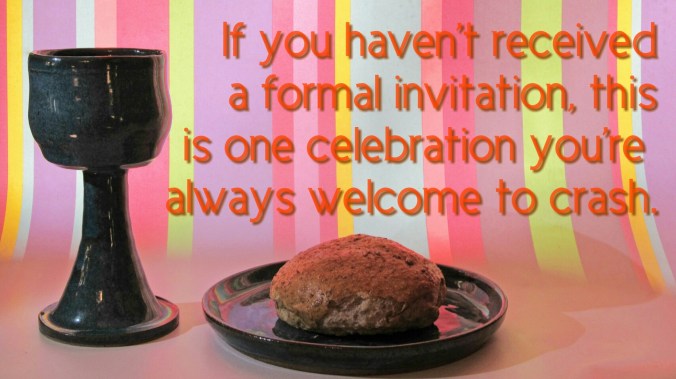
Invitation: I was hungry.

image

On my first day of freshman orientation at Notre Dame, the opening meeting ended with a mass. My three roommates and I walked up to receive communion together. As I later learned, two of us were practicing Roman Catholics, one was from a Roman Catholic family but going through a “rebellious phase,” and the fourth was a Buddhist whose parents had been born in China. He didn’t know thing one about Roman Catholicism, let alone the Eucharist, but in my naivete I assumed we were all Catholic and didn’t question anything when he stepped up to take communion with us. Afterward he asked: “So what was that bread thing all about?” Slightly scandalized, I gave him a brief outline of the Lord’s Supper and advised him that in the future, he should probably decline partaking. He shrugged and said: “I was hungry. It was bread.” Continue reading

Invitation: Lives of Welcome

1456074286689

When you throw a party, how early do you send out invitations? Nobody with a lick of sense creates a playlist, orders a cake, sets out coasters, fills a cooler with ice and then just hopes people will show up. We send out invitations weeks or sometimes months in advance so the people who are important to us can plan to be there. We lay the groundwork.

How do you feel when you get a last minute invitation? I feel like an afterthought. Continue reading

Invitation: Say Grace

1455479279579

Mission trips are enriching and humbling experiences. I was 40 years old when I participated in my first one. We went to Lake Charles, Louisiana to help rebuild homes and lives after Hurricane Rita tore through the city. Our leader and trip coordinator was a retired pastor I greatly admired. He had decades of mission experience, and shared wisdom and advice with us in preparation for the trip. One of the the things he told us was that people would be grateful for our help and would offer us food and drinks.

“Accept them,” he said.

He explained there might be a temptation to say no if we thought the person was being generous beyond their means out of sense of obligation. It was not our job to make that decision for them. We might be offered food we didn’t recognize or think we’d like. Barring food allergies or ethical restrictions, we were advised to accept and eat at least a small portion. When someone offered us hospitality, we were to accept it because refusing it would display a lack of respect to the soul and person. The pastor’s advice to drop my paternalistic, privileged attitude (my words, not his) has stuck with me all these years. He taught me to say “yes” was to say grace.

Recently I realized there was even more depth to this lesson.

The people we served had no idea what kind of people we were when we weren’t roofing, repairing fences, or clearing debris. They didn’t see our petty squabbles about church policy, estranged families, drunken self-pity, and criminal records. We were each invited to their table because, at least for that moment, we had all gathered in the name of Christ. And that’s all they needed to know.

We can have a lot of trouble extending the same grace to people we know well. If you knew all my bad behaviors – or thought you did – you might not think I should be accepting communion. You really might think I shouldn’t be offering it. But in that moment, whether we are giving or receiving, we are gathered because of Christ. In that moment, we are what Christ hopes we can be all the time. All the other moments of our lives may range from imperfect to downright wicked, but at Christ’s table we gather for a single, pure purpose. Grace allows us to accept the Bread of Life. Grace allows us to offer the Cup of Salvation.

When Christ invites us, we are to say “yes.” And that’s all we need to know.

May the peace of our Lord Jesus Christ be with you all.

Invitation: Forks and Elbows

1454855006658

Etiquette.

Now there’s a concept that’s become twisted over the centuries. A couple years ago I attended a class that was supposed to be on workplace etiquette,  but turned out to be mostly about table manners: what to do with your napkin and your elbows and your bread plate and all that jazz. The presenter insisted breaches of etiquette could seriously limit your career. This view of etiquette as a set of arcane rules the elite use to distinguish the worthy from the unworthy warps the true purpose of etiquette, which is kindness.

The classic etiquette dilemma when presented with a very formal table is: “Which fork do I use?” The implication is that using the wrong fork would signal your lack of class. Do you know why the general rule is “start from the outside in?” A good host sets a place with only the utensils that will be needed, in the order they will be needed. This way, a guest does not need to understand the difference between a fish fork and a fruit fork. The formal setting was designed to minimize the embarrassment of guests, not to create it.

My mother-in-law had a rule of thumb about decorating: no matter how good it might look, never put anything where someone may accidentally break it, because you don’t want to set anyone up for embarrassment. As far as I know, you won’t find that in a book on manners, but it is an excellent example of etiquette. Etiquette should always be about making someone feel comfortable and welcome, not about belittling them.

What is the proper etiquette for a faith community? In many instances, it has been as warped at the communion table as at the dinner table. We develop rules about language, behavior, and belief that may seem completely arbitrary to an outsider (and frankly to many insiders as well): what to wear, how to pray, where to sit, when to stand. When we set up insider rules then judge people for not following them, we are not being at all Christ-like. Sadly, we are too often more concerned with calling someone out for using the wrong fork or hymnal than with creating an environment that helps people learn and grow in ways that foster harmony. In a faith community and all other matters, etiquette is not about looking outside ourselves for reasons to be offended, but about looking inside to ask if we are genuinely caring about others. Jesus wasn’t concerned with arbitrary rules imposed by polite society, but he was interested in creating a just society where all were valued. At the last supper he didn’t worry whose elbows were on the table; he was preparing for the ultimate sacrifice to make sure everyone was welcome to the feast.

May the peace of our Lord Jesus Christ be with you all.

Invitation: Come as You Are

1454252550303

Most of our experience with communion is in a fairly formal setting. The priest or worship leader takes us through a familiar ritual. The bread is dedicated specifically to the purpose of communion. Depending on your tradition and beliefs, it may or may not be considered sacred but, knowing what it symbolizes, we all treat it with reverence and respect. As far as reenactments of Jesus’s last supper go, it’s pretty inaccurate.

The Gospel of Matthew tells us: “While they were eating, Jesus took bread…” No one processed into the room with consecrated wafers or a loaf with a slit in the bottom to make it easier to break. There may have been unleavened bread on the table for a traditional Passover meal, but otherwise it was unremarkable. Jesus used bread that was already present — and possibly half-eaten. The cup was just a cup. The gathered disciples would have washed it up after the meal with all the other cups and by the next morning probably couldn’t remember which one it had been.

Then there’s Judas. In all four Gospels, Jesus is aware his betrayer is at the table. He doesn’t identify Judas by name. He doesn’t exclude Judas from the meal. Instead Jesus shows him the same love and offers him the same blessing as everyone present.

The last supper — or first Eucharist — was made of the ordinary: the half-eaten, backwash-tainted, treacherous things and people at hand. It was sacred not because of the sanctity of the elements, but because Christ’s transformational presence makes the ordinary sacred. Your participation in communion does not require your perfection; it requires humble recognition of your deeply flawed nature. That’s the door through which Christ’s broken body and shed blood enter and transform you. And nobody can shut it but you.

If Christ welcomed even Judas at the first Eucharist, what possible reason could there be for anyone to be excluded? Who can say: “I get to determine who is worthy of the grace Christ gives freely?” We don’t get to decide that about other people, and other people don’t get to decide that about us. We don’t even get to decide it for ourselves. Communion isn’t about the perfect loaf of bread for the perfect people. It’s about Christ turning leftovers into a banquet that feeds the world.

May the peace of our Lord Jesus Christ be with you all.


Invitations to Communion

1451766966701

I was raised Roman Catholic and am now a member of the Disciples of Christ. In both traditions, though they have different understandings of the essential nature of communion, it is central to the liturgy. Several years ago I was honored to serve a term as one of the elders at a Disciples church. Among other duties, each week we issued an invitation before communion. We understood the table as Christ’s table, so the invitation needed to be inclusive of everyone present. Sometimes that included people we didn’t like or had active disagreements with, but we were called to be representatives of a nature higher than our own. Delivering the invitation was deeply meaningful and sacred to me.

On Sundays I will be adding an extra post reminiscent of those invitations. Of course I can’t follow up with an actual loaf of bread or cup of wine, but I hope they help you feel welcomed in the body of Christ.

You may have noticed that, in the devotionals, I don’t write in first person singular. That’s because there’s no “I” in Team Jesus.  Kidding …  and anyway there’s one in “Christ.” The devotionals are not about pushing my particular take on doctrine, theological specifics, conservative versus liberal views, or other personal agendas. Writing as “we” helps remind me of that. My invitational style is going to be a little different. When I was an elder I took an event from my life or something I’d learned that reminded me of the universal nature of Christ’s love, and adapted it to the purpose. The concept of open communion is not itself universal, and may come across as a theological statement if that’s not your belief. If you feel that way but otherwise enjoy the blog , maybe skip the invitations, and stick to reading the daily posts. I won’t be offended, though I’ll miss you. The invitation may be my words, but the nature of it is something I can only aspire to.

Peace!