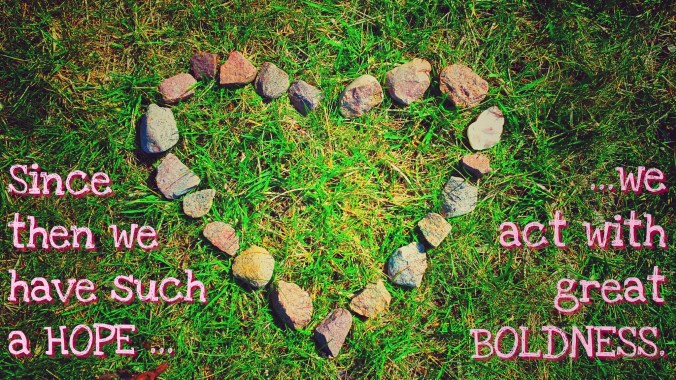
Hearts Of Stone

1458243566040.jpg

Today’s readings (click below to open in new tab/window):
Psalms 27; 147:12-20, Exodus 7:25-8:19, 2 Corinthians 3:7-18, Mark 10:17-31


In his second letter to the church in Corinth, Paul tells the people the law under Moses (which he calls the “ministry of death”) was chiseled in stone, while the ministry of the Spirit is written on their hearts. He also distinguishes them as the ministry of condemnation and the ministry of justification.  For people who were used to having all of God’s requirements written down in an agreed-upon format, this was an understandably difficult transition.

The New Testament wasn’t compiled until well after Paul’s death. When he preached about Christ, Paul wasn’t beholden to specific texts, a situation with both challenges and advantages. He had to constantly meditate on what the will of Christ might be, since he was the first person bringing this message to most of the people he encountered. On the other hand, not being bound by chapter and verse, he was free to speak the language of the heart, which created opportunities for mercy often unthinkable under the restrictions of pure law.

The New Testament is a collection of testimony and letters of advice and encouragement, not a basis for hard and fast laws, no matter how much some might like it to be. So how do we know what to do? The challenge of the ministry of justification is that we can’t actually read what is written on anyone else’s heart. Because it’s our nature to prefer defined expectations, we tend to assume it matches what is written on our own, and build our expectations for them on that basis. If we begin to judge people for not meeting our own self-imposed limits and rules, we are back to the ministry of condemnation, and the living words written on our hearts harden like stone tablets.

Our job is to understand what God has written on our own hearts, and live accordingly. Paul’s ministry of justification assumes the law is on our hearts, and encourages us to assume the same of others. Christ invites and trusts us to fulfill the law of love, and encourages us to allow others the freedom to do the same.

Comfort: The ministry of death has passed. Christ offers us new life.

Challenge: We are responsible for discerning, through our relationship with Christ, what is right and what is wrong.

Prayers: Merciful God, thank you for the ministry of life made possible through Jesus Christ. I pray for the wisdom and discernment to follow your will, not my own. Spare me from judgment as I spare my neighbor. Amen.

Discussion: What hard and fast rules do you cling to that may be more yours than God’s?

Join the discussion! If you enjoyed this post, feel free to join an extended discussion as part of the C+C Facebook group. You’ll be notified of new posts through FB, and have the opportunity to share your thoughts with some lovely people. Or feel free to comment here on WordPress, or even re-blog – the more the merrier!

A Stone’s Throw from Grace

stones-1523693-1279x852

Today’s readings (click below to open in new tab/window):
Psalms 42; 146, Genesis 26:1-6, 12-33, Hebrews 13:17-25, John 7:53-8:11


You don’t have to be a Christian to recognize the quote, “Let he who is without sin cast the first stone.” It’s the pivotal line from a story in John’s Gospel. In this story, the scribes and Pharisees brought to Jesus a woman who’d been caught in adultery. The prescribed Mosaic punishment was death by stoning, but the Pharisees – knowing that stoning wasn’t exactly Jesus’s style – asked him what should be done. They hoped to trap him into contradicting the law so they could bring charges against him. Jesus paused for a bit, wrote something on the ground, and then gave his famous answer. One by one her accusers slipped away until only Jesus was left. He refused to condemn her, saying only “Go and sin no more.”

The inclusion of this story in John’s Gospel is not without controversy. It doesn’t appear in the earliest manuscripts, and many editions of the Bible are sure to note this. It’s kind of ironic that such a questionable story became one of the most recognizable. Why does this story compel us?

Perhaps because – authentic or not – it embodies an idea that it seems we need to hear and learn over and over again. If our relationship with God is about pointing out what other people are doing wrong, instead of humbly examining our own hearts, we aren’t getting the message.

Do we as a faith community need to hear about the reality of sin and immorality? Absolutely. Do we as a faith community need to point to and single out and shame it everywhere we (think we) see it? Absolutely not.

Why is it so many non-Christians (and former Christians) see the faith as full of people ready to cast stones? Well … they’re not entirely wrong. The loudest messages shouted from beneath the Christian banner tend to be ones of condemnation. Now loudest doesn’t mean exclusive or truest or most frequent, but it does disproportionately influence what people perceive and remember.

Christ’s message isn’t one of condemnation; it is of love. We all know John 3:16 and wave it around a lot to point out who is “saved” and who isn’t, but for some reason we don’t spend nearly as much time on 3:17: “For God did not send his Son into the world to condemn the world, but to save the world through him.” Condemnation cuts people off or turns them off, and neither wins anyone to Christ. But we like it. We struggle with (and succumb to) the same temptation as the Pharisees to twist scripture to justify punishing or imposing our will on others. Once Christianity became the dominant force of the Western world, we seemed to forget forcing the Good News on people is bad news.

Grace invites us in and asks us to leave the door open; religion is an excuse to shut people out. When Jesus tells us what is sinful, it’s not so we know when to punish or control other people; it’s so we know when we are creating a rift between ourselves and God. If other’s people sin does not affect us or exploit the innocent, it’s none of our business. In a culture where the Christian majority has learned to take offense at the idea of sharing public space with people who don’t share our faith or values (and we forget even within Christianity they are nuanced), it affects us far less than we like to think it does. Every one of us has enough planks in his or her eye to keep us too busy to worry about someone else’s speck.

We are forgiven. That is a thought that should be so humbling we can’t conceive of throwing stones. Instead, let us pass on the message of grace and love by being Christ’s open hands to the world.

Comfort: God’s love will deliver us from fear.

Challenge: Ask yourself what temptations you find hardest to resist, then ask what need is still not being met by giving in to them.

Prayer: In you O Lord I seek refuge and peace. Amen.

Discussion: What fears drive your behavior?

Join the discussion! If you enjoyed this post, feel free to join an extended discussion as part of the C+C Facebook group. You’ll be notified of new posts through FB, and have the opportunity to share your thoughts with some lovely people. Or feel free to comment here on WordPress, or even re-blog – the more the merrier!