Fragrant

1458179647754.jpg

Today’s readings (click below to open in new tab / window):
Psalms 5; 147:1-11, Exodus 7:8-24, 2 Corinthians 2:14-3:6, Mark 10:1-16


In his second letter to the Corinthians, Saint Paul wrote:

“[W]e are the aroma of Christ to God among those who are being saved and among those who are perishing; to the one a fragrance from death to death, to the other a fragrance from life to life.”

Fragrances are complex. What smells pleasant on one person’s skin may be noxious on someone else. Just as body chemistry interacts with the composition of cologne or perfume, spiritual “chemistry” impacts the impression we make on those we meet. There is no single way to live as a Christian. If we slap on a particular style of speech or manners just because it is popular or endorsed by a celebrity, and it doesn’t authentically line up with who we are, the effect can be disastrous. At best we may seem like a cheap knock-off, at worst we will radiate a stench of deception. Authenticity is more important than brand recognition.

The powerhouses of attraction are not the fragrances we spray on, but those scents other people may not consciously detect. Pheromones are chemical signals secreted by animals and humans to trigger physiological responses in others. We don’t consciously control them, yet they can powerfully influence attraction or repulsion.

What signals of spirit and character do we unknowingly emit? When people encounter us, do they sense we are more interested in sharing the good news, or in showing off how “saved” we are? Do our words and actions leave an aftertaste of love or judgment? If we parrot Christ’s message of love, but demonstrate it through anger and condemnation, our fragrance quickly turns from sweetness to stench.

We can’t control other people’s perceptions, but we can cultivate authentic and loving hearts. Be truthful, even when it means admitting you have doubts. Reserve judgment, for someone sharing a beer and bad karaoke may reach a lost soul more effectively than a pew and a hymn – and vice versa. Don’t let your testimony be the cheap overused cologne that lingers unpleasantly after you go. Let it be the undetectable fragrance others can’t help but pursue.

Comfort: Your way of being Christian, as long as it grows from an authentic relationship with Christ, will speak to the people who need to hear it.

Challenge: Be authentic. God didn’t create you to be someone else.

Prayer: Loving God, may my words and actions be a sweet aroma, drawing the world to your grace. Thank you for meeting me where I am, loving me as I am, and challenging me to be more. Amen.

Discussion: Do any of the ways you express your faith feel artificial? How could you change them, or maybe even abandon them entirely?

Join the discussion! If you enjoyed this post, feel free to join an extended discussion as part of the C+C Facebook group. You’ll be notified of new posts through FB, and have the opportunity to share your thoughts with some lovely people. Or feel free to comment here on WordPress, or even re-blog – the more the merrier!


Good News / Bad News

1458062295810.jpg

Today’s readings (click below to open in new tab/window):
Psalms 34; 146, Exodus 5:1-6:1, 1 Corinthians 14:20-40, Mark 9:42-50


We’ve all seen them: evangelists who go Full Brimstone attempting to convert non-believers. From the classic “If you’re wrong you’re going to hell!” to the modern “God Hates Fags” tactics deployed at military funerals and on cable, someone is always telling someone else why God is damning them to eternal suffering. Fear-based evangelism is notoriously ineffective except for fundraising from believers, but let’s give the benefit of the doubt to its practitioners and assume they are fumbling to share the core message of salvation through Christ. Then let’s meditate on some teachings of Paul and Jesus.

Paul advised the Corinthian that speaking in tongues impressed some believers, but to non-believers it was gibberish that at best said nothing and at worst confused or repelled them. He told those with the gift of prophecy to keep it reined in; believers and non-believers alike could be overwhelmed by more than two or three speakers at time. Zeal is admirable, but leading with the big guns doesn’t exactly tell people you come in peace.

Jesus told people it was better to cut off a hand or foot or to poke out an eye if those parts presented stumbling blocks to the little ones following him. This passage follows Christ’s rebuke of disciples who were unhappy to see strangers casting out demons in his name. Attacking their fledgling faith would have accomplished nothing, and may even have destroyed the good work they were doing.

Our convictions in Christ remain firm, but how we share them with others is important. When Jesus told the rich young man he would have to give up everything he owned to become a disciple … the rich young man walked away. If it doesn’t work for Jesus, it’s not going to work for us. The good news we have to share is not that hell is our default destination and we have the exclusive ticket out; the good news is God loves everyone enough to offer them eternal life. If that seems like a distinction without a difference, remember that famed dog- and horse-whisperers succeed because they teach by understanding their students, not forcing the students to understand them.

Comfort: There’s always another way to share the good news of our faith.

Challenge: Before sharing the Gospel, decide whether you’re trying to win souls or just win arguments.

Prayer: Loving God, thank you for the good news of Jesus Christ! Give me the courage and wisdom to share your word effectively with those who need to hear it. Amen.

Discussion: Are you comfortable speaking about your faith? Is any discomfort you have about what you believe, or about what you think you need to say to share it?

Join the discussion! If you enjoyed this post, feel free to join an extended discussion as part of the C+C Facebook group. You’ll be notified of new posts through FB, and have the opportunity to share your thoughts with some lovely people. Or feel free to comment here on WordPress, or even re-blog – the more the merrier!

Not Against Us

1457972178830.jpg

Today’s readings (click below to open in new tab / window):
Psalms 119:73-80; 145, Exodus 4:10-20 (21-26) 27-31, 1 Corinthians 14:1-19, Mark 9:30-41


The Rev. Martin Luther King Jr. claimed the most segregated hour in America was 11:00 a.m. on Sunday morning. Our chosen church communities tend to resemble us racially, politically, and economically. It’s comfortable and easy to be with people “like us” and erect tall walls on a foundation of small differences. However, comfortable and easy are not Christian virtues. Today’s readings contain lessons about being in community with people different from ourselves.

In Exodus 4, Moses meets his brother Aaron. Together they deliver the Lord’s message to the Hebrews. Moses was raised Egyptian, spent forty years living as a Midianite, and was slow of speech (possibly due to a speech impediment). Aaron was of the priestly Levite class of Hebrews and quite eloquent. Together they represented an effective marriage of substance and style.

In 1 Corinthians 14 Paul addresses the importance of the spiritual gifts of prophecy, speaking in tongues, and interpretation. While emphasizing the need for prophecy (defined not so much as making predictions but as speaking words of encouragement, rebuke, and consolation from God), he also asks the question: what good is speaking in tongues if no one understands? Without interpretation, a person gifted with tongues does not build up the community, and without something to interpret, a person so gifted doesn’t bring much to the table.

When the disciples complained about people who were casting out demons in Jesus’s name, yet were not following them, Jesus told them: “Whoever is not against us is for us.” He knew the common goal of spreading the good news overrode petty differences.

Insisting on our specific way merely protects our egos when other gifts and perspectives make us feel insecure about our own. When we build or join a community, do we seek those whose strengths and weaknesses complement our own? If a church wants to tackle poverty, but is mostly a lot of rich people deciding what’s best for “the poor” without knowing or even asking them, how effective can it be? A team of co-workers who all share the same perspective rarely create innovative solutions. Our diversity was not created to be a source of jealousy or conflict, but to help us help each other.

Comfort: Your weaknesses are an opportunity to appreciate someone else’s strengths.

Challenge: Make a point of attending a church service or social event with people you normally don’t interact with.

Prayer: Thank you, Creator God, for the great diversity of life. Teach me to appreciate the beauty in the abundant shapes and thoughts of your world. I praise your holy vision and creativity. Amen.

Discussion: In what areas of your life do you seek like company? Are these areas where it might make sense to diversify your community?

Join the discussion! If you enjoyed this post, feel free to join an extended discussion as part of the C+C Facebook group. You’ll be notified of new posts through FB, and have the opportunity to share your thoughts with some lovely people. Or feel free to comment here on WordPress, or even re-blog – the more the merrier!

Who Gives Speech to Mortals?

1457912343122.jpg

Today’s readings (click below to open in new tab / window):
Psalms 84; 150, Exodus 3:16-4:12, Romans 12:1-21, John 8:46-59


When God appeared to Moses from a burning bush and asked him to confront Pharaoh about freeing the Israelites, Moses was understandably hesitant. After all, the Egyptian king already wanted him dead, and Moses had spent the last forty years as a humble shepherd. How could he effectively present himself as God’s messenger? He wanted assurance the Egyptians would believe him.

To convince Moses that Pharaoh would listen, God commanded him to throw his staff to the ground. It became a serpent, and then a staff again when Moses grabbed it by the tail. The Lord then commanded Moses to tuck his hand inside his robe. When he drew it out again, it was white with leprosy. At God’s command he repeated the actions, and it was healed. Armed with these signs and more, Moses still resisted, insisting he was slow of speech and tongue. God, seeming almost exasperated by the this point, replied: “Who gives speech to mortals? Who makes them mute or deaf, seeing or blind? Is it not I, the LORD? Now go, and I will be with your mouth and teach you what you are to speak.”

Let’s consider for a moment the assurances God gave Moses. He didn’t arm Moses with magical amulets or enchanted weapons. Instead he said: show them your staff; show them your hands. God was telling Moses: “You are already equipped to do my work. Trust me.”

We often feel unwilling and ill equipped to do what God asks. Excuses come fast and easily. We lack finances. We lack time. We lack talent. But who gives us talent? Who makes us smart or senseless, rich or poor? When we answer the Lord’s call, he will equip us. This isn’t to say things will be easy. Moses experienced many trials both before and after his people left Egypt, and never entered the promised land himself, but God equipped him each step of the way.

Our gifts may seem completely ordinary until we trust God to use them, but when we do … who knows what miracles may happen and souls may be freed?

Comfort: You have been created with everything you need.

Challenge: Meditate on what you have to offer, no matter how small, that God could use.

Prayer: God of Creation, thank you for the many gifts you have given me. Teach me to see myself as you do: a child with limitless potential inspired by your love. Amen.

Discussion: What excuses do you use to avoid what’s asked of you?

Join the discussion! If you enjoyed this post, feel free to join an extended discussion as part of the C+C Facebook group. You’ll be notified of new posts through FB, and have the opportunity to share your thoughts with some lovely people. Or feel free to comment here on WordPress, or even re-blog – the more the merrier!

Curveballs

1457561126801

Today’s readings (click below to open in new tab/window):
Psalms 5; 147:1-11, Genesis 50:15-26, 1 Corinthians 12:1-11, Mark 8:11-26


Imagine you are Jesus. You’ve just miraculously fed four thousand people with no more than a few loaves and fishes. Not long before that you fed a greater crowd with fewer resources. Now you are in a boat with your disciples trying to use a parable about yeast to warn them about the pharisees and Herod. After a few minutes of pondering what you mean, they decide you are upset because … there is only one loaf of bread in the boat. If you were Jesus, would you have been a little frustrated that no one could seem to get past the lack of bread?

Are we wiser than the disciples? Do we treat every challenge like it’s the first one, or do we learn from our faith journey? No matter how many difficulties we’ve experienced, when new ones arise it can be hard to remember what we’ve survived. If God has seen us through illness, addiction, or betrayal are we able to trust He will see us through the newest crisis on the horizon? It’s not always easy, especially when we face the unfamiliar. Our first reaction is usually fear. But as the disciples eventually learned, trust in God can displace the fear. Trust may not completely eliminate the fear – we are only human! – but it changes our understanding of it. The trick is to remember that to God, this struggle is no worse than the ones that have come before.

Even the “best” lives are not free of challenges. As our faith matures, we begin to recognize huge challenges that didn’t register as important before. Issues of injustice, for example, become more obvious and less acceptable to us. If we can accept that life will never stop throwing us curveballs, that we have not failed because our lives aren’t perfected, maybe we can stop being surprised and devastated by them. If we are more in control of our reactions, we can surrender our troubles to God that much sooner. Some days we may ask how the bread could possibly be enough, but God is leading us to the bigger questions.

Comfort: You are not going through anything that God can’t see you through.

Challenge: When you are frightened by challenges, say prayers of thanks for all the situations God has already brought you through.

Prayer: Loving God, thank you for being with me in all situations. Forgive me when my fear interrupts my faith. Teach me to trust in you always. Amen.

Discussion: What things upset or frighten you because you can’t control them? Are you able to turn them over to God?

Join the discussion! If you enjoyed this post, feel free to join an extended discussion as part of the C+C Facebook group. You’ll be notified of new posts through FB, and have the opportunity to share your thoughts with some lovely people. Or feel free to comment here on WordPress, or even re-blog – the more the merrier!
Healthy Fear

1456487713873

Today’s readings (click below to open in new tab/window):
Psalms 22; 148, Genesis 43:1-15, 1 Corinthians 7:1-9, Mark 4:35-41


What words describe your feelings about Jesus? Awe? Love? Gratitude? Comfort? How about… fear? The Bible uses the phrase “fear of God” or “fear of the Lord” to describe the proper reverence we owe God, but Jesus is generally portrayed as more immediate, more understanding, more human. His disciples found him sufficiently charismatic to leave behind jobs, homes, and families and follow him far and wide. He persuaded people through love, not fear. But is there a fearful side to Jesus?

One day Jesus and the disciples were on a boat after a long day of preaching to large crowds when a storm rose. Jesus might have slept right through it, but the disciples were afraid and woke him. He “rebuked the wind, and said to the waves, ‘Quiet! Be still! ‘ Then the wind died down, and it was completely calm.” Afterward the terrified disciples asked each other who this person was, that he commanded nature herself. We might assume such a display would be inspiring, but when someone you think you know turns out to be entirely more powerful than you can understand, it is unsettling. Jesus changed from magnetic preacher to unknown quantity in a heartbeat.

Some disciples must have doubted the safety of continuing to follow this powerful figure. When we study Jesus, do we settle for “Jesus 101” – the introductory course with a benign, almost chummy Jesus? Or do we go for the advanced study: a Jesus who can be intimidating and demanding, but who offers a much richer life? Maybe we can synthesize the two: a Jesus who upends our expectations and draw us into new – sometimes frightening – lives, but loves and supports us through the demands of the new life he offers. When the Jesus who calmed the storm washed his disciples’ feet at the Last Supper, he taught us true power bends itself toward service. How can we not be humbled? Remembering Jesus is more than a companion who walks and talks with us “in the garden” helps us realize the deep reality of who Christ is – and who we can become in him.

Comfort: Jesus is with us to ride out life’s storms.

Challenge: When you are in trouble and it seems Jesus may be “in the stern, asleep on the cushion,” trust he is still faithful to you.

Prayer: God of power and majesty, I am your humble servant. Give me the courage to serve as Jesus served. Amen.

Discussion: When has following Jesus been scary?

Join the discussion! If you enjoyed this post, feel free to join an extended discussion as part of the C+C Facebook group. You’ll be notified of new posts through FB, and have the opportunity to share your thoughts with some lovely people. Or feel free to comment here on WordPress, or even re-blog – the more the merrier!

Fool Me

1455593850320

Today’s readings (click below to open in new tab/window):
Psalms 34; 146, Genesis 37:12-24, 1 Corinthians 1:20-31, Mark 1:14-28


We train our children not to trust strangers, especially ones promising treats. As adults we try to follow our own advice. We are skeptical of offers that sound “too good to be true.” Most of us don’t hitchhike or pick up hitchhikers. We lock up our homes, cars, and jewelry. Given the nature of the world, all these precautions are wise.

On the other hand, we still like our quick fixes and easy assurances. Proof lies in the bank accounts and hypocrisy of televangelists, politicians, snake oil salesmen, and home shopping gurus. Headline after headline reminds us we entrust them with far too much of our faith and money.

What then are we to make of fishermen who “immediately” dropped everything to follow Jesus, as Mark tells us, simply because he asked them to? In hindsight we support the decision, but what about anyone who abandoned her or his life today to follow someone promising to make them “day traders of men?” Do the words “cult” and “deprogram” come to mind? Were the first disciples wise people or lucky fools?

The difference between wisdom and foolishness is a tough call. Because God’s values are upside down compared to the world’s values, we are constantly called to evaluate our decisions, and sometimes to act in ways others would consider foolish. For example, how many of use are willing to decrease our standard of living – move into a smaller house, drive a cheaper car, or take a lower paying job – to spend more money or time on the poor? Very few, and they are often judged with humor at best and cynicism at worst. The world tells us this is foolishness, yet it is freedom.

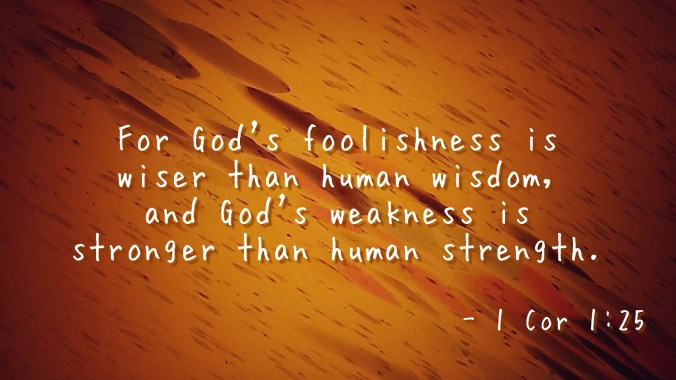
In 1 Corinthians, Paul tells us God makes the foolish wise and the wise foolish. Let’s not get cocky about which side of that equation we land on. Determining whether a path is right or merely attractive can take serious discernment. We want to follow Jesus urgently, but we want to be sure the path we choose truly leads to him. Let’s choose our guides with Godly wisdom and worldly foolishness.

Comfort: Your choices are between you and God.

Challenge: “Foolishly” critique your own opinion on a controversial issue.

Prayer: God of wisdom, bless me with your foolishness.

Discussion: Have you ever felt like a fool for Christ? When and why?

Join the discussion! If you enjoyed this post, feel free to join an extended discussion as part of the C+C Facebook group. You’ll be notified of new posts through FB, and have the opportunity to share your thoughts with some lovely people. Or feel free to comment here on WordPress, or even re-blog – the more the merrier!

I Want That

christmas-2971961_1920

Today’s readings (click below to open in new tab/window):
Psalms 84; 148, Isaiah 24:14-23, 1 Peter 3:13-4:6, Matthew 20:17-28


If you didn’t tell people you were a Christian, would they feel compelled to ask about your hope?

The First Epistle of Peter, written to an audience spanning the Roman provinces of Asia Minor, is concerned largely with the relationship between Christians and the surrounding culture. In response to a growing sense among non-believers that Christians were troublemakers, dissidents, and generally immoral the letter encouraged Christians to respect authority and to face discrimination and persecution for doing what is right as opportunities to achieve solidarity with Christ’s suffering.

The letter advises: “Always be ready to make your defense to anyone who demands from you an accounting for the hope that is in you; yet do it with gentleness and reverence.”

Why should people care enough to ask about someone’s hope? Because when we follow Christ, it should be obvious we “do not fear what they fear.” When we don’t fear what other people do, it makes them uncomfortable until they know why. And what are these things people fear? Radical forgiveness (both human and divine). Disregard for public opinion. Willingly becoming a servant to all. Death. Life.

If we never mention being a Christian, people should still see these traits in us. And any unease it causes them should fade when, with gentleness and reverence, we explain our faith.

A good friend of mine, raised without religion, arrived at faith not because Christians tried to talk her into it but because, in her words, “I saw a light in them and thought, I want that.” This light was evident in their everyday attitudes and actions, and buoyed them up through both difficulties and celebrations. Strong-armed evangelistic tactics would have been wasted on her, but the fruits of the Spirit were a compelling witness.

It’s not for us to judge whether the light of Christ dwells within the heart of any individual, but Christians can certainly create barriers to obscure it. Anger, fear, hostility, condemnation, self-righteousness, and stubbornness are all like shades we draw around our hearts. Each one makes it harder for the light to shine into the world; draw enough, and it is obscured entirely. Then no one has anything to ask about, because we look the same as or worse than the rest of the world.

We can positively influence the world’s (and our own) perception of the faithful without making demands or forcing ourselves upon it. The witness of a servant full of hope and without fear is a remarkable thing. Let us strive to be a people who cause other people to say, “I want that.”

Additional reading: for thoughts on today’s passage from Matthew, see Ask? Away!

Comfort: The light of Christ shines within you.

Challenge: Let is shine in the world as well.

Prayer: As for me, I am poor and needy, but the Lord takes thought for me. You are my help and my deliverer; do not delay, O my God. (Psalm 40:17)

Discussion: Have you known anyone who lights up a room without saying anything?

Join the discussion! If you enjoyed this post, feel free to join an extended discussion as part of the C+C Facebook group. You’ll be notified of new posts through FB, and have the opportunity to share your thoughts with some lovely people. Or feel free to comment here on WordPress, or even re-blog – the more the merrier!

Chairity

cafeteria-1441575-1598x1062

Today’s readings (click below to open in new tab/window):
Psalms 130; 148, Nehemiah 12:27-31a, 42b-47, Revelation 19:11-16, Matthew 16:13-20


When Jesus asked his disciples who the people thought he was, they answered Elijah, John the Baptist, Jeremiah, and other prophets. He then more pointedly asked them “But who do you say that I am?” Peter quickly answered “the Messiah” and Jesus told him this knowledge came not from flesh and blood, but from God. Then Jesus instructed his disciples to tell no one else.

Who do you think Jesus is?

Like Peter we can answer “the Messiah” because it’s definitely not a secret any more … but what does that mean to us? After the crucifixion and the resurrection, the role of “the Messiah” meant something very different to Peter and the disciples. Christians unite around the idea of Christ as Messiah, yet given the variety in our expression of faith and belief, mostly derived from the same Biblical sources, we don’t all mean the same thing when we say it.

Is there a perfectable understanding of Christ we all strive toward? Plato had a theory of ideal forms. Summarized in a simple example, there exists a metaphysical ideal form of any object, such as a chair, which is the standard by which we recognize other less-than-ideal objects in the physical world as chairs. Is there an ideal form of Christ (which would be, one supposes … Christ himself) which helps us recognize expressions of Christ in this world we presently inhabit?

Chairs can be plush, wooden, yielding, rigid, wheeled, or rocking. They can have various numbers of legs or – in the case of bean bags – no legs at all. Yet in all their variety they hold in common factors which define them as chairs.

If Peter and the disciples who knew Jesus personally underwent a transformation in their understanding of Jesus, let’s not be too quick centuries later to declare one earthly expression the only real thing. This isn’t some wishy-washy excuse to turn Jesus into whatever we’d like him to be. To the contrary, encountering Jesus changes us, never the other way around.

The same Christ can inspire one person to a conservative worldview and another to a progressive worldview. Both probably believe the other to be misguided, but there will be central issues – such as feeding the hungry and caring for the ill – upon which they agree. Why do we find it so much easier to focus on the areas where we disagree, when areas of agreement are where we find Christ?

When it comes to discipleship, we all get some right and some wrong. Moving toward that ideal form of discipleship – that understanding of who Christ is and what he asks of us – is a lifelong endeavor. Let us undertake that journey with humility, love, and mercy. Isn’t that who we say we are?

Comfort: Christ’s love is greater than we imagine.

Challenge: So let’s not limit him to what we can imagine.

Prayer: I wait for the LORD, my soul waits, and in his word I hope (Psalm 130:5)

Discussion: What words describe Jesus for you?

Join the discussion! If you enjoyed this post, feel free to join an extended discussion as part of the C+C Facebook group. You’ll be notified of new posts through FB, and have the opportunity to share your thoughts with some lovely people. Or feel free to comment here on WordPress, or even re-blog – the more the merrier!

Lake of Doubt

lake-2063957_1920

Today’s readings (click below to open in new tab/window):
Psalms 104; 149, Ezra 9:1-15, Revelation 17:1-14, Matthew 14:22-36


Employers tend to base their decisions about promotions around two criteria: qualifications and seniority. How they balance these criteria depends largely on what kind of business environment they have. In a unionized factory, for instance, seniority plays a larger role than it would in a tech start-up where youth may provide more advantage. Just because someone has been around the longest doesn’t mean they’re the best at their job or the most qualified to lead, manage, or train others and neither does being the best at hottest new skill set. In both cases, and most others, failing to balance these criteria properly poses a danger of setting someone up to fail.

When the boatful of disciples were startled to see Jesus walking toward them across the lake, Peter cried, “Lord, if it is you, command me to come to you on the water.” As Peter crossed the water the wind picked up and he panicked and began to sink. Of course Jesus didn’t let him drown, but pulled him from the water and said “You of little faith, why did you doubt?”

After the boat landed at Gennesaret, word spread quickly among the people. They brought many sick people to Jesus and sought “to touch even the fringe of his cloak; and all who touched it were healed.”

Peter, who had been with Jesus since the beginning, thought he had the faith to follow Jesus anywhere and folded in the crunch, but among the people of Gennesaret who had little experience but lots of faith many were healed . It’s probably no accident these stories appear back-to-back in Matthew’s Gospel. In earlier chapters, the author stresses that what Jesus is able to accomplish through us depends a great deal on the degree of faith we exhibit.

The less susceptible we are to worldly distractions, and the more we rely on Christ than ourselves, the more confidently we can stride across that lake of doubt. Some of that comes from experience, and some from the childlike faith which is too fervent to be discouraged. It is a balance we must learn to recognize within ourselves. Jesus doesn’t set us up to fail, so let’s not do it to ourselves by second guessing him or imposing our own will. Whether we’re Peter or a hopeful stranger, let us be humble enough to trust Christ will do what he says he will. It is through humility he promotes the first to be last.

Comfort: Christ is invested in your spiritual success.

Challenge: Try to be honest objective when understanding your own strengths and weaknesses.

Prayer: Lord I believe. Help my unbelief. Amen.

Discussion: How does doubt hold you back?

Join the discussion! If you enjoyed this post, feel free to join an extended discussion as part of the C+C Facebook group. You’ll be notified of new posts through FB, and have the opportunity to share your thoughts with some lovely people. Or feel free to comment here on WordPress, or even re-blog – the more the merrier!