Conspiracy Theory

binoculars-67535_1920.jpg

Today’s readings (click below to open in new tab/window):
Psalms 143; 147:12-20, Ezra 1:1-11, 1 Corinthians 16:1-9, Matthew 12:15-21


It’s hardly even news any more when we discover the people who are supposed to be leading us or serving the public are not working in our best interest. The outrage we feel over scandals is less about being surprised or disappointed, and more about vindicating our suspicions about how the “other side” abuses its power.

From the personal and petty to the global and grandiose, people with power can’t seem to help abusing it and maintaining a choke hold on it. The Pharisees felt Jesus and his teachings threatened their power and they were willing to play dirty to retain it. Like the power-hungry across all times, they convinced themselves and others it was for the greater good.

It would be nice to say Christians today were not nearly as prone to conspire against Christ, but would it be true? Early Christians held beliefs that ran counter to the dominant culture. In America and large sections of the western world, Christians are the dominant culture. Because this is the case, it is easy to start assuming the things we value as a society must be Christian. We conflate value-neutral systems like capitalism and democracy, and institutions like the military and the constitution, with Christianity in a way that makes them seem like the Unified Theory of Everything Good. When Jesus gets bound up in marketing gimmicks and partisan politics and national pride, we have — intentionally or not — conspired to undermine his message. When Christians view and treat the poor as moral failures instead of fellow travelers, or encourage others to do so, we have traded Christ for comfort.

What if we could conspire on behalf of Christ? What if, instead of assuming Christ should value the same things we do, we sought to live in loving contrast to the parts of our culture — even the self-identified Christian ones — that resemble the institutions and hypocrisies he criticized? What if we did so in a way that was not about toppling the powerful, but raising the downtrodden? If we aren’t rocking the boat in radically inclusive ways, we’ll never know what it’s like to walk on water.

Comfort: The values Christ stands for are timeless…

Challenge: … so we can’t assume all his teachings were about the past.

Prayer: I love the LORD, because he has heard my voice and my supplications. (Psalm 116:1)

Discussion: Are there any conspiracy theories you think are true?

Join the discussion! If you enjoyed this post, feel free to join an extended discussion as part of the C+C Facebook group. You’ll be notified of new posts through FB, and have the opportunity to share your thoughts with some lovely people. Or feel free to comment here on WordPress, or even re-blog – the more the merrier!


The Sword and the Word

james-pond-191266

Photo by James Pond on Unsplash

Today’s readings (click below to open in new tab/window):
Psalms 36; 147:12-20, Jeremiah 38:1-13, 1 Corinthians 14:26-40, Matthew 10:34-42


Some Biblical passages are challenging to understand. Not because of difficult language, but because of difficult ideas. And which ideas seem difficult vary from person to person. For me, today’s passage from Matthew has always been tough:

Do not think that I have come to bring peace to the earth;
I have not come to bring peace, but a sword.
For I have come to set a man against his father,
and a daughter against her mother,
and a daughter-in-law against her mother-in-law;
and one’s foes will be members of one’s own household.

How do we reconcile the blessed peacemakers of the Beatitudes from Matthew 5 with the sword and household strife in Matthew 10?

Is it a literal sword? That depends on who you ask. This passage has been used to justify taking up arms. But if we look at the physical use of swords by Christ and his disciples in the gospels, including the time he tells them to sell their cloaks to buy swords, he never encourages using them and chastises the disciple who strikes with one to defend him.

This divisive sword, this render of home and family, seems more akin to the metaphorical eyes we are to pluck out to avoid sin. But what does it represent?

I believe that, under the right circumstances, love and forgiveness can be perceived as a threat and, yes, even a weapon. Not everyone is willing to get on board with the radical call to sacrifice – both material and spiritual – that is part of discipleship. Not everyone wants to forgive. Maybe they simply don’t agree with the whole philosophy behind it. Maybe they don’t like having a mirror held up to their lives. Maybe they’ve been so abused by twisted religion that they can no longer associate Christ with anything good.  Whatever the reason, standing firm in our beliefs has the potential to alienate even the closest family members – to sever bonds, however regretfully, like a sword. And like any true swordsman, once we’ve unsheathed it, we must be prepared to follow through.

And there’s the Christian paradox. Christ asks us to wield a metaphorical sword which creates real-world enemies … even as he commands us to love those enemies and do good to those who persecute us. We don’t seek to create strife, but it will happen. And we are to respond to it with a love and humility that seemingly gives our foes all the advantages. For if we abandon love, we have surrendered everything.

Christ’s teachings divided his people against themselves and against him, and he forgave while he looked down on his foes from the cross. Surely we can make peace across a dinner table.

Comfort: Blessed are the peacemakers, for they shall be called the children of God.

Challenge: Just because someone rejects you doesn’t mean you must reject them.

Prayer: Do not hide your face from me. Do not turn your servant away in anger,
you who have been my help. Do not cast me off, do not forsake me, O God of my salvation! If my father and mother forsake me, the LORD will take me up. (Psalm 27:9-10)

Discussion: Have you ever been at odds with friends or family over your faith?

Join the discussion! If you enjoyed this post, feel free to join an extended discussion as part of the C+C Facebook group. You’ll be notified of new posts through FB, and have the opportunity to share your thoughts with some lovely people. Or feel free to comment here on WordPress, or even re-blog – the more the merrier!

Faith and Friction

emery-cloth-1827149_1920

Today’s readings (click below to open in new tab/window):
Psalms 5; 145, 2 Kings 21:1-18, 1 Corinthians 10:14-11:1, Matthew 8:28-34


Early followers of Christ lived in a culture where a temple or idol to one deity or another lurked around almost every corner. Even within the Christian church, Jews and Gentiles had backgrounds and beliefs which were not always in agreement. This created complicated social situations where believers had to balance being a loving neighbor (or business partner or customer) against upholding their principles.

In today’s reading from Corinthians, Paul writes about eating meat sacrificed to idols or demons – which would have been forbidden under Jewish law. Instead of declaring such actions sinful or not, he wrote: “‘All things are lawful,’ but not all things are beneficial. ‘All things are lawful,’ but not all things build up.” He advised them their actions should be chosen in accordance with their convictions, yet not to undermine their witness to the people around them. He didn’t want them leading anyone into behavior that other person thought was a sin.

We face similar challenges. Every day we are called to follow our principles even when they run contrary to social pressures, politics, employers, friends, family, foreign cultures, and fellow people of faith. In some situations, particularly matters of personal ethics, we may simultaneously be judged by some people as too pious while others see us as terrible sinners. If we remain loving, it doesn’t matter. Christ didn’t worry about being called a glutton or a drunkard, and John the Baptist was just fine being a holy freak. Isn’t it liberating to know our allegiance is never to public opinion, but to God, “for why is [our] freedom being judged by another’s conscience?”

We are not a people bound by laws and technicalities of action and thought (no matter how much some people might cling to that model). We are a people freed by love and meant to love freely. Our faith is in constant friction with the world. We are called to live our faith, but never to impose it. It is up to us to decide whether that friction is a source of irritation like sandpaper on skin, or a source of warmth like two hands rubbing together as if in prayer.

Comfort: You don’t need to worry about how other people judge you.

Challenge: Seek common ground rather than the upper hand.

Prayer:  Give justice to the weak and the orphan; maintain the right of the lowly and the destitute. Rescue the weak and the needy; deliver them from the hand of the wicked. Amen. (Psalm 82:3-4)

Discussion: Where do you encounter the most friction between your faith and the world?

Join the discussion! If you enjoyed this post, feel free to join an extended discussion as part of the C+C Facebook group. You’ll be notified of new posts through FB, and have the opportunity to share your thoughts with some lovely people. Or feel free to comment here on WordPress, or even re-blog – the more the merrier!

When In (or occupied by) Rome…

rome-2527638_1920

Today’s readings (click below to open in new tab/window):
Psalms 84; 148, 2 Kings 19:1-20, 1 Corinthians 9:16-27, Matthew 8:1-17


The main conflict in the Gospels is between Jesus and the leaders of the Jewish faith. In Acts and the epistles, conflict arises as Jewish and Gentile Christians struggle to become one church. On a larger scale, the backdrop of the entire New Testament is the occupying Roman empire. Christ’s teachings threatened upheaval not just to the Jewish religious leaders, but to the greater social and political order enforced from Rome.

In his lessons and parables Christ used imperial imagery such as kingdoms and victories in a way that turned conventional systems of power and justice upside down. By turning this language on its head in the service of God, he was telling people the existing social structure was not meant to last. Because Judaism was practiced at the pleasure of the emperor, and Jesus was the kind of rabble-rouser who drew the wrong kind of attention, many Jews wished to silence him and his original followers lived under this constant imperial threat. Modern readers of the gospel need to seriously consider how cozy we want to get with the empire – whatever form it takes – today. Then and now, seeking the approval and the favor of the worldly powers-that-be never makes them more just; rather it compromises our integrity and puts us at their mercy. It is when they convince us they are on our side that we are most susceptible to compromising ourselves to share their power.

However, true to his inclusive nature, Jesus did not draw firm lines between the Romans and the Jews when it came to mercy and faith. When a Roman centurion asked Jesus to come heal his beloved slave, Jesus declared it was the faith of the centurion – and not the slave – that dwarfed the faith he had found in Israel. This declaration made it clear that God’s grace was not confined by ethnic or cultural boundaries, and also that Jesus’ Jewish disciples should not become too complacent about their own spiritual situation.

The Roman Empire may be long gone, but imperialism in its many forms is alive and well. Our relationship to the world remains complicated. Are we sharing Christ’s message even when it makes us vulnerable outsiders, or are we selling out the rabble rouser to live comfortably under the empire he confronted?

Comfort: God’s kingdom continues to transform earthly realms.

Challenge: Meditate on what “imperialism” we must stand up to today.

Prayer:  Teach me, Lord, to be faithful to your kingdom above all others. Amen.

Discussion: What do you consider the value of separating church and state?

Join the discussion! If you enjoyed this post, feel free to join an extended discussion as part of the C+C Facebook group. You’ll be notified of new posts through FB, and have the opportunity to share your thoughts with some lovely people. Or feel free to comment here on WordPress, or even re-blog – the more the merrier!

Rights and Wrongs

butterfly-757995_1920

Today’s readings (click below to open in new tab/window):
Psalms 116; 147:12-20, 2 Kings 18:28-37, 1 Corinthians 9:1-15, Matthew 7:22-29


The Apostle Paul was aware some church members were quick to criticize him. He was careful not to hand those people ammunition to use against him. Many apostles lived off the generosity of the community because they felt the service they provided justified those benefits. Paul compared it to military service, where one was not expected to fund the expenses of serving. Without benefactors many would not have been able to do the work of evangelizing, which is why under the religious Law it was basically a right. Paul and his close associate Barnabas purposely did not avail themselves of those rights so no one could claim they were in it for the benefits rather than the faith.

Do we ever exercise our rights to the point where we are no longer doing what is right? Or do we submit our civil rights to our moral responsibilities and our integrity? For example, we can remain well within our legal rights as employers and still exploit our workers. Even Christians will claim “it’s just business” to excuse shabby and outright unethical treatment of neighbors who also happen to be employees or vendors. In times not-so-long past sixteen hours a day of forced child labor was perfectly legal, but it was never a just way to do business.

In his first letter to the Corinthians, Paul mentioned more than once how not everything that was permissible was beneficial. He taught we are to serve our neighbor’s good before our own, even if that means abdicating some of our own rights. Is that a thought we’re comfortable with today? We throw around the idea of “rights” without really agreeing on what that means. Constitutional rights? Nations have constitutions which vary widely. Human rights? We can’t agree on them in a single country, let alone universally. And they are often at odds.

Did Jesus spend more time talking about rights or responsibilities? If the gospel we try to live and spread is to look and sound like Jesus,  perhaps the conversation among Christians needs to shift accordingly. When we pray to be forgiven our debts as we forgive our debtors, let’s reflect on what standard we’re setting.

Comfort: God is merciful.

Challenge: Be merciful in gratitude.

Prayer:  If you, O LORD, should mark iniquities, Lord, who could stand? But there is forgiveness with you, so that you may be revered. (Psalm 130:3-4)

Discussion: If you had to write a Bill of Responsibilities for the constitution, what would be at the top?

Join the discussion! If you enjoyed this post, feel free to join an extended discussion as part of the C+C Facebook group. You’ll be notified of new posts through FB, and have the opportunity to share your thoughts with some lovely people. Or feel free to comment here on WordPress, or even re-blog – the more the merrier!

Junk Drawer

20171004_224149-01

Today’s readings (click below to open in new tab/window):
Psalms 96; 147:1-11, 2 Kings 18:9-25, 1 Corinthians 8:1-13, Matthew 7:13-21


What if the secret to life was at the bottom of your junk drawer? It could be lying there just under a dried up glue stick, a souvenir Disney keychain that’s too big for your pocket, and that not-quite-eleven inch piece of twine that will be perfect for something … someday (not). Not that it’s some seemingly worthless item which unlocks your mind and heart. What if the secret to life was the bottom of the drawer itself? Once you’ve actually emptied that drawer and kept it empty, you’ve learned something about paring away the unnecessary.

And if you’re thinking, “Then I could use the drawer for something meaningful” … stop.

You don’t need to fill the drawer. You really don’t. A drawer with nothing in it may seem like the most pointless thing in the world, but if you can become comfortable with it, that’s the first step to realizing what’s in all the other drawers might not be so meaningful either.

Jesus told his disciples, “Enter through the narrow gate; for the gate is wide and the road is easy that leads to destruction, and there are many who take it. For the gate is narrow and the road is hard that leads to life, and there are few who find it.”

So why is Jesus hidden behind the narrow gate? Why not hang out on the wide road that seems more inviting? If you want to get through a narrow gate, you can’t be loaded down with a lot of junk. Bulging backpacks and overstuffed luggage aren’t going to cut it. It’s hard to truly depend on God when we’re carrying around baggage – physical, emotional, theological – that is evidence we’re relying on everything we’ve managed to amass for ourselves. The gate is narrow so we arrive on the other side carrying only what is essential.

If we can’t keep one drawer empty, how will we get rid of the rest of it?

The secret to navigating that hard road and narrow gate isn’t always finding the right gear. Sometimes it’s more a matter of dropping everything that’s useless.

Comfort: You don’t have to have the solution to everything.

Challenge: Empty one drawer in your home.

Prayer: Loving God, help me to shed everything that stands between me and you. Amen.

Discussion: What’s in your junk drawer?

Join the discussion! If you enjoyed this post, feel free to join an extended discussion as part of the C+C Facebook group. You’ll be notified of new posts through FB, and have the opportunity to share your thoughts with some lovely people. Or feel free to comment here on WordPress, or even re-blog – the more the merrier!
Caught

network-1028678_1920

Today’s readings (click below to open in new tab/window):
Psalms 108; 150, 2 Kings 17:1-18, Acts 9:36-43, Luke 5:1-11


Something a little different today: light meditation on Luke’s story of Jesus recruiting the first apostles.

[Jesus] got into one of the boats, the one belonging to Simon, and asked him to put out a little way from the shore. Then he sat down and taught the crowds from the boat.

Isn’t this often how we encounter God? Going about our daily business, generally aware that he’s around, but not focused on him until he steps up and asks something of us. That’s when we start paying attention; when we really listen for what he has to tell us.

“Put out into the deep water and let down your nets for a catch.” Simon answered, “Master, we have worked all night long but have caught nothing. Yet if you say so, I will let down the nets.”

How often do we put off turning to God until after we’ve exhausted all other options? We rely on our own plans, our own strength, and then even when we listen to him it’s more out of a sense of desperation or obligation than strong conviction.

When they had done this, they caught so many fish that their nets were beginning to break. So they signaled their partners in the other boat to come and help them. And they came and filled both boats.

The rewards of following Christ are both personal and communal. When we let the Spirit fill us to bursting, we can’t help but share that bounty with our neighbors. When we overflow with love, those we help are also helping us.

But when Simon Peter saw it, he fell down at Jesus’ knees, saying, “Go away from me, Lord, for I am a sinful man!”

When we realize the magnitude of Christ’s gifts of love and forgiveness, we may not feel worthy. Yet Christ hasn’t asked our opinion on the matter; his sacrifice was for everyone. Choosing to accept it is not about whether we deserve it, but about loving him for making it.

Then Jesus said to Simon, “Do not be afraid; from now on you will be catching people.” When they had brought their boats to shore, they left everything and followed him.

May we go and do likewise.

Amen.

Comfort: Christ’s invitation to follow is for everyone.

Challenge: Ask yourself if there’s anything you need to leave behind to follow Christ.

Prayer: Make a joyful noise to God, all the earth; sing the glory of his name;
give to him glorious praise. (Psalm 66:1-2)

Discussion: How would you feel about Jesus showing up at your job?

Join the discussion! If you enjoyed this post, feel free to join an extended discussion as part of the C+C Facebook group. You’ll be notified of new posts through FB, and have the opportunity to share your thoughts with some lovely people. Or feel free to comment here on WordPress, or even re-blog – the more the merrier!

Defenseless and Naked

the-taking-of-christ-1602

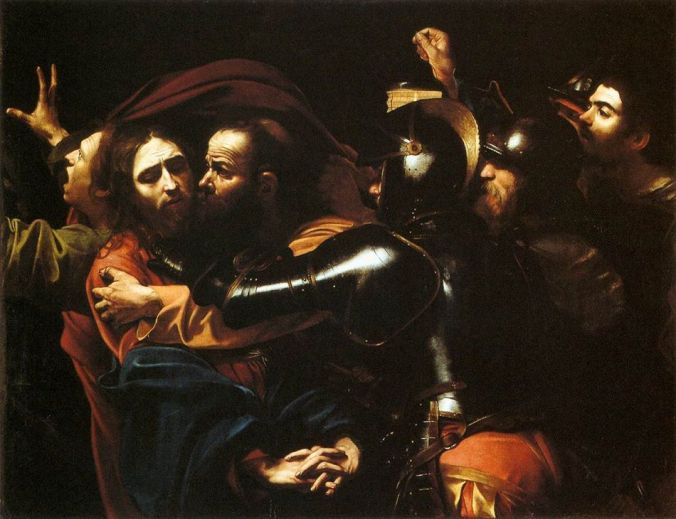
The Taking of Christ (Judas’ Kiss), Caravaggio, 1602

Today’s readings (click below to open in new tab/window):
Psalms 122; 149, 1 Kings 7:51-8:21, Acts 28:17-31, Mark 14:43-52


The Garden of Gethsemane was a place Jesus often met with his disciples. It’s no surprise that Judas, leading a band of Jewish leaders and armed Roman soldiers,  knew to find him there. The kiss Judas placed on Christ’s cheek is the most obvious moment of betrayal in this famous scene, but betrayal was everywhere.

Beforehand the disciples had fallen asleep when Jesus needed company, and afterward Peter would deny knowing him – events that bookended a series of betrayals small and large. In a betrayal of Christ’s mission, as well as his lessons, one of the disciples struck the slave of the high priest with a sword and cut off his ear. All the disciples fled, and one young man in particular left behind the linen cloth that was all he’d been wearing.

None of us wants to think we would abandon or betray Jesus, but these were his closest friends and even they couldn’t follow him all the way to the cross.

We want to defend Christ, but following him means abandoning our weapons. Sometimes those are actual weapons, but sometimes they are weapons of anger, pride, and force we think we are using to attack his opponents without understanding attacking is not serving.

We don’t want to admit we’ve strayed – or even fled – from Christ, but that moment of spiritual nakedness, when our weakness or sin is uncovered and on display, eventually catches up to us. Often it’s revealed by our enemies who use it to expose our hypocrisy, and other times we sabotage ourselves; either way the shame is real.

Defenseless and naked. We can end up there through poor choices and weak excuses.

Or we can volunteer.

When we volunteer, when we follow Christ to the foot of the cross and humbly lay our betrayals there, when we lay down the weapons, armor, intellect, strength, or self-righteousness which we have called discipleship without understanding what that truly means … our new life begins.

We enter life defenseless and naked. It’s a kind of spiritual symmetry that’s how we and the apostles would be reborn in Christ.


Comfort: Christ is our strength and hope. 

Challenge: Be sure what you do in the name of Christ is what Christ would have you do.

Prayer: Merciful Lord, I seek to be born anew each day. Amen. 

Discussion: The apostles had chances to commit and re-commit to Christ. Have you ever felt the need to re-commit to your faith?

Join the discussion! If you enjoyed this post, feel free to join an extended discussion as part of the C+C Facebook group. You’ll be notified of new posts through FB, and have the opportunity to share your thoughts with some lovely people. Or feel free to comment here on WordPress, or even re-blog – the more the merrier!
A Convenient Time

interview-2211354_1920

Today’s readings (click below to open in new tab/window):
Psalms 130; 148, 2 Samuel 19:24-42, Acts 24:24-25:12, Mark 12:35-44


Governor Felix of Caesarea, where Paul stood trial for accusations made by Jewish leadership of Jerusalem, was familiar with and curious about the Way (an early name for Christianity). He invited Paul to speak with him about faith in Christ. Notoriously cruel and lusty, Felix grew afraid when Paul spoke of “righteousness, self-control and the judgment to come.” He dismissed Paul until a more convenient time. Two years later after Paul had failed to offer a bribe and Felix was replaced as governor, Paul remained in prison

Apparently a “convenient” time for faith never presented itself. Felix was neither ready nor willing to embrace the Way, and Paul suffered for it. Procrastination is a trait that not only harms the procrastinator, but can result in unfair, unpleasant consequences for others. Perhaps this is most apparent in a work environment, where one person’s procrastination causes delays, difficulties, and stress further down the line. But what of spiritual procrastination? Who does it harm?

Maybe we can think about it like cleaning a closet – a task most of us put off as long as we can. Findings things becomes increasingly difficult. Eventually the closet may cease to be useful, and becomes storage for things we vaguely recollect but never use again. The longer we put off following (or more fully following) the call of God, the less likely we are to answer it later. We tell ourselves we’ll get around to it after we put other lives in order, but we never quite do. When we’re desperate we might rummage around for that thing we need that we think is in there, but because we haven’t tended it properly, it’s just more frustrating mess. In the meantime, the hungry stay hungry, the lonely stay lonely, and we spiritually flounder.

Consider the widow whose offering of two small coins Jesus called “more […] than all the others.” She didn’t wait until she had enough money saved to make those two coins convenient, yet her gift was an enormous blessing. Let us do what we can right now, for the convenient time may never arrive.


Comfort: Today is exactly the right day to draw nearer to God.

Challenge: Start something you’ve been putting off. Don’t just plan to start; actually do it.

Prayer: God, I surrender myself to you today, and trust you will provide tomorrow. Amen.

Discussion: Felix was waiting for a bribe from Paul. When we effectively tell God “I’ll get around to that after [fill in the blank]…” is that like demanding an unearned favor before doing the right thing?

Join the discussion! If you enjoyed this post, feel free to join an extended discussion as part of the C+C Facebook group. You’ll be notified of new posts through FB, and have the opportunity to share your thoughts with some lovely people. Or feel free to comment here on WordPress, or even re-blog – the more the merrier!

I Will Follow You (Wherever You May Go)

whereweregoing

Today’s readings (click below to open in new tab/window):
Psalms 97; 147:12-20, 2 Samuel 15:1-18, Acts 21:27-36, Mark 10:32-45


Jesus wanted the disciples to be prepared for what was to come. In very plain language he predicted his death three times, yet the disciples did not seem to understand. On the third occasion he said:

See, we are going up to Jerusalem, and the Son of Man will be handed over to the chief priests and the scribes, and they will condemn him to death; then they will hand him over to the Gentiles; they will mock him, and spit upon him, and flog him, and kill him; and after three days he will rise again.

In the very next paragraph, “James and John […] said to him, ‘Teacher, we want you to do for us whatever we ask of you.’” They asked to sit at his right and left hands in paradise.  Jesus had to decline, but it seems gracious that he humored them at all considering what he’d told just them. One paragraph following the next doesn’t mean quite a bit of time couldn’t have elapsed between them, but asking favors after that seems a little … self-involved.

Yet we can all be self-involved. Our calling is to follow Christ and share him with others, but some of the most popular Christian books and preachers focus on the “name it and claim it” gospel which teaches what Jesus can do for us. Church is for worshipping our God, but we often choose one based more on how good it makes us feel than how it challenges us to grow in the radical love and humility Christ requests of his disciples.

We don’t find that “peace which passes all understanding” (Philippians 4:7) by praying for trouble-free lives, but by following Jesus wherever he leads, including enemy territory. And that “perfect love which casts out fear” (1 John 4:18)? It doesn’t sprout in hearts that play it safe; we first must face the fear of loving those we find unlovable.

Following Christ is its own reward. Step by step we are transformed and grow less concerned about what Christ can do for us, and more about how we can serve him.


Comfort: Following Christ transforms us. 

Challenge: Keep a journal about how following Christ changes you.

Prayer: Loving God, I set my face towards Christ. May my discipleship glorify your name. Amen.

Discussion: What’s the difference between a selfish prayer, and a prayer for yourself?

Join the discussion! If you enjoyed this post, feel free to join an extended discussion as part of the C+C Facebook group. You’ll be notified of new posts through FB, and have the opportunity to share your thoughts with some lovely people. Or feel free to comment here on WordPress, or even re-blog – the more the merrier!