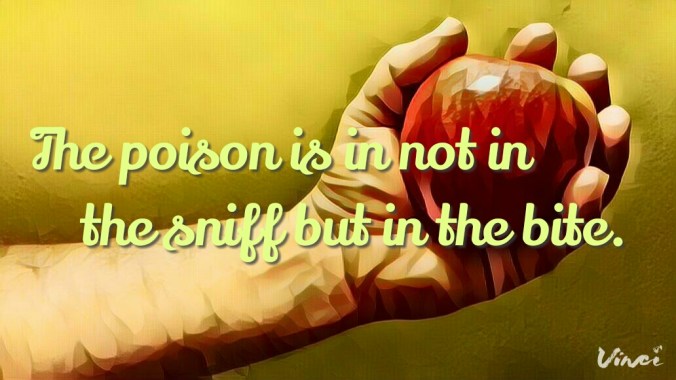
Just one bite …

1474513132673.jpg

Today’s readings (click below to open in new tab/window):
Psalms 65; 147:1-11, Esther 6:1-14, Acts 19:1-10, Luke 4:1-13


Ever long for the day when your faith is so strong, temptation will never taunt you again? Spoiler alert: it will be a long wait. Even Jesus, when he spent forty days in the desert preparing for his ministry, felt the devil’s temptations to abandon his ministry for a life of worship and power.

Temptations can shame us. We think we are the only people tempted to think or act a certain way. Ironically we are especially reluctant to confess to those who could counsel us best, because we want to keep their respect. Instead we battle urges in silence and solitude, and the very thing we try to avoid – food, sex, gossip, drugs, alcohol – becomes the center of our attention because we have nowhere to banish it. Scriptures like Matthew 5:28 (“anyone who looks at a woman lustfully has already committed adultery with her in his heart”) convince us temptation has already condemned us.

When we speak openly to trusted counselors or support groups about our temptations we find that we are not alone. We also find speaking the truth unlocks the mental prison where we are trapped alone and wrestling with guilt. We learn scriptural words like “lust” and “covet” don’t refer to casual thoughts, but to ungoverned desire. We learn to check casual thoughts before they become ungoverned desire. Most importantly, we learn sunlight is the best disinfectant even for spiritual ailments.
When we pray “lead us not into temptation but deliver us from evil” what are we really asking? To avoid all instances of temptation? Unrealistic. We are acknowledging temptation is part of life, and that we depend on God to help us cope. Tempted until the end of his ministry, Jesus prayed in the Garden of Gethsemane that his burden might pass. The important lesson is that he submitted his will to God’s.

Don’t be discouraged – experiencing temptation doesn’t mean we’ve already lost the battle! Resisting temptation in small things helps us build strength in case serious temptations arise. Let’s follow the example of Jesus, and acknowledge our temptation, but choose to submit to God.

Comfort: God is greater than temptation; we just have to invite him in.

Challenge: If you struggle with temptation, find a place to talk about it.

Prayer: God of strength, deliver us from evil. Amen.

Discussion: How do you deal with temptation?

Join the discussion! If you enjoyed this post, feel free to join an extended discussion as part of the C+C Facebook group or follow @comf_and_chall on Twitter. You’ll  have the opportunity to share your thoughts with some lovely people. Or feel free to comment here on WordPress, or even re-blog – the more the merrier!

Know When to Hold ‘Em

1474139974300.jpg

Today’s readings (click below to open in new tab/window):
Psalms 56; 149, Esther 2:5-8, 15-23, Acts 17:16-34, John 12:44-50


A young man asked me for advice about going on his first job interviews. He was going through his “emo” phase – hair grown out over his eyes, t-shirts with four-letter words, black nail polish. I suggested that for some  employers he’d need to adjust his look – hair out of the face, collared shirt, remove the polish. He replied: “If they don’t like me the way I am, it’s their loss.”

“Tell me how that pays,” I said, and explained people are rarely hired to be themselves; employers hire the parts that fill the role for the duration of the shift and want you to leave the rest at home. If they ask you to compromise your values, it’s not the right job for you; if they forbid t-shirts with rude gestures, make the concession. Self-expression is important, but not in all ways at all times.

Esther had a sort of involuntary job interview when she was taken with many women to the king’s palace so he could select a queen. She listened to the king’s eunuch, who “had charge of the women” and asked only what he advised. She also remembered her uncle Mordecai’s advice, and didn’t revealed her kindred or her people” who were Jewish exiles in Persia. The king chose Esther because he believed her beauty and temperament filled the role of queen.

Mordecai overheard a plot to kill the king, and Esther passed this information along, gaining favor for herself and her uncle. As Esther’s story unfolds, she wisely decides when to reveal herself, when to hold back, and how to gain the trust of the king.

Sharing the gospel is not unlike interviewing for a job, or courting a king – it’s not dishonest to exercise discretion. We don’t want to blurt out absolutely everything in a take-me-or-leave-me ultimatum. Trust and relationships take time. Bosses, spouses, and friends are more receptive to challenging ideas when they come from a trusted ally than from a stranger who claims to know better. People are not projects; to bring them to Christ, we must learn to love them first.

(For further thoughts on today’s reading from Acts 17, see The Unknown God.)

Comfort: You don’t have to win converts on the spot; take your time to get to know people, and Christ will shine through.

Challenge: Be deliberate about holding and freeing your tongue.

Prayer: Loving God, teach me when to speak and when to remain silent. Amen.

Discussion: Has your enthusiasm for a project ever backfired?

Join the discussion! If you enjoyed this post, feel free to join an extended discussion as part of the C+C Facebook group or follow @comf_and_chall on Twitter. You’ll  have the opportunity to share your thoughts with some lovely people. Or feel free to comment here on WordPress, or even re-blog – the more the merrier!

Seeing God Everywhere

1474036758376.jpg

Today’s readings (click below to open in new tab/window):
Psalms 130; 148, Esther 1:1-4, 10-19, Acts 17:1-15, John 12:36b-43


The Book of Esther is not just a captivating story, it is an unusual part of the Bible: it never mentions God. This glaring omission made it a controversial addition to both Jewish and Christian canon. A work about Jewish/Persian relations from a clearly Jewish perspective, Esther shows little regard for Jewish law. But because it is included, we can assume those who selected it believed it had something to say about our relationship with God.

Are we prepared to see God in people, things and events which are not explicitly Christian, or religious in any way? We should be. God is present in all the world at all times. If we limit ourselves to people and experiences with a big, bold Christian sticker on them, we’ll spend a lot of time rejecting that presence. Our own Christian faith is not irrelevant or unimportant; indeed, our faith tradition teaches us to see God in context. We trust that God moves in people and in ways we may never fully understand. When someone is blessed with the gift of music, generosity, or poetry, we know that gift comes from God, even when the possessor of the gift doesn’t believe so. If we ignore or denigrate them because they don’t fall comfortably into a Christian marketing plan, we snub gifts God has given the world.

Our relationship with the secular world is complicated. In the Gospel of Luke, Jesus himself offers us messages which may seem to conflict. In verse 9:50 he tells the disciples “whoever is not against you is for you,” while in 11:23 he says “whoever is not with me is against me.” The earlier verse is an instruction to the disciples about others doing good works, while the latter concludes a parable about Jesus’ role in salvation. If we take a long view of the Gospels, don’t we see a Christ whose actions favor acceptance and love of those rejected by self-righteous religious figures? The Pharisees accused Jesus of being too worldly because he didn’t seek reasons to reject people, but to love them. Can we do less?

Comfort: God loves us whether or not we meet others’ expectations.

Challenge: As you are exposed to popular entertainment and culture, look for where God’s presence is realized, and where it is rejected.

Prayer: Compassionate God, I will seek you in everyone and everything. Amen.

Discussion: In what secular art (music, film, paintings, etc) have you seen signs of God?

Join the discussion! If you enjoyed this post, feel free to join an extended discussion as part of the C+C Facebook group. You’ll be notified of new posts through FB, and have the opportunity to share your thoughts with some lovely people. Or feel free to comment here on WordPress, or even re-blog – the more the merrier!