
Growing Gratitude

worshipping-god-2101347_1920

Today’s readings (click below to open in new tab/window):
Psalms 116; 147:12-20, Nehemiah 1:1-11, Revelation 5:11-6:11, Matthew 13:18-23


For you have delivered my soul from death,
my eyes from tears,
my feet from stumbling.

I walk before the LORD
in the land of the living.

I kept my faith, even when I said,
“I am greatly afflicted”;

I said in my consternation,
“Everyone is a liar.”

It’s hard to overestimate the importance of gratitude in improving our attitude. From bestselling books, to inspirational speakers, to social media challenges, we encounter reminders to be grateful all over the place. The United States and other countries have set aside national holidays of thanksgiving dedicated specifically to the idea (if not always the practice) of gratitude.

But there is a subtle yet important difference between thanks and gratitude. Thanks is reaction; we offer it in response to something we’ve been given – things like presents, good health, food, service, and encouragement. Gratitude is a state of mind that exists beyond and between the gifts. We may become more acutely aware of it under certain conditions, but real gratitude comes from within us, not from what others have done for us.

The author of Psalm 116 was both thankful and grateful. His reasons for thanks are abundantly clear: the Lord has kept him from stumbling, dried his tears, and rescued him from death. His gratitude is apparent in different verses. Even during times of difficulty, the psalmist keeps his faith. He doesn’t have to deny his state of affliction or the misdeeds of liars to maintain gratitude, because it doesn’t require us to be thankful for our present circumstances. Gratitude sustains us when we feel like we have nothing at present to be thankful for.

Gratitude is not just a state of heart, but a practice. We can build emotional and spiritual resilience by being intentional about our practice. Daily reflection or journaling on why we are grateful can help us through those rougher patches. Expressing gratitude is an important component of our regular worship. In times of stress, a litany of gratitude can calm us. When life is overwhelmingly busy, focusing on gratitude can help us get our priorities straight.

Gratitude is a gift and a prayer which centers and grounds us. When we have to dig deep for it, we find a wellspring of the holy.

Comfort: Our God has done great things for us.

Challenge: Let us learn to be grateful even when things aren’t great.

Prayer: I will offer to you a thanksgiving sacrifice and call on the name of the LORD. (Psalm 116:17)

Discussion: What are you grateful for today?

Join the discussion! If you enjoyed this post, feel free to join an extended discussion as part of the C+C Facebook group. You’ll be notified of new posts through FB, and have the opportunity to share your thoughts with some lovely people. Or feel free to comment here on WordPress, or even re-blog – the more the merrier!


Cause and Effect

gear-952450_1920

Today’s readings (click below to open in new tab/window):
Psalms 108; 150; Jeremiah 44:15-30; Acts 18:24-19:7; Luke 10:25-37


Baseball is notorious for its superstitions. Players (and fans) will eat specific foods, wear specific clothes (often without washing them), and refrain from haircuts, shaving, or even bathing once they believe a certain behavior has brought them luck. Performance may improve when someone feels confident or empowered, but the activities themselves have nothing to do with winning or losing (cue disapproving comments from dedicated baseball fans). Human beings are wired to draw conclusions from perceived patterns, but when these patterns are coincidental or casual we are noticing a correlation, not a cause.

The Jewish people who sought refuge in Egypt dedicated themselves to idolatry because of a correlation. When the prophet Jeremiah warned them to stop making sacrifices to the goddess Asherah, also known as the queen of heaven, they outright refused, saying:

We used to have plenty of food, and prospered, and saw no misfortune. But from the time we stopped making offerings to the queen of heaven and pouring out libations to her, we have lacked everything and have perished by the sword and by famine.

Jeremiah had a different take. He claimed the desolation and disaster which befell them happened because the Lord was no longer willing to tolerate their abominable behavior. We can also be a little too ready to draw conclusions, with a solid amount of certainty, which turn out to undermine our faith.

One example is the sense among many Christians (and frankly many non-believers as well) that poverty is a result of moral failing. Another closely related example is that good health is a result of strong faith. These types of assumptions contain at least two dangers. The first is that they teach us to think of people who suffer from misfortune as lacking faith and therefore undeserving of mercy. The second is that they leave us unprepared for our own times of trial; many people experience a crisis or loss of faith when the good luck they attributed to faith finally runs out.

Because thinking critically is difficult and time-consuming, we are prone to substituting correlation – superstition – for faith, even doubling down after a superstition has been pointed out to us. Yet under duress, one is easily unraveled and disproved while the other is not. Faith can stand up to scrutiny, so let’s be brave enough to challenge the idol of our own thinking.

Additional Reading: For thoughts on today’s passage from Luke, see Good Samaritan and One of the good ones…

Comfort: Faith withstands both criticism and superstition.

Challenge: Think critically about what you believe.

Prayer: Bless our God, O peoples, let the sound of his praise be heard, who has kept us among the living, and has not let our feet slip. (Psalm 66:8-9)

Discussion: Do you have any superstitions?

Join the discussion! If you enjoyed this post, feel free to join an extended discussion as part of the C+C Facebook group. You’ll be notified of new posts through FB, and have the opportunity to share your thoughts with some lovely people. Or feel free to comment here on WordPress, or even re-blog – the more the merrier!

Roots and Fruits

forest-1598108_1920

Today’s readings (click below to open in new tab/window):
Psalms 84; 148, 2 Kings 19:1-20, 1 Corinthians 9:16-27, Matthew 8:1-17


The surviving remnant of the house of Judah shall
again take root downward,and bear fruit upward.
– 2 Kings 19:3

How deep are your spiritual roots? Deep enough to keep you healthy during times of spiritual drought? Whether your answer is “Yes”, “No” or “Good question…” you can always deepen them. One good way is to set aside time for regular spiritual practices. As with anything, the time you dedicate to spiritual practice will improve the results. A neglected garden is soon choked out by weeds and devoured by pests, and a neglected spiritual life is soon choked out and devoured by the demands and distractions of daily life. When we attempt to pluck fruit from either of them, we will very likely be disappointed.

But what does spiritual practice look like? And what if you don’t like gardening? Approaches to spiritual practices can range from the Biblical classics of prayer, meditation, and fasting to hiking, music, journaling and – yes – even gardening. A spiritual practice is anything that puts in your touch with your connection to the holy. Regular, intentional practices help our spiritual roots grow deeper and prepare us to better weather hard times and celebrate joyous ones. Find a practice that speaks to you, rather than trying to conform to one someone else prescribes, and it will be easier to maintain.

How high are your spiritual fruits? Probably about as high as your roots are deep. If you aren’t sure what gifts you have to share, spend some time discovering what feeds your roots. Chances are your gifts are closely related. And don’t waste time comparing them to other people’s gifts: it would be pretty foolish of a Granny Smith to spend time regretting it wasn’t a watermelon. Different plants thrive under different soil conditions and varying amounts of water and sunlight. People’s spirits are no less diverse. Your unique gifts are part of a well-balanced spiritual diet for the world. Feed your roots well, and you won’t be able to help producing fruits for all to share!

Comfort: Your gifts are meant to be shared…

Challenge: … so tend them with love and gratitude toward the one who gave them.

Prayer:  Thank you Lord for the many gifts you have given me. I will use them to honor your name. Amen.

Discussion: How do you tend to your spiritual roots?

Join the discussion! If you enjoyed this post, feel free to join an extended discussion as part of the C+C Facebook group. You’ll be notified of new posts through FB, and have the opportunity to share your thoughts with some lovely people. Or feel free to comment here on WordPress, or even re-blog – the more the merrier!

Enough for today

lilies

Today’s readings (click below to open in new tab/window):
Psalms 62; 145, 2 Kings 17:24-41, 1 Corinthians 7:25-31, Matthew 6:25-34


Has anyone ever stopped worrying because someone said, “Stop worrying?”

When Jesus told his disciples not to worry about having enough food (God takes care of the birds!) or clothing (God dresses the grass itself in lilies!), or about life in general (can you add an hour to your life that way?) he knew this.  He had a bigger point to make.

No matter how well off we might be, we are still prone to worry. The impulse to get food on our table and have a roof to keep that table under, as well as the fear we could lose it all, drives our behavior in instinctual, inescapable ways. On some level we doubt that faith alone will provide for all our material needs; the history of humankind does more to confirm than to dispel that doubt.

But that’s not all Jesus was saying.

After the birds and the lilies, he says, “strive first for the kingdom of God and his righteousness, and all these things will be given to you as well.” We can read this at least a couple ways. The first is the simpler: have faith and live righteously, and God will provide. The second is broader. In telling us to strive for the kingdom, it asks us to be the instruments of justice as described by citizenship in the kingdom. In the service of kingdom justice, we feed the hungry, tend to the sick, clothe the naked, and welcome the stranger. By being the last and by tending to the troubles of today – not just our troubles, but the troubles of our neighbor – we expand the kingdom in a way that begins to soothe that primal, hungry fear.

The end of worry is a long term endeavor. We still work toward it. Yes we are assured we can let go of individual worry for this particular day, but that process is inseparable from how we participate in the life of our greater community. When we sacrifice our lives to a kingdom free from worry, we will be freed in turn. We will not stop worrying because we are told to, but because we are told how.

Comfort: There is relief from worry.

Challenge: When you worry, ask yourself what you should be doing instead.

Prayer: Whom have I in heaven but you? And there is nothing on earth that I desire other than you. (Psalm 73:25)

Discussion: What is the difference between worrying and preparing?

Join the discussion! If you enjoyed this post, feel free to join an extended discussion as part of the C+C Facebook group. You’ll be notified of new posts through FB, and have the opportunity to share your thoughts with some lovely people. Or feel free to comment here on WordPress, or even re-blog – the more the merrier!
Fools for Wisdom

you-shall-love-the-lord-your-god-2-1175525-1599x1063

Today’s readings (click below to open in new tab/window):
Psalms 130; 148, 2 Kings 1:2-17, 1 Corinthians 3:16-23, Matthew 5:11-16


What does it mean to be wise? Unlike certain types of intelligence, wisdom is not something we can rate on a scale. Neither is it the same as knowledge, which we can acquire by the ton without finding an ounce of wisdom. The cliché that wisdom comes with experience certainly holds some truth, yet many people manage to experience decades without growing much wiser at all and some young people are what we call wise beyond their years. Though most of us would like to be wise, few of us would honestly describe ourselves as such.

In his first letter to the Corinthians, Paul calls the thoughts of the wise futile. He advises them: “Do not deceive yourselves. If you think that you are wise in this age, you should become fools so that you may become wise.” What could this contradictory message mean?

Worldly wisdom points toward wealth, power, security, and a legalistic kind of justice. God’s wisdom, expressed through the teachings of Christ, points toward humility, mercy, risk, and a kind of justice that is about serving those most in need. The worldly view is often more appealing, and the temptation to twist scripture to rationalize our own desires and prejudices is a strong one. When we interact with the world, particularly if we are called to lead in some way, we should humbly seek God’s will above our own. Our confidence is to be primarily in God, not in our own thoughts and desires. True wisdom tries less to impose itself and more to invite others along.

Acting out of God’s wisdom may make us look foolish to the world, but it also empowers us. When Jeremiah insisted he was too young to be a prophet, God told him: “Do not say, ‘I am only a boy’; for you shall go to all to whom I send you, and you shall speak whatever I command you.” (Jer 1:7). Is there a sense of freedom in knowing we are not under pressure to be wise, but instead to be listening for and guided by God’s wisdom? After we listen we must still act with integrity, discernment, and accountability – as only a fool can do.

Comfort: Trust in the Lord with all your heart and lean not on your own understanding; in all your ways submit to him, and he will make your paths straight (Proverbs 3:5-6).

Challenge: Once in a while consider the possibility that you might be wrong about something you are sure about, and pray on that.

Prayer: Search me, O God, and know my heart; test me and know my thoughts. See if there is any wicked way in me, and lead me in the way everlasting.
(Psalm 129:23-24)

Discussion: Who do you consider wise?

Join the discussion! If you enjoyed this post, feel free to join an extended discussion as part of the C+C Facebook group. You’ll be notified of new posts through FB, and have the opportunity to share your thoughts with some lovely people. Or feel free to comment here on WordPress, or even re-blog – the more the merrier!

… and the creeks don’t rise.

holding-hands-1308211-1599x1066

Today’s readings (click below to open in new tab/window):
Psalms 84; 148, 1 Kings 11:26-43, James 4:13-5:6, Mark 15:22-32


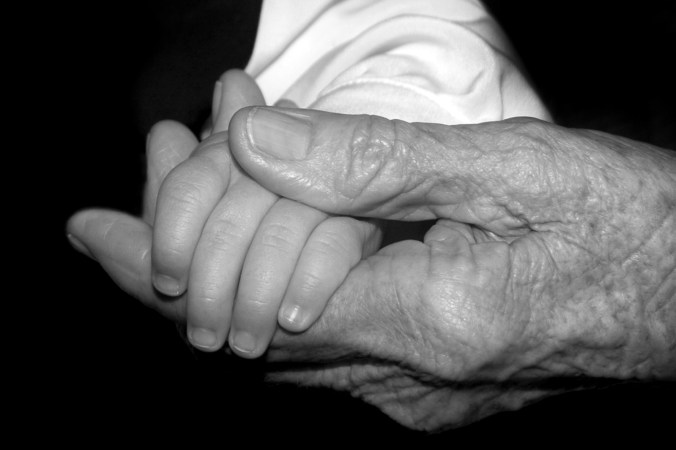
My paternal grandmother had a habit of concluding any talk about future plans with a “God willing.” As a kid I thought it seemed unnecessarily pessimistic and cast any life events more than a couple weeks out under the shadowy gloom of imminent death. At times it seemed almost superstitious, like tossing spilled salt over your shoulder – except it was a spill of hopes and dreams that needed protecting. Had I paid more attention to the Epistle of James, I might have felt differently:

Come now, you who say, “Today or tomorrow we will go to such and such a town and spend a year there, doing business and making money.” Yet you do not even know what tomorrow will bring. What is your life? For you are a mist that appears for a little while and then vanishes. Instead you ought to say, “If the Lord wishes, we will live and do this or that.”

Grandma didn’t have an easy childhood, and knew hardship well into adulthood. She had more than her share of disappointments and regrets, of dreams and hopes which evaporated like mist, many of which I didn’t appreciate or learn about until I was an adult. Using “God willing” like ending punctuation was more than a superstition; it was a reflection of her life experience. The negativity I associated with it? That was on me.

Today I understand “God willing” as a humble admission of our own limitations. A prayer even. Not a reflexive, superstitious prayer like knocking wood to stave off bad luck, or crossing yourself to ward off the malocchio. More a moment of deference to a God we love and trust whether or not our plans materialize – because our plans are frail things to stand on and our God is powerful and loving enough to catch us when they shred beneath our feet. A brief prayer approaching perfect contemplation when we are grateful and content with what we have in the present moment and expect nothing further.

As the future unfolds into the present, let us pray such prayers. God willing, of course.


Comfort: Whether or not your plans work out, God is with you. 

Challenge: Talk with a parent, grandparent, or other older relative about something they do which doesn’t make sense to you. Do this in a spirit of trying to understand.

Prayer: Thy will be done. Amen. 

Discussion: Are there any things about your family that make more sense to you now than they did when you were younger?

Join the discussion! If you enjoyed this post, feel free to join an extended discussion as part of the C+C Facebook group. You’ll be notified of new posts through FB, and have the opportunity to share your thoughts with some lovely people. Or feel free to comment here on WordPress, or even re-blog – the more the merrier!

Getting Warmer

1504645594735

Today’s readings (click below to open in new tab/window):
Psalms 12; 146, 1 Kings 8:65-9:9, James 2:14-26, Mark 14:66-72


Today’s reading from Mark finds Peter warming himself by a fire in the courtyard of the high priest’s palace, where inside Jesus is standing trial and facing a battery of false witnesses. The witnesses outside aren’t much more truthful. When a servant woman confronts Peter as a companion of Jesus, he denies it and retreats to the forecourt, where it is less warm but he can still feel like he hasn’t abandoned Jesus. After the cock crows she points him out to the gathered guards and other bystanders, but still he denies knowing Jesus. When the bystanders themselves begin accusing him, he curses and swears he doesn’t know Jesus.

After the cock crowed a second time and he remembered how Jesus had predicted these denials, could Peter feel warm no matter how close he got to the fire?

It can be easy to convince ourselves we’re standing by Jesus when we’ve really chosen the coziness of the courtyard over the real heat in the courtroom.  How close do we let ourselves get before our rationalizations begin? Do we want “Christian” values enacted as law … until they affect our wallets? Do we turn the other cheek … until our physical safety is threatened? Do we love our neighbors … until they put up a campaign sign for the other candidate?

We all fall short of living Christ’s love perfectly. When we do, it’s important that instead of making excuses about laws and practical repercussions, we are honest with ourselves and others about our failures, limitations, and fears. Christ knows and forgives them, but we can’t be forgiven for something we won’t confess.

In his epistle, James talks about works as evidence of faith. He’s not saying we’re saved by works – he’s saying if our heart isn’t changed enough to move us to action, it isn’t changed enough. When Jesus talked about loving people, he wasn’t promoting warm feelings, but charitable actions. We can say we love our enemies, but if we don’t do good to them, it’s not the kind of love Jesus addresses. Merely doing no harm falls short of the glory. By extension, if we say we love Jesus but that love ends with words – in the warm courtyard of personal salvation safely removed from the danger of the courtroom  – and risks not even our comfort, do we love enough?

When we hear the crow that forces us to face our shortcomings, it’s not too late to do better. Peter remained the rock of the newly forming church. His courage backslid once or twice but, as the memory of that courtyard surely never left him, he ultimately did right – even when it cost him.

Christ promises us a failure is not an end. When confessed and confronted, it is an opportunity to grow ever closer to him.


Comfort: You haven’t done anything God hasn’t already forgiven someone else for. 

Challenge: Look for reasons to love extravagantly, rather than excuses to stay comfortable.

Prayer: Loving God, may my actions reflect the state of my heart, and may the state of my heart reflect Christ. Amen. 

Discussion: Where do you struggle to act on your faith because doing so is uncomfortable or impractical?

Join the discussion! If you enjoyed this post, feel free to join an extended discussion as part of the C+C Facebook group. You’ll be notified of new posts through FB, and have the opportunity to share your thoughts with some lovely people. Or feel free to comment here on WordPress, or even re-blog – the more the merrier!

Just five more minutes, Jesus…

20170901_232523

Today’s readings (click below to open in new tab/window):
Psalms 88; 148, 1 Kings 5:1-6:1, 6:7, Acts 28:1-16, Mark 14:27-42


Are you a fan of the snooze button? Do you crave those precious extra minutes under the covers after the alarm goes off? Or maybe you are the snooze alarm when your children or spouse make it your responsibility to get them moving by asking for “just five more minutes.” Perhaps you belong to that increasingly rare breed who wake up refreshed and – miracle of miracles – don’t need an alarm.

Whatever your situation, research shows that using the snooze alarm leaves you feeling less rested. Once you’ve been jolted awake, the sleep cycle doesn’t continue, it reboots.

At the Garden of Gethsemane, Peter, James, and John did some notorious snoozing. As Jesus remained resigned to God’s will but prayed desperately that the cup of the crucifixion might pass him by, his friends couldn’t manage to stay awake. Three times he woke them, and they didn’t know what to say to him.

Only hours earlier he had predicted that in the hour of his death they would desert him, and Peter declared “Not me!” Yet even in this matter of sleep the disciple’s weak flesh overrode his willing spirit, a foreshadowing of the greater desertion to come. Jesus, fatigued and frightened, had to rouse them to accompany him in his last moments of freedom.

The trick to avoiding the snooze button is to develop healthy sleep patterns. If you don’t have them, you have to work at retraining your body and mind – or flesh and spirit, if you will. Developing healthy spiritual patterns can be similar. If we don’t have them, when life’s alarms go off – alarms like death, illness, betrayal, and tragedy – leaning  on faith may seem more an effort than a comfort.

Despite Christ’s warnings, Peter wasn’t ready in the garden. He wasn’t ready at the crucifixion. But after Christ returned from death? Reboot. His flesh and spirit finally knew true rest in the embrace of Christ. We too can find that strength-building rest if our faith is not merely a series of reactions to alarms, but a healthy, regular pattern of renewal that helps us stay spiritually awake.


Comfort: You can find rest in Christ. 

Challenge: Read this article on improving your sleep, and see if you can make any changes that might help.

Prayer: Merciful God, let me rest in your arms and find strength for my days. Amen. 

Discussion: Do you get all the sleep you need? Why or why not?

Join the discussion! If you enjoyed this post, feel free to join an extended discussion as part of the C+C Facebook group. You’ll be notified of new posts through FB, and have the opportunity to share your thoughts with some lovely people. Or feel free to comment here on WordPress, or even re-blog – the more the merrier!

A Convenient Time

interview-2211354_1920

Today’s readings (click below to open in new tab/window):
Psalms 130; 148, 2 Samuel 19:24-42, Acts 24:24-25:12, Mark 12:35-44


Governor Felix of Caesarea, where Paul stood trial for accusations made by Jewish leadership of Jerusalem, was familiar with and curious about the Way (an early name for Christianity). He invited Paul to speak with him about faith in Christ. Notoriously cruel and lusty, Felix grew afraid when Paul spoke of “righteousness, self-control and the judgment to come.” He dismissed Paul until a more convenient time. Two years later after Paul had failed to offer a bribe and Felix was replaced as governor, Paul remained in prison

Apparently a “convenient” time for faith never presented itself. Felix was neither ready nor willing to embrace the Way, and Paul suffered for it. Procrastination is a trait that not only harms the procrastinator, but can result in unfair, unpleasant consequences for others. Perhaps this is most apparent in a work environment, where one person’s procrastination causes delays, difficulties, and stress further down the line. But what of spiritual procrastination? Who does it harm?

Maybe we can think about it like cleaning a closet – a task most of us put off as long as we can. Findings things becomes increasingly difficult. Eventually the closet may cease to be useful, and becomes storage for things we vaguely recollect but never use again. The longer we put off following (or more fully following) the call of God, the less likely we are to answer it later. We tell ourselves we’ll get around to it after we put other lives in order, but we never quite do. When we’re desperate we might rummage around for that thing we need that we think is in there, but because we haven’t tended it properly, it’s just more frustrating mess. In the meantime, the hungry stay hungry, the lonely stay lonely, and we spiritually flounder.

Consider the widow whose offering of two small coins Jesus called “more […] than all the others.” She didn’t wait until she had enough money saved to make those two coins convenient, yet her gift was an enormous blessing. Let us do what we can right now, for the convenient time may never arrive.


Comfort: Today is exactly the right day to draw nearer to God.

Challenge: Start something you’ve been putting off. Don’t just plan to start; actually do it.

Prayer: God, I surrender myself to you today, and trust you will provide tomorrow. Amen.

Discussion: Felix was waiting for a bribe from Paul. When we effectively tell God “I’ll get around to that after [fill in the blank]…” is that like demanding an unearned favor before doing the right thing?

Join the discussion! If you enjoyed this post, feel free to join an extended discussion as part of the C+C Facebook group. You’ll be notified of new posts through FB, and have the opportunity to share your thoughts with some lovely people. Or feel free to comment here on WordPress, or even re-blog – the more the merrier!

Cornered

corner-1031569_1920

Today’s readings (click below to open in new tab/window):
Psalms 123; 146, 2 Samuel 18:9-18, Acts 23:12-24, Mark 11:27-12:12


Have you ever heard the phrase “paint yourself into a corner?” It means to unwittingly trap yourself in a no-win situation, like a person who, while painting a floor, ends in a corner where they can neither finish the job nor exit the room without making a mess.

The forty or so Jewish men of Jerusalem who were committed to killing Paul painted themselves into a kind of reputational corner. They publicly took an oath not to eat or drink until they’d killed him. Unfortunately for them (though fortunately for Paul), Paul’s nephew overheard their plot and arranged to have Paul removed to Caesarea before they could act. Scripture doesn’t tell us what the forty-plus men did next, but oaths were serious business so they couldn’t break one lightly. Given the undesirable and unlikely outcome of letting themselves die of hunger and thirst, we might wonder how long it took each of them to break down and take that first bite after realizing they faced the choice of dying or becoming an oath-breaker.

Remember Galileo? The Church convicted him of heresy for promoting the idea that the earth revolved around the sun. They clung to a vision of the cosmos with the earth at the physical center, despite clear evidence to the contrary. The paint on the church floor dried for centuries before they managed to escape the corner of pride and willful ignorance.

When a cherished or comforting belief conflicts with undeniable reality, clinging to that belief doesn’t demonstrate strong faith; it illuminates a fear that God does not dwell in the truth. A round earth and a heliocentric orbit may have once felt like threats to the Christian worldview, but scientists of the church like LeMaitre and Mendel, who advanced the fields of physics and genetics, understood the discovery of new truths – even if they conflict with our current beliefs – leads us to greater understanding of God.

Let us never be so closed-minded that our thoughts and words conspire to trap us into a corner where our instinct to be defensive overrides our willingness to expand our understanding.


Comfort: Wherever the truth leads you, God is there. 

Challenge: Read this article about scientists who were also Christians.

Prayer: Gladden the soul of your servant, for to you, O Lord, I lift up my soul. (Psalm 86:4)

Discussion: Have you ever been afraid of the truth?

Join the discussion! If you enjoyed this post, feel free to join an extended discussion as part of the C+C Facebook group. You’ll be notified of new posts through FB, and have the opportunity to share your thoughts with some lovely people. Or feel free to comment here on WordPress, or even re-blog – the more the merrier!