
Barnacle-Free Faith

barnacles and crustations

Today’s readings (click below to open in new tab/window):
Psalms 104; 149, Genesis 29:1-20, Romans 14:1-23, John 8:47-59


One characteristic of an effective movement, whether religious or secular, is an ability to stay focused. Unfortunately, the older and larger a movement grows, the more likely it is to lose focus. We need look only as far as the church to see a primary example. Early Christians were focused around the idea that Jesus was the savior, and through him all sin was forgiven. They had de facto leaders but no real bureaucracy, and were more focused on freedom than restriction.

Is that what the church looks like today? Can we imagine Peter poring over investment policy revisions, or Paul reading the latest theories on why you should have one third more seats than you do members? These activities aren’t wrong in and of themselves, but if we’re not careful we may start thinking and behaving as if the point of church is to perpetuate church, rather than to serve God.

One of Paul’s purposes in writing to the Roman (and other) churches was to encourage them to stick to the basics of the faith. Like present-day churches, the simple ideas and practices that bound them as a community began to accumulate individual and cultural restrictions. Like barnacles on a ship – sometimes known as fouling organisms – these additions adversely impacted the performance and structure of the church. Paul told the Romans they needed to scrape off “fouling” ideas.

Today’s church can be just as prone to fouling ideas. Most of the time we can recognize them because they separate us from each other or the world around us. Any time we decide someone who professes dedication to Christ is not a “real” Christian because their denomination, practices, or identity don’t fit our mold, we are probably victims of fouled faith. Rifts have developed over everything from whether coffee is allowed in the sanctuary to politically correct language in hymns to the proper order of a liturgy. As Christians, we are called to find ways to rise above such trivialities and unite rather than divide.

Paul adds a wrinkle though: we can’t just write off people with sincerely held belief in more rules than we believe as silly or misguided. In Paul’s example, the “strong” who believed no food was unclean didn’t need to make a show of eating certain foods to the “weak” who clung to prior practices. Relationship with Christ and God is central to faith and community, so causing someone to feel they were undermining that relationship was not “walking in love;” if someone believed something was unclean, it was indeed unclean to them. Your stumbling blocks and someone else’s may differ.

Of course, if it’s our belief-barnacle we will struggle to recognize it as such, and the older and bigger it is, the more difficult it will be to scrape off. Then there’s the danger that in our zeal to tear off the non-essentials we carelessly go too far and scrape away part of the hull; we don’t want to damage or discard what is necessary and true. And there’s the balance of community: learning to respect each other’s sincerely held beliefs and practices without imposing them on each other – and over time stripping away all that is not part of Christ.

Faith is not always simple, but let’s resist the temptation to complicate it unnecessarily. If we focus on winning souls instead of winning arguments, the barnacles on our faith fall away much more easily.

Comfort: Christ is the lens that focuses our faith.

Challenge: What barnacles have you accumulated? Scrape them off.

Prayer: God of Abundance, I will keep my eye on Christ. Amen

Discussion: If you’re not a sailor, barnacles may not mean much to you. What are some other metaphors for religious or spiritual “clutter?”

Join the discussion! If you enjoyed this post, feel free to join an extended discussion as part of the C+C Facebook group. You’ll be notified of new posts through FB, and have the opportunity to share your thoughts with some lovely people. Or feel free to comment here on WordPress, or even re-blog – the more the merrier!

God Will Provide the Lamb

1454470349739

Today’s readings (click below to open in new tab/window):
Psalms 96; 147:1-11, Genesis 22:1-18, Hebrews 11:23-31, John 6:52-59


Abraham was one hundred and Sarah was ninety when Isaac, the son God promised them, was born. How must Abraham have felt when God asked him to offer his son as a sacrifice? Abraham neither objected to this request nor delayed in responding; he set out with Isaac the next morning for Moriah. This is the Abraham who laughed when God told him Sarah would conceive a child. The Abraham who took down kings to free his people. The Abraham who challenged God not once, not twice , but six times to spare the citizens of Sodom. Yet when asked to make a burnt offering of his son, he complied without argument. Why?

On the way, Isaac asked his father where the sacrificial lamb was. Abraham replied: “God himself will provide the lamb.” We might read this as an attempt to deceive Isaac, but we must remember this is the Abraham who spent many years arguing with God about what was possible, only to be proven wrong time after time. Obedient as he had become, could this Abraham have believed for a moment God would renege on the promise Isaac represented? Tradition tells us Abraham passed God’s test because he was willing to kill his son. Is it possible he passed the test because he trusted his God not to take his child? That he finally trusted God enough not to argue, but to risk being wrong? If so, “God himself will provide the lamb” sounds less like a comforting lie and more like a prayer of self-reassurance. In the end, God spared Isaac and did indeed provide a ram. Abraham’s descendants formed a great nation.

How often have we hesitated to commit ourselves totally to God because we fear what we may be asked to sacrifice? God is not a despot demanding sacrifices out of cruelty or insecurity, but until we trust him enough to risk the annihilation of submission we keep part of ourselves from him. Whatever our faith strips away from us needs to go. Whatever our faith has in store for us is greater than we can imagine.

Comfort: God is faithful, always.

Challenge: Read through today’s passage from Genesis a couple times. The first time imagine yourself in Abraham’s place. The second time, imagine you are Isaac hearing the story for the first time.

Prayer: Pray the Prayer of Dedication below, thinking about what it might cost you.

Lord Jesus, I give you my hands to do your work. I give you my feet to go your way. I give you my tongue to speak your words. I give you my mind that you may think in me. I give you my spirit that you may pray in me. Above all, I give you my heart that you may love in me your Father and all mankind. I give you my whole self that you may grow in me, so that it is you, Lord Jesus, who live and work and pray in me.

Discussion: What have you given up – voluntarily or involuntarily – only to discover something better was waiting?

Join the discussion! If you enjoyed this post, feel free to join an extended discussion as part of the C+C Facebook group. You’ll be notified of new posts through FB, and have the opportunity to share your thoughts with some lovely people. Or feel free to comment here on WordPress, or even re-blog – the more the merrier!

Hagar and the Horrible

1454382625545

Today’s readings (click below to open in new tab/window):
Psalms 12; 146, Genesis 21:1-21, Hebrews 11:13-22, John 6:41-51


Ever see those Christian t-shirts, bookmarks, or mugs declaring: “God won’t give you more than you can handle?” It’s a comforting thought — if we don’t think about it too long. However, if we are struggling with chronic pain, the loss of a child, or any number of devastating life events, this sentiment not only rings false, but raises a terrible theological question: “How could God give this to me?”

Abraham and Sarah had a servant named Hagar. God had promised them a child, but in their impatience they forced Hagar to conceive. After Sarah gave birth to Isaac she was jealous of Hagar’s son Ishmael, and told Abraham to banish them both. He sent them packing with some bread and a water skin. After much wandering, a thirsty and desperate Hagar placed Ishmael under the meager comfort of shady bush and waited for him to die.

God didn’t single out Hagar for suffering: Sarah and Abraham did. Abuse and oppression are never part of “God’s plan” for us. Neither are disease nor loss. God may use trials to strengthen us, but God does not heap hardship upon us just to test our endurance or faithfulness. Hardship finds us nevertheless.

Before her son could die, God led Hagar to a well. She and her son survived, and surely they were both influenced for the better or worse — or both — by this trauma. Eventually, as God promised, Ishmael’s descendants formed a mighty nation, alongside the descendants of Isaac. Of course Ishmael’s success did not justify the sufferings of Hagar, but it also meant she did not suffer in vain. What lesson might we learn from this story? Perhaps that no situation is so bleak God can’t help us through it somehow. A God who meets us at our breaking point is very different than a God who pushes us there.

Suffering can force us into a spiritual wilderness where we must rely on God to find our way. When we are in such a state of surrender, God’s mercies can redefine our suffering to have dignity and purpose. God will always offer you more grace than you can handle.

Comfort: Your suffering is not meaningless because God suffers with you.

Challenge: Be cautious about attributing God’s will to humanity’s weakness.

Prayer: Merciful and Loving God, I will trust in you and your grace at all times. Amen.

Discussion: What situations in your life are causing you pain, and how might God help you find a higher purpose for them?

Join the discussion! If you enjoyed this post, feel free to join an extended discussion as part of the C+C Facebook group. You’ll be notified of new posts through FB, and have the opportunity to share your thoughts with some lovely people. Or feel free to comment here on WordPress, or even re-blog – the more the merrier!

Looking for Loaves in All the Wrong Places

nutritional content

Today’s readings (click below to open in a new tab/window):
Psalms 122; 149, Genesis 18:1-16, Hebrews 10:26-39, John 6:16-27


Carbs are the enemy of faith.

After miraculously feeding five thousand people with only five barley loaves and two fish, Jesus and his disciples waited until evening and moved across the Sea of Galilee from Tiberias to Capernaum. By morning the crowds had found them. Jesus declared to them: “Very truly, I tell you, you are looking for me, not because you saw signs, but because you ate your fill of the loaves. Do not work for the food that perishes, but for the food that endures for eternal life, which the Son of Man will give you.” The people craved the bread, yet didn’t understand the root of their hunger.

If we have poor eating habits, we often aren’t able to distinguish between cravings and hunger. We know we want something and turn to sugary, fatty foods for a quick fix. They are tasty and relieve our immediate needs, but only for a short time. The more we try to satisfy our hunger with carbs and fat, the more we crave, and in the long run we feel worse. Dieting often fails because instead of making a true lifestyle change as nutritionists advise, we turn to short-term solutions which focus on weight instead of health. When our goals are met, we drop our vigilance and unhealthy habits creep back in. It’s not entirely unlike a cycle where we berate ourselves for our sinfulness and try to overcome it through own strength rather than Christ’s, only to find ourselves in the same place when we can’t resist the cravings.

What’s the nutritional content of our faith? The prosperity gospel teaches us if we say the right prayers or tithe the right amount, we will be rewarded with material goods. Some churches are all about the entertainment value of a worship service because they value high attendance over deep experience. Designed for high volume and low quality, these are more business model than ministry – fifty million served, but not called to serve. Christ calls us to a lifestyle change. He doesn’t tell us what we want to hear or what makes us feel good; he tells us about the food of eternal life. Jesus’s lean meats and broccoli may not sound as much fun as hot fudge Sundays, but he’s saving our lives.

Comfort: The more faithfully we follow Christ, the less we crave the things that don’t feed our spirits.

Challenge: Clean your spiritual cupboard; meditate on discarding teachings that prey on your cravings and filling yourself with those that satisfy eternally.

Prayer: Lord, I will rely on your strength rather than my own. Amen.

Discussion: What do you crave that you know isn’t good for you?

Join the discussion! If you enjoyed this post, feel free to join an extended discussion as part of the C+C Facebook group. You’ll be notified of new posts through FB, and have the opportunity to share your thoughts with some lovely people. Or feel free to comment here on WordPress, or even re-blog – the more the merrier!
 

Attitude of Abundance

GRASPFUTURE

Today’s readings (click below to open in a new tab/window):
Psalms 88; 148, Genesis 17:15-27, Hebrews 10:11-25, John 6:1-15


Our culture promotes irony and cynicism. These can be useful and enlightening, but many times they simply mask an underlying state of fear. When push comes to shove, we tend to hoard the resources we have rather than trust them to God’s abundance. Even in faith communities simple optimism is often characterized as simple-mindedness.

God told Abraham and Sarah, at 100 and 90 years old respectively, they would conceive a child. Abraham laughed in disbelief. When their son was born, they did as God had instructed and named him Isaac, meaning “he laughs.” With God in the mix, irony became hope.

When thousands gathered at the Sea of Galilee to hear Jesus preach, he asked his disciple Philip where they could buy bread to feed everyone. We don’t know if Phillip laughed, but it’s easy to imagine a dismissive chuckle when he told Jesus they would need more than six months’ wages to buy enough food. And it seems likely there might have been some eye rolling when Andrew mentioned a boy with five loaves of bread and two fish. Yet from this tiny bit, upon Christ’s instructions, they managed to feed everyone with twelve baskets left over.

At first glance the common theme between these stories seem to be that God is most visibly present in the impossible. Unfortunately this idea pushes God outside our normal expectations into a realm where we can only experience his blessings through reality-warping events.

An important lesson in these stories is that God has created us not be starved by fear and doubt, but to feast on possibilities and faith. The approach we take affects the quality of our lives, and the lives of others. More than a simple “can-do” attitude, faith that God’s world is abundant opens us up to true generosity. If we stop worrying that what we have is not enough, we grow comfortable with being generous even in uncertain times. Individuals with this faith can have a positive impact, and communities that cultivate this attitude will find endless doors opening. Behind them is revealed God’s presence in our everyday lives.

The world teaches fear. An abundant faith – focusing not on scarcity and stinginess, but on hope and generosity – is countercultural and revolutionary. Live on the edge.

Comfort: You need less than you think you do. You can give more than you think you have.

Challenge: Embrace hope.

Prayer: Loving God, please help me to remember there is far more to your gifts in the world – seen and unseen – than I could ever comprehend. I will trust you. Amen.

Discussion: In what areas of your life – money, time, affection, etc. – do you take an approach of scarcity? How can you become more generous?

Join the discussion! If you enjoyed this post, feel free to join an extended discussion as part of the C+C Facebook group. You’ll be notified of new posts through FB, and have the opportunity to share your thoughts with some lovely people. Or feel free to comment here on WordPress, or even re-blog – the more the merrier!


Test Everything

test-all-things

Today’s readings (click below to open in a new window/tab):
Psalms 65; 147:1-11, Genesis 16:1-14, Hebrews 9:15-28, John 5:19-29


Some days the biggest stumbling block to faith is scripture itself. Amid its inspiration, today’s passage from Genesis contains some truly horrifying ideas. God promised Abram he would father a nation, but he and his wife Sarai did not immediately conceive a child. An impatient Sarai suggested Abram impregnate her servant Hagar. Under the law, Sarai could have claimed legal possession of the child. The law also claimed that if Hagar started acting “uppity” after conceiving, her mistress could punish her – so naturally that’s exactly what happened. When Hagar ran away, God advised her to return with the promise her child would also beget a nation.

Forced surrogacy. Abuse. Slavery seemingly endorsed by God. Is it any wonder many people find it so easy to reject the Bible wholesale?

Many Biblical literalists and devout atheists approach the Bible in the same way: either it’s all factual or it’s all useless. They simply come to opposite conclusions. Moderate and progressive Christians can find themselves caught up in defending why they bother with the Bible at all, if they don’t find scripture inerrant. Convoluted excuses and justifications for stories like this one (and worse) erode faith rather than strengthen it.

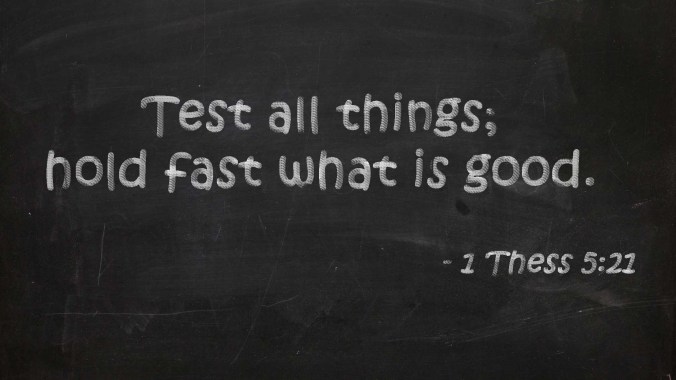
The Bible is not all there is to God. And specific translations or interpretations (and in the modern age that’s all most of us who don’t read Hebrew and Greek have got) even less so. Treating it like it is might be the most acceptable form of idolatry going today. God can withstand our questions and criticisms of Bronze Age culture. Just because Jesus didn’t explicitly condemn slavery doesn’t mean we should approve it. 1 Thessalonians 5:21 advises: “Test all things; hold fast what is good.” God has given us the ability to discern what is moral and what is immoral, though in some cases like slavery it takes us far longer than it should to make the right call. Acceptable practices become unacceptable, and “abominable” practices such as short hair on women grow inoffensive.

The fact that people have been able to use the Bible to both justify and condemn slavery tells us the truth it contains needs more consideration than the popular “The Bible says it, I believe it, that settles it.” Trust that truth is Godly, wherever it is found.

Comfort: God and truth withstand all scrutiny.

Challenge: Meditate on what previously acceptable practices have been morally rejected in your lifetime, and vice versa.

Prayer: God, help me to approach all things, including scripture, with your guidance. Amen.

Discussion: How would you describe your relationship with the Bible?

Join the discussion! If you enjoyed this post, feel free to join an extended discussion as part of the C+C Facebook group. You’ll be notified of new posts through FB, and have the opportunity to share your thoughts with some lovely people. Or feel free to comment here on WordPress, or even re-blog – the more the merrier!
Sleeping with the Enemy

WEAKRESOLVESTRONGFAITH

Today’s readings (click below to open in a new window):
Psalms 56; 149, Genesis 12:9-13:1, Hebrews 7:18-28, John 4:27-42


How do we approach people we assume to be our enemies? Today’s readings feature two stories about people traveling through presumably hostile territory. They start with very different mindsets, and have very different results.

When Abram and his beautiful wife Sarai arrived in Egypt, he instructed her to pose as his sister so the Egyptians who wanted to woo her would treat him well. Otherwise, he feared, they might murder him to take her. Word of her beauty reached Pharaoh and soon she was living in his home. Displeased with this situation, God afflicted Pharaoh’s household with great plagues. His lie thus revealed, Abram was forced to flee with Sarai.

While passing through Samaria, Jesus stopped at a well. He had a very candid though compassionate conversation with a woman he met there. Once he revealed himself to be the messiah by showing he knew undisclosed details of her life, she was not afraid to challenge him about his relationship with non-Jews. After the people of her town heard her story, they invited Jesus to stay and he spent two days with them. As a result many Samaritans became believers.

Abram told an easy lie, and Jesus told hard truths. The Egyptians treated Abram well for a while, but no relationship was established. In the end, the lie forced him away. The Samaritan woman respected Jesus because he told the truth, and returned his frankness. The initial conversation between them does not read as comfortable, but in the end he formed an unexpected and important relationship with the Samaritan people.

The world tells us never to trust our enemies, and to do unto them before they do unto us. Jesus teaches and shows us another way. It is a more risky path, as we can never be sure of our enemy’s intentions, but it also opens a door to the possibility of reconciliation. If we refuse to hear someone’s story, or respond with judgment, that door stays closed. Being the first to offer a hand in peace is not a sign of a weak resolve, but of a strong faith.

Comfort: Jesus doesn’t want a relationship with your Sunday best, he wants one with your honest everyday self.

Challenge: Do you have any enemies you could get to know better? Try to do so.

Prayer: Prince of Peace, teach me the ways of peace. Amen.

Discussion: Who do you consider your enemies? How do you communicate with them?

Join the discussion! If you enjoyed this post, feel free to join an extended discussion as part of the C+C Facebook group. You’ll be notified of new posts through FB, and have the opportunity to share your thoughts with some lovely people. Or feel free to comment here on WordPress, or even re-blog – the more the merrier!

The Fine Line

1452988121799

Today’s readings (click to open in a new window):
Psalms 19; 150, Genesis 7:1-10, 17-23, Ephesians 4:1-16, Mark 3:7-19


The line between faith an insanity can be hard to identify. When Noah heard the voice of God telling him to build an ark, he must have questioned which side of the line he was on. His neighbors, friends, and family – the ones who didn’t scoff at him outright – surely had questions as well. How must it have felt to explain the enormous construction project going on in his back yard? Following God’s orders very likely ruined his reputation as a stable individual. At least until the rains started.

Not everything God would have us do will make sense to the outside world – and maybe not even to ourselves. Showing generosity to people who haven’t earned it, granting mercy to those who have wronged us, taking in strangers – these things seem scandalous by worldly standards. When God “asks” us to do something – through intuition, conscience, or other means – are we strong enough to ignore the mocking, sometimes hostile voices discouraging us? We probably won’t be asked to accomplish something as huge as 1.5 million cubic feet of boat, but when we open ourselves to ridicule the burden may feel almost as enormous.

When Noah and his family closed the door of the ark, they had no idea how long they might be afloat or what their final fate might be. Following God often means the faith that we are doing the right thing must be sufficient to carry us through dark and confusing times. We want to be sure we are on the right side of that line between faithful and crazy, but we often don’t. When it comes to leaps of faith we can pray, discern, and hope … but we can never be 100% sure. If we turn out to be wrong, or if things just turn out differently than expected, listening to that voice the next time may be difficult.

Not every little whim is a calling from God, but sometimes we need to risk looking a little crazy. That’s OK. We may turn out to be the only one with the good sense to get out of the rain.

Comfort: Faith may ask crazy things of us, but God will see us through.

Challenge: Is anything you have left undone nagging at your conscience? If so, pray and meditate on what’s holding you back.

Prayer: All-knowing God, I will trust you even when I don’t understand you.

Discussion: What’s the most outlandish thing you’ve done on intuition? How did it work out?

Join the discussion! If you enjoyed this post, feel free to join an extended discussion as part of the C+C Facebook group. You’ll be notified of new posts through FB, and have the opportunity to share your thoughts with some lovely people. Or feel free to comment here on WordPress, or even re-blog – the more the merrier!
It Rolls Downhill

Rabies 010

Today’s readings (click to open in new window): 
Psalms 104; 149, Genesis 6:9-22, Hebrews 4:1-13, John 2:13-22


“Tourist prices” have been a problem for as long as people have traveled out of town. For example, non-Jewish currency was forbidden inside the temple at Jerusalem, so pilgrims needed to exchange it with money changers in the temple’s outer court before purchasing sacrificial animals. Doves, lambs, and other creatures are difficult to travel with, so livestock merchants also set up shop there. Both money changers and merchants took advantage of captive customers by demanding high prices. When Jesus arrived at the temple, he was so outraged to find “a den of thieves” where people traded faith for profit that he fashioned a whip out of cords and drove them all out. Not only had commerce defiled the temple, the institution that was supposed to protect the people was exploiting them.

The faithful are called to steward our resources justly. That means more than tithing and charity. Wealth does not buy us the privilege to shift social burdens onto the poor. In his encyclical on the environment, Pope Francis describes how the poor are disproportionately affected by climate change and pollution. The wealthy consume resources and produce waste at a much greater rate than the poor, but poor communities are where we dump trash, manufacture toxins, and  ignore contamination. This burden shift occurs down the road and around the globe. Industries with environmentally devastating activities forbidden under national policies exploit poorer, unregulated countries. Many economic and social forces impact the differences between wealthy and poor communities, but property values are not Christian values. Living in a nice neighborhood doesn’t mean we deserve more justice. Faith calls us to deploy our resources in a way that protects the most vulnerable among us.

Are we in the outer court exchanging profit for justice, or are we working to make sure the poor – whom Jesus told us to serve – are at the heart of God’s kingdom? Rock bottom prices have high human costs. Pollutants we vote or litigate out of our back yards are forced into someone else’s. When the choices we make to better our lives negatively impact others, we need to make better choices. Maybe we can start by treating the poor as we would treat our own family … because Christ has made them so.

Comfort: Rich, poor, or in between, God’s justice is meant for all of us equally.

Challenge: Read about how the poor have been unfairly impacted by pollution in Ringwood, New Jersey (also known as Sludge City), Horlivka, Ukraine, or Flint, Michigan.

Prayer: Lord, help me to live justly, not just for my own righteousness, but for the love of your creation. Amen.  

Discussion: Where in your own community do you see links between poverty and injustice?

Join the discussion! If you enjoyed this post, feel free to join an extended discussion as part of the C+C Facebook group. You’ll be notified of new posts through FB, and have the opportunity to share your thoughts with some lovely people. Or feel free to comment here on WordPress, or even re-blog – the more the merrier!


Naked and Unashamed

apple-1122537_1920

Today’s readings (click below to open in new tab/window):
Psalms 42; 146, Genesis 3:1-24, Hebrews 2:1-10, John 1:19-28


“Who told you that you were naked?”

That’s the question God asks Adam and Eve when He finds they have covered themselves in fig leaves because they are ashamed. No one had to tell them; they knew as soon as they ate the fruit from the Tree of Knowledge of Good and Evil. What exactly about their nakedness was shameful? Minutes earlier it hadn’t bothered them – or God – at all. Perhaps it wasn’t the physical nakedness that shamed them, but the spiritual nakedness. That’s a lot harder to cover up.

Was there really anything special about the fruit? If God had commanded them not to sit in the Lawn Chair of the Knowledge of Good and Evil, the serpent would have reminded them how tired their legs were. It was inevitable.

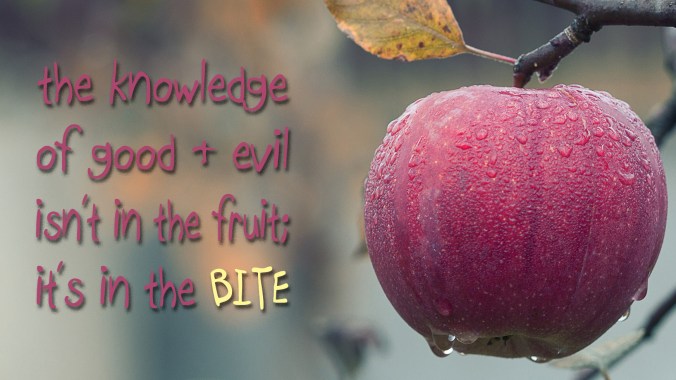
Our reason for desiring “forbidden fruit” always seems solid … right up until we begin to pay the consequences. Like every human being, Adam and Eve already had the capacity for good and evil, but because they had not been disobedient, they did not have the knowledge of it. Immediately upon disobeying God they became aware of how deeply flawed they actually were. Like any one of us, they didn’t want those flaws exposed to the world or to God. Fumbling to conceal themselves only made mistakes more apparent. Whether or not we believe in a literal Eden, the story teaches us that as soon as we are aware of our disobedience, we feel separated from God.  The knowledge is not contained in the fruit, but in the bite.

It took a Christ who was willing to die on our behalf to reveal to us that God loves and forgives us despite our flaws. Our vain and impossible attempts at perfecting ourselves – our fig leaves – only further separate us from God, because we inevitably fall short and condemn ourselves. We’d be better off never having covered up at all. Christ invites us to drop the fig leaves and return to God on God’s terms – spiritually naked and humbly dependent. Christ uncovers our shame, and covers us in love.

Comfort: God loves you just as you are.

Challenge: In what ways are you still trying to prove yourself to God? How can you let go of these “fig leaves?”

Prayer: Loving Creator, I present myself humbly before you. I trust that you love me despite my sins and failures. I thank you for Christ who strengthens and redeems me. Amen.

Discussion: What tempts you? How do you feel after you give in?

Join the discussion! If you enjoyed this post, feel free to join an extended discussion as part of the C+C Facebook group. You’ll be notified of new posts through FB, and have the opportunity to share your thoughts with some lovely people. Or feel free to comment here on WordPress, or even re-blog – the more the merrier!