Math Nerd Theology

1452489798883

Today’s readings (click below to open in new tab/window):
Psalms 5; 145, Genesis 2:4-9 (10-15) 16-25, Hebrews 1:1-14, John 1:1-18


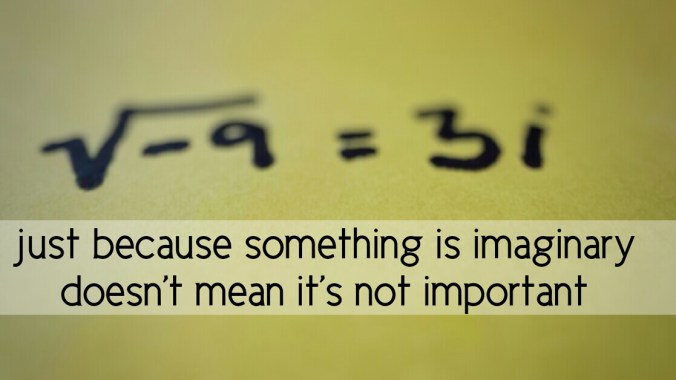
First, a short math lesson. When you square any number, positive or negative, the result is always a positive number: 3 x 3 = 9 and -3 x -3 = 9. Fairly straight forward, yes? (If not, don’t worry; there won’t be a quiz). However, some equations can’t be solved without finding the square root of a negative number. Since such a number does not exist, mathematicians invented an imaginary unit named i. Perhaps it’s more correct to say they discovered it; philosophers have debated for centuries whether mathematical concepts are invented or discovered. In either case, the square of i is -1. No one can hold up i fingers or charge $i for a pound of bananas, but i is necessary to calculate the square root of -9, which is 3i. 

End of math lesson. But what was the point?

The Gospel of John tells us that in the beginning, there was the Word, and the Word was with God, and the Word was God. In the original Greek, John uses the term logos, which means “word” but also means “reason.” John’s logos is Christ, so John is claiming Christ has been present and co-existent with God from before the beginning of the world. How can this be? Like i, faith in the logos solves an otherwise impossible problem. John has no direct evidence for it, but he invents/discovers it to make sense of God’s relationship with the world expressed through Christ. Some may call it imaginary, but it is also necessary.

Critics of faith often mock it for lacking reason. If your faith comes under fire for being unreasonable, think of i (but not too hard, or your brain may start to itch). Just because something can’t be pointed to or counted doesn’t mean it’s not essential to the fabric of the universe. We don’t call the entire field of mathematics a sham because it relies on an “imaginary” unit. The claim of Hebrews 11:1 that “faith is the evidence of things unseen” is our version of i, the necessary but unknowable solution for morality, eternity, and the soul.

And we thought algebra would never be good for anything.

Comfort: Faith isn’t about seeing, but believing.

Challenge: Call your algebra teacher and apologize for not paying more attention.

Prayer: All powerful Creator, I thank you for being present in the world, though your mystery is beyond my understanding. Amen.

Discussion: Have you ever found a use for something you thought would be useless when you learned it?

Join the discussion! If you enjoyed this post, feel free to join an extended discussion as part of the C+C Facebook group. You’ll be notified of new posts through FB, and have the opportunity to share your thoughts with some lovely people. Or feel free to comment here on WordPress, or even re-blog – the more the merrier!


It Takes a Village to Raise a Lazarus

community

Today’s readings (click below to open in new tab/window):
Psalms 99; 146, Jonah 2:2-9, Ephesians 6:10-20, John 11:17-27, 38-44
Eve of Epiphany Readings:
Isaiah 66:18-23, Romans 15:7-13 


Is  faith sufficient as an individual experience, or does it need to be shared among a community of believers? When Jesus returned to Bethany because his friend Lazarus had died, the grief of Mary and Martha, sisters of Lazarus, was certainly shared. Neither knew what to expect, but they shared faith in Jesus. They only knew that in their time of great grief, they needed to be with him. Even after he told them he was the resurrection and the life, the sisters didn’t imagine he would bring Lazarus back to them. When he asked the mourners to roll back the stone covering the tomb, Martha said four days had passed and there would be a stench. Yet moments later Jesus commanded Lazarus to walk out of the tomb, and he did.

Jesus was the source, but it was a community that made his final sign meaningful.
Mary and Martha, each with an imperfect but united faith, together believed that whatever Jesus thought fit to ask, God would deliver. At least a few mourners must have volunteered to move the stone, as it was large and heavy enough to cover the mouth of a cave. The gathered crowd  listened to Jesus loudly giving thanks to God for their benefit so they might believe. Finally, Lazarus arose and returned to his friends and family, restoring their community.

Experienced in isolation, faith may be a comfort to us but it’s of little use to the greater body of Christ. When a community shares its faith – when one person answers Christ’s call to dive into the stench and darkness of tombs like poverty and disease, and another person trusts God to provide even when a loved one is caught in the hopeless living death of addiction, and the rest of us are inspired by and act because of their belief, and therefore sisters and brothers we thought lost forever return to us – that community finds new life as no individual could.

Faith requires community to achieve its fullest expression. Our own imperfect faith is a gift because it reminds us to seek others.

Comfort: When you have faith you are never alone.

Challenge: Explore a faith community that is unfamiliar to you.  Perhaps a charity, or another congregation. If you can, spend some time helping them with their mission.

Prayer: Thank you God for easing my burden by making me only one member of a larger body in Christ. Amen.

Discussion: What do you find most rewarding about community? Most difficult?

Join the discussion! If you enjoyed this post, feel free to join an extended discussion as part of the C+C Facebook group. You’ll be notified of new posts through FB, and have the opportunity to share your thoughts with some lovely people. Or feel free to comment here on WordPress, or even re-blog – the more the merrier!
Dress for Spiritual Success

1451793751266

Today’s readings (click below to open in new window/tab):
Psalms 111; 150, 1 Kings 3:5-14, Colossians 3:12-17, John 6:41-47


Whether you leave your house dressed in a bathrobe, a suit and tie, or a wedding dress, it’s the same you underneath. Despite employer dress codes, you are no less competent on casual Friday than you are when dressed for a board meeting at 8:00 a.m. on Tuesday. However there are times when what you wear is crucial. A nurse treating infectious patients must wear protective clothing. Hikers need footwear to provide both comfort and stability. Dancers are hindered if their clothes do not allow freedom of movement.

In his letter to the Colossians, Paul says they should clothe themselves “with compassion, kindness, humility, meekness, and patience” and “love, which binds everything together in perfect harmony.” Some clothes communicate how we intend to interact with the world. Opposing teams and referees all wear different uniforms for a reason. Someone can say “I’m a professional football player” but until they’re suited up and on the field, they’re not playing professional ball. We can quote scripture and doctrine all day long, but if we haven’t put on a Christian attitude, why would anyone believe us?  Sure, meekness might itch a little and sometimes we can’t wait to slip out of that patience at the end of the day, but they are part of the dress code for the best job in the world.

The good news is, once you’ve broken them in, they are pretty comfortable. Kindness feels less like a tie choking off your breathing and more like a scarf keeping you warm. Humility changes from a girdle squeezing in your less virtuous bulges to a support that helps you keep your back straight and head high. None of us are able to display Paul’s list of virtues all the time, but the more conscious we are about putting them on, the more they become part of us, and the more prepared we feel.

These garments will protect you. They will provide comfort and stability. They will give you confidence to move freely in a world that doesn’t always understand what you’re doing. Dressing for success doesn’t have to cost a dime.

Comfort: Love of God and neighbor is the most beautiful thing you can wear.

Challenge: As you are getting dressed for the day, be intentional about putting on your garments of faith as well.

Prayer: Loving God, I will clothe myself in faith to please you and serve your world. Amen.

Discussion: What’s your favorite item of clothing and why?

Join the discussion! If you enjoyed this post, feel free to join an extended discussion as part of the C+C Facebook group. You’ll be notified of new posts through FB, and have the opportunity to share your thoughts with some lovely people. Or feel free to comment here on WordPress, or even re-blog – the more the merrier!

Christmas Every Day

1451071069675

Readings:  Psalms 2; 148, Micah 4:1-; 5:2-4, 1 John 4:7-16, John 3:31

Today is the day! The long-awaited Christ has come. We shout “Emmanuel!” because God is with us in the flesh. The spirit of this holiday is expansive enough to include many other traditions like brightly lit trees and gift exchanges which, while not uniquely Christian, reflect our joyous celebration.

Tomorrow, or maybe even as early as this evening, we will begin thinking about the clean-up. Most Christmas trees will be down before the new year begins; a few may make it until Epiphany – the day marking the end of the twelve day season of Christmastide. The annual “War on Christmas” will declare its annual 11-month cease-sire as merchants clear the way for Valentine’s Day and summer fashions. Many people who thought it was crucial for cashiers and baristas to say “Merry Christmas” during the entire season of Advent will stop caring on December 27th without realizing the irony.

The intense activity of Christmas – or at least the effort we invest in its more secular aspects – is not sustainable all year long. We may talk about keeping the spirit of Christmas in our hearts all year long, but we aren’t all that good at it. After the holidays, donations to food banks and other charities drop dramatically, but the needs they serve do not diminish. Christmas as a special day of celebration is wonderful, but Jesus did not remain an infant forever, and after Christmas the way we celebrate him must also mature.

We can bring light into dark places through acts of kindness and attitudes of love. We can offer gifts of time, talents, and money so we love people in need as children of God more than once a year. Instead of seeking meaningless offense at otherwise well-intended holiday greetings, we can speak loudly against words and actions of actual oppression and injustice. Like the infamous inn, our lives can become so full we turn away the arrival of Christ without realizing what we’ve done. We can create room by living as if Christmas is not the end of a season, but the beginning of a life where Christ dwells within and among us.

Comfort: Christmas is more than a day; it’s a life of hope, love, peace, and joy.

Challenge: Over the next 11 months, plan a monthly Christmas “celebration” to bring the light of Christ into places and lives that need it.

Prayer: [Read Psalm 96 or Psalm 98, aloud or to yourself].

Discussion: Do you have any Christmas traditions that you could revisit throughout the year?

Join the discussion! If you enjoyed this post, feel free to join an extended discussion as part of the C+C Facebook group. You’ll be notified of new posts through FB, and have the opportunity to share your thoughts with some lovely people. Or feel free to comment here on WordPress, or even re-blog – the more the merrier!

The Joy of Being Wrong

1450757422871

Readings: Psalms 33; 146, 2 Samuel 7:18-29, Galatians 3:1-14, Luke 1:57-66


Zechariah was a learned priest who kept God’s commandments. When an angel told him his elderly wife Elizabeth would have a baby, Zechariah was too smart to believe him. Displeased, the angel struck him mute. When the baby was born, Elizabeth named him John. This was a break from tradition, as there were no Johns in the family. The household looked to Zechariah to make the call. The “right” thing to do would have been to pick a family name, but Zechariah was no fool. He wrote down “John” and was once more able to speak. He had learned the pitfalls of having to be right.

Generally speaking, we are not rewarded for being wrong. To the contrary, we usually suffer some penalty, even if it’s just loss of face. Employers, children, friends, and church exert an enormous amount of pressure to be right. Of course “wrong” is never our goal, but being afraid to be wrong prevents us from taking chances – pretty much the opposite of faith.

In science, negative results provide good information, yet there is a bias against publishing them. Valuable lines of communication are cut off when we hide our mistakes. How much richer the world is when, instead of having to be right, we are open to learning! The need to be right – politically, morally, spiritually – closes us off from the insights of others, and those others are children of God with equally valid perspectives. We don’t always have to agree with them; abandoning the need to be right is not the same as always being wrong.

Perhaps the greatest downfall of having to be right is how it limits our vision to only the things we can conceive. Zechariah’s rejection of the unknown relegated him to the sidelines of the most important story in history. His decision to risk being wrong in the eyes of others put him back in the game. How many angels have we rejected? How many traditions have robbed us of faith? Sometimes being wrong is not an occasion for shame, but for joy!

Comfort: Only God is always right; the rest of us are allowed to be human.

Challenge: The next time someone offers an opinion you disagree with, listen to understand, rather than to argue.

Prayer: Loving God, I will seek to lean on your wisdom more than my own understanding.

Discussion: Have you ever been pleased to discover you were wrong about something?

The Joy of Possibility

1450592478761

Readings: Psalms 24; 150, 1 Samuel 2:1b-10, Titus 2:1-10, Luke 1:26-38


“For nothing is impossible with God.”

So concludes the angel Gabriel when he tells Mary she will be the mother of the long-awaited messiah, and that her cousin Elizabeth, thought to be barren, will give birth also.

Do we believe Gabriel’s claim?

It’s easy to doubt. We don’t always get what we pray for, even when those prayers are frequent and fervent. We are witnesses to terrible tragedy. People we love get sick and die. Addictions destroy lives. Anger destroys families.

And yet…

People forgive loved ones for doing terrible things. Submission to a higher power restores sobriety to the hopeless. Terminal diagnoses are defied. Survivors of terrible tragedies make peace with their enemies, rebuild their lives, and inspire others. Each of these things at some point seems like an impossibility, but they all happen. Certainly not every time, or even as often as we would like, but they do happen. And only through God’s grace.

Advent reminds us that in the darkest times, our God creates possibilities. Jerusalem had been under Roman occupation for over 60 years at the time of Christ’s birth. Several self-proclaimed messiahs had already died trying to win the freedom of the Jewish people. Then an angel appeared to a young girl of no significance, and announced the impossible. Even if we aren’t sure about the whole angel-virgin-manger story, the truth of a Messiah who upends expectations and continues to free us until this very moment seems impossible.

The impossible is not just the highly improbable. The impossible is something our minds and spirits can’t even conceive. A messiah who conquers his enemies by being crucified? Not on the radar. A kingdom where the last are first and the first are last? Not something we’d plan for.

Our God is a God of inconceivable possibility. He is with us in the midst of our suffering, which itself is a seeming impossibility. Mary did not wait to rejoice until God’s promise was fulfilled – she began when the possibility was revealed to her. Surely this joy was not without its own terrors for a young girl whose pregnancy would raise questions and even hostility. Even in the face of fear and suffering, let us rejoice because God is creating possibilities beyond our imaginations.

Comfort: Nothing is impossible with God.

Challenge: Watching the news and hearing about world events can be very disheartening. Try to spend as much time looking for news about possibilities as being fed news about tragedy.

Prayer: Hear a just cause, O LORD; attend to my cry; give ear to my prayer from lips free of deceit. From you let my vindication come; let your eyes see the right. (Psalm 17:1-2)

Discussion: Have you ever experienced something you would have thought impossible?

Join the discussion! If you enjoyed this post, feel free to join an extended discussion as part of the C+C Facebook group. You’ll be notified of new posts through FB, and have the opportunity to share your thoughts with some lovely people. Or feel free to comment here on WordPress, or even re-blog – the more the merrier!
Peace as Perspective

1450504704309

Readings: Psalms 90; 149, Zephaniah 3:14-20, Titus 1:1-16, Luke 1:1-25


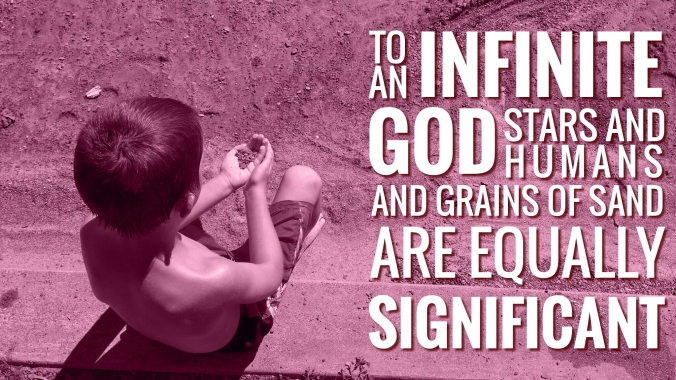
Pondering the universe generally elicits two responses: awe at its grandeur, and a sense of insignificance. In Madeleine L’Engle’s novel A Wind in the Door, when human characters learn to let go of limited concepts of time and space they can converse with stars. In the scale of the infinite universe – and an infinite God – size and distance are irrelevant so humans and stars are equally important. If that’s not mind-bending enough, they meet within a mitochondrion, thousands of which can exist inside a single human cell, to formulate a plan to save the world. The novel teaches that none of us are insignificant, but none of us are solely responsible for history.

When an angel told Zechariah, the father of John the Baptist, that his elderly wife would conceive a child who would herald the messiah, Zechariah did not believe. As a result, he became mute until after John’s birth. Zechariah teaches us that insisting on our own limited view of things makes us powerless in the face of the future. Fortunately John believed in God’s long term plan, and trusted in something greater than himself until his death.

God plays a very long game. Martin Luther King Jr. may have said it best: “The arc of the moral universe is long but it bends toward justice.” Our efforts may seem to make little difference, but from an infinite perspective, a small kindness and a great accomplishment are not very different. It is the accumulation and interaction of these kindnesses and accomplishments that matters. To paraphrase Leo Tolstoy, we add our own light to the sum of all light. On a small scale light moves quickly, but across the galaxy it travels for many thousands of years and the star that generated it may have burned out before we ever see it. So it is with our contributions to the world: they may not be fully understood until long after we have burned out, but our light goes on.

Today’s struggles do not define us. Like mitochondria each of us is a tiny part adding life to the eternal body of Christ. Such perspective adds to the sum of our peace.

Comfort: To an eternal God, stars and humans and grains of sand are equally significant.

Challenge: Read Psalm 90, noting the eternal perspective of the psalmist.

Prayer: Let Your work appear to Your servants
And Your majesty to their children.
Let the favor of the Lord our God be upon us;
And confirm for us the work of our hands;
Yes, confirm the work of our hands. (Psalm 90:16-17)

Discussion: Have you ever been involved in a long-term project, perhaps one that continues long after you stopped (or will stop) being part of it? What did that feel like?

Join the discussion! If you enjoyed this post, feel free to join an extended discussion as part of the C+C Facebook group. You’ll be notified of new posts through FB, and have the opportunity to share your thoughts with some lovely people. Or feel free to comment here on WordPress, or even re-blog – the more the merrier!

Love Dangerously

1449898213207

Readings: Psalms 90; 149, Haggai 2:1-9, Revelation 3:1-6, Matthew 24:1-14


Love hurts.

More than a pop song cliche, it’s a truth which is unpleasant and unavoidable – unless we opt out of love altogether. Whether we cause the pain or feel it, every relationship is eventually tested. Marriages struggle. Children leave home. Children fail to leave home. Friends let us down. The songs are usually about romantic love, but it’s true even of the agape love practiced by followers of Christ.

How many times heard someone say (or said ourselves), “I just don’t want to be hurt … again?”  Maybe they were cheated on. Maybe they were taken advantage of. The reasons for hurt are endless but here’s the thing: we already hurt, because we are already broken people in a broken world. There is no “again;” there is only “still.”

The pain of love is different from the pain of brokenness. The pain of love is like a bone being set, a wound being drained, or the pain of pouring out our secrets to a therapist. It is a productive pain and if we choose to avoid it, healing eludes us.

When Christ asks us to love God and to love one another, he promises us a spiritual comfort but does not promise us a life free of pain or danger. To the contrary, he warns us our choice to follow him into a life of agape love will cause many to scorn us and possibly put us in harm’s way. That harm isn’t always physical. Sometimes it is an injury to the spirit that occurs precisely because we have chosen to help others. Loving leaves us vulnerable.

Like our bodies, our spirits have an instinct to recoil from that which hurts us. As the Great Physician, Jesus tells us the remedy often means taking a greater risk and putting ourselves in danger of more pain – not to become victims or masochists, but to improve our spiritual health. Eventually love mends the breaks and wounds in our spirit, but we must take risks.

Love hurts. Not loving hurts more, because improperly set spiritual bones leave us as hobbled as physical ones.

Comfort: It may take a long time, but loving others heals our own brokenness.

Challenge: For an example of love that valued risk over comfort, read this perspective on Mary, the mother of Jesus.

Prayer: Loving God, give me the courage to love, even when doing so is dangerous. Amen.

Discussion: Different people have different methods of expressing love and recognizing when they are loved. What are yours? (If you’re not sure, maybe take a look at the The 5 Love Languages site of Dr. Gary Chapman).

Join the discussion! If you enjoyed this post, feel free to join an extended discussion as part of the C+C Facebook group. You’ll be notified of new posts through FB, and have the opportunity to share your thoughts with some lovely people. Or feel free to comment here on WordPress, or even re-blog – the more the merrier!

Hope Realistically

1449111283187

Readings: Psalms 18:1-20; 147:12-20, Amos 4:6-13, 2 Peter 3:1-10, Matthew 21:33-46


Wouldn’t it be nice if people of faith were assured peaceful, healthy, uncomplicated lives? Some preachers – mostly of the “send us your money to pray over” variety – claim disease and difficulty can be overcome by faith alone, and that adversity simply fills a void where faith is lacking. The prophet Amos, describing God’s attempts to use drought, famine, and plague to convince the people of Israel to return to him, would claim differently. The faithful and the wicked suffered the consequences of the wicked together. When the world experiences similar troubles today, whether we believe they are sent directly by God or the natural consequences of our own misguided actions, faith is not guaranteed to shield us.

In Jesus’s parable of the landowner, tenant farmers kill the blameless servants who have come to collect the agreed upon share of the harvest on behalf of their master the landowner. One might expect the aura of authority lent by their master would protect the servants, but it does not. One can find many parallels in our modern world, where Christians continue to be persecuted for their faith. From actual martyrdom and execution to depression, addiction, illness, and crime,,, our faith exempts us from none of it.

If we are not spared suffering, why have faith at all?

Faith is the source of hope. We believe in God’s eternal plan of justice and salvation, and trust our sufferings are finite. As part of a larger body, we know the suffering and even destruction of one part does not have to mean the death of the whole. We stand in the center of the wreckage and devastation – and sometimes the wreckage and devastation dwell in the center of us – but we do not allow them to define us. In the face of seemingly endless disaster, is there anything realistic about hope? There is if our hope is dependent not on this moment, but on the faith that the Kingdom of God will not be denied. The ailing body of humankind will be raised to true life again. A stumble is still a step forward.

Comfort: God is with us through suffering, whether or not it is of our own making.

Challenge: When others suffer, let’s offer support instead of empty words.

Prayer: Guard me as the apple of the eye; hide me in the shadow of your wings, from the wicked who despoil me, my deadly enemies who surround me. (Psalm 17:8-9)

Discussion: Do you think there is anyone who hasn’t somehow caused someone else to suffer?

Join the discussion! If you enjoyed this post, feel free to join an extended discussion as part of the C+C Facebook group. You’ll be notified of new posts through FB, and have the opportunity to share your thoughts with some lovely people. Or feel free to comment here on WordPress, or even re-blog – the more the merrier!

The End Is Near

winter-83112_1280

Today’s readings (click below to open in new tab/window):
Psalms 63; 149, Micah 7:11-20, 1 Peter 4:7-19, Matthew 20:29-34


The world has been ending for a very long time.

When I was a child, priests and Sunday School teachers, caught up in the atmospheric dread of the Cold War, terrified me by preaching the imminent end of the world and the threat of Russia. I confided my fears to my mother, and it turned out when she had gone to Catholic school at the same parish, the priest and nuns gave the students a specific date to expect the end. She too was terrified until the date came and went. There was supposed to be some lesson in that about being prepared, but all she seemed to learn was a distrust of the clergy.

Peter, like many disciples, genuinely believed Christ would be returning in his lifetime or shortly after, but it didn’t happen. The hundreds of predictions of the end of the world since then have been miserably wrong. One of these more recent debacles was blamed on faulty decimal placement.

On this last day of the liturgical year, we look forward to the beginning of Advent and the new year. Except we don’t traditionally welcome it with parties and feasts. It doesn’t have an equivalent of Ash Wednesday which precedes Lent. Instead, our scripture readings turn to apocalyptic themes and prophets of doom. The stores may be full of twinkling lights and cheerful music, but they represent the false promise of satisfaction via worldly accumulation. Without the rich contemplation of Advent, they offer little more than a picture of a feast offers a starving family.

The world will end someday. Until it does, we are left to contemplate how to balance living both as if it will happen tomorrow, and as if it will happen millennia after we have passed.

But how different do those lives look?

In either case, our neighbor struggling with depression will still need a kind shoulder. The bellies of hungry children halfway around the world won’t stop rumbling. We still need to forgive that person who wronged us sooner rather than later. Our sacrifices and our love and our faith are neither more nor less meaningful, and always necessary. Advent is the time we set aside to remember that while we mourn the broken nature of the world, we are also waking to the promise of its new life in Christ.

The end is near. We need not fear it, for so is the beginning.

Comfort: Christ makes the world new for us each day.

Challenge: Remember the past, live the present, shape the future.

Prayer: Because your steadfast love is better than life, my lips will praise you.
So I will bless you as long as I live; I will lift up my hands and call on your name. (Psalm 63:3-4)

Discussion: Do you observe Advent in any way? If so, what does it mean to you? If not, do you see any value in it?

Join the discussion! If you enjoyed this post, feel free to join an extended discussion as part of the C+C Facebook group. You’ll be notified of new posts through FB, and have the opportunity to share your thoughts with some lovely people. Or feel free to comment here on WordPress, or even re-blog – the more the merrier!