Feedback


improve

Today’s readings (click below to open in new tab/window):
Psalms 36; 7, Ecclesiastes 8:14-9:10, Galatians 4:21-31, Matthew 15:9-39


Imagine you are going to ask your employer for a raise or a promotion. You’ve prepared a list of all the reasons you think you deserve it. Are you also prepared to hear your boss share any reasons she or he feels you don’t deserve it?

What about when we decide to offer unsolicited criticism to a friend or coworker? Are we ready for them to return the favor?

Real-life conversations are not like those in a movie or television episode where someone gets to say their piece without interruption and leave the scene with a dramatic exit. When we initiate a challenging or difficult conversation, we should be prepared to hear what the other party has to say. Sometimes that means things won’t turn out the way we want.

The author of Psalm 7 knew this. When asking the Lord to save him from his enemies, he must have been certain of his own blamelessness to say:

O LORD my God, if I have done this,
if there is wrong in my hands,
if I have repaid my ally with harm
or plundered my foe without cause,
then let the enemy pursue and overtake me,
trample my life to the ground,
and lay my soul in the dust.

Fortunately for those of us less confident in our own righteousness, Christ teaches us that we are not caught in a cycle of tit for tat – that God’s mercy isn’t contingent on our blamelessness, but on our own willingness to show mercy ourselves. Unlike asking for a raise, when we ask God for forgiveness, we don’t need to build a case for it so much as humbly acknowledge and repent of our wrongdoing. When we feel convicted of our sins and failings, the Spirit isn’t trying to beat us down into a place of guilt, but to lift us up to a place of renewal.

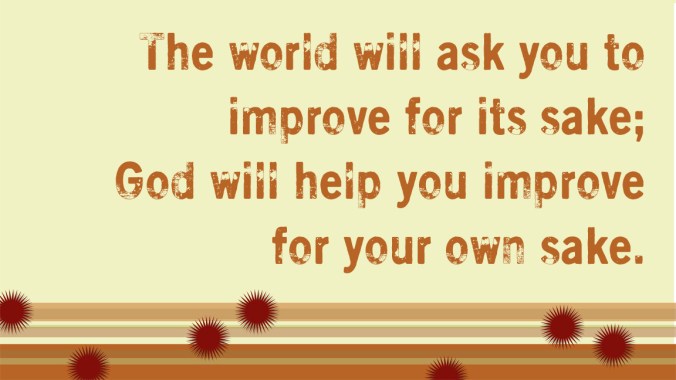
Eventually we all need to face difficult truths about ourselves. The difference between the world and God is that the world wants you to improve before it can love you, and God loves and forgives you so that you can improve.

Comfort: God loves us despite our flaws.

Challenge: Ask a trusted friend to suggest a way you could improve, then pray about it.

Prayer: Merciful and loving God, thank you for loving me where I am today, and loving me enough to lead me somewhere better tomorrow.

Discussion: What flaw do you struggle to change?

Join the discussion! If you enjoyed this post, feel free to join an extended discussion as part of the C+C Facebook group. You’ll be notified of new posts through FB, and have the opportunity to share your thoughts with some lovely people.

Found Wanting or Wanting to be Found?

feestmaal

Belshazzar’s Feast, Rembrandt, 1637

Today’s readings (click below to open in new tab/window):
Psalms 47; 147:12-20, Daniel 5:13-30, 1 John 5:13-20 (21), Luke 5:1-11


Jesus knows you are flawed, and loves you anyway. God knows you are flawed, and loves you anyway. People know you are flawed, and some of them will love you and some of them won’t, but none of them are God so in the long run it doesn’t matter. That leaves you. You know you are flawed; how will you deal with it?

King Belshazzar was deeply flawed, and he seemed to revel in it. When he desecrated the temple vessels of the captured Jews, a mysterious hand wrote strange words on the palace wall. Terrified, he brought in the captive prophet Daniel to interpret them for him. Because Belshazaar praised false idols but ignored the “God in whose power [was his] very breath,” Daniel interpreted the words as follows:

 mene, God has numbered the days of your kingdom and brought it to an end; tekel, you have been weighed on the scales and found wanting; upharsin, your kingdom is divided and given to the Medes and Persians

Belshazzar was killed that same night.

Peter was also flawed. When he first realized Christ’s nature, “he fell down at Jesus’ knees, saying, ‘Go away from me, Lord, for I am a sinful man!’” Jesus replied, “Do not be afraid; from now on you will be catching people.” Peter would remain highly flawed throughout his career as apostle and founder of the church, but his attitude of faith and repentance kept him close to God.

Some of us think our flaws put distance between us and God. With this mindset, we worry we aren’t as “good” as other Christians (who are doing their own worrying). When things get tough we don’t want to burden others with our struggles (though they would happily lend an ear, a hand, or a buck). With this mindset, our flawed ego tells us we couldn’t possibly be forgiven.

Not so.

Do not be afraid. Belshazzar teaches us to be aware of our flaws. Peter teaches us not to be so aware of them that we despair. God loves us too much to leave us where we are.

Comfort: God loves you as you are.

Challenge: Love and trust God enough to make you even better.

Prayer: Thank you, Holy God, for the forgiveness and love you offer even though I can never earn it. Amen.

Discussion: Have you ever felt like your flaws put distance between you and God?

Join the discussion! If you enjoyed this post, feel free to join an extended discussion as part of the C+C Facebook group  or visit comfortandchallenge.tumblr.com. You’ll  have the opportunity to share your thoughts with some lovely people. Or feel free to comment here on WordPress, or even re-blog – the more the merrier!

More Than Good Enough

1471183447641.jpg

Today’s readings (click below to open in new tab/window):
Psalms 19; 150, Judges 16:15-31, 2 Corinthians 13:1-11, Mark 5:25-34


Today we reach the end of the story of Samson. He has been unlikable, dull-witted, egotistical, impulsive, deceptive, a fatally sore loser, and more than a bit of a hound. In the plus column: he was physically strong because from birth he was consecrated to God as a Nazirite. His role as the God-appointed judge of Israel was “to begin to deliver Israel from the hands of the Philistines.” He accomplished his goal in spectacularly bloody fashion and died without revealing a single redeeming character trait. Charitably, he is not a poster child for righteousness. And that is why we should thank him.

If we can put aside our feelings about the violence of the story (although it may not bother some of us), we can take away an important lesson: God works with what we have to give. We may not have slain anyone because we lost a bet, or burned down entire farms because of a bad breakup, but we have plenty of our own flaws and self-destructive tendencies. God knows this, and is willing to work with us anyway.

It’s easy to think of ourselves or someone else as too flawed to be instruments of God. After all, God knows about the faults the rest of the world sees, and also those we manage to hide from everyone else. Shame, modesty, or both tell us we aren’t good enough to be of any real use to God. Judgment tells us someone else isn’t. When we picture a “servant of the Lord” that picture doesn’t usually include co-dependence, bad credit, or a pornography habit—all of which are small potatoes compared to Samson’s indiscretions. God will choose who God will choose, and our opinion doesn’t carry a lot of weight—especially when God chooses us. Moses tried to beg off because of a speech impediment, and Paul spoke frequently of an unidentified “thorn in his flesh” that kept him humble despite his importance.

We should try to correct our flaws, but rather than letting them define us, let’s try to see how God might be working in us, and in others.

Comfort: No matter how cracked, we are valuable vessels to God.

Challenge: When you find yourself judging someone, think about the hidden strengths God may have given her or him.

Prayer: God of healing, work through me as you will. Amen.

Discussion: Some psychological theories say the flip side of every virtue is a vice. Have you ever found that to be true?

For thoughts on today’s text from Mark, also see Go In Peace.

Join the discussion! If you enjoyed this post, feel free to join an extended discussion as part of the C+C Facebook group. You’ll be notified of new posts through FB, and have the opportunity to share your thoughts with some lovely people. Or feel free to comment here on WordPress, or even re-blog – the more the merrier!