Foundation

dostoesvsky

Today’s readings (click below to open in new tab/window):
Psalms 96; 148, 1 Samuel 2:1-10, Ephesians 2:1-10, Matthew 7:22-27


In Fyodor Dostoevsky’s novel The Brothers Karamazov, brothers Ivan and Aloysha engage in long and compelling arguments about the nature of God, faith, and the problem of evil. At one point Ivan asks his brother if, to create a utopia where humanity was eternally happy and at peace, he could justify torturing a blameless infant to death.

Of course Aloysha says no. In the context of the novel his answer has many meanings, but let us consider it in light of Christ’s parable in Matthew about the man who built his house on a foundation of stone, versus the man who built his house on a foundation of sand. Naturally the house built on sand crumbled, while the one on the stone foundation endured. The strong foundation results from following Christ’s teachings, the weak foundation from ignoring them.

Foundations matter. The ends do not always justify the means. When we build lives, families, churches, and communities our intentions mean nothing if our methods are corrupt. Houses built on sand and stone may appear equally grand for a short while, but eventually the underpinnings will be revealed. If we have sacrificed the least among us to build monuments, no matter how grand, they magnify not the Lord but our weakness.

Also in Matthew Christ said:

[M]any will say to me, ‘Lord, Lord, did we not prophesy in your name, and cast out demons in your name, and do many deeds of power in your name?’ Then I will declare to them, ‘I never knew you; go away from me, you evildoers.’

History is full of innocents sacrificed in the name of religion. Many monuments but not a single utopia has sprung from their “unavenged tears” (to quote Dostoevsky). But the one innocent who sacrificed himself willingly ushered in the Kingdom of Heaven. That is our model for a foundation of stone: a willingness to sacrifice ourselves to serve the kingdom. According to psalmists and prophets, God measures us not by how many we have persecuted on His behalf but by the holy sacrifice we have made of our own lives.

Comfort: Christ was the sacrifice that assures us the Kingdom.

Challenge: If what you desire requires someone else to make a sacrifice you do not have to make, you are very likely desiring the wrong thing.

Prayer: God of strength, teach me to build on the firm foundation of Christ, that my efforts may be lasting testaments to your glory. Amen.

Discussion: What clubs, associations, teams, or other groups do you belong to? Have you ever let them persuade you to accept a questionable means to justify a desirable end?

Join the discussion! If you enjoyed this post, feel free to join an extended discussion as part of the C+C Facebook group. You’ll be notified of new posts through FB, and have the opportunity to share your thoughts with some lovely people.
Who gives the growth?

LeSphinx1862012T13382

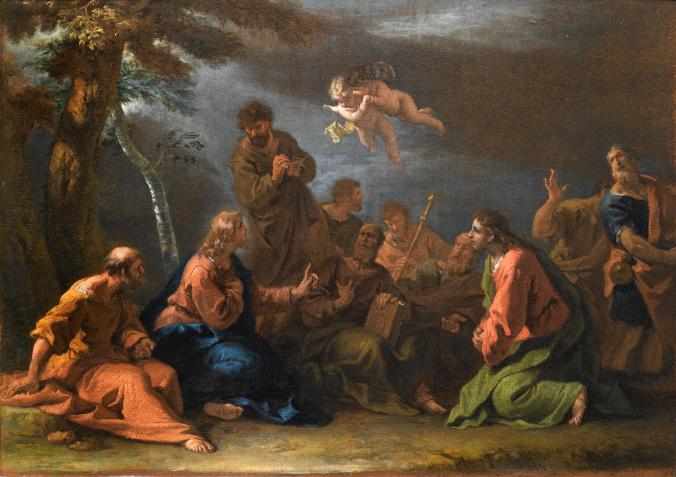
The Sermon on the Mount, Sebastiano Ricci

Today’s readings (click below to open in new tab/window):
Psalms 36; 147:12-20, 1 Kings 22:29-45, 1 Corinthians 2:14-3:15, Matthew 5:1-10


One of the challenges of resolving petty disagreements is we disagree on what’s petty. What seems like a harmless, off-the-cuff remark to me may feel like a biting comment to you. What seems like a minor annoyance to you may legitimately irritate me to tears. If we come from different parts of the world, something as simple as ordering five hot dogs with a palm facing outward instead of inward might be the insult that sets the lifelong tone of our relationship.

Paul knew petty squabbles could tear apart the early church. When the faithful in Corinth began to divide along lines of who had been converted by Paul and who by Apollos, he knew he needed to push them back together. He told the church that he had planted the seed of faith and Apollos had watered it, but both were only servants of God – the source of the seed and the actual growth.

After a couple thousand years of growth, we are still responsible for tending it, and sometimes we still need to be reminded we are not its source. The nature of the God we serve is deeper and more vast than we can possibly comprehend individually or collectively. Paul describes his role as the builder of a solid foundation upon which many others will build. Everything that people add to that foundation will eventually be tested, and what is not worthy will burn away.

Are we focused on adding things that will endure?

The church has outlasted bad doctrine, power struggles waged on a global scale and in the choir loft, corruption, and schism. What endures? The peacemaking. The mercy. The meek and poor in spirit. Those things, as Jesus preached in the Beatitudes, which are not about leaving our own bold though impermanent mark like graffiti across the face of the foundation, but about serving God by serving others.

We will, accidentally and intentionally, hurt each other. It is in the extending and accepting of olive branches – specifically when we would rather not – that we water and tend the growth. Better to set one small stone of mercy wisely and firmly in place than a great boulder which crumbles because we’ve carved our name too deeply into it.

Comfort: Even if only in a small way, you are adding to the foundation.

Challenge: Think about what you are adding and whether it serves you or God.

Prayer: Restore us, O God; let your face shine, that we may be saved. (Psalm 80:3)

Discussion: Has God ever used you or someone you know to turn a petty squabble into a moment of grace?

Join the discussion! If you enjoyed this post, feel free to join an extended discussion as part of the C+C Facebook group. You’ll be notified of new posts through FB, and have the opportunity to share your thoughts with some lovely people. Or feel free to comment here on WordPress, or even re-blog – the more the merrier!

Foundations and Fruits

1475550505969.jpg

Today’s readings (click below to open in new tab/window):
Psalms 5; 145, Hosea 6:7-7:7, Acts 22:30-23:11, Luke 6:39-49


“Why do you call me ‘Lord, Lord,’ and do not do what I tell you? I will show you what someone is like who comes to me, hears my words, and acts on them. That one is like a man building a house, who dug deeply and laid the foundation on rock; when a flood arose, the river burst against that house but could not shake it, because it had been well built. But the one who hears and does not act is like a man who built a house on the ground without a foundation. When the river burst against it, immediately it fell, and great was the ruin of that house.”

Jesus spoke these words to a great crowd about two thousand years ago, and they are still instructive today. Modern Christians spend a lot of time talking about being Christian, what to believe, and who is and who isn’t really a Christian. Yet Christ is clear the hallmark of a person who follows him is the fruit that person bears. It’s easy to hear his words, to parrot them back to each other in an endless, self-satisfied echo chamber, and think we are being good Christians. But that’s not the firm foundation Jesus describes. The actions we take (or neglect) either support or undermine the credibility of the Gospel. If we spend all our time congratulating ourselves for not being those particular sinners – pointing out specks while ignoring our own logs – we haven’t done a darn thing to actually further the kingdom. To do the things Jesus tells us to do, we have to step out of church, Bible study, and Sunday school. If “each tree is known by its fruit,” what will you be known for? Works like feeding the hungry and visiting the sick may not earn us salvation, but if these aren’t the kinds of fruit we bear, it may be time to check for root rot.

It’s never too late to start laying that firm foundation, never too late to do more than hear the words of Jesus but to act on them.

Comfort: Acting on Jesus’s words helps us experience love and joy.

Challenge: Make the necessary changes in your life to help your faith radiate outward, rather than focus only inward.

Prayer: Loving God, I will follow Jesus in both word and deed. Amen.

Discussion: Some people find it easier to act out the Gospel, and some find it easier to talk about it. Do you fall into one of these camps?

Join the discussion! If you enjoyed this post, feel free to join an extended discussion as part of the C+C Facebook group or follow @comf_and_chall on Twitter. You’ll  have the opportunity to share your thoughts with some lovely people. Or feel free to comment here on WordPress, or even re-blog – the more the merrier!