Sleeping with the Enemy

WEAKRESOLVESTRONGFAITH

Today’s readings (click below to open in a new window):
Psalms 56; 149, Genesis 12:9-13:1, Hebrews 7:18-28, John 4:27-42


How do we approach people we assume to be our enemies? Today’s readings feature two stories about people traveling through presumably hostile territory. They start with very different mindsets, and have very different results.

When Abram and his beautiful wife Sarai arrived in Egypt, he instructed her to pose as his sister so the Egyptians who wanted to woo her would treat him well. Otherwise, he feared, they might murder him to take her. Word of her beauty reached Pharaoh and soon she was living in his home. Displeased with this situation, God afflicted Pharaoh’s household with great plagues. His lie thus revealed, Abram was forced to flee with Sarai.

While passing through Samaria, Jesus stopped at a well. He had a very candid though compassionate conversation with a woman he met there. Once he revealed himself to be the messiah by showing he knew undisclosed details of her life, she was not afraid to challenge him about his relationship with non-Jews. After the people of her town heard her story, they invited Jesus to stay and he spent two days with them. As a result many Samaritans became believers.

Abram told an easy lie, and Jesus told hard truths. The Egyptians treated Abram well for a while, but no relationship was established. In the end, the lie forced him away. The Samaritan woman respected Jesus because he told the truth, and returned his frankness. The initial conversation between them does not read as comfortable, but in the end he formed an unexpected and important relationship with the Samaritan people.

The world tells us never to trust our enemies, and to do unto them before they do unto us. Jesus teaches and shows us another way. It is a more risky path, as we can never be sure of our enemy’s intentions, but it also opens a door to the possibility of reconciliation. If we refuse to hear someone’s story, or respond with judgment, that door stays closed. Being the first to offer a hand in peace is not a sign of a weak resolve, but of a strong faith.

Comfort: Jesus doesn’t want a relationship with your Sunday best, he wants one with your honest everyday self.

Challenge: Do you have any enemies you could get to know better? Try to do so.

Prayer: Prince of Peace, teach me the ways of peace. Amen.

Discussion: Who do you consider your enemies? How do you communicate with them?

Join the discussion! If you enjoyed this post, feel free to join an extended discussion as part of the C+C Facebook group. You’ll be notified of new posts through FB, and have the opportunity to share your thoughts with some lovely people. Or feel free to comment here on WordPress, or even re-blog – the more the merrier!
Worship Well

DCP_0580

Today’s readings (click below to open in a new tab/window):
Psalms 130; 148,Genesis 11:27-12:8, Hebrews 7:1-17, John 4:16-26


Samaritans and Jews shared common roots but also shared a bitterness – even a hostility – over religious differences. When Jesus passed through Samaria, he sat by a well to rest while his disciples went into town for food.  He asked a local woman for a drink of water, and as a result of the conversation that followed she recognized him as a prophet. Then, for the first time in John’s gospel, Jesus identified himself as the Messiah. John the Baptist and the disciples already believed this but, according to John’s narrative, Jesus had not confirmed it. So why would he choose to reveal himself openly to this non-Jewish woman in this non-Jewish place?

The well where they met was Jacob’s well, a site significant to both Jewish and Samaritan history. When Jesus said those who drank its waters would be thirsty again, but those who drank the living water he offered would never thirst again, he was saying eternal life was not found in or bound to any material source but in the truth. When the woman pointed out that Jews worship in Jerusalem and Samaritans on Mount Gerizim, he responded: “the hour is coming when you will worship the Father neither on this mountain nor in Jerusalem […], when the true worshipers will worship the Father in spirit and truth.”  His words told her, and tell us today, God is greater than any constraints of tradition or culture.

What constraints do Christians place on God and worship today? We insist on creeds and denominations that are more products of political history than spiritual necessity. Within denominations we have yet more division among groups who believe they own more truth than others. Like a person who believes nothing exists beyond what can be seen through a single window, we can mistakenly use the Bible to limit our understanding of God rather than accept truth wherever it is found.

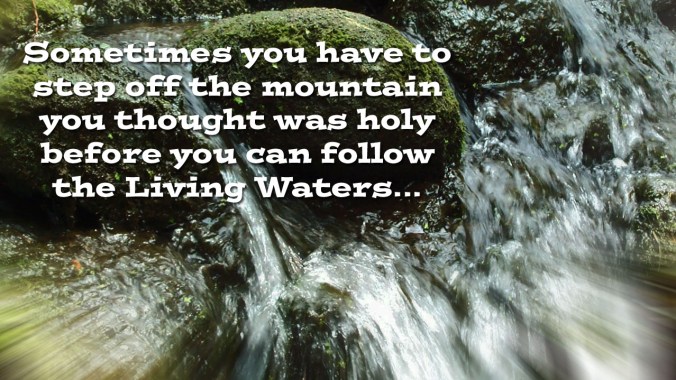
Unexpected revelation from God occurs not when we are certain and comfortable, but when we are questioning and in strange – perhaps enemy – territory. Sometimes we have to leave our temple or mountain to find where the living waters flow.

Comfort: God is greater than any box we try to put him in.

Challenge: Think critically about your own assumptions, including those taught to you.

Prayer: God of all creation, forgive me when I don’t love all you have made. Amen.

Discussion: What restrictions do you try to place on God? Who do you exclude as a result?

Join the discussion! If you enjoyed this post, feel free to join an extended discussion as part of the C+C Facebook group. You’ll be notified of new posts through FB, and have the opportunity to share your thoughts with some lovely people. Or feel free to comment here on WordPress, or even re-blog – the more the merrier!
Decrease to Increase

YourBest

Today’s readings (click below to open in a new tab/window):
Psalms 15; 147:1-11, Genesis 9:18-29, Hebrews 6:1-12, John 3:22-36


The ministry of John the Baptist was a big success. Business was so good he had customers lined up from Bethany to Aenon, where he moved because it had more water to let him do his job. He had his own disciples and irritated all the right authorities. Yet when Jesus arrived on the scene, John willingly gave it all up. John knew something we often forget: successful ministry is not determined by numbers or longevity, but by how well it advances the message and mission of Christ. When John’s followers began flocking to Jesus, John didn’t start planning how to win them back. Instead he said of Jesus: “He must increase, but I must decrease.”

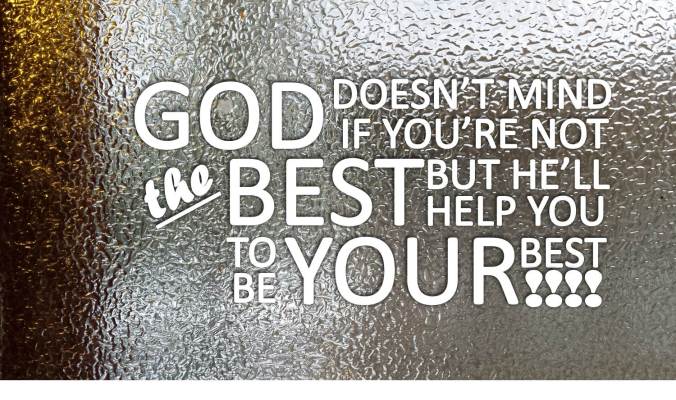
Christian ministry is not a competition, but our competitive nature can sneak into it. Choir solos, sermons, fundraisers, offerings, praise hands, potluck contributions – sometimes we can’t help comparing these things, especially if we are good at them. If healthy competition pushes us to do our best work, the ministry may benefit. When we start thinking of our collaborators as rivals, we do a disservice to everyone, and undermine the community and the ministry. Whether an individual or church, we let our lights shine to illuminate the love of Christ, not to put a spotlight on ourselves. Even if we are the very best at something, sometimes we must intentionally step aside to let others play their parts. Being our best – not the best – is what matters.

Mature preachers will say praise and criticism are the same. In other words, they hear feedback, but do Christ’s work for the sake of the work, not the reaction. Praise does not swell their heads, and criticism does not defeat them. This ego-free attitude requires cultivation, but our work will be the better for it. There’s nothing wrong with enjoying a compliment for a job well done, but if our focus moves from Jesus to acquiring compliments (or members, or money, or readers), our work suffers.

For others to increase, sometimes we must decrease. But if we do it to help Jesus increase, we rise along with him.

Comfort: The best ministries are collaborations; you don’t have to do everything yourself.

Challenge: Whenever you feel competitive with someone, ask yourself whether it is healthy or unhealthy.

Prayer: Gracious God, teach me to appreciate the diversity of the Body of Christ. Amen.

Discussion: Where do you find yourself competing when you could be cooperating?

Join the discussion! If you enjoyed this post, feel free to join an extended discussion as part of the C+C Facebook group. You’ll be notified of new posts through FB, and have the opportunity to share your thoughts with some lovely people. Or feel free to comment here on WordPress, or even re-blog – the more the merrier!

The Fine Line

1452988121799

Today’s readings (click to open in a new window):
Psalms 19; 150, Genesis 7:1-10, 17-23, Ephesians 4:1-16, Mark 3:7-19


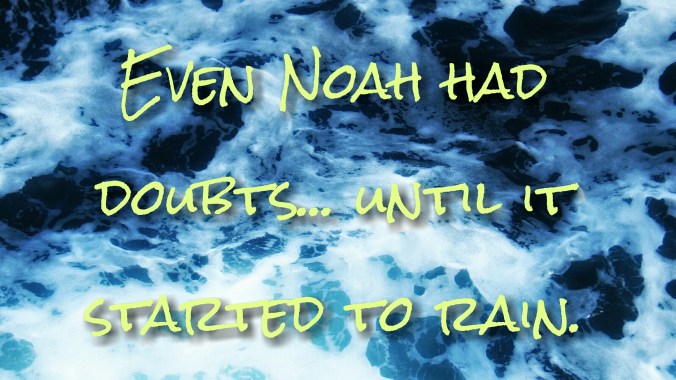
The line between faith an insanity can be hard to identify. When Noah heard the voice of God telling him to build an ark, he must have questioned which side of the line he was on. His neighbors, friends, and family – the ones who didn’t scoff at him outright – surely had questions as well. How must it have felt to explain the enormous construction project going on in his back yard? Following God’s orders very likely ruined his reputation as a stable individual. At least until the rains started.

Not everything God would have us do will make sense to the outside world – and maybe not even to ourselves. Showing generosity to people who haven’t earned it, granting mercy to those who have wronged us, taking in strangers – these things seem scandalous by worldly standards. When God “asks” us to do something – through intuition, conscience, or other means – are we strong enough to ignore the mocking, sometimes hostile voices discouraging us? We probably won’t be asked to accomplish something as huge as 1.5 million cubic feet of boat, but when we open ourselves to ridicule the burden may feel almost as enormous.

When Noah and his family closed the door of the ark, they had no idea how long they might be afloat or what their final fate might be. Following God often means the faith that we are doing the right thing must be sufficient to carry us through dark and confusing times. We want to be sure we are on the right side of that line between faithful and crazy, but we often don’t. When it comes to leaps of faith we can pray, discern, and hope … but we can never be 100% sure. If we turn out to be wrong, or if things just turn out differently than expected, listening to that voice the next time may be difficult.

Not every little whim is a calling from God, but sometimes we need to risk looking a little crazy. That’s OK. We may turn out to be the only one with the good sense to get out of the rain.

Comfort: Faith may ask crazy things of us, but God will see us through.

Challenge: Is anything you have left undone nagging at your conscience? If so, pray and meditate on what’s holding you back.

Prayer: All-knowing God, I will trust you even when I don’t understand you.

Discussion: What’s the most outlandish thing you’ve done on intuition? How did it work out?

Join the discussion! If you enjoyed this post, feel free to join an extended discussion as part of the C+C Facebook group. You’ll be notified of new posts through FB, and have the opportunity to share your thoughts with some lovely people. Or feel free to comment here on WordPress, or even re-blog – the more the merrier!
It Rolls Downhill

Rabies 010

Today’s readings (click to open in new window): 
Psalms 104; 149, Genesis 6:9-22, Hebrews 4:1-13, John 2:13-22


“Tourist prices” have been a problem for as long as people have traveled out of town. For example, non-Jewish currency was forbidden inside the temple at Jerusalem, so pilgrims needed to exchange it with money changers in the temple’s outer court before purchasing sacrificial animals. Doves, lambs, and other creatures are difficult to travel with, so livestock merchants also set up shop there. Both money changers and merchants took advantage of captive customers by demanding high prices. When Jesus arrived at the temple, he was so outraged to find “a den of thieves” where people traded faith for profit that he fashioned a whip out of cords and drove them all out. Not only had commerce defiled the temple, the institution that was supposed to protect the people was exploiting them.

The faithful are called to steward our resources justly. That means more than tithing and charity. Wealth does not buy us the privilege to shift social burdens onto the poor. In his encyclical on the environment, Pope Francis describes how the poor are disproportionately affected by climate change and pollution. The wealthy consume resources and produce waste at a much greater rate than the poor, but poor communities are where we dump trash, manufacture toxins, and  ignore contamination. This burden shift occurs down the road and around the globe. Industries with environmentally devastating activities forbidden under national policies exploit poorer, unregulated countries. Many economic and social forces impact the differences between wealthy and poor communities, but property values are not Christian values. Living in a nice neighborhood doesn’t mean we deserve more justice. Faith calls us to deploy our resources in a way that protects the most vulnerable among us.

Are we in the outer court exchanging profit for justice, or are we working to make sure the poor – whom Jesus told us to serve – are at the heart of God’s kingdom? Rock bottom prices have high human costs. Pollutants we vote or litigate out of our back yards are forced into someone else’s. When the choices we make to better our lives negatively impact others, we need to make better choices. Maybe we can start by treating the poor as we would treat our own family … because Christ has made them so.

Comfort: Rich, poor, or in between, God’s justice is meant for all of us equally.

Challenge: Read about how the poor have been unfairly impacted by pollution in Ringwood, New Jersey (also known as Sludge City), Horlivka, Ukraine, or Flint, Michigan.

Prayer: Lord, help me to live justly, not just for my own righteousness, but for the love of your creation. Amen.  

Discussion: Where in your own community do you see links between poverty and injustice?

Join the discussion! If you enjoyed this post, feel free to join an extended discussion as part of the C+C Facebook group. You’ll be notified of new posts through FB, and have the opportunity to share your thoughts with some lovely people. Or feel free to comment here on WordPress, or even re-blog – the more the merrier!
 

Math Nerd Theology

1452489798883

Today’s readings (click below to open in new tab/window):
Psalms 5; 145, Genesis 2:4-9 (10-15) 16-25, Hebrews 1:1-14, John 1:1-18


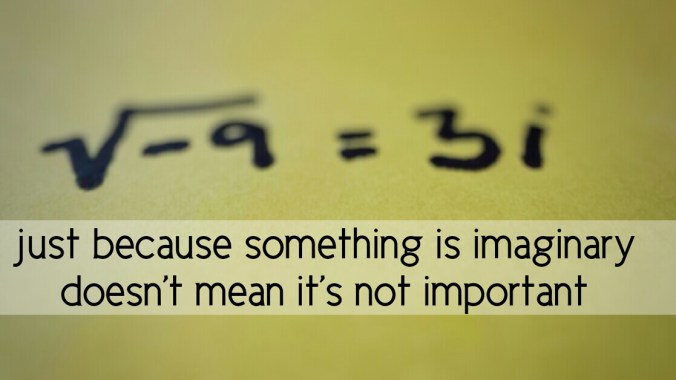
First, a short math lesson. When you square any number, positive or negative, the result is always a positive number: 3 x 3 = 9 and -3 x -3 = 9. Fairly straight forward, yes? (If not, don’t worry; there won’t be a quiz). However, some equations can’t be solved without finding the square root of a negative number. Since such a number does not exist, mathematicians invented an imaginary unit named i. Perhaps it’s more correct to say they discovered it; philosophers have debated for centuries whether mathematical concepts are invented or discovered. In either case, the square of i is -1. No one can hold up i fingers or charge $i for a pound of bananas, but i is necessary to calculate the square root of -9, which is 3i. 

End of math lesson. But what was the point?

The Gospel of John tells us that in the beginning, there was the Word, and the Word was with God, and the Word was God. In the original Greek, John uses the term logos, which means “word” but also means “reason.” John’s logos is Christ, so John is claiming Christ has been present and co-existent with God from before the beginning of the world. How can this be? Like i, faith in the logos solves an otherwise impossible problem. John has no direct evidence for it, but he invents/discovers it to make sense of God’s relationship with the world expressed through Christ. Some may call it imaginary, but it is also necessary.

Critics of faith often mock it for lacking reason. If your faith comes under fire for being unreasonable, think of i (but not too hard, or your brain may start to itch). Just because something can’t be pointed to or counted doesn’t mean it’s not essential to the fabric of the universe. We don’t call the entire field of mathematics a sham because it relies on an “imaginary” unit. The claim of Hebrews 11:1 that “faith is the evidence of things unseen” is our version of i, the necessary but unknowable solution for morality, eternity, and the soul.

And we thought algebra would never be good for anything.

Comfort: Faith isn’t about seeing, but believing.

Challenge: Call your algebra teacher and apologize for not paying more attention.

Prayer: All powerful Creator, I thank you for being present in the world, though your mystery is beyond my understanding. Amen.

Discussion: Have you ever found a use for something you thought would be useless when you learned it?

Join the discussion! If you enjoyed this post, feel free to join an extended discussion as part of the C+C Facebook group. You’ll be notified of new posts through FB, and have the opportunity to share your thoughts with some lovely people. Or feel free to comment here on WordPress, or even re-blog – the more the merrier!


Playing God

1455593850320

Today’s readings (click below to open in new tab/window):
Psalms 123; 146, 1 Kings 21:17-29, 1 Corinthians 1:20-31, Matthew 4:12-17


Imagine a great crime has been committed against you – one that cannot be made right. The perpetrator is apprehended and found guilty. When the perpetrator demonstrates he’s really sorry, the judge defers the sentence until after perpetrator’s death, at which time his son will suffer the penalty. If you’d have a hard time feeling like justice was being served, you’re probably not alone.

This is pretty much what happened after Ahab, who along with his wife Jezebel had a man stoned under false pretenses to take his ancestral land, humbled himself before an angry God. After Ahab put on some sackcloth, fasted, and put on a sad face, God decided punishment could wait.

Unfair as it seems, God – being almighty and all – gets to call the shots. We don’t have to agree, like, or understand it. But it does teach us something about the practical application of Biblical principles: just because God gets away with it doesn’t mean we can or should.

Punishing the children of the guilty, instead of or in addition to the guilty themselves, is not a just system for human beings to administer. We can’t point to books like Joshua, wherein God commanded virtual genocide, to justify our own tribal violence against people of a different faith or ethnicity. When the psalmists beg God to smash out the teeth and kill the children of their enemies, we can’t assume that’s the sort of behavior God encourages us to pursue. When we twist scripture to justify our worst impulses, who exactly are we serving?

Over and over, God offers redemption and forgiveness to the very people we would expect God to punish. Saul the oppressor of Christians becomes the Apostle Paul. The Ninevites who enslaved Israel are sent the reluctant prophet Jonah and they repent (much to Jonah’s disappointment).  God will do what God will do. Who among us dares to say when God should punish and when God should redeem?

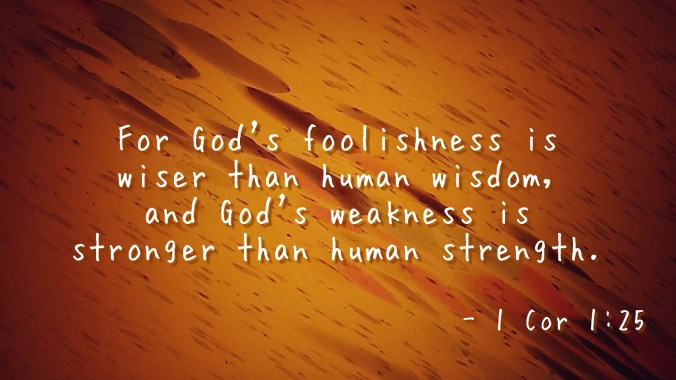
In his first letter to the Corinthians, Paul wrote: “God’s foolishness is wiser than human wisdom.” Let’s walk and act humbly, leaving God’s choices to God.

Additional Reading:
For more on today’s passage from 1 Corinthians, see Fool Me.

Comfort: You don’t have to figure out what God would do; God will do it.

Challenge: Be cautious when using scripture to justify your actions.

Prayer: Merciful God, in my foolishness lead me to your wisdom. Amen. 

Discussion: What actions of God in the Bible are hard for you to understand?

Join the discussion! If you enjoyed this post, feel free to join an extended discussion as part of the C+C Facebook group. You’ll be notified of new posts through FB, and have the opportunity to share your thoughts with some lovely people. Or feel free to comment here on WordPress, or even re-blog – the more the merrier!

Two Tents

starry-sky-2285950_1920

Today’s readings (click below to open in new tab/window):
Psalms 62; 145, 2 Samuel 7:1-17, Acts 18:1-11, Mark 8:11-21


A man goes to a psychiatrist. “Doc,” he says, “you gotta help me. I can’t sleep. One night I dream I’m a wigwam, and the next night I dream I’m a tepee.” The psychiatrist thinks for a minute and then she says: “I think the problem is you’re two tents.”

Tents figure prominently in two of today’s readings. In Acts, we learn that Paul was a tentmaker by trade – though the word translated as “tentmaker” could also be interpreted as leather worker, tailor, etc. In Samuel, the time has come to plan for a temple, a permanent home for the God of Israel who has been traveling and living in tents for over 400 years.

There’s a subtle but important shift in thinking when our God stops wandering with us and puts down roots. We start to think of the Holy of Holies as a destination where once it was a traveling companion. The rest of the world, while still part of the miraculous creation, loses potential to become a temporary center of our faith.  Church becomes a place we go, rather than an inescapable community we are all called to carry through the wilderness.

Imagine being responsible for hauling God from place to place. Not in a Lost Ark face-melting kind of way, but in the sense of undeniable presence. Would your attitude toward school be different if God was waiting whenever you opened your backpack? What would work be like if unzipping your laptop case filled the room with a holy glow? How would you feel about your purchases at the mall if God got a peek when you opened your wallet?

Church may be a focal point, but God is present in all those places and more: every nook and cranny, every canyon and plain. Everywhere. When we open our doors, our mouths, or our wallets the God we worship can be seen. If what dwells in our hearts doesn’t align with the God who inhabits the world, we’re going to lose some sleep. But when it’s the same tent inside and out, our peace is secured.


Additional Reading:
For thoughts on today’s passage from Mark, see Here’s Your Sign, Curveballs, and So. Much. Bread.

Comfort: God is always with you.

Challenge: Pick one object – like your wallet, briefcase, etc – and for the next week each time you open it take a moment to be aware of the presence of God.

Prayer: God of all creation, I will worship you at all times and in all places. Amen.

Discussion: Where  or when do you most strongly feel the presence of God?

Join the discussion! If you enjoyed this post, feel free to join an extended discussion as part of the C+C Facebook group. You’ll be notified of new posts through FB, and have the opportunity to share your thoughts with some lovely people. Or feel free to comment here on WordPress, or even re-blog – the more the merrier!

Minority Report

1499743114647

Today’s readings (click below to open in new tab/window):
Psalms 62; 145, 1 Samuel 15:1-3, 7-23, Acts 9:19b-31, Luke 23:44-56a


When a Supreme Court decision is split, the justices in the minority may offer a dissenting opinion. While this opinion is not legally binding, it is more than protest or rebuke. It may be used persuasively in future arguments to limit or overturn the majority opinion.

Joseph of Arimathea offered his own form of dissenting opinion. A member of the council that accused and condemned Jesus, he “had not agreed to their plan and action.” Rather, he asked Pilate for Christ’s body for proper burial. This was a bold request, as victims of crucifixion – especially those accused of sedition as Jesus was – were usually left on the cross for several days as a warning to others.

After Joseph laid Jesus in the tomb, the women who’d been following Jesus since Galilee prepared the spices and ointments for his body, then finished their Sabbath preparations.

Imagine the feelings of loss. Of hopelessness. Yet in doing what needed to be done, they defied despair. Burying Jesus was at once unremarkable – Jewish people died and were buried every day – and extraordinary because their messiah was brutally taken from them.

Did they have any inkling how bold they were to carry on? In the face of death and oppression, their ordinary acts declared, “We still have faith. We are still God’s people. We still obey God’s ordinances. This was not what we hoped for, but you have not destroyed us.” They may have felt confused and crushed but they persisted. They remained present. Like dissenting justices, from defeat they wrung an investment in the future.

None of them fully understood that God was at work, unseen and unheard, turning death upside down and inside out. Also like justices, they had no idea when or if their commitment would pay off.

What defeats are you suffering? What tempts you to despair? Remember the Spirit moves in ways not yet known to you. Persevering in small acts of faith will sustain you until they are known. Today you may not be able to see past the tomb of defeat, but unimaginable resurrection is around the corner.


Additional Reading:
For thoughts on today’s passage from Acts, see If Paul could do it….

Comfort: God is not idle.

Challenge: Meditate on how your habits change when you are distressed. Do these changes help or hinder you?

Prayer: For God alone my soul waits in silence; from Him comes my salvation (Psalm 62:1)

Discussion: In hindsight are you able to see times God was delivering you without your being aware of it??

Join the discussion! If you enjoyed this post, feel free to join an extended discussion as part of the C+C Facebook group. You’ll be notified of new posts through FB, and have the opportunity to share your thoughts with some lovely people. Or feel free to comment here on WordPress, or even re-blog – the more the merrier!

Psalm 103: Steadfast

1497230899739

Today’s readings (click below to open in new tab/window):
Psalms 103; 150, Deuteronomy 6:1-9 (10-15), Ephesians 4:1-16, John 1:1-18


We all need reassurance sometimes. On days when we seek to be comforted, there aren’t many resources better than Psalm 103. The psalmist blesses the Lord for all the goodness that is part of the Lord’s nature. When we trust in the Lord, this goodness showers down upon us in countless ways. Today, let’s enjoy some reassurance courtesy of Psalm 103.

Our God forgives, heals, and redeems (vv 3-4). So many messages seem to say God’s default attitude toward us is one of damnation until we choose to be saved, as if God locked a door between us and wishes us luck finding the key in the person of Jesus. The Lord’s desire is that we all be saved. God puts no barriers in our way; we may do that ourselves, but God provides the tools to tear them down.

The Lord works justice for the oppressed (vv 6-7). Hope in an eternal afterlife may be comforting, but it does little to relieve suffering in the here and now. God is also concerned with justice on the earth, particularly for those who are marginalized and exploited. When that process seems excruciatingly slow, it’s not because God doesn’t care.

The Lord’s compassion is far greater than humankind can understand (vv 8-14). We are incapable of conceiving emotions and attitudes beyond human ones. We fear the limits of God’s love and compassion do not exceed our own. Yet the psalmist assures us that God, understanding we are frail and temporary as dust, forgives us based not on our merits but on his mercy – mercy like but greater than that of a parent for a child. The only thing we need to fear is the Lord, and that fear ultimately offers a peace beyond understanding.

The Lord is steadfast (vv 15-18). Unlike mortals, who flourish and perish like flowers, God’s love, mercy, and affections are not subject to whims, and don’t sway back and forth like grass in the wind.

The Lord loves us, wants what is best for us, and is there for us to reach out to … always and all ways.

Comfort: Take comfort in God’s love for you.

Challenge: For the next week, when you stress or fear turn to Psalm 103.

Prayer: Bless the LORD, O my soul, and all that is within me, bless his holy name.

Discussion: Where do you go – a place, an activity, a person – to find comfort?

Join the discussion! If you enjoyed this post, feel free to join an extended discussion as part of the C+C Facebook group. You’ll be notified of new posts through FB, and have the opportunity to share your thoughts with some lovely people. Or feel free to comment here on WordPress, or even re-blog – the more the merrier!