Fearfully and Wonderfully Made

1454871305319

Today’s readings (click to open in a new tab/window):
Psalms 139; 150, Malachi 4:1-6, 2 Corinthians 3:7-18, Luke 9:18-27


Is the concept of an all-knowing God intimidating or comforting? The author of Psalm 139 finds great comfort in the idea that God has been and always will be with him, from conception through death. He portrays God’s constant presence not as one of judgment, but one of personal investment. As God’s carefully wrought works of art, “fearfully and wonderfully made,” we are each of us His precious creation.

Artists frequently compare their own creations to children; how could we be less to God? Like all good parents, He does not coerce our love through threats, nor does He abandon us when we make mistakes. God has our best interests at heart; Jesus assures us no father, when his child asks for a fish, would hand him a snake. Good parents can be strict, but always with an eye toward guiding and challenging children to be their best selves.

Psalm 139 provides beautiful images of the relationship God intends to have with us: guide, artist, parent, creator. Jesus used similar metaphors to describe our relationship to God, and they can help us explore His unknowable yet always loving nature. Whether we are living in the light or the darkness, God desires an intimate connection with each of His children.

Focusing on  God’s presence in our lives, even when we don’t necessarily “feel” it, inspires us to rise to the opportunity of being our best selves. Without reducing God’s role in our lives merely to a supportive buddy or life coach, we can contemplate God’s presence as we devise plans, make decisions, and take actions. Pausing to reflect on how God might view an action before we commit to it can help us transcend fleeting impulses which may not serve us well. If such reflection nags our conscience or sense of guilt, they may be signposts pointing us to a better – if sometimes more difficult – path. God does not promote shame but does encourage us to have self-control. God’s presence is not a fist knocking us down, but a hand lifting us up. Let’s grab it and be the wonderful creations God intended.

Comfort: God is with us always, waiting to lift us ever higher.

Challenge: Before going to bed each night, reflect on which of the day’s actions glorified God, and which you might have done differently if you’d been keeping God in mind. Thank God for loving you enough to help you do better tomorrow.

Prayer: Thank you God for always calling me toward the right direction.

Discussion: Can you imagine yourself as a work of art? If not, why not? If so, what kind of art would you be?

Join the discussion! If you enjoyed this post, feel free to join an extended discussion as part of the C+C Facebook group. You’ll be notified of new posts through FB, and have the opportunity to share your thoughts with some lovely people. Or feel free to comment here on WordPress, or even re-blog – the more the merrier!


A Stone’s Throw from Grace

stones-1523693-1279x852

Today’s readings (click below to open in new tab/window):
Psalms 42; 146, Genesis 26:1-6, 12-33, Hebrews 13:17-25, John 7:53-8:11


You don’t have to be a Christian to recognize the quote, “Let he who is without sin cast the first stone.” It’s the pivotal line from a story in John’s Gospel. In this story, the scribes and Pharisees brought to Jesus a woman who’d been caught in adultery. The prescribed Mosaic punishment was death by stoning, but the Pharisees – knowing that stoning wasn’t exactly Jesus’s style – asked him what should be done. They hoped to trap him into contradicting the law so they could bring charges against him. Jesus paused for a bit, wrote something on the ground, and then gave his famous answer. One by one her accusers slipped away until only Jesus was left. He refused to condemn her, saying only “Go and sin no more.”

The inclusion of this story in John’s Gospel is not without controversy. It doesn’t appear in the earliest manuscripts, and many editions of the Bible are sure to note this. It’s kind of ironic that such a questionable story became one of the most recognizable. Why does this story compel us?

Perhaps because – authentic or not – it embodies an idea that it seems we need to hear and learn over and over again. If our relationship with God is about pointing out what other people are doing wrong, instead of humbly examining our own hearts, we aren’t getting the message.

Do we as a faith community need to hear about the reality of sin and immorality? Absolutely. Do we as a faith community need to point to and single out and shame it everywhere we (think we) see it? Absolutely not.

Why is it so many non-Christians (and former Christians) see the faith as full of people ready to cast stones? Well … they’re not entirely wrong. The loudest messages shouted from beneath the Christian banner tend to be ones of condemnation. Now loudest doesn’t mean exclusive or truest or most frequent, but it does disproportionately influence what people perceive and remember.

Christ’s message isn’t one of condemnation; it is of love. We all know John 3:16 and wave it around a lot to point out who is “saved” and who isn’t, but for some reason we don’t spend nearly as much time on 3:17: “For God did not send his Son into the world to condemn the world, but to save the world through him.” Condemnation cuts people off or turns them off, and neither wins anyone to Christ. But we like it. We struggle with (and succumb to) the same temptation as the Pharisees to twist scripture to justify punishing or imposing our will on others. Once Christianity became the dominant force of the Western world, we seemed to forget forcing the Good News on people is bad news.

Grace invites us in and asks us to leave the door open; religion is an excuse to shut people out. When Jesus tells us what is sinful, it’s not so we know when to punish or control other people; it’s so we know when we are creating a rift between ourselves and God. If other’s people sin does not affect us or exploit the innocent, it’s none of our business. In a culture where the Christian majority has learned to take offense at the idea of sharing public space with people who don’t share our faith or values (and we forget even within Christianity they are nuanced), it affects us far less than we like to think it does. Every one of us has enough planks in his or her eye to keep us too busy to worry about someone else’s speck.

We are forgiven. That is a thought that should be so humbling we can’t conceive of throwing stones. Instead, let us pass on the message of grace and love by being Christ’s open hands to the world.

Comfort: God’s love will deliver us from fear.

Challenge: Ask yourself what temptations you find hardest to resist, then ask what need is still not being met by giving in to them.

Prayer: In you O Lord I seek refuge and peace. Amen.

Discussion: What fears drive your behavior?

Join the discussion! If you enjoyed this post, feel free to join an extended discussion as part of the C+C Facebook group. You’ll be notified of new posts through FB, and have the opportunity to share your thoughts with some lovely people. Or feel free to comment here on WordPress, or even re-blog – the more the merrier!

Hagar and the Horrible

1454382625545

Today’s readings (click below to open in new tab/window):
Psalms 12; 146, Genesis 21:1-21, Hebrews 11:13-22, John 6:41-51


Ever see those Christian t-shirts, bookmarks, or mugs declaring: “God won’t give you more than you can handle?” It’s a comforting thought — if we don’t think about it too long. However, if we are struggling with chronic pain, the loss of a child, or any number of devastating life events, this sentiment not only rings false, but raises a terrible theological question: “How could God give this to me?”

Abraham and Sarah had a servant named Hagar. God had promised them a child, but in their impatience they forced Hagar to conceive. After Sarah gave birth to Isaac she was jealous of Hagar’s son Ishmael, and told Abraham to banish them both. He sent them packing with some bread and a water skin. After much wandering, a thirsty and desperate Hagar placed Ishmael under the meager comfort of shady bush and waited for him to die.

God didn’t single out Hagar for suffering: Sarah and Abraham did. Abuse and oppression are never part of “God’s plan” for us. Neither are disease nor loss. God may use trials to strengthen us, but God does not heap hardship upon us just to test our endurance or faithfulness. Hardship finds us nevertheless.

Before her son could die, God led Hagar to a well. She and her son survived, and surely they were both influenced for the better or worse — or both — by this trauma. Eventually, as God promised, Ishmael’s descendants formed a mighty nation, alongside the descendants of Isaac. Of course Ishmael’s success did not justify the sufferings of Hagar, but it also meant she did not suffer in vain. What lesson might we learn from this story? Perhaps that no situation is so bleak God can’t help us through it somehow. A God who meets us at our breaking point is very different than a God who pushes us there.

Suffering can force us into a spiritual wilderness where we must rely on God to find our way. When we are in such a state of surrender, God’s mercies can redefine our suffering to have dignity and purpose. God will always offer you more grace than you can handle.

Comfort: Your suffering is not meaningless because God suffers with you.

Challenge: Be cautious about attributing God’s will to humanity’s weakness.

Prayer: Merciful and Loving God, I will trust in you and your grace at all times. Amen.

Discussion: What situations in your life are causing you pain, and how might God help you find a higher purpose for them?

Join the discussion! If you enjoyed this post, feel free to join an extended discussion as part of the C+C Facebook group. You’ll be notified of new posts through FB, and have the opportunity to share your thoughts with some lovely people. Or feel free to comment here on WordPress, or even re-blog – the more the merrier!
Generosity and Grace

Santorini Skyline

Today’s readings (click to open in a new tab/window):
Psalms 67; 150, Genesis 13:2-18, Galatians 2:1-10, Mark 7:31-37


When Jesus healed people, he didn’t treat just their physical ailments; he also acknowledged them in a way that restored the dignity they had been denied. Charity and mercy should not be top-down experiences where the more fortunate look pitiably upon the less fortunate. They are more like the closing of a circuit through which grace flows and connects us all in the Spirit.

It’s easy to squeeze the grace out of our generosity. We insist on knowing who is worthy of it. We decide what is best for people without getting to know them. If it gets uncomfortable, we distance ourselves socially and emotionally from the people we are helping. Sometimes we dismiss the efforts of people who take a different approach than we do. Our focus can be too much on how charity makes us feel, rather than on the need we are meeting.

How Jesus healed a man of deafness and a speech impediment (a common combination, since it is difficult to mimic what we can’t hear) is a wonderful model for works we do in Christ’s name. First, he didn’t try to determine worth or blame, but accepted a person who came to him in faith. Next, instead of making a public show of his kindness, he took the man aside, thereby giving him a choice of whether to tell his own story. Then Jesus literally got his hands dirty and put them on the man in an intimate way, because sometimes love has to be messy. All the while Jesus was prayerful, but confident that God would guide him. He comprehensively addressed both the root of the problem (the man’s deafness) and the symptoms (his speech impediment). Finally, after word of his generosity spread, Jesus humbly gave the glory to God.

Grace-filled generosity does not insist on its own way, but responds to the needs of others. Unlike enabling, it empowers recipients to make their own decisions about what to do next. Once someone’s ability to hear (or eat or sleep warmly) is restored, they are free to speak the good news as they will.

Comfort: Sometimes we offer assistance, sometimes we receive it, and at all times we are worthy of dignity.

Challenge: Do some volunteer work that allows you to interact with the recipients of the work. Try to see them not as people who need something you have, but as people who are equally in need of God’s gifts as you are.

Prayer: Gracious and generous God, I will do my best to give as you would have me do, not as my fears and doubts would. Amen.

Discussion: When you give someone a gift, what expectations accompany it?

Join the discussion! If you enjoyed this post, feel free to join an extended discussion as part of the C+C Facebook group. You’ll be notified of new posts through FB, and have the opportunity to share your thoughts with some lovely people. Or feel free to comment here on WordPress, or even re-blog – the more the merrier!

Naked and Unashamed

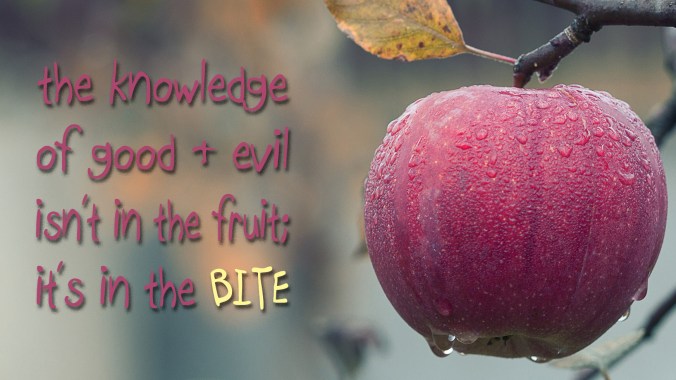
apple-1122537_1920

Today’s readings (click below to open in new tab/window):
Psalms 42; 146, Genesis 3:1-24, Hebrews 2:1-10, John 1:19-28


“Who told you that you were naked?”

That’s the question God asks Adam and Eve when He finds they have covered themselves in fig leaves because they are ashamed. No one had to tell them; they knew as soon as they ate the fruit from the Tree of Knowledge of Good and Evil. What exactly about their nakedness was shameful? Minutes earlier it hadn’t bothered them – or God – at all. Perhaps it wasn’t the physical nakedness that shamed them, but the spiritual nakedness. That’s a lot harder to cover up.

Was there really anything special about the fruit? If God had commanded them not to sit in the Lawn Chair of the Knowledge of Good and Evil, the serpent would have reminded them how tired their legs were. It was inevitable.

Our reason for desiring “forbidden fruit” always seems solid … right up until we begin to pay the consequences. Like every human being, Adam and Eve already had the capacity for good and evil, but because they had not been disobedient, they did not have the knowledge of it. Immediately upon disobeying God they became aware of how deeply flawed they actually were. Like any one of us, they didn’t want those flaws exposed to the world or to God. Fumbling to conceal themselves only made mistakes more apparent. Whether or not we believe in a literal Eden, the story teaches us that as soon as we are aware of our disobedience, we feel separated from God.  The knowledge is not contained in the fruit, but in the bite.

It took a Christ who was willing to die on our behalf to reveal to us that God loves and forgives us despite our flaws. Our vain and impossible attempts at perfecting ourselves – our fig leaves – only further separate us from God, because we inevitably fall short and condemn ourselves. We’d be better off never having covered up at all. Christ invites us to drop the fig leaves and return to God on God’s terms – spiritually naked and humbly dependent. Christ uncovers our shame, and covers us in love.

Comfort: God loves you just as you are.

Challenge: In what ways are you still trying to prove yourself to God? How can you let go of these “fig leaves?”

Prayer: Loving Creator, I present myself humbly before you. I trust that you love me despite my sins and failures. I thank you for Christ who strengthens and redeems me. Amen.

Discussion: What tempts you? How do you feel after you give in?

Join the discussion! If you enjoyed this post, feel free to join an extended discussion as part of the C+C Facebook group. You’ll be notified of new posts through FB, and have the opportunity to share your thoughts with some lovely people. Or feel free to comment here on WordPress, or even re-blog – the more the merrier!

Last Man Standing

city-1759377_1920

Today’s readings (click below to open in new tab/window):
Psalms 116; 147:12-20, Zephaniah 3:1-13, 1 Peter 2:11-25, Matthew 20:1-16


Jesus told a parable about a landowner who hired some men to work in his vineyard. He hired one group in the morning, another group around noon, and a third group late in the afternoon. Each of them agreed to the same payment of one denarius, an average day’s wages. The first group grumbled when they were not paid more than those who had worked only an hour, but the landowner reminded them they had agreed to a sum, and he was free to be generous with his money as he saw fit.

This parable is about how God’s grace is not something earned, but something given freely and equally. There’s a short bit in the middle that might deserve a little more attention than it usually gets. When the landowner asks the late shift why they stood idle all day, they answered “Because no one has hired us.”

There’s no indication they were less worthy of being hired. It seems the landowner himself had passed them over without notice earlier in the day. We don’t know why they were left waiting. The fact that they were demonstrates something we tend to minimize: not everyone is treated the same. It’s tempting to start rationalizing why they might not have been hired – what it was they might have done differently – but why is that? We are attracted to the prospect of getting what we deserve. Random unfairness offends us; it jars us when people who work less hard get more (though we’re less bothered by people who work harder and get less).

We assume idling is laziness, but the truth is many people through no fault of their own are left standing in life’s line while others are invited to skip ahead of them to participate more fully in life’s bounty. This line jumping is not always random; the invitations are extended by other people, and people are not without bias. Throughout history through the present day, ethnicity, gender, ability, and social standing have influenced who gets an invitation, but we’ve always wrapped those biases in a veneer of merit.  Any given individual might be an exception, but the trend holds.

When for decades upon decades bias has consistently left entire communities standing until late in the day, it is not just in a Biblical sense to insist they figure out on their own how to make do with a fraction of what others have had many more generation’s opportunity to earn. When real-world equivalents of the landowner seek to offer them what is just in the long term instead of what we seems fair in the short term, those among us who were hired early in the day (as individuals or as members of a community that’s been making the selections) ought not grumble like we’re the ones who’ve been cheated out of wages.

A full measure of grace is extended to all who show up to accept it. If we are to conform our hearts to Christ’s heart, shouldn’t we learn the first person hired is not more deserving of generosity than the one left to wait?

Comfort: Whether you are first or last in line, God offers the same grace.

Challenge: When you assume someone is lazy or undeserving, challenge your own assumptions. about their life experiences.

Prayer: I love the LORD, because he has heard my voice and my supplications. Because he inclined his ear to me, therefore I will call on him as long as I live. (Psalm 116:1-2)

Discussion: When has someone made incorrect assumptions about you? What were the consequences? Did you correct them?

Join the discussion! If you enjoyed this post, feel free to join an extended discussion as part of the C+C Facebook group. You’ll be notified of new posts through FB, and have the opportunity to share your thoughts with some lovely people. Or feel free to comment here on WordPress, or even re-blog – the more the merrier!

Sowers Gonna Sow

seeds-1117851_1920

Today’s readings (click below to open in new tab/window):
Psalms 12; 146, Ezra 5:1-17, Revelation 4:1-11, Matthew 13:1-9


In the Parable of the Sower, a man casts seeds across many types of ground. Some of it is a bare path where the birds can snatch it up. Some of it is rocky and rootless. Some is thorny and inhospitable. And finally, some of it is good soil. The different types of ground, Jesus eventually explains to his disciples, represent the different types of people who hear the Gospel.

Not much is said about the sower, who may be Jesus, but who may also be anyone (or everyone) spreading the Good News. Would we consider this sower a good steward of his responsibilities? It sounds like an awful lot of seed went to waste. Why weren’t his efforts more focused? Was he unable to tell good soil from bad? Maybe. Maybe not. In the end, each type of soil yielded or did not as was its nature … but the sower left no ground without potential.

When it comes to spreading grace, or acts inspired by grace, stewardship takes on a new dimension. Funds may be limited, but generosity is not. Physical resources may be limited, but love is not. Time and talents may be limited, but forgiveness is not. So why be stingy with generosity, love, or forgiveness? Even if they don’t yield what we would hope, we don’t run out of them. They are meant to be cast about widely – almost irresponsibly – because they aren’t about what we get back.

Are some people going to take advantage of our good nature? Almost certainly. Are some people never going to “get it together” despite our best efforts to support them? Definitely. Is it our job to size them up in advance and decide whether or not to waste our efforts? Or to withhold that seed in a clenched fist, as though there’s a finite supply, until we find the exactly right spot to sow it?

If we want to be sowers like the one in the parable … it is not. So sow.

It’s a balancing act. We want to be wise about how we steward finite resources to meet needs, but we also want to be wise about which resources were never ours to keep anyway.

Comfort: The more generous you are, the less you will need.

Challenge: When you find yourself withholding what you have received through grace, meditate on why.

Prayer: Because the poor are despoiled, because the needy groan, may the Lord now rise up, and may we follow. (based on Psalm 12:5)

Discussion: Do you think your definition of who “deserves” grace is the same as God’s?

Join the discussion! If you enjoyed this post, feel free to join an extended discussion as part of the C+C Facebook group. You’ll be notified of new posts through FB, and have the opportunity to share your thoughts with some lovely people. Or feel free to comment here on WordPress, or even re-blog – the more the merrier!

Good Luck, Bad Luck, Pot Luck

bread-1281053_1280

Today’s readings (click below to open in new tab/window):
Psalms 89:1-18; 147:1-11, 2 Kings 22:14-23:3, 1 Corinthians 11:23-34, Matthew 9:9-17


Today’s reading from 1 Corinthians is probably familiar to anyone who has celebrated communion in a Christian church. Paul’s recounting of Christ’s words over the bread and cup at the Last Supper are often called the Words of Institution, and are shared as a priest, minister, deacon, or elder breaks the bread.

In the early church, the symbolic or sacramental communion meal was frequently accompanied by a more literal meal, called an Agape Feast (that is, Love Feast). This meal was intended to be shared equally among everyone in attendance. Unfortunately the intent and practice of the meal soon parted ways. People who could bring the most ended up gorging themselves while others got little, and the wine flowed more freely than it should have. Paul reprimanded the church community at Corinth, reminding them of the purpose for these meals, and to keep their lustier appetites in check.

In modern churches, communion is usually a dignified event, but the tendency for some people to think they have more right to the community’s resources and decision-making because they bring more to the table can linger. In some congregations the currency of influence is literal cash, but it can also be seniority, sweat equity, piety, or other factors. When we have contributed much, we can struggle to remember what it means for the first to be last.

Matthew tells us of another meal where Jesus, much to the dismay of the Pharisees, deliberately sat and ate with tax collectors (Jewish people in the employ of their Roman oppressors) and sinners. Though he owed them no explanation, he said “I have come to call not the righteous but sinners.” Jesus extended compassion, grace, and mercy where the religious – the righteous – would not. At other times Jesus did eat with Pharisees, but unlike the tax collector crowd they needed to be reminded they too were sinners, just a different variety.

When we break bread with Jesus, regardless of the size of our contributions or self-righteousness, we are all equal. Our present fortunes, for good or ill, do not make us more or less beloved by God. We are called not to push our way to the head of the line for the largest portion, but to serve each other. As Paul advised the Corinthians, “when you come together to eat, wait for one another.” Through the waiting we learn grace is not for those who deserve it, but those who need it. And that’s all of us.

Comfort: Jesus calls  not to the righteous, but sinners.

Challenge: Volunteer at a soup kitchen, food bank, or other charity.

Prayer:  Our soul waits for the LORD; he is our help and shield. Our heart is glad in him, because we trust in his holy name. (Psalm 33:20)

Discussion: Do we have to admit to being sinners before we can hear Christ’s call?

Join the discussion! If you enjoyed this post, feel free to join an extended discussion as part of the C+C Facebook group. You’ll be notified of new posts through FB, and have the opportunity to share your thoughts with some lovely people. Or feel free to comment here on WordPress, or even re-blog – the more the merrier!

Invitation: Preemptive Strike

argument-238529_1920

Earlier this week, I had a brief exchange with a stranger on Facebook.

He’d made a comment claiming that he couldn’t talk to liberals because as soon as they learned he was a Republican, they accused him of being a racist, anti-gay, hateful, gun nut. I responded that I am a liberal Christian and didn’t make any of those assumptions about him.

He replied, “Good for you for not being like all the rest of them.”

I don’t think he saw the irony of defending himself against stereotyping by promoting more stereotyping.

I’ve had similar online and face-to-face exchanges with people who claim Christians do nothing but promote intolerance and then dismiss countless examples of charitable and loving efforts as “exceptions that prove the rule” – which, by the way, isn’t really what that phrase means.

Right now we live in an atmosphere that promotes division. It encourages us to assign one label to a person – conservative, liberal, Christian,  atheist, feminist, socialist, capitalist, whatever – and assume they possess all the attitudes, behaviors, and beliefs of the most extreme people who claim those labels.

That there is some lazy thinking, and even lazier loving. It gives us permission to stereotype and perceive ourselves as victims of stereotyping at the same time. It even recycles language formerly associated primarily with racism, such as “That Joe is one of the ‘good’ ones.”

This kind of thinking is not fair or welcoming. We can’t express it in our churches and homes and expect anyone to take us seriously when we say all are welcome at Christ’s table.

On the flip side, we shouldn’t assume others are thinking that way. If you suspect someone may want to judge or stereotype you because they identify as liberal or conservative, don’t preemptively do their job for them by being pre-offended. Let them do their own dirty work of exclusion. Or – better yet – be pleasantly surprised that they don’t hate you because you’re different.

There will always be some people who want to deliberately exclude or oppress others, and we will stand up to such injustice.  There will be many more people – myself included – who will always be in a state of learning about how we can better relate to and learn from our fellow human beings.

At Christ’s table, we manage to put our differences on hold for the duration of a single, communal meal. One bite, one sip. Whatever else is going on in our lives, we find common purpose and need at Christ’s table. Can we take that moment and expand it? Throughout the week, can we preemptively assume we will accept and be accepted? We very well might do so and be wrong, but otherwise we will miss every chance to be right.

May the peace of our lord Jesus Christ be with you all.

Just Like Us

Today’s readings (click below to open in new tab/window):
Psalms 104; 149, 2 Samuel 16:1-23, Acts 22:17-29, Mark 11:1-11


Political intrigue. Royal infighting. Double agents. Unchecked lust. Questioned loyalties. Revenge killings.

The story of David and his family could be the plot of a bestselling summer beach novel or a hit Netflix series. At any given point in the narrative, it’s hard to draw a firm line between the good guys and the bad guys. Sometimes they don’t even know themselves. When David’s bodyguards want to kill someone for cursing him, he stops them and says:

“If he is cursing because the LORD has said to him, ‘Curse David,’ who then shall say, ‘Why have you done so?’ […] My own son seeks my life; how much more now may this Benjaminite! Let him alone, and let him curse; for the LORD has bidden him.”

David is tragically flawed. So is Absalom, the son who betrays him. Both have complex motivations for their behavior. We can in turn find both of them completely sympathetic and utterly disappointing.

In other words, Bible Stars: They’re Just Like Us!

Past or present and undoubtedly into the future, humanity is what it is.

We can bemoan the state of the world and its inhabitants, or we can be grateful for a God who loves creation enough to work with us as we are. We will misstep; we will falter; we will do horrible things; but God will not give up on us – even when we give up on ourselves. For all his flaws, David remained a willing servant. Even during the time of his exile, he considered not that God had let him down, but that his desires might not be God’s will.

If God loves, accepts, and works through the frustrating brood that is humanity … so must we. No matter how much we anger and dumbfound one another, there really are no alternatives. Christ challenges us to do good to the people who are unlike us, the people who hurt us, the people who have nothing to offer us. Rather than denigrate others for their flaws and sins, let us embrace and uplift each other as God will always do with us.


Additional Reading:
For thoughts on today’s reading from Acts, see Citizenship.

Comfort: God loves us as we are and calls us to be more. 

Challenge: Try praying for your enemies, not to defeat them, but to bless them.

Prayer: Loving and righteous God, teach me to love as Christ loved. Amen.

Discussion: Does it comfort or trouble you that giants of the faith are very much like us?

Join the discussion! If you enjoyed this post, feel free to join an extended discussion as part of the C+C Facebook group. You’ll be notified of new posts through FB, and have the opportunity to share your thoughts with some lovely people. Or feel free to comment here on WordPress, or even re-blog – the more the merrier!