Keep it in the Closet

1461629354844.jpg

Today’s readings (click below to open in new tab/window):
Psalms 97; 145, Leviticus 16:1-19, 1 Thessalonians 4:13-18, Matthew 6:1-6, 16-18


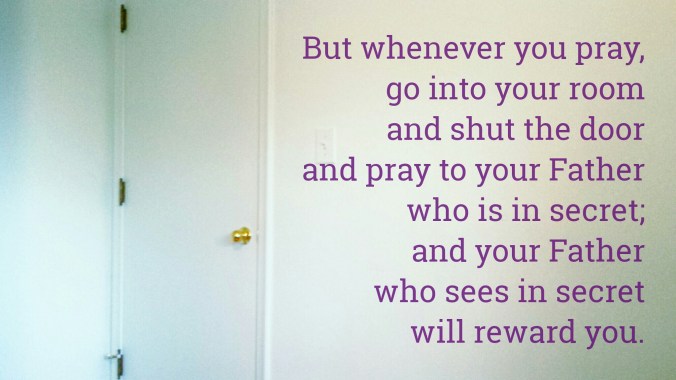
Other than during a tornado watch, when is the last time any of us prayed in a closet? Most of us would probably answer: “Never.” Yet that is exactly what Christ advised his disciples to do: “whenever you pray, go into your room and shut the door and pray to your Father who is in secret; and your Father who sees in secret will reward you.”

Most translations use the word “room” but the Greek is closer to “inner room” – or closet. Of course Christ’s point was not the architecture, but the privacy. Even in Christ’s time, public prayer was often more a bid for the admiration of people, rather than communion with God.

We’ve all heard prayers that sound like the person praying was being paid by the word. Christ tells to pray privately, and not heap on words as if desperately trying to tip some divine scale. Ideally prayer is not a monologue, so it needs a lot of silent time to leave room for God.

When Christ says those who pray or give alms in a public manner have already received their reward, he is commenting on motive. People who make a show of piety in order to win admiration have their reward when someone notices, but not beyond.

On the other hand, going too far the other way and making a show of hiding our deeds is still missing the point. People seeking a relationship with God pray or fast only as an expression of their love for God, and attention (or its lack) doesn’t matter. God isn’t a trophy wife, so Christ teaches us to behave in ways that don’t sully the relationship by making it about other people’s opinions.

From the time we are assigned our first 200-word essay, we are taught the number of words we use is important. One of the toughest lessons for any professional writer is to cut, and cut again, until only meaningful words remain. Perhaps this is why writer Anne LaMott’s two favorite prayers are: “Help me, help me, help me” and “Thank you, thank you, thank you.”

Comfort: God knows what we need before we speak.

Challenge: Find an isolated place to pray.

Prayer: Compassionate God: help me. Thank you.

Discussion: What do you feel is the role of public prayer?

Join the discussion! If you enjoyed this post, feel free to join an extended discussion as part of the C+C Facebook group. You’ll be notified of new posts through FB, and have the opportunity to share your thoughts with some lovely people.

Unthinkable Donkeys

20160320_222231-01.jpeg

Christ Entering Jerusalem by Ernst Deger

Today’s readings (click below to open in new tab):
Psalms 84; 150, Zechariah 9:9-12, 1 Timothy 6:12-16, Zechariah 12:9-11, 13:1, 7-9


The Sunday before Easter is Palm (or Passion) Sunday, when we remember Christ’s triumphal entry into Jerusalem. At the height of his ministry and controversy, Christ entered the city riding a donkey, and the huge crowd gathered for Passover greeted him by throwing palm fronds on the path before him. This gesture was a sign of respect for victorious warrior kings … but that donkey told another story.

The prophet Zechariah wrote about the coming messiah as someone who would “command peace to the nations.” Traditionally a warrior king rode into conquered territory on an armored warhorse to signal his victory and dominance. A donkey, though, sent a message of humility. To a people hoping for a military savior to conquer their oppressors, this idea would have chafed. Yet Zechariah was not the only prophet telling the people of Israel to expect the unexpected. Christ’s reign was accomplished not only through peace, but through subservience, including submission to death on a cross. It was unthinkable. It certainly wasn’t what people wanted to hear, but prophetic voices told them anyway.

Like the Israelites, do we hope to assert our future through force? Every year churchgoers read the passion story and join our voices to those who shouted: “Crucify him!” By Easter we’re back to celebrating the resurrection, and little has changed. Rather than humbly live as we believe, we try to pass laws imposing our beliefs on the nation. We fail to speak truth to power – because in this time and place we are the power. All our talk of peace crumbles when we feel threatened; surely Jesus didn’t expect us to suffer for our faith when we could defend ourselves by going on the offensive?

Jesus enters the world through the poor, the sick, and the oppressed. Through our enemies. When we treat them with love we aren’t doing it on behalf of Jesus – we are doing it for Jesus. Christ reaches us not through merely unexpected avenues, but through unthinkable ones. Following Christ means choosing the donkey instead of the warhorse, even when that palm-strewn road leads to the cross.

Comfort: There are voices telling us how to follow Christ. We just need to learn to listen for them.

Challenge: Be careful not to confuse civic and secular authority with salvation and grace.

Prayer: God of Love, teach me the humble way of Jesus. Grant me ears to hear the truth, even when I don’t like it. Set words of peace and justice on my lips. Amen.

Discussion: What leaders appeal to your sense of anger, force, or division? When they speak, are you able to separate what you want to hear from the truth?

Join the discussion! If you enjoyed this post, feel free to join an extended discussion as part of the C+C Facebook group. You’ll be notified of new posts through FB, and have the opportunity to share your thoughts with some lovely people. Or feel free to comment here on WordPress, or even re-blog – the more the merrier!

Get Over It

image

Today’s readings (click below to open in new tab / window):
Psalms 22; 148, Exodus 9:13-35, 2 Corinthians 4:1-12, Mark 10:32-45


When Christians – or any other religions – gain secular power, trouble follows. Some Christians like to claim we live in a nation that is – or at least should be – Christian. What exactly does that mean? To which particular branch of Christianity do they refer? And most importantly what part of the teachings of Jesus leads them to believe political power is a good influence on Christian character – or vice versa?

Jesus tells his disciples repeatedly, they are to be servants as he is a servant. To be first, they must be slaves of all. We live in a time and place where practicing our faith does not threaten our well-being. On the other hand, having been told that we should expect persecution, we have greatly skewed our sense of what that means. Having no real reason to fear martyrdom, we behave as if any loosening of our grasp on power and control is a form of persecution. For evidence we only need look as far as the trumped up War on Christmas: how did temples to commerce become a battlefront for religious freedom? Then there’s the outrage over religious displays which have been removed from government property or – worse yet! – made inclusive. Government establishment of our religion makes us beholden to that government – the antithesis of what Jesus taught.

In twenty-first century America we simply don’t suffer serious persecution for our faith – unless allowing people to disagree with us or having our feelings hurt has become a form of persecution. Instead of railing against perceived slights, we should celebrate them! When we rub society the wrong way, we’re just doing our job. When we rub other Christians the wrong way, we’re probably earning overtime. Paul says: “We are afflicted in every way, but not crushed; perplexed, but not driven to despair; persecuted, but not forsaken; struck down, but not destroyed.” Does that sound like “Happy Holidays?” When we trade grace for outrage at everyone who doesn’t follow our beliefs, we demonstrate a faith too weak to handle the persecution ladled on those who truly spread the Good (but sometimes unpopular) News.

Comfort: Your faith doesn’t obligate you to be outraged over petty things.

Challenge: A lot of the things we think of as religiously sanctioned – think Christmas shopping – are really not.

Prayer: God of Mercy, help me to walk and speak humbly but confidently in your light. Amen.

Discussion: What things offend you more than they maybe should?

Join the discussion! If you enjoyed this post, feel free to join an extended discussion as part of the C+C Facebook group. You’ll be notified of new posts through FB, and have the opportunity to share your thoughts with some lovely people. Or feel free to comment here on WordPress, or even re-blog – the more the merrier!

Reading the Room

1455538193481

Today’s readings (click below to open in new window/tab):
Psalms 119:73-80; 145, Genesis 37:1-11, 1 Corinthians 1:1-19, Mark 1:1-13


Have you heard the expression “read the the room?” It refers to someone’s ability to gauge an audience’s mood and response. Comedians learn to read a room because every crowd responds differently. Executives read a room to determine the level of support for a proposal. Comedians can change the content of the message to please an audience, but a good leader with an important message can adjust only the style, never the meaning.

Jacob and his son Joseph were not skilled at reading a room.

Jacob’s obvious favoritism toward Joseph left his other eleven sons bitter. When he gave Joseph a special robe with long sleeves, it might as well have had a target embroidered on the back. At the age of seventeen Joseph began having prophetic dreams. In these dreams, his brothers – represented by sheaves of wheat or stars – bowed down to him. Whether he was simply oblivious to his brothers’ scorn, or wanted to spite them because of it, sharing his dreams made them more jealous than ever and they began to plot against him.

As Christians, we will be called to say unpopular things. We can adjust our style (even Paul adapted to local audiences) but we don’t have the option of altering the core message, because it originates with Christ. We want his message about God’s love and justice to be taken seriously and understood clearly.Therefore we should think before we speak, and try to anticipate how we will be perceived. Dressing our message in flamboyant, self-important language and attitude will cause people to react favorably or unfavorably more because of the style than the content. Giving the impression that we believe we are somehow superior to our listeners will give them an excuse stop listening. We want to be confident but not cocky; we are the trusted bearers of the message, not its source. A little humility goes a long way.

Humility will not always prevent others from criticizing, demeaning, or persecuting us for sharing the Gospel. In the end we want to be the best ambassadors for Christ we can be, regardless of the cost.

Comfort: You can have confidence in the Gospel.

Challenge: Work on striking a balance between knowing your audience and remaining true to your message.

Prayer: Loving God, thank you for the Gospel message of love and justice. Lend me strength and wisdom to share it with others. Amen.

Discussion: Have you ever changed your message because it was unpopular? What were the consequences?

Join the discussion! If you enjoyed this post, feel free to join an extended discussion as part of the C+C Facebook group. You’ll be notified of new posts through FB, and have the opportunity to share your thoughts with some lovely people. Or feel free to comment here on WordPress, or even re-blog – the more the merrier!

Ego to Ashes

1455077864911

Today’s readings (click below to open in a new tab/window):
Psalms 5; 147:1-11, Amos 5:6-15, Hebrews 12:1-14, Reading Luke 18:9-14


Ash Wednesday is the day Christians around the world begin the annual Lenten pilgrimage. Most of us will travel more spiritually than physically, and hopefully in a direction taking us closer to God in Christ. Our modes of transportation vary: prayer, fasting, giving something up, taking something extra on – the possibilities are limitless. And like physical pilgrims, we may find we need to carefully select which belongings will travel well to a destination we may not know much about.

Today’s parable from Luke highlights one possession it might be better to leave behind: ego. When we read about the Pharisee who thanks God he is not the tax collector praying nearby, we aren’t surprised Jesus says the tax collector (who is humbly praying for mercy) is more justified before God. Most of us – even religious leaders – identify more with the character of the tax collector than the Pharisee. But should we? Is it truth or ego that tells us we are appropriately humble?

The moment we thank God we are not the Pharisee (or one of the people at that church), we are guilty of his sin: pride and judgment. In Jesus’ time, the message of beloved sinners was revolutionary. People needed to hear it. Twenty centuries on, as a faith community familiar with Jesus’s teachings, we need to be careful not to wear the tax collector’s humility as the latest fashion of outward righteousness. Letting go of the idea that we have the right ideas about God can be scary, because it erodes our comfortable, Christian identity.

As we prepare for our Lenten journey, let’s unpack the thick cloak of ego to make room for humble uncertainty. This type of uncertainty isn’t so much doubt as an intentional loosening of our preconceived notions of God and self, so we can be open to growth. If we cling too tightly to who we are, we are closed to who God would have us become.

Sometimes we are the Pharisee. Sometimes we are the tax collector. Most often we are a mix of both. God will help us find the balance.

Comfort: Our Lenten journey to the cross may be frightening, but the promise of resurrection is certain.

Challenge: What person or group do you possibly feel superior to? Pray for the humility to love them without judgment.

Prayer: Merciful God, give me a heart humble and open enough to know your glory.

Discussion: How are you observing Lent this year?

A Stone’s Throw from Grace

stones-1523693-1279x852

Today’s readings (click below to open in new tab/window):
Psalms 42; 146, Genesis 26:1-6, 12-33, Hebrews 13:17-25, John 7:53-8:11


You don’t have to be a Christian to recognize the quote, “Let he who is without sin cast the first stone.” It’s the pivotal line from a story in John’s Gospel. In this story, the scribes and Pharisees brought to Jesus a woman who’d been caught in adultery. The prescribed Mosaic punishment was death by stoning, but the Pharisees – knowing that stoning wasn’t exactly Jesus’s style – asked him what should be done. They hoped to trap him into contradicting the law so they could bring charges against him. Jesus paused for a bit, wrote something on the ground, and then gave his famous answer. One by one her accusers slipped away until only Jesus was left. He refused to condemn her, saying only “Go and sin no more.”

The inclusion of this story in John’s Gospel is not without controversy. It doesn’t appear in the earliest manuscripts, and many editions of the Bible are sure to note this. It’s kind of ironic that such a questionable story became one of the most recognizable. Why does this story compel us?

Perhaps because – authentic or not – it embodies an idea that it seems we need to hear and learn over and over again. If our relationship with God is about pointing out what other people are doing wrong, instead of humbly examining our own hearts, we aren’t getting the message.

Do we as a faith community need to hear about the reality of sin and immorality? Absolutely. Do we as a faith community need to point to and single out and shame it everywhere we (think we) see it? Absolutely not.

Why is it so many non-Christians (and former Christians) see the faith as full of people ready to cast stones? Well … they’re not entirely wrong. The loudest messages shouted from beneath the Christian banner tend to be ones of condemnation. Now loudest doesn’t mean exclusive or truest or most frequent, but it does disproportionately influence what people perceive and remember.

Christ’s message isn’t one of condemnation; it is of love. We all know John 3:16 and wave it around a lot to point out who is “saved” and who isn’t, but for some reason we don’t spend nearly as much time on 3:17: “For God did not send his Son into the world to condemn the world, but to save the world through him.” Condemnation cuts people off or turns them off, and neither wins anyone to Christ. But we like it. We struggle with (and succumb to) the same temptation as the Pharisees to twist scripture to justify punishing or imposing our will on others. Once Christianity became the dominant force of the Western world, we seemed to forget forcing the Good News on people is bad news.

Grace invites us in and asks us to leave the door open; religion is an excuse to shut people out. When Jesus tells us what is sinful, it’s not so we know when to punish or control other people; it’s so we know when we are creating a rift between ourselves and God. If other’s people sin does not affect us or exploit the innocent, it’s none of our business. In a culture where the Christian majority has learned to take offense at the idea of sharing public space with people who don’t share our faith or values (and we forget even within Christianity they are nuanced), it affects us far less than we like to think it does. Every one of us has enough planks in his or her eye to keep us too busy to worry about someone else’s speck.

We are forgiven. That is a thought that should be so humbling we can’t conceive of throwing stones. Instead, let us pass on the message of grace and love by being Christ’s open hands to the world.

Comfort: God’s love will deliver us from fear.

Challenge: Ask yourself what temptations you find hardest to resist, then ask what need is still not being met by giving in to them.

Prayer: In you O Lord I seek refuge and peace. Amen.

Discussion: What fears drive your behavior?

Join the discussion! If you enjoyed this post, feel free to join an extended discussion as part of the C+C Facebook group. You’ll be notified of new posts through FB, and have the opportunity to share your thoughts with some lovely people. Or feel free to comment here on WordPress, or even re-blog – the more the merrier!

Dress for Spiritual Success

1451793751266

Today’s readings (click below to open in new window/tab):
Psalms 111; 150, 1 Kings 3:5-14, Colossians 3:12-17, John 6:41-47


Whether you leave your house dressed in a bathrobe, a suit and tie, or a wedding dress, it’s the same you underneath. Despite employer dress codes, you are no less competent on casual Friday than you are when dressed for a board meeting at 8:00 a.m. on Tuesday. However there are times when what you wear is crucial. A nurse treating infectious patients must wear protective clothing. Hikers need footwear to provide both comfort and stability. Dancers are hindered if their clothes do not allow freedom of movement.

In his letter to the Colossians, Paul says they should clothe themselves “with compassion, kindness, humility, meekness, and patience” and “love, which binds everything together in perfect harmony.” Some clothes communicate how we intend to interact with the world. Opposing teams and referees all wear different uniforms for a reason. Someone can say “I’m a professional football player” but until they’re suited up and on the field, they’re not playing professional ball. We can quote scripture and doctrine all day long, but if we haven’t put on a Christian attitude, why would anyone believe us?  Sure, meekness might itch a little and sometimes we can’t wait to slip out of that patience at the end of the day, but they are part of the dress code for the best job in the world.

The good news is, once you’ve broken them in, they are pretty comfortable. Kindness feels less like a tie choking off your breathing and more like a scarf keeping you warm. Humility changes from a girdle squeezing in your less virtuous bulges to a support that helps you keep your back straight and head high. None of us are able to display Paul’s list of virtues all the time, but the more conscious we are about putting them on, the more they become part of us, and the more prepared we feel.

These garments will protect you. They will provide comfort and stability. They will give you confidence to move freely in a world that doesn’t always understand what you’re doing. Dressing for success doesn’t have to cost a dime.

Comfort: Love of God and neighbor is the most beautiful thing you can wear.

Challenge: As you are getting dressed for the day, be intentional about putting on your garments of faith as well.

Prayer: Loving God, I will clothe myself in faith to please you and serve your world. Amen.

Discussion: What’s your favorite item of clothing and why?

Join the discussion! If you enjoyed this post, feel free to join an extended discussion as part of the C+C Facebook group. You’ll be notified of new posts through FB, and have the opportunity to share your thoughts with some lovely people. Or feel free to comment here on WordPress, or even re-blog – the more the merrier!

Lake of Doubt

lake-2063957_1920

Today’s readings (click below to open in new tab/window):
Psalms 104; 149, Ezra 9:1-15, Revelation 17:1-14, Matthew 14:22-36


Employers tend to base their decisions about promotions around two criteria: qualifications and seniority. How they balance these criteria depends largely on what kind of business environment they have. In a unionized factory, for instance, seniority plays a larger role than it would in a tech start-up where youth may provide more advantage. Just because someone has been around the longest doesn’t mean they’re the best at their job or the most qualified to lead, manage, or train others and neither does being the best at hottest new skill set. In both cases, and most others, failing to balance these criteria properly poses a danger of setting someone up to fail.

When the boatful of disciples were startled to see Jesus walking toward them across the lake, Peter cried, “Lord, if it is you, command me to come to you on the water.” As Peter crossed the water the wind picked up and he panicked and began to sink. Of course Jesus didn’t let him drown, but pulled him from the water and said “You of little faith, why did you doubt?”

After the boat landed at Gennesaret, word spread quickly among the people. They brought many sick people to Jesus and sought “to touch even the fringe of his cloak; and all who touched it were healed.”

Peter, who had been with Jesus since the beginning, thought he had the faith to follow Jesus anywhere and folded in the crunch, but among the people of Gennesaret who had little experience but lots of faith many were healed . It’s probably no accident these stories appear back-to-back in Matthew’s Gospel. In earlier chapters, the author stresses that what Jesus is able to accomplish through us depends a great deal on the degree of faith we exhibit.

The less susceptible we are to worldly distractions, and the more we rely on Christ than ourselves, the more confidently we can stride across that lake of doubt. Some of that comes from experience, and some from the childlike faith which is too fervent to be discouraged. It is a balance we must learn to recognize within ourselves. Jesus doesn’t set us up to fail, so let’s not do it to ourselves by second guessing him or imposing our own will. Whether we’re Peter or a hopeful stranger, let us be humble enough to trust Christ will do what he says he will. It is through humility he promotes the first to be last.

Comfort: Christ is invested in your spiritual success.

Challenge: Try to be honest objective when understanding your own strengths and weaknesses.

Prayer: Lord I believe. Help my unbelief. Amen.

Discussion: How does doubt hold you back?

Join the discussion! If you enjoyed this post, feel free to join an extended discussion as part of the C+C Facebook group. You’ll be notified of new posts through FB, and have the opportunity to share your thoughts with some lovely people. Or feel free to comment here on WordPress, or even re-blog – the more the merrier!

Enforced Belief (And Other Myths)

Ghirlandaio,_Domenico_-_Calling_of_the_Apostles_-_1481

Commissioning the Twelve Apostles depicted by Domenico Ghirlandaio, 1481

Today’s readings (click below to open in new tab/window):
Psalms 135; 145, Jeremiah 36:11-26, 1 Corinthians (13:1-3) 13:4-13, Matthew 10:5-15


When Jesus sent out the Twelve to spread the Gospel to the “lost sheep of the house of Israel,” he gave them several instructions. They were to accept no payment for any of the healing they did. They were to take not much more than the clothes on their backs, for the people should show them hospitality. When they reached a town or village, they were to select a worthy home to stay in, and “let [their] peace come upon it.” If the house turned out not to be worthy, they were to “let [their] peace return to [them].” And if any town or house would not welcome them, they were to shake its dust from their feet as they left it.

Note the absence of any type or coercion or retaliation. The fate of anyone who rejected the Gospel was ultimately between them and God. Of course the Twelve had no legal authority to enforce belief, but then again “enforced belief” is an oxymoron. Without the power of an empire behind them Jesus and his disciples were an all-volunteer movement. So how did Christianity become less about sacrificing and suffering for our beliefs and more about making others suffer for not agreeing to share them?

Jesus asks us to share the Gospel, but he doesn’t ask us to enforce it. When the Twelve met resistance, they simply withdrew the only thing they had to offer, which was the peace they knew. If someone doesn’t want to embrace the message, there’s not much we can do about it. Petty pressures like trying to wring a “Merry Christmas” out of a  cashier in a setting that is essentially a temple to commerce only reinforces the stereotype that Christians are intolerant. Do such actions seem like the love Paul describes in Corinthians – a love which is patient, kind, and does not insist on its own way? Real evangelizing begins with vulnerability.

A Christianity consumed with exerting the upper hand is far removed from the Beatitudes, the Apostles, and the greatest who seek to be least. Jesus said we are blessed when we are persecuted for his name’s sake, not when we persecute in his name. When emperors (and their admirers) claim to be wearing Christian clothes but are more interested in destroying perceived enemies than loving them, speaking the naked truth in humility may be the most powerful witnessing we can do.

Comfort: Jesus is a comfort to the afflicted…

Challenge: …and an affliction to the comfortable.

Prayer:  Rejoice in the LORD, O you righteous,
and give thanks to his holy name! (Psalm 97:12)

Discussion: Do you think there is such a thing as a Christian nation?

Join the discussion! If you enjoyed this post, feel free to join an extended discussion as part of the C+C Facebook group. You’ll be notified of new posts through FB, and have the opportunity to share your thoughts with some lovely people. Or feel free to comment here on WordPress, or even re-blog – the more the merrier!

Whaddya know?

adult-education-2706977_1920.jpg

Today’s readings (click below to open in new tab/window):
Psalms 122; 149, 2 Kings 11:1-20a, 1 Corinthians 7:10-24, Matthew 6:19-24


In his first letter to the Corinthians, Paul offers a teaching to men and women who have become followers of Christ, but whose spouses are unbelievers. He tells them not to divorce if the unbeliever still consents to stay together; indeed the unbelieving spouse is made holy by their union and may yet be saved. However if the unbelieving partner leaves, the believer is not bound by the marriage.

Paul makes clear to his audience an important distinction about this teaching and some of his others: it comes from him, not from God. Paul’s marriage advice was based on faithful conclusions he drew from his best understanding of Christ and the gospel, and undoubtedly he fully believed what he was saying, but he was still humble enough not to speak on behalf of God.

A lot of preachers – and for that matter a lot of lay people – fail to make that same distinction, even internally.

For example, we all know about television and radio evangelists, and local clergy as well, who just can’t seem to resist any opportunity to blame a natural disaster on some group of sinners. They will declare it the wrath of God or a message from Christ without any evidence beyond their own axe to grind. For purposes of this comparison it doesn’t even matter whether they are right: what matters is they don’t know whether they are or not, but claim it as if God told them personally. Talk about taking the Lord’s name in vain.

We can know better. More importantly, we can do better. Let’s never be so certain we know who God wants to punish that we don’t leave room for mercy. Remember Zoar? That’s the city God spared, but people who want us to remember (and misrepresent) only Sodom and Gomorrah don’t tend to bring it up. And then there’s Nineveh: God strong-armed his not-so-faithful servant Jonah into convincing them to repent when Jonah would rather have seen them destroyed.

Our national or cultural enemies – even the sinners we really think ought to – do not define God’s enemies. Our thoughts – even ones that seem soundly theological – are not God’s thoughts. We want to be very careful not to attribute our own words to God. Better to faithfully ponder and acknowledge how little we know for a lifetime than to try standing firm on nothing.

Comfort: Great faith doesn’t always have answers.

Challenge: Don’t try to make your biases into God’s biases.

Prayer: I will bless you as long as I live; I will lift up my hands and call on your name. (Psalm 63:4)

Discussion: What’s the difference between admitting what we don’t know, and being the type of “lukewarm” believer Christ warns against?

Join the discussion! If you enjoyed this post, feel free to join an extended discussion as part of the C+C Facebook group. You’ll be notified of new posts through FB, and have the opportunity to share your thoughts with some lovely people. Or feel free to comment here on WordPress, or even re-blog – the more the merrier!