Astounding Gifts

1472184908647.jpg

Today’s readings (click below to open in new tab/window):
Psalms 88; 148, Job 9:1-15, 32-35, Acts 10:34-48, John 7:37-52


“The circumcised believers who had come with Peter were astounded that the gift of the Holy Spirit had been poured out even on the Gentiles.” (Acts 10:45)

This verse illustrates the difference between superficial acceptance and true inclusion, a distinction sometimes lost on the most well-meaning individuals and communities. Sitting at a table with Gentiles was a major step forward for the Jewish apostles, but until the Spirit poured gifts upon the new arrivals, the apostles were unready to accept them as worthy of the same baptism in Christ.

How long do we wait until we truly include new people in our faith community? We almost always let them in the door, and eagerly recruit them for bake sales or nursery duty, but when do we stop thinking of them as the “new” people? Do we wait until they somehow earn our approval, like the apostles did, or do we start treating them as equal members of the body of Christ ASAP? Each person brings their own astounding gifts, so by keeping them at arm’s length we do a disservice to ourselves. Each person also comes with their own baggage and flaws, and we can’t be present with them in their struggles until we accept those, too. It’s not like we don’t have our own… Beyond that, it is simply the Christian thing to do.

Conversely, sometimes we withhold our own gifts until we are confident a community has fully embraced us. While it’s natural to be cautious when entering a new group, too much hesitation may send a false signal that we want to maintain distance. Our own gifts are for sharing, because life in a Christian community is a two- (and twenty- and two hundred-) way street. Being part of a community means offering support to it as we are able, as much as expecting it to be there for us.

We may not even know we possess a gift until the community invites us to take a risk. A gift is something you give, not something you hoard. Let us give and receive them with equal enthusiasm.

Comfort: Christ teaches us we are truly accepted, and to be truly accepting.

Challenge: Look for opportunities to share your gifts. Don’t be shy.

Prayer: God of truth, thank you for bestowing, revealing, and using the gifts of your people. Amen.

Discussion: Have you ever been surprised to discover a gift in yourself or someone else?

Join the discussion! If you enjoyed this post, feel free to join an extended discussion as part of the C+C Facebook group. You’ll be notified of new posts through FB, and have the opportunity to share your thoughts with some lovely people. Or feel free to comment here on WordPress, or even re-blog – the more the merrier!

Invitation: Helicopter

image


We live right across the street from a hospital with a helipad. Several times a week – or maybe several times a day on long summer holiday weekends – we can hear the emergency helicopter landing and taking off. From inside the house it sounds no louder than a leaf blower, but outside the protection of our thick walls, on the front porch or in the yard, the deafening sound is a physical presence pushing against your sense of safety.

Every time I hear the helicopter, I am conflicted. The choppy roar of its rotors means someone has been injured severely. But that sound also means there’s a chance that person can be saved, a chance that didn’t exist before air ambulances were available.

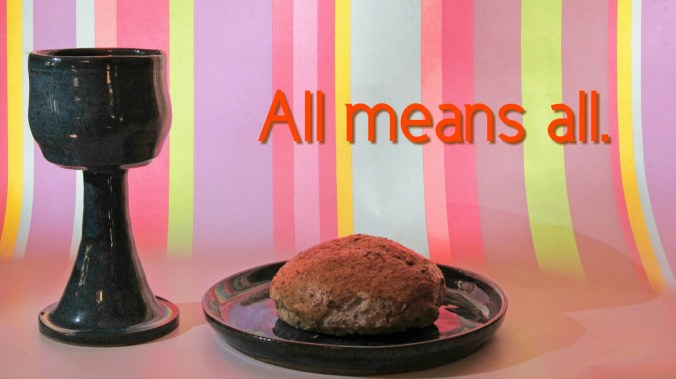
This is not unlike the conflict I feel at the communion table.

The Eucharist exists because we, as individuals and a species, suffer from severe spiritual injuries. It is a weekly reminder that we are broken in ways that need serious attention. It is also a reminder that we can be saved. There was a time, the time before Christ offered to love us into wholeness, when we were offered no hope for such injuries. I’m sad it is necessary but so grateful for its presence. What a bittersweet balance.

Inside the walls of the church, the Words of Institution are more comfort than disturbance: “Before Jesus was given up to death, a death he freely accepted, he gave You thanks…” Outside the walls of the church, these words can seem threatening to the injured. Imagine being hurt so badly you need to be airlifted to a hospital. Imagine the overwhelming sound and chaos and immensity of a helicopter descending onto your broken body. That doesn’t feel like hope – that feels like disaster.

When we invite someone to the table for the first time, we need to understand a lifeline sometimes looks like a noose. Where we appreciate the helicopter because it’s already saved us, they may just hear a confusing, even frightening, noise. We don’t fix that by speaking more loudly (or more frequently, or more insistently). We fix it by offering to ride with them, to hold their hand, and to stay by their side until the fear and pain have passed. Until it sounds like hope.

If you are a frequent guest of the table, extend your hand. If you have never come to the table, please accept that hand and try to believe the fear does not outweigh the promise. Our pilot has only your salvation at heart.

May the peace of the Lord Jesus Christ be with you all. Amen.

Invitation: yinzgimmegum

1463341210136.jpg

The ride from New Castle, Pennsylvania to South Bend, Indiana is just shy of six hours – depending on the driver. In August of 1985 I made this trip with my parents so they could drop me off at school for my freshman year. About mid-trip, my mouth started to feel a little dry. My mother always had some mints or gum, so I leaned into the front seat to ask for some. Now I grew up in a Western Pennsylvania area with a very specific dialect popularly known as “Pittsburghese,” so while other people might have asked “May I have some of your gum?” I rapidly blurted: “Hey yinz gimme gum?” Continue reading

Invitation: I Can See Clearly Now

1461528876101.jpg

Lately I’ve been thinking a lot about my eyes. Design-wise they aren’t so great. I am very near-sighted. I’m fortunate that my vision is easily corrected with glasses or contacts, but without corrective lenses my adult vision has landed somewhere between 20/220 and 20/240. Legal blindness is 20/200 in the better eye. I can’t read normal print more than about 6 inches from my face, and headlines are a strain at arm’s length. Since eyeglasses weren’t invented until the latter half of the 13th century, I am grateful to have been born afterward. In the 12th century, despite a pretty capable brain, my options would have been quite limited by my visual impairment. My potential – maybe my understanding of the world – would probably never have exceeded the length of my arm. Ironically, my inability to see would have rendered others unable to see me for who I truly was. Continue reading