Math Nerd Theology

1452489798883

Today’s readings (click below to open in new tab/window):
Psalms 5; 145, Genesis 2:4-9 (10-15) 16-25, Hebrews 1:1-14, John 1:1-18


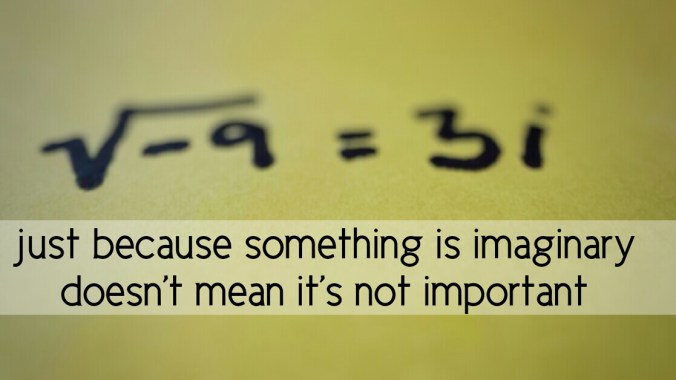
First, a short math lesson. When you square any number, positive or negative, the result is always a positive number: 3 x 3 = 9 and -3 x -3 = 9. Fairly straight forward, yes? (If not, don’t worry; there won’t be a quiz). However, some equations can’t be solved without finding the square root of a negative number. Since such a number does not exist, mathematicians invented an imaginary unit named i. Perhaps it’s more correct to say they discovered it; philosophers have debated for centuries whether mathematical concepts are invented or discovered. In either case, the square of i is -1. No one can hold up i fingers or charge $i for a pound of bananas, but i is necessary to calculate the square root of -9, which is 3i. 

End of math lesson. But what was the point?

The Gospel of John tells us that in the beginning, there was the Word, and the Word was with God, and the Word was God. In the original Greek, John uses the term logos, which means “word” but also means “reason.” John’s logos is Christ, so John is claiming Christ has been present and co-existent with God from before the beginning of the world. How can this be? Like i, faith in the logos solves an otherwise impossible problem. John has no direct evidence for it, but he invents/discovers it to make sense of God’s relationship with the world expressed through Christ. Some may call it imaginary, but it is also necessary.

Critics of faith often mock it for lacking reason. If your faith comes under fire for being unreasonable, think of i (but not too hard, or your brain may start to itch). Just because something can’t be pointed to or counted doesn’t mean it’s not essential to the fabric of the universe. We don’t call the entire field of mathematics a sham because it relies on an “imaginary” unit. The claim of Hebrews 11:1 that “faith is the evidence of things unseen” is our version of i, the necessary but unknowable solution for morality, eternity, and the soul.

And we thought algebra would never be good for anything.

Comfort: Faith isn’t about seeing, but believing.

Challenge: Call your algebra teacher and apologize for not paying more attention.

Prayer: All powerful Creator, I thank you for being present in the world, though your mystery is beyond my understanding. Amen.

Discussion: Have you ever found a use for something you thought would be useless when you learned it?

Join the discussion! If you enjoyed this post, feel free to join an extended discussion as part of the C+C Facebook group. You’ll be notified of new posts through FB, and have the opportunity to share your thoughts with some lovely people. Or feel free to comment here on WordPress, or even re-blog – the more the merrier!


Why Three Kings?

1452051859496

Today’s readings (click below to open in new tab/browser):
Psalms 72; 147:1-11, Isaiah 49:1-7, Revelation 21:22-27, Matthew 12:14-21
Epiphany readings: 
Isaiah 60:1-6, Ephesians 3:1-12, Matthew 2:1-12


Today we celebrate Epiphany, the manifestation of Christ to the gentiles. Traditionally the gentiles are represented by the Magi. The gospel of Matthew tells us wise men followed a star from the east, paid tribute to the infant Christ, and returned home by a different route because a dream warned them King Herod was plotting against the newly-born messiah. Most nativity scenes depict them as three kings, though there is no scriptural basis for their rank or count other than the number of gifts.

Maybe they’re better off dropping the king bit and sticking to being just wise. Psalm 72 describes what it means for God’s presence to be felt throughout the gentile world, and kings don’t fare well. They bow before the presence, offer tribute, and oppressive ones are crushed. On the other hand the poor, needy, and oppressed are mentioned favorably ten times in this twenty-verse psalm. God judges them with justice; he defends, delivers, redeems, helps, pities, and saves them. Jesus’s message of the first being last and the last being first doesn’t originate with him; it is a natural evolution of the messages of the psalmists and the prophets. Jesus is the one who brought it home.

A mainstay of modern Roman Catholic social teaching is a preferential option for the poor. In other words, Christians are obligated to serve those who are impoverished financially and/or spiritually. Theologians of other denominations share similar teachings. Depending on our worldview, how we choose to meet that obligation can take many forms. Christ has trusted us with a duty, and also trusts us to determine the best means to execute that duty. Sometimes that means we can disagree about how we should serve. What it never means is starting from an attitude where the poor – of pocket or spirit – are a nuisance, morally lacking, or lesser than anyone else. Whatsoever we do for the least among us, we do also for Christ. We are to be kings bowing to babes.

The Magi’s gifts of gold, frankincense, and myrrh represented royalty, holiness, and death. Jesus re-gifted them to us as humility, grace, and life regardless of our worthiness. Let’s pay it forward.

Comfort: God’s love is for all, not just the privileged or perfect.

Challenge: What programs in your local community help the poor? How can you help them?

Prayer: Loving God, thank you for all I have. I will not forget that you ask me to share it with those who have less. Amen.

Discussion: We are often distrustful or uncomfortable with people who have significantly more or less material wealth than we do. Why do you think that is?

Join the discussion! If you enjoyed this post, feel free to join an extended discussion as part of the C+C Facebook group. You’ll be notified of new posts through FB, and have the opportunity to share your thoughts with some lovely people. Or feel free to comment here on WordPress, or even re-blog – the more the merrier!
It Takes a Village to Raise a Lazarus

community

Today’s readings (click below to open in new tab/window):
Psalms 99; 146, Jonah 2:2-9, Ephesians 6:10-20, John 11:17-27, 38-44
Eve of Epiphany Readings:
Isaiah 66:18-23, Romans 15:7-13 


Is  faith sufficient as an individual experience, or does it need to be shared among a community of believers? When Jesus returned to Bethany because his friend Lazarus had died, the grief of Mary and Martha, sisters of Lazarus, was certainly shared. Neither knew what to expect, but they shared faith in Jesus. They only knew that in their time of great grief, they needed to be with him. Even after he told them he was the resurrection and the life, the sisters didn’t imagine he would bring Lazarus back to them. When he asked the mourners to roll back the stone covering the tomb, Martha said four days had passed and there would be a stench. Yet moments later Jesus commanded Lazarus to walk out of the tomb, and he did.

Jesus was the source, but it was a community that made his final sign meaningful.
Mary and Martha, each with an imperfect but united faith, together believed that whatever Jesus thought fit to ask, God would deliver. At least a few mourners must have volunteered to move the stone, as it was large and heavy enough to cover the mouth of a cave. The gathered crowd  listened to Jesus loudly giving thanks to God for their benefit so they might believe. Finally, Lazarus arose and returned to his friends and family, restoring their community.

Experienced in isolation, faith may be a comfort to us but it’s of little use to the greater body of Christ. When a community shares its faith – when one person answers Christ’s call to dive into the stench and darkness of tombs like poverty and disease, and another person trusts God to provide even when a loved one is caught in the hopeless living death of addiction, and the rest of us are inspired by and act because of their belief, and therefore sisters and brothers we thought lost forever return to us – that community finds new life as no individual could.

Faith requires community to achieve its fullest expression. Our own imperfect faith is a gift because it reminds us to seek others.

Comfort: When you have faith you are never alone.

Challenge: Explore a faith community that is unfamiliar to you.  Perhaps a charity, or another congregation. If you can, spend some time helping them with their mission.

Prayer: Thank you God for easing my burden by making me only one member of a larger body in Christ. Amen.

Discussion: What do you find most rewarding about community? Most difficult?

Join the discussion! If you enjoyed this post, feel free to join an extended discussion as part of the C+C Facebook group. You’ll be notified of new posts through FB, and have the opportunity to share your thoughts with some lovely people. Or feel free to comment here on WordPress, or even re-blog – the more the merrier!

Spit, Mud, and Healing

brokenwhole

Today’s readings (click below to open in new window/tab):
Psalms 20; 145, Joshua 3:14-4:7, Ephesians 5:1-20, John 9:1-12, 35-38


All four gospels tell the story of Jesus healing a blind man on the Sabbath. The mechanics of it are simple: he spits on the ground, makes mud, and rubs it on the man’s eyes. Afterward the man rinses the mud off and can see. Mud and spittle were a common enough medical treatment in the Greco-Roman world of the period, so it’s very likely someone had tried this remedy before, maybe more than once. What was so different about Jesus? We could say “He was the magic son of God!” and be satisfied with that answer, but the story reveals more.

Jesus started from a different perspective than the people around him: they believed the man was blind because he had sinned, but Jesus told them that was not true. Instead, he saw an opportunity to reveal God’s glory by helping someone who hadn’t even asked for help.

How much dirt and spit have we wasted by pre-judging a situation? How could a different perspective help transform the most common, mundane elements in our lives into opportunities to reveal God’s love to the world? Residents of Cateura, Paraguay are a fine example. Their survival depends on harvesting recyclables from an enormous trash dump just outside one of the poorest slums in South America. But in this, they have found beauty: they have crafted a world-renowned children’s orchestra of instruments made from discarded articles pulled from the dump.

A blind beggar turned into a prophet. Broken pipes turned into flutes. The people and things in our lives that seem broken or useless transformed by the power of the Spirit into … what? We may not restore someone’s sight, but we can help restore hope, peace of mind, or the simple comfort of a hot meal and a warm bed. What if we have dirt or spittle (metaphorically speaking) but not both? Then we have an opportunity to combine our resources with another person’s, and the invitation for the working of the Spirit is doubled (or tripled, or…). Looking with Christ’s eyes, we see brokenness as only the first step toward wholeness.

Comfort: No matter how broken we may be, God can put us back together.

Challenge: What relationships or situations in your life have you written off as too broken to fix? Ask a friend or mentor how you might change your perspective on the situation to better resolve it.

Prayer: Gracious God, teach  me to see opportunities instead of problems. Amen.

Discussion: Have you ever witnessed or experienced healing where others had written off any such possibility?

Join the discussion! If you enjoyed this post, feel free to join an extended discussion as part of the C+C Facebook group. You’ll be notified of new posts through FB, and have the opportunity to share your thoughts with some lovely people. Or feel free to comment here on WordPress, or even re-blog – the more the merrier!

Christmas Every Day

1451071069675

Readings:  Psalms 2; 148, Micah 4:1-; 5:2-4, 1 John 4:7-16, John 3:31

Today is the day! The long-awaited Christ has come. We shout “Emmanuel!” because God is with us in the flesh. The spirit of this holiday is expansive enough to include many other traditions like brightly lit trees and gift exchanges which, while not uniquely Christian, reflect our joyous celebration.

Tomorrow, or maybe even as early as this evening, we will begin thinking about the clean-up. Most Christmas trees will be down before the new year begins; a few may make it until Epiphany – the day marking the end of the twelve day season of Christmastide. The annual “War on Christmas” will declare its annual 11-month cease-sire as merchants clear the way for Valentine’s Day and summer fashions. Many people who thought it was crucial for cashiers and baristas to say “Merry Christmas” during the entire season of Advent will stop caring on December 27th without realizing the irony.

The intense activity of Christmas – or at least the effort we invest in its more secular aspects – is not sustainable all year long. We may talk about keeping the spirit of Christmas in our hearts all year long, but we aren’t all that good at it. After the holidays, donations to food banks and other charities drop dramatically, but the needs they serve do not diminish. Christmas as a special day of celebration is wonderful, but Jesus did not remain an infant forever, and after Christmas the way we celebrate him must also mature.

We can bring light into dark places through acts of kindness and attitudes of love. We can offer gifts of time, talents, and money so we love people in need as children of God more than once a year. Instead of seeking meaningless offense at otherwise well-intended holiday greetings, we can speak loudly against words and actions of actual oppression and injustice. Like the infamous inn, our lives can become so full we turn away the arrival of Christ without realizing what we’ve done. We can create room by living as if Christmas is not the end of a season, but the beginning of a life where Christ dwells within and among us.

Comfort: Christmas is more than a day; it’s a life of hope, love, peace, and joy.

Challenge: Over the next 11 months, plan a monthly Christmas “celebration” to bring the light of Christ into places and lives that need it.

Prayer: [Read Psalm 96 or Psalm 98, aloud or to yourself].

Discussion: Do you have any Christmas traditions that you could revisit throughout the year?

Join the discussion! If you enjoyed this post, feel free to join an extended discussion as part of the C+C Facebook group. You’ll be notified of new posts through FB, and have the opportunity to share your thoughts with some lovely people. Or feel free to comment here on WordPress, or even re-blog – the more the merrier!

The Joy of the Unexpected

1450947693329

Readings: Psalms 18:1-20; 147:12-20, Isaiah 60:1-6, Galatians 3:23-4:7, Matthew 1:18-25

Every year at Christmas time we revisit the Nativity story in scripture readings and carols. The words and melodies bring us comfort and joy in part because they are so familiar and meet our expectations. This comfort in the familiar is kind of ironic considering the Nativity story itself is one of upended expectations and surprises.

First we have Mary, the mother of Jesus. Of everyone in the story, she has the most to be surprised about. No one expects a visit from an angel who announces God will create a child in your virgin womb. Then there’s Joseph, Mary’s betrothed. He doesn’t expect Mary to become pregnant, and he doesn’t expect divine intervention in the form of a dream telling him to stay with her. In an important subplot, we have Mary’s relatives Elizabeth and Zechariah. These two are both surprised by Elizabeth’s late-in-life pregnancy. All of these people have a trait in common (though Zechariah took a little while to come around): they all adapt to the unexpected. Every one of them had reasons to be doubtful, frightened, or resentful. Instead they chose to alter their plans to reflect their new circumstances, and thus ushered into life John the Baptist and Jesus the Christ.

The message of the Nativity is this: God enters the world in unexpected ways. If we insist on our own plans rather than God’s, we may never notice opportunities to share in the greater plan unfolding across history.

The unexpected can be frightening, but it is both inevitable and constant. When confronted with the choice to resist or embrace the unexpected, the former limits us, and the latter unlocks our potential. The quick decision to befriend a stranger we might have avoided may be where we both see Christ in action. An invitation to lead or serve in unfamiliar ways may reinvigorate a flagging ministry. An unplanned job termination may result in a meaningful vocation we never considered. It seems God rarely calls the prepared, but prepares the called. Let us joyfully meet Christ where he shows up, instead of missing him because we insist on looking only where planned for him to be.

Comfort: The unexpected is often a blessing waiting to be claimed.

Challenge: Ask yourself which of your plans are in conflict with God’s plans for you.

Prayer: God of mystery and grace, I will seek you wherever you lead. Amen.

Discussion: What unexpected event or encounter has influenced your life?

Join the discussion! If you enjoyed this post, feel free to join an extended discussion as part of the C+C Facebook group. You’ll be notified of new posts through FB, and have the opportunity to share your thoughts with some lovely people. Or feel free to comment here on WordPress, or even re-blog – the more the merrier!
Love Dangerously

1449898213207

Readings: Psalms 90; 149, Haggai 2:1-9, Revelation 3:1-6, Matthew 24:1-14


Love hurts.

More than a pop song cliche, it’s a truth which is unpleasant and unavoidable – unless we opt out of love altogether. Whether we cause the pain or feel it, every relationship is eventually tested. Marriages struggle. Children leave home. Children fail to leave home. Friends let us down. The songs are usually about romantic love, but it’s true even of the agape love practiced by followers of Christ.

How many times heard someone say (or said ourselves), “I just don’t want to be hurt … again?”  Maybe they were cheated on. Maybe they were taken advantage of. The reasons for hurt are endless but here’s the thing: we already hurt, because we are already broken people in a broken world. There is no “again;” there is only “still.”

The pain of love is different from the pain of brokenness. The pain of love is like a bone being set, a wound being drained, or the pain of pouring out our secrets to a therapist. It is a productive pain and if we choose to avoid it, healing eludes us.

When Christ asks us to love God and to love one another, he promises us a spiritual comfort but does not promise us a life free of pain or danger. To the contrary, he warns us our choice to follow him into a life of agape love will cause many to scorn us and possibly put us in harm’s way. That harm isn’t always physical. Sometimes it is an injury to the spirit that occurs precisely because we have chosen to help others. Loving leaves us vulnerable.

Like our bodies, our spirits have an instinct to recoil from that which hurts us. As the Great Physician, Jesus tells us the remedy often means taking a greater risk and putting ourselves in danger of more pain – not to become victims or masochists, but to improve our spiritual health. Eventually love mends the breaks and wounds in our spirit, but we must take risks.

Love hurts. Not loving hurts more, because improperly set spiritual bones leave us as hobbled as physical ones.

Comfort: It may take a long time, but loving others heals our own brokenness.

Challenge: For an example of love that valued risk over comfort, read this perspective on Mary, the mother of Jesus.

Prayer: Loving God, give me the courage to love, even when doing so is dangerous. Amen.

Discussion: Different people have different methods of expressing love and recognizing when they are loved. What are yours? (If you’re not sure, maybe take a look at the The 5 Love Languages site of Dr. Gary Chapman).

Join the discussion! If you enjoyed this post, feel free to join an extended discussion as part of the C+C Facebook group. You’ll be notified of new posts through FB, and have the opportunity to share your thoughts with some lovely people. Or feel free to comment here on WordPress, or even re-blog – the more the merrier!

Love Anyway

1449813512085

Readings: Psalms 102; 148, Haggai 1:1-15, Revelation 2:18-29, Matthew 23:27-39


Jesus told the Pharisees: “I send you prophets, sages, and scribes, some of whom you will kill and crucify, and some you will flog in your synagogues and pursue from town to town” (Matt 23:34). A little later he added: “How often have I desired to gather your children together as a hen gathers her brood under her wings, and you were not willing!” (v 37). Through his frustration, the underlying message is: love keeps trying until there is nothing left to do.

This is not so different from the frustration we feel when a child’s battle with substance abuse leads to repeated betrayal. When a friend’s mental illness seems determined to isolate her from others. When a sibling refuses to forgive family disputes.

To a lesser degree we may feel it when we do volunteer work and recipients seem less than grateful. Or when they seem to take advantage of our generosity. Or when sincere but fumbling attempts to support a disadvantaged group are met with suspicion or criticism.

One natural response to perceived rejections is to give up on loving, perhaps telling ourselves to save our love for where it is appreciated. Another response, one much more difficult and requiring sincere humility, is to examine whether we could try to love them differently. God extended all possible chances despite knowing the outcome. Should we do less?

We can’t cure another person’s addiction or illness. We can’t force people to express gratitude in a manner acceptable to us. We can keep reaching out in love to a person drowning in suffering, until he either accepts our hand or is pulled beneath the waves. God knew the Jewish people would not heed his cries until it was too late, but love compelled him to keep trying. If we love someone thinking we can save them, we will inevitably be disappointed. If we love someone with an agenda that serves our ego more than their need, we will burn out. When we love someone without expectation, we become a steady light in the darkness.

Comfort: We are not responsible for how others respond to our love; only to love them anyway.

Challenge: When you feel your love is rejected, consider doing something differently.

Prayer: I keep the LORD always before me; because he is at my right hand, I shall not be moved. (Psalm 16:8)

Discussion: When you feel your love is rejected, redirect it.

Join the discussion! If you enjoyed this post, feel free to join an extended discussion as part of the C+C Facebook group. You’ll be notified of new posts through FB, and have the opportunity to share your thoughts with some lovely people. Or feel free to comment here on WordPress, or even re-blog – the more the merrier!
Love Generously

1449724358670

Readings: Psalms 18:1-20; 147:12-20, Amos 9:1-10, Revelation 2:8-17, Matthew 23:13-26

Have you ever wondered why gold is such a valuable currency? It boils down to a few reasons: it doesn’t corrode or react easily with other substances; it’s rare but not too rare; it melts at a high enough temperature to be stable but not so high as to be unworkable; and it is an easily identifiable color. Most importantly, it is valuable because we agree it is.

When Jesus chastises the temple officials by calling them “blind guides” because they teach the faith without comprehending it, he says they value oaths made on the gold in the temple more than oaths made on the temple itself. He asks: “[W]hich is greater, the gold or the sanctuary that has made the gold sacred?” (Matt 23:17). Knowingly or not, these leaders had agreed on what they valued most, and they chose poorly.

Our time and energy are our most precious currency, each minute a coin we choose to spend in some way. What have we agreed deserves our investment? The treasures we gather up in life are only valuable if they are made sacred by the love and faith surrounding them. If our money doesn’t go toward helping those in need, if our home is not open to those seeking shelter, if our larders are locked away from the hungry … of what value are they? If their only value is in the having, then we are like dragons afraid to leave our cave because the world might sneak in and steal our hoard. Gold is nothing but a heavy, beautiful shackle until we bring our treasure to the temple where it can be converted to the limitless currency of love. We must spend it to make more.

True agape love does not corrode and is not eroded by circumstance. It is rare, but not so rare we can’t mine it within ourselves. It is malleable enough to suit many needs, but stable enough to be reliable. People know it when they see it. Perhaps the whole world does not agree on its value, but within the temple of Christ’s body,  it ransoms the world.

Comfort: Our treasure is not measured by what we keep, but by what we give away.

Challenge: If you don’t already do so, consider pledging a small monthly amount to a charity of your choice (other than or in addition to your church).

Prayer: Loving God, I commit my treasures to your service. Amen.

Discussion: What types of investment do you consider to be wise ones?

Join the discussion! If you enjoyed this post, feel free to join an extended discussion as part of the C+C Facebook group. You’ll be notified of new posts through FB, and have the opportunity to share your thoughts with some lovely people. Or feel free to comment here on WordPress, or even re-blog – the more the merrier!

Love Obediently

1449555465030

Readings: Psalms 33; 146,  Amos 7:10-17,  Revelation 1:9-16,  Matthew 22:34-46


When a Pharisee lawyer asks Jesus which is the greatest commandment, he replies:

You shall love the Lord your God with all your heart, and with all your soul, and with all your mind.’ This is the greatest and first commandment. and a second is like it: ‘You shall love your neighbor as yourself.’ On these two commandments hang all the law and the prophets.

– Matthew 23:37-39

This famous passage is one of the most direct answers Jesus provides. These two commandments are simple, yet they lack specificity. Exactly how are we supposed to love our God and our neighbors? Or for that matter, ourselves? Is God commanding us to feel a certain way, and if so … is that even something we can control?

We like to say that nothing is impossible with God (Luke 1:37), but we can also be assured God does not ask us to do the impossible. In the case of these commandments, “love” is not expressed in feelings; rather it is demonstrated in attitudes and an actions. Loving a creator we can’t see or hear may be challenging, but we can maintain attitudes of praise, gratitude, and a healthy kind of fear.

Regarding neighbors, we can love someone in a Christian sense without feeling any affection for them at all. We demonstrate it by respecting all persons as beloved creatures of God, offering charity when needed in a manner that respects the dignity of the recipient, and doing the hard work of forgiving offense. Some people will say being nice to someone we don’t like – maybe the opinionated brother-in-law who sucks all the air out of the room on Christmas Eve – is a form of hypocrisy, but that’s only true if we speak of or do ill to them when they aren’t around. The agape love Jesus calls us to is indifferent to our actual feelings. Otherwise, it’s not sacrificial at all. We’re allowed not to like someone. We are called to love them anyway.

And the “ourselves” part? It is perfectly fine to have boundaries and expectations that we will also be respected. Sacrificial love is about the betterment of others, not the abasement of ourselves. Sometimes we suffer because we love, but we don’t love because we suffer. To love is to approach the world and its inhabitants as though God has entrusted their care personally to us … because God has.

Comfort: Our loving actions can heal our unloving hearts.

Challenge: Pay attention to whether your emotions are dictating your actions, or vice versa.

Prayer: Let your steadfast love, O LORD, be upon us, even as we hope in you. (Psalm 33:22)

Discussion: Do you feel you can love someone without liking them?

Join the discussion! If you enjoyed this post, feel free to join an extended discussion as part of the C+C Facebook group. You’ll be notified of new posts through FB, and have the opportunity to share your thoughts with some lovely people. Or feel free to comment here on WordPress, or even re-blog – the more the merrier!