Invitation: Faith is a Roller Coaster

1453645845969

Who doesn’t love roller coasters?

OK, lots of people don’t, but I sure do. One of my favorites is the Superman ride at Six Flags in Gurnee, Illinois. Once a rider is strapped in, your arms and legs are free, and your torso is harnessed so that your back is to the track and you are facing outward. As the track soars, swoops, and twists you get a superhero-eye’s view of the sky and earth – a childhood fantasy come to life.

The first time I rode it the line was two hours long. The day and the company were pleasant, but still I had a queasy feeling replacing the usual excitement. Part of the fun of a coaster ride is the fear and feeling of survival, but for some reason the fear was more intense than usual. I hadn’t been to an amusement park in years, and had put on a lot of weight since the last visit. Part of me was irrationally convinced I was too heavy for the ride. Voices and visions of snapping gears and the rapidly approaching ground filled my mind. Other people heavier than me were getting on and safely returning, but reality wasn’t reassuring. I considered ditching the line and waiting for my friends.

Unlike Superman, I can’t deflect bullets, but once in a while I can bite them. Sweating and nauseated, I said a little prayer as the attendant secured me into the ride and launched us down the track.

It was the best coaster ride I’ve ever been on, and you can bet I’ve been back. Why the irrational fear? It’s because I wasn’t who I thought I should be, and let my insecurities tell me lies about where I belonged.

Church can be that way.

Some people don’t come to church because they believe they aren’t good enough. Or others come to church and believe the invitation to the communion table couldn’t possibly include them, even when the attendant tells them it does. In their minds, somehow their sins and shortcomings are weightier than the sins of everybody else in the crowd. They may even believe God has forgiven far worse sins than theirs, but for some reason they are still afraid. This attitude may seem like humility, but in truth it requires an enormous ego to believe your burdens are the only ones in creation God can’t lift off you. You just aren’t that special.

But you are beloved by God. Jesus said: “It is not the healthy who need a doctor, but the sick. I have not come to call the righteous, but sinners.” (Mark 2:17 and Matthew 9:12) Your sins and imperfections are not barriers between you and Christ: they are doors. The bigger your issue, the wider your door. You just need to be willing to open it.

Faith has lots of ups and downs, twists and turns. It can be exhilarating and terrifying at the same time. Through it all, no matter your burdens, God will be strong enough to carry you. Strap in and come to the table.

May the peace of our Lord Jesus Christ be with you all.

Invitation: Prince of Peace, King of the Road

1453047848831

My grandparents were generous people. They didn’t have a lot, especially when they were a younger couple, but any family members or friends present at meal-time were fed. Actually it didn’t have to be meal-time: if you showed up, they offered you food. Somehow Grandma could transform half a pound of ground beef and a can of tomatoes into a meal for a dozen people gathered in their tiny four-room house.

The village where they lived had a nearby rail yard, so it was not infrequent for hobos to drop by asking for food. Today “hobo”can have an offensive connotation, but in the first half of the 20th century hobo culture thrived. Grampa would  tell me stories about how Grandma cooked up breakfast for them, and shared stories and conversation.

Because hobos were a community, they liked to help each other out. Often they would draw discreet symbols on fenceposts or the like to let each other know what they could expect from the owners of the home. One of the earliest symbols was a plus sign or cross (+). This indicated the people in the home were friendly and would be willing to feed you. Over the years these symbols evolved. The cross eventually came to mean: “these people will feed you, but you’ll have to listen to some bible-thumping first … and they might not get to the feeding.” Another sign like a small table (∏) gradually replaced the cross as a symbol for a generous home.

I was almost forty years old when I first heard the term “table theology.” It describes a type of worship that doesn’t focus as much on the crucifixion of Christ as his efforts to bring us together in loving community. Table theology doesn’t exclude the importance of crucifixion – the communion meal at the center of the table symbolizes Christ’s death! – but it promotes his message we are to love one another.

In secular society, the symbol of the cross has similarly evolved. Polls consistently show non-Christians no longer associate the faith and its most famous symbol with radical love and self-sacrifice, but with judgment and exclusion. Sadly that’s often true. Some churches are more concerned with who can’t come to the table (or enter the door, or lead the choir, or preach the sermon) than they are with sharing Christ’s unconditional love. James 2:16 tell us: “If one of you says to them, ‘Go in peace; keep warm and well fed,’ but does nothing about their physical needs, what good is it?” Being welcome to the table is not a reward, because none of us perfectly deserves it; welcome is a default position because we are all wandering children of God who are hungry, even when we don’t know what for. Sharing this sacred meal opens an ongoing, sacred conversation among a person, a community, and our God. Come in from the cold. Have your fill of the Bread of Life. Tell your friends.

May the peace of our Lord Jesus Christ be with you.

Invitation: Interlopers Welcome

1452436642538

A couple years ago, this little gray striped cat started hanging out on our back porch. If you sat on the steps, she would lie next to you and scoot closer until you petted her. She was pretty and friendly and maybe most importantly she didn’t trigger any of the allergies that prevented us from keeping a cat in the house.

One afternoon she was purring with a little more urgency than usual and looking into the kitchen. Both of us had Italian grandmothers, so naturally we fed her. We emptied a can of tuna into a bowl and set it out. She wolfed it down. After that, Miss Susan Moochie (yep that’s what we call her) was a  daily visitor. We started buying tuna and cat food to be ready for her visits. We even rotated brands and flavors when she seemed to lose interest.

After a while, a couple other cats started showing up. These two were a little more wild and had no interest in meeting us. One was white with gray markings. We called it The Nemesis. The other was almost all black and we just called it The Other One. Together they were… The Interlopers. Miss Susan Moochie didn’t like to eat when The Interlopers were around. We didn’t want them around harassing our Miss Susan, so we’d shoo them away. As soon as she was done eating we brought her leftovers into the house.

Little by little, Miss Susan started skipping a day here or there, or leaving more than half the food untouched. The Interlopers were persistent, and seemed hungry. When the weather started to turn cold, we felt a little bad for them, and stopped taking in the leftovers. The Nemesis and The Other One consistently finished off whatever was in the bowl. Gradually, Miss Susan weaned herself off our company and generosity. We can only assume it was because she didn’t care for the continuing presence of The Interlopers.

Now we feed the Interlopers when they show up. The Nemesis will let me pet it once in a while, but never for long. The Other One has never even been close enough to bite the hand that feeds it. They aren’t the cats we wanted, but they are faithful and in need. Probably they are faithful because they are in need.

I don’t particularly like The Interlopers, but that felt like a pretty darn hypocritical reason not to feed them. After all, in Matthew and Luke Jesus says: “If you love those who love you, what credit is that to you? Even sinners love those who love them.” That got me thinking about people and church and communities. We are sad when the “right” people move on because the “wrong” people — usually people who have less than we do or are unfamiliar to us — have invaded our church, or neighborhood, or country.

We are called to love the people who do not love us. Christ invites everyone to the table, and we’re not going to love them all. Some people may harass us and others may not speak to us. Some may seem like they’re only showing up to take and not to give. We don’t get to pick and choose who Christ feeds. Jesus is the host and whether we showed up to the party first or last, dressed to the nines or looking like we don’t care, we are his guests and arrive on equal terms. We are all interlopers to someone. How fortunate for us Jesus is the one with the can opener.

The Peace of Christ be with you.

You Don’t Know Me

Today’s readings: Psalms 46 or 47; 149, Isaiah 45:14-19, Colossians 1:24-2:7, John 8:12-19

1452316370492

Judgment: to some degree, we’re all guilty of of it. At our best we can take a mental step back and move beyond it. At our less-than-best, we’re capable of doling out some pretty shabby treatment. Why do we judge? Sometimes it’s out of fear. Other times it’s because we see traits reflected in others that we don’t like in ourselves. Once in a while it’s because we need to believe someone did something wrong — usually defining “wrong” as something we haven’t done or been caught doing — that caused their illness, death, poverty, unemployment, public shame, prison sentence, or other problem. After all, the unacceptable alternative would be to admit that under the same circumstances we might have the same outcome, rather than convince ourselves we are saved by our virtue. Continue reading

Something To Chew On

Today’s readings: Psalms 46 or 97; 147:12-20, Deuteronomy 8:1-3, Colossians 1:1-14, John 6:30-33, 48-51

1452141617072

Bread gets a bad rap. The carbs, preservatives, bleached flours, and chemicals it contains fill our media and magazines with articles about how they are slowly killing us. We see it on a restaurant table and know it’s there to fill us up before the real food arrives. Baking it ourselves is better, but in most homes that is a rare and indulgent occasion. If Jesus called himself the “bread of life” in the United States today, some disciple would try to substitute a lettuce wrap Continue reading

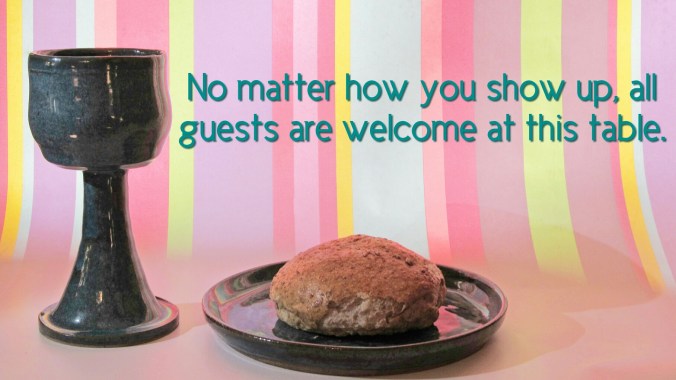
Invitation: Eat up.

1451796766436

When I was around 14 years old, my dad brought home a friend from work. Let’s call him Walt. Walt had fallen on some hard times personally and financially. For several months Walt spent a lot of time at our house in the evenings and on weekends. He helped out with home improvement projects. He played games in the yard with us. He had dinner with us on many evenings. Most importantly, Walt was not alone.

One Saturday we installed paneling in the living room. I say “we” but I was only peripherally involved; my dad and Walt did almost all the work, though I did lend the occasional steadying third set of hands. It was a big project, and we worked well past our home’s normal supper time. When the project was done, we washed up and sat down to supper, which was already on the table.

“Eat up,” I said to Walt. “You sure earned it.”

That was a mistake. My dad shot me a look that I knew meant we were going to have a talk.

A few hours later, after good food (my mom is a great cook!) and plenty of conversation and laughter, Walt went home. I had forgotten all about my earlier misstep, but my dad hadn’t. As the front door shut he turned to me with a stern look.

“Don’t ever tell anyone they have to earn a meal here,” he said. “That’s not how we do things. You should know better.” I started to say it was a joke, but didn’t get to finish. “It wasn’t funny. Don’t do it again.”

My dad is not a particularly religious man, but that day he taught me a very Christ-like lesson. When Christ invites us to the table, it’s not because we’ve somehow earned it; it’s because he loves us. Christ offers us a grace freely given, and no one else around the table gets to judge who should partake. We don’t even get to judge how much. In the Parable of the Workers, laborers who work a partial shift get paid just as much as laborers who work a whole shift. If that seems unfair, take it up with Jesus. Until he says differently, we are all welcome at the table.

The Peace of Christ be with you.


This first invitation is dedicated with much love and thanks to my dad, who is so encouraging to me about the blog and has provided great feedback that has helped shape it. Love you, Dad!

Stepping Stone

1451492741600

Today’s readings: Psalms 98; 147:12-20, 1 Kings 3:5-14, James 4:13-17, 5:7-11, John 5:1-15

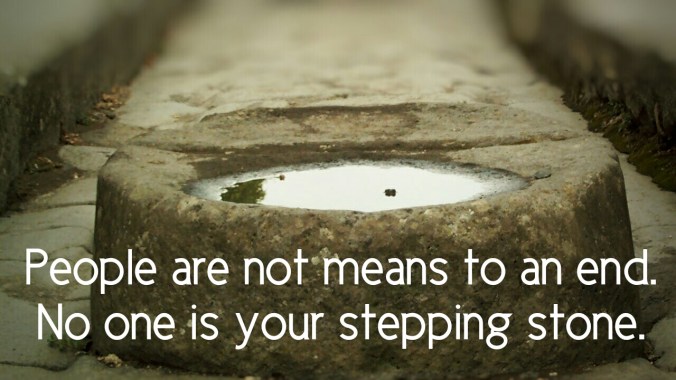
Faith is, among other things, a path to wholeness. We may feel we walk it alone, but fellow travelers always accompany us. Therefore we need to be mindful of both the destination and our conduct along the way. On his path Jesus encounters a sick man who has been waiting 38 years to get into a pool with alleged healing properties. When Jesus asks if he wants to be made well, the man replies: “Sir, I have no one to put me into the pool when the water is stirred up; and while I am making my way, someone else steps down ahead of me.” In 38 years not one person headed to the same destination for the same purpose had offered to help him. Worse, they had stopped him. These people were probably not malicious, but in their desperation and single-mindedness paid him no regard. Instead, he became their stepping stone.

How do we treat our fellow travelers? What goals are we so focused on that we can’t see the need around us? Perhaps we give others what we want them to need, instead of what they really do. Or maybe our need for a perfectly executed church service results in a less meaningful one. Our best intentions to create an inclusive, mission-centered, welcoming community will be short-sighted and potentially hurtful if we can’t place our personal goals in the context of the gathered faithful. Maybe we’ll make it to the pool, but what will we leave in our wake?

On the other side of this equation, today’s story teaches us our wholeness does not ultimately depend on our fellow travelers, but on God’s endless mercy. When Jesus tells the sick man to take up his mat and walk, the lack of mercy from everyone else becomes irrelevant. The beauty of the healing is lost on his fellow travelers who are more concerned he is carrying his mat in violation of Jewish sabbath law. Eyes set upon their own ritual holiness, they attack the uncontrollable divinity in their midst. Sometimes the most important part of our faith journey is the detour.

Comfort: We are never alone in our faith journey.

Challenge: We are never alone in our faith journey.

Out of Thin Air

Today’s readings: Psalms 93; 147:1-11, 1 Kings 17:17-24, 3 John 1-15, John 4:46-54

1451459082880

Why do miracles happen? American Christianity often portrays them as rewards for diligent prayer and great faith. The Gospel of John tells a different story. Jesus performed seven miracles – John called them “signs”- before he was crucified. The second was the healing of a royal official’s son. The official met Jesus in Cana, about 25 miles southwest from where his son lay dying in Capernaum, and asked Jesus to save him. While Jesus did heal the official’s son, his initial response seems almost perturbed: “Unless you see signs and wonders you will not believe.” Jesus was coerced by his mother into the first sign at the wedding in Cana, grumbled about the second, and things didn’t improve much for the next five.  When he raised Lazarus, he wept over his friends’ lack of faith. According to John, signs were performed for the unfaithful.

For some people, faith in God rests on miracles. Jesus, on the other hand, treated miracles as necessary disturbances to the natural order used to persuade people.  God’s presence is not extraordinary, but an ongoing relationship during ordinary life. Like air, it is a life-sustaining presence constantly surrounding us and within us. We don’t normally think about air unless we can’t breathe. John’s Jesus delivers miracles like he’s performing spiritual CPR on those who can no longer inhale God’s presence on their own.

Isn’t it better not to need it in the first place? Like air or water, our spiritual environment can become polluted. Sometimes we trash it ourselves, and sometimes we are downwind from the spiritually toxic. When our faith feels choked off, it may be time to start cleaning up and preventing more damage. This could be a slow process: anger, hate, greed, fear, and poisons like them take time to remove. They are dangerous and unpleasant to handle, but with God’s help handle them we must. The alternative is spiritual suffocation.

Still prefer to wait on a miracle? Neither miracles nor CPR are a permanent fix: if our habits don’t change, our old problems will return. God is always present; live clean and breathe deep.

Comfort: God is as close as the air we breathe.

Challenge: Take an inventory of what’s polluting your spiritual environment.

We interrupt our regularly scheduled Advent broadcast … or do we?

20131130_155258-01

As we embark on the the fourth and final week, I want to acknowledge I’ve received some questions about the Advent themes and the “traditional” order they’ve fallen in. For some people and traditions the themes of Hope, Love, Peace, and Joy are familiar, but the expected order is different. For others the actual themes themselves may vary.

It’s all OK.

Traditions like Advent wreaths, candles, and the season itself don’t exist for our slavish dedication. They are rituals we have created to periodically remind ourselves of certain aspects of our faith. The point of them is not whether the pink candle is for Joy or the fourth week is for Peace, but to help us reflect on our need for Christ to enter our lives and the world.

Maybe mixing it up is a good thing. When people ask whether I get tired of reading the same scriptures every year, of hearing the same story of Jesus being born,  or of celebrating them same seasons over and over, my answer is always: “No, I don’t, because even though the stories don’t change, I’m in a different place in my life and faith journey, so I am always hearing and learning something different.” Mixing up the weeks of Advent provides another opportunity for fresh perspective, while at the same time providing a familiar and comforting framework.

In a couple days our readings will include the Magnificat, the words of Mary as she praises God for using her as a vessel to redeem her people. Mary’s prayer speaks new messages to me every time I read it. It doesn’t change, but I do. For some people though, it will be the same every time, and that’s fine. They made need a slight change to hear new meaning, and an unexpected difference in the order of themes or a fresh Biblical interpretation like The Message may provide the catalyst.

So if your regular broadcast of Advent has been interrupted, I hope that has helped you see, hear, feel, consider, and learn new things. Christ enters the world in unexpected ways. Expect that.


Peace as Preparation

Today’s readings: Psalms 18:1-20; 147:12-20, Zechariah 4:1-14, Revelation 4:9-5:5, Matthew 25:1-13

1450324264571

In the Gospel of Matthew, Jesus relates a parable about ten bridesmaids – five foolish and five wise. They all take lamps to meet the bridegroom, but only the wise ones take supplies to keep the lamps burning when the bridegroom is delayed. The foolish bridesmaids ask the other for oil, but the wise ones are wise enough to say no because they’d all be unprepared. The foolish bridesmaids leave to buy oil and return to find the bridegroom and wise bridesmaids have left them behind.

It’s not difficult to imagine the foolish bridesmaids thought of themselves as unlucky, or victims of the wise bridesmaids’ stingy nature. Very often what we call poor luck or unfairness is our own lack of preparation. How do we properly prepare for the kingdom of God?

By not giving away more oil than we can spare. That doesn’t mean a lack of generosity; we should be generous of spirit and wallet. The oil we need to keep topped off is the energy to stay vigilant for the presence of Christ in the world. Many things conspire to steal this energy if we allow them: demanding jobs,  busy social schedules, housekeeping, and so on. None of these things is inherently problematic – they are  mostly good! – but neither is any of them our true purpose. If we don’t learn to say “no more oil for you, foolish bridesmaid” the energy left over for worship, charity, and our relationship with God can quickly dwindle to nothing. And by the way, if we think of those as “left overs” the reserves are already below acceptable levels. “What does it profit a man to gain the whole world and forfeit his soul?” (Mark 8:36)

Preparation means laying the groundwork for our whole lives, not just our spare time, to serve God. When we carefully steward our resources, we have enough energy to seek Christ and our peace in him. We must fill and refill our own lamps through prayer, service, rest, and worship.The wise will not save us from ourselves. Have you checked your oil lately? Tomorrow could be too late.

Comfort: It’s okay to do less so you can be more.

Challenge: Take an inventory of your obligations and eliminate the ones that drain your oil.