Impractically Possible

1460085491562.jpg

Today’s readings (click below to open in new tab/window):
Psalms 47; 147:12-20, Exodus 16:10-22, 1 Peter 2:11-3:12, John 15:12-27


After his resurrection, Jesus commanded his apostles to carry on his mission of love for the world and one another.He unflinchingly told these newly appointed bearers of love how the world would receive them: people who hated him would hate them; authorities who persecuted him would persecute them. Imagine similar words coming from a corporate recruiter looking for top talent, or a politician trying to build grassroots support: follow me and you’ll be hated and persecuted! Why would anyone sign up?

In the case of the apostles, they were motivated by love. Their leader had laid down his life for them – for the whole world – and in doing so overcame death. He wasn’t asking them to do anything he hadn’t done. Experiencing such love straight from the source left them unable to deny that the mission was worth any risk. The eternal life that Jesus promises doesn’t begin after our deaths, but in the moment we realize the willingness to lay down our lives down for one another frees us to love as Jesus loves.

Except for John, all the apostles died as martyrs. Most of us will not be tested to this extreme, but there are other ways of laying down our lives than death. Taking the smallest slice of cake or dropping spare change into a charity bucket is good but not enough. Following Jesus makes impractical and dangerous demands that may  require us to risk our finances, reputations, and livelihoods. Love that requires us to take in strangers and to decline striking back in revenge seems positively scandalous. In a culture where Christians are the default authority, we will be at odds with fellow believers who would cling to the dominance of Christendom so blindly they cannot recognize when we are no longer the light revealing the corruption of the empire, but the empire itself casting long shadows of injustice. We value security above faith at our own spiritual peril.

Jesus does not prioritize the safety of our bank account, good name, or physical person. He does call us to sacrifice all these things in service to each other.

Comfort: In the long run the sacrifices we make to follow Jesus do not deny us of anything, but help him give us everything.

Challenge: Almost all of us have a point where our desire to be safe impedes our desire to be faithful. Discuss this with some fellow believers.

Prayer: Loving God, give me strength to follow in the steps of Christ. Amen.

Discussion: When does your faith inconvenience you? Does it ever put you in harm’s way?

Join the discussion! If you enjoyed this post, feel free to join an extended discussion as part of the C+C Facebook group. You’ll be notified of new posts through FB, and have the opportunity to share your thoughts with some lovely people.

Whether to Wither

vinebranches

Today’s readings (click below to open in new tab/window):
Psalms 99; 147:1-11, Exodus 15:22-16:10, 1 Peter 2:1-10, John 15:1-11


A friend who is a lifelong gardener once said she was amused when people found peace in parables about sowing, tending and harvesting. Gardening, she said, is brutal. One is continually ripping living things from the ground to make room for other, more desirable living things. Foundering plants are removed to prevent the spread of rot and disease. As in today’s parable about the vine and branches, a gardener prunes away unproductive branches so they don’t drain resources from or contribute to the demise of healthy ones.

Sometimes parables like the vine are used to paint a picture of a God who’s waiting to damn us. It’s not difficult to take a story with actual burning in it as proof God is eagerly stoking the fires of hell for us right now. Preaching and teaching which use this fear of punishment to motivate us produce obedience that more resembles a hostage situation than worship. When Jesus says unfruitful branches will be trimmed and thrown into the fire, is he being a ruthless gardener and threatening us with eternal suffering?

Not quite. The difference between us and a withered branch on a grapevine is that we have a choice in whether we wither. Jesus knows the world is a hard place, a wild place overgrown with corruption and danger. He is not resigning us to the inferno, but extending an offer to shelter in his love, where our spirits can grow fruitful. Without the love of God, we are subject to everything that tries to choke out and nibble away at our spirits. Christ’s message about unhealthy branches is more lifeline than threat. He concludes by saying: “I have said these things to you so that my joy may be in you, and that your joy may be complete.”

God’s hope for us – and therefore Christ’s hope for us – is that we will know and flourish in his love. He wants us to know the natural consequences of ignoring or rejecting that love is a withering of the soul. Christ does not threaten us with death. He invites us to life.

Comfort: Christ provides nurturing shelter in a world overgrown with disorder.

Challenge: If you are a gardener, allow a small section of your garden to grow untended. If you are not a gardener, cultivate a small bed of flowers or herbs. What do you think you will learn?

Prayer: God of Life, thank you for tending my soul. I will seek shelter in your love. Amen.

Discussion: Do you relate to the images of a vine and branches? Why or why not?

Join the discussion! If you enjoyed this post, feel free to join an extended discussion as part of the C+C Facebook group. You’ll be notified of new posts through FB, and have the opportunity to share your thoughts with some lovely people.

Rod and Staff

1459594711536.jpg

Today’s readings (click below to open in new tab/window):
Psalms 23; 149, Exodus 13:17-14:4, 2 Corinthians 4:16-5:10, Mark 12:18-27


Psalm 23 is arguably the most recognized psalm in the psalter. It chronicles the typical day in the life of a shepherd and flock, through danger and safely home again. The metaphor of Christians as sheep may seem less than flattering; author Russell Banks once observed sheep were only slightly more intelligent than lawn furniture. Critics of the faith have said it accurately describes mindless followers, but the metaphor is not so much about following as about the relationship binding a shepherd and his flock.

At the end of the day, a shepherd uses a rod to count and inspect each sheep for injuries, a practice known as passing “under the rod.” The rod can also be thrown in front of a sheep to startle it back on course. Although other images of rods, such as “spare the rod and spoil the child” and Proverbs 13:24 (“He who withholds his rod hates his son,
But he who loves him disciplines him diligently.”) are more about discipline, the audience of this psalm knew the rod was not used to strike, but to tend.

Impulsive pursuits may leave us stranded in a spiritual bramble. We get caught up following other sheep and find ourselves in unfamiliar or even hostile territory. We tangle ourselves in gossip at work or church. We feel pressure to overspend in order to keep up appearances with friends and neighbors. As a result, we feel lost, overwhelmed, or out of control. At these times, depending on our relationship to our shepherd can literally save us.

To Jesus’ contemporaries the rod and staff were symbols of loving authority. When he called himself the Good Shepherd, Jesus was telling his listeners, “I have your best interests at heart, and often that will require a course correction.” Are we challenged when trying to integrate the ideas of “love” and “authority” into a unified whole? Have we learned to picture the rod in Jesus’ hand as an instrument of punishment or nurture?

We may not be immediately comfortable accepting the humility necessary to admit we need shepherding, but eventually we realize it is a true blessing that our God does not send us alone into the wilderness. Following Christ will always lead us home.

Comfort: Christ seeks to rescue every sheep, no matter how lost.

Challenge: If possible, visit a meditation labyrinth (or use a finger labyrinth). As you move to the center, meditate on a problem that has you feeling lost. On the way out, ask God to lead you home, and give thanks for Jesus, the Good Shepherd.

Prayer: Merciful and loving God, always lead me home to you.

Discussion: How do you feel about being disciplined? How do you react to it?

Join the discussion! If you enjoyed this post, feel free to join an extended discussion as part of the C+C Facebook group. You’ll be notified of new posts through FB, and have the opportunity to share your thoughts with some lovely people.

Not Against Us

1457972178830.jpg

Today’s readings (click below to open in new tab / window):
Psalms 119:73-80; 145, Exodus 4:10-20 (21-26) 27-31, 1 Corinthians 14:1-19, Mark 9:30-41


The Rev. Martin Luther King Jr. claimed the most segregated hour in America was 11:00 a.m. on Sunday morning. Our chosen church communities tend to resemble us racially, politically, and economically. It’s comfortable and easy to be with people “like us” and erect tall walls on a foundation of small differences. However, comfortable and easy are not Christian virtues. Today’s readings contain lessons about being in community with people different from ourselves.

In Exodus 4, Moses meets his brother Aaron. Together they deliver the Lord’s message to the Hebrews. Moses was raised Egyptian, spent forty years living as a Midianite, and was slow of speech (possibly due to a speech impediment). Aaron was of the priestly Levite class of Hebrews and quite eloquent. Together they represented an effective marriage of substance and style.

In 1 Corinthians 14 Paul addresses the importance of the spiritual gifts of prophecy, speaking in tongues, and interpretation. While emphasizing the need for prophecy (defined not so much as making predictions but as speaking words of encouragement, rebuke, and consolation from God), he also asks the question: what good is speaking in tongues if no one understands? Without interpretation, a person gifted with tongues does not build up the community, and without something to interpret, a person so gifted doesn’t bring much to the table.

When the disciples complained about people who were casting out demons in Jesus’s name, yet were not following them, Jesus told them: “Whoever is not against us is for us.” He knew the common goal of spreading the good news overrode petty differences.

Insisting on our specific way merely protects our egos when other gifts and perspectives make us feel insecure about our own. When we build or join a community, do we seek those whose strengths and weaknesses complement our own? If a church wants to tackle poverty, but is mostly a lot of rich people deciding what’s best for “the poor” without knowing or even asking them, how effective can it be? A team of co-workers who all share the same perspective rarely create innovative solutions. Our diversity was not created to be a source of jealousy or conflict, but to help us help each other.

Comfort: Your weaknesses are an opportunity to appreciate someone else’s strengths.

Challenge: Make a point of attending a church service or social event with people you normally don’t interact with.

Prayer: Thank you, Creator God, for the great diversity of life. Teach me to appreciate the beauty in the abundant shapes and thoughts of your world. I praise your holy vision and creativity. Amen.

Discussion: In what areas of your life do you seek like company? Are these areas where it might make sense to diversify your community?

Join the discussion! If you enjoyed this post, feel free to join an extended discussion as part of the C+C Facebook group. You’ll be notified of new posts through FB, and have the opportunity to share your thoughts with some lovely people. Or feel free to comment here on WordPress, or even re-blog – the more the merrier!
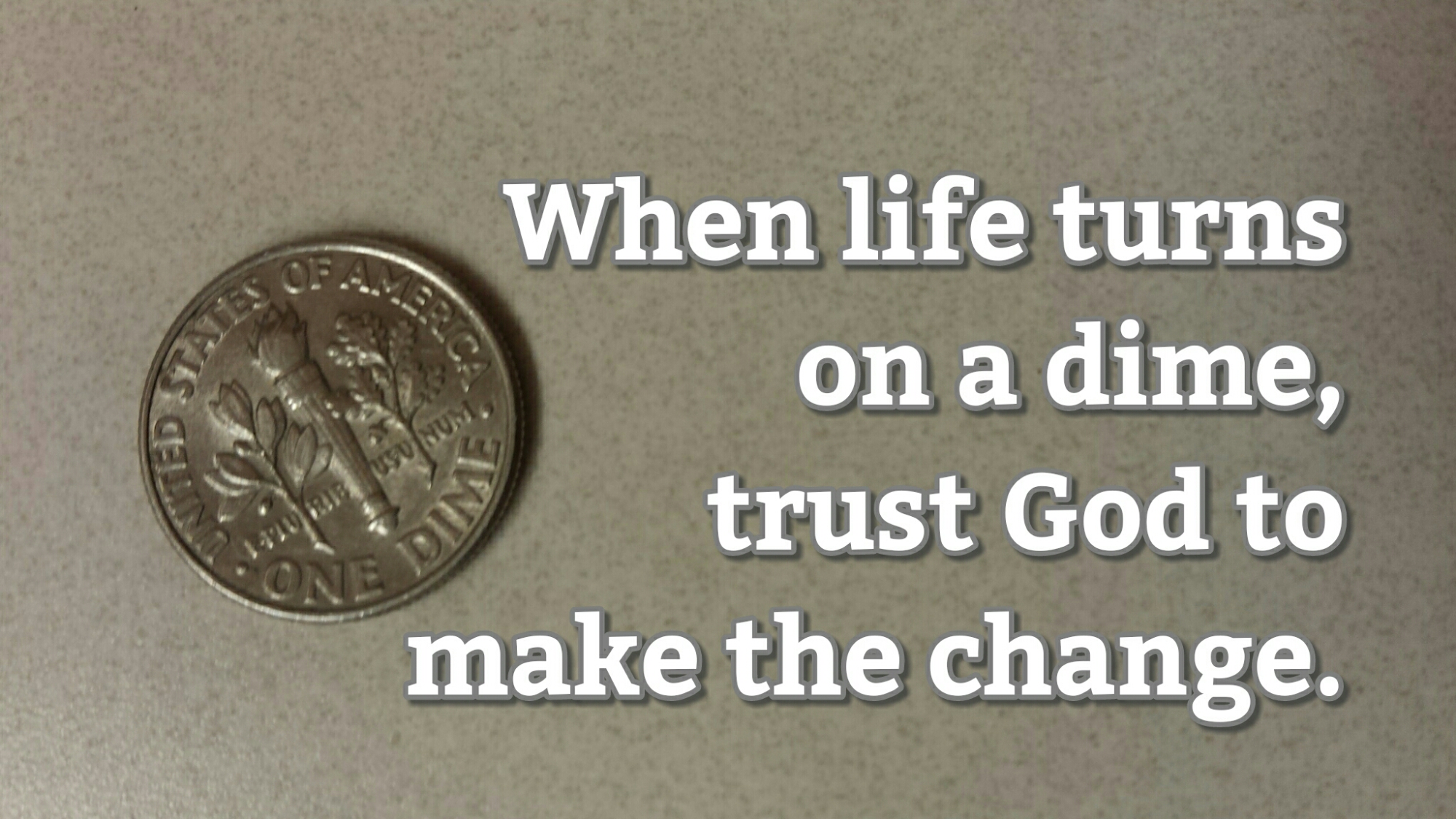
On The Dime

image


Today’s readings (click below to open in new tab/window):
Psalms 27; 147:12-20, Exodus 1:6-22, 1 Corinthians 12:12-26, Mark 8:27-9:1


Have you ever heard the expression “life turns on a dime?” It refers to the way our fortunes can change with little to no warning. When a new king who did not know Joseph or Joseph’s family rose over Egypt, he did not look kindly on the Hebrews. This new king viewed them as a potential threat, should they decide to align with his enemies. To preempt any uprising, he put harsh taskmasters over them and turned them into a nation of slaves. He went so far as to tell the Hebrew midwives to kill any male children at birth. The midwives were clever, and said Hebrew women were strong and gave birth on their own before a midwife could arrive. In a generation, the Israelites went from famine to favor to fetters.

In what must have felt like a mid-stream change of course to the disciples, Jesus began to teach them he would have to undergo great suffering, die, and rise again to fulfill his mission as Messiah. After all the miraculous healing, multiplication of loaves and fishes, and adoration of the crowds, Peter couldn’t believe his ears. He tried to tell Jesus it didn’t need to be so, and Jesus famously responded: “Get behind me, Satan!”

Psychologists tell us change –– good or bad – is an enormous source of stress, and sudden change even more so. In truth, life is nothing but change. Our bodies are machines of change, transforming food and air into blood and thoughts. As we sleep, our planet moves around the sun and our sun turns with galaxies and we wake unimaginable distances from where we laid our head. Change is unceasing; only our awareness of it flickers.

At the center of it all is God. He is the fixed point on which all else pivots. No matter our fortune, no matter where in the universe we stand, Jesus is the north star of our faith, guiding us toward the loving creator at its heart. Whether we are showered with riches or stripped of dignity, focusing on the center keeps us from spinning out of control.

Comfort: Focusing on God keeps everything in perspective.

Challenge:  Talk with a friend about their perceptions of your ability to handle change.

Prayer: God of creation, you are my center and my focus. Thank you for your constant love. Teach me to keep your ways in focus. Amen.

Discussion: What changes do you find especially difficult? What makes you dig in your heels and say: “Enough!”

Join the discussion! If you enjoyed this post, feel free to join an extended discussion as part of the C+C Facebook group. You’ll be notified of new posts through FB, and have the opportunity to share your thoughts with some lovely people. Or feel free to comment here on WordPress, or even re-blog – the more the merrier!

Curveballs

1457561126801

Today’s readings (click below to open in new tab/window):
Psalms 5; 147:1-11, Genesis 50:15-26, 1 Corinthians 12:1-11, Mark 8:11-26


Imagine you are Jesus. You’ve just miraculously fed four thousand people with no more than a few loaves and fishes. Not long before that you fed a greater crowd with fewer resources. Now you are in a boat with your disciples trying to use a parable about yeast to warn them about the pharisees and Herod. After a few minutes of pondering what you mean, they decide you are upset because … there is only one loaf of bread in the boat. If you were Jesus, would you have been a little frustrated that no one could seem to get past the lack of bread?

Are we wiser than the disciples? Do we treat every challenge like it’s the first one, or do we learn from our faith journey? No matter how many difficulties we’ve experienced, when new ones arise it can be hard to remember what we’ve survived. If God has seen us through illness, addiction, or betrayal are we able to trust He will see us through the newest crisis on the horizon? It’s not always easy, especially when we face the unfamiliar. Our first reaction is usually fear. But as the disciples eventually learned, trust in God can displace the fear. Trust may not completely eliminate the fear – we are only human! – but it changes our understanding of it. The trick is to remember that to God, this struggle is no worse than the ones that have come before.

Even the “best” lives are not free of challenges. As our faith matures, we begin to recognize huge challenges that didn’t register as important before. Issues of injustice, for example, become more obvious and less acceptable to us. If we can accept that life will never stop throwing us curveballs, that we have not failed because our lives aren’t perfected, maybe we can stop being surprised and devastated by them. If we are more in control of our reactions, we can surrender our troubles to God that much sooner. Some days we may ask how the bread could possibly be enough, but God is leading us to the bigger questions.

Comfort: You are not going through anything that God can’t see you through.

Challenge: When you are frightened by challenges, say prayers of thanks for all the situations God has already brought you through.

Prayer: Loving God, thank you for being with me in all situations. Forgive me when my fear interrupts my faith. Teach me to trust in you always. Amen.

Discussion: What things upset or frighten you because you can’t control them? Are you able to turn them over to God?

Join the discussion! If you enjoyed this post, feel free to join an extended discussion as part of the C+C Facebook group. You’ll be notified of new posts through FB, and have the opportunity to share your thoughts with some lovely people. Or feel free to comment here on WordPress, or even re-blog – the more the merrier!

The Truth about Crumbs and Dogs

1457351532294

Today’s readings (click below to open in new tab/window):
Psalms 119:73-80; 145, Genesis 49:1-28, 1 Corinthians 10:14-11:1, Mark 7:24-37


Not many people win an argument with Jesus. In Mark’s gospel there is only one example. She was both a Gentile and a woman, neither of which Mark’s audience would normally find persuasive. Yet she manages to change Jesus’ mind. When she asks him to rid her daughter of an unclean spirit, he tells her the food he offers should go to the children (of Israel) and not the dogs (a slur on her people). When she replies even the dogs get the children’s crumbs, her words stir him to help her daughter. What does it tell us that Jesus not only changed his mind, but was convinced to do so by someone considered a lowly outsider?

For one thing, it tells us we ought to be cautious about being overly sure of ourselves. If Jesus can change his mind, we can too. Closing our minds, especially when we are called to be merciful, betrays both the ministry of Jesus and what we ourselves are called to do. The moment we declare boundaries around the realm of God’s grace, we have placed our own wisdom above that of Christ.

It also tells us outsiders can be insightful critics. Individuals and communities often dismiss valid criticisms because they come from “outsiders” who couldn’t possibly understand, or perceive objective yet unflattering observations as attacks. Instead of absorbing facts and asking ourselves hard questions, we dig in our heels and counter-attack. And it doesn’t take much for us to tag someone as other: Christian communities do this both with non-Christians, and fellow believers who are in different denominations or understand scripture differently. Not so with Jesus. When an outsider presented a valid perspective, he responded not with defense or attack, but reconciliation and healing. That must be our model as well.

We don’t want to change our beliefs or practices like a reed swaying in the breeze of every opinion, but if continuing those beliefs and practices requires us to ignore or reject challenging truths … they were never very strong anyway. Weak faith shrinks by rejecting truth; strong faith expands by accepting it.

Comfort: Truth will only make your faith stronger.

Challenge: Consider how do you deal with challenges to your beliefs? Do you calmly consider other opinions, or do you immediately seek to dismiss or refute them?

Prayer: God, you alone know all truth. Help me to love the world as you have truly created it, and not as my limited human understanding has tried to define it. Amen.

Discussion: Some might argue Jesus already knew he was going to reconcile with the woman. If this is the case, why might he have at first denied her? Does it change our understanding of the lessons in the story?

Join the discussion! If you enjoyed this post, feel free to join an extended discussion as part of the C+C Facebook group. You’ll be notified of new posts through FB, and have the opportunity to share your thoughts with some lovely people. Or feel free to comment here on WordPress, or even re-blog – the more the merrier!


“Not the heart, but the stomach”

1457189838895

Today’s readings (click below to open in new tab/window): 
Psalms 43; 149, Genesis 47:27-48:7, 1 Corinthians 10:1-13, Mark 7:1-23


Most of us identify the “self” with the brain or head. Our physical voice resonates inside our skull, so we assign that same voice to our mental life. Hearing our own recorded voice can be shocking; because it differs so greatly from what we expect, the experience can border on identity crisis. However, this sense of identity belonging to the head is not universal. Cultures have placed the self in the heart, the kidneys, and elsewhere. Helen Keller wrote of her pre-lingual existence: “If I had made a man, I should certainly have put the brain and soul in his finger-tips.”

What organs best describe our faith experience?

Do we rely on our gut? Instinct is a fine survival tool, but doesn’t always align with faith. The instinct to fit into our tribe is so strong that we can elevate tribal traditions to immutable laws and ostracize those who don’t follow along. For example, the Jewish people practiced ceremonial hand-washing before meals. It was not a religious law, but a human one. When the Pharisees and scribes accused the disciples of disrespecting tradition by not washing their hands, Jesus pointed out how the religious leaders truly disrespected God by rationalizing away his commands.

The Pharisees relied on brainpower to the detriment of their souls. They allowed some Jews to dodge financial support of their parents – part of God’s command to honor them – by pledging money or property to the temple, thereby making it unavailable for other use. This clever ploy – benefiting both the pledger and the temple – was within the letter of the law, but far from its spirit. The brain may love a faith full of loopholes, but Jesus doesn’t.

Jesus taught faith comes from the heart. Regarding Jewish dietary laws, he said everything that enters the body is destined for the sewer, so it can not defile us, but if our heart generates wickedness, we are defiled from within. Our physical hearts have tremendous influence on our brain function. Our spiritual hearts should similarly influence our minds and guts away from defilement toward true faith and love.

Comfort: Christ’s law is love.

Challenge: It can be easy to vilify the Pharisees and distance ourselves from them. Like us, they were products of their culture. Try reading today’s passage from Mark with some sympathy for the Pharisees and ask yourself what cultural traditions are more important to you than they need to be.

Prayer: Create in me a clean heart, O God. May my mind and will always be in your service. Amen.

Discussion: Have you ever been surprised to learn something you thought had religious roots was only a local tradition?

Join the discussion! If you enjoyed this post, feel free to join an extended discussion as part of the C+C Facebook group. You’ll be notified of new posts through FB, and have the opportunity to share your thoughts with some lovely people. Or feel free to comment here on WordPress, or even re-blog – the more the merrier!

No Excuses

1456963310560

Today’s readings (click below to open in new tab/window):
Psalms 27; 147:12-20, Genesis 46:1-7, 28-34, 1 Corinthians 9:1-15, Mark 6:30-46


In what ways are we humans responsible to each other? This question produces heated debates about public policy for everything from healthcare to school lunches to seat belt laws to immigration. While one side cries “nanny state” and the other cries “class warfare” both seem less interested in compassion than in domination. People of faith can not look to secular leaders – even Christian ones – for answers about how to respond to God’s call to compassion. Fortunately, we have Christ as our guide.

When Jesus led his disciples to what he hoped would be a place of rest, and instead found a great crowd already waiting, he didn’t complain or look for a different place. Rather, “he had compassion for them, because they were like sheep without a shepherd; and he began to teach them many things.” Compassion drove him even when he sought rest. Does our own compassion take precedence over our immediate fears and desires, or is it a slave to budgets, calendars, and convenience? It is tempting to make excuses when compassion asks for more than we want to give, especially to strangers. Compassion can be inconvenient, and may make demands of us when we are tired, hungry, or poor ourselves.

When the disciples asked Jesus to send that same crowd into town so they could find dinner, his response was: “You give them something to eat.” The disciples’ first reaction was to claim they couldn’t afford food for everyone. How often have we answered the call to compassion with similar excuses? Yet Jesus only asked them to give what was at hand, which turned out to be more than enough. He didn’t ask them to evaluate who was truly deserving, or to run a stewardship campaign to determine what resources were available. He trusted that God would use the gifts of the people to provide what was needed.

We can try to instill fairness, wisdom and compassion into secular society and government, but in the end Jesus is telling each of us: “you feed them” (or clothe them, or heal them, or help them). Will we respond with compassion or an excuse?

Comfort: The gifts you already possess are enough to make an important difference to someone.

Challenge: Of course you can’t be all things to all people at all times, but also try not to let yourself off the hook by dismissing what you have to offer.

Prayer: Gracious God, thank you for the gifts you have entrusted to me. Please bless me with the strength and will to use them in your service. Amen.

Discussion: In what ways are you stingy with your compassion? What excuses do you make for not using your gifts?

Join the discussion! If you enjoyed this post, feel free to join an extended discussion as part of the C+C Facebook group. You’ll be notified of new posts through FB, and have the opportunity to share your thoughts with some lovely people. Or feel free to comment here on WordPress, or even re-blog – the more the merrier!

The Staircase

1456888961544

Today’s readings (click below to open in new tab/window):
Psalms 5; 147:1-11, Genesis 45:16-28, 1 Corinthians 8:1-13, Mark 6:13-29


The French have an expression: l’esprit d’escalier. Its translation is “staircase wit.” It describes that moment someone thinks of the perfect retort – but too late, such as when we’re out the door and down the stairs after a confrontation. If such a confrontation catches us unawares, we can easily find ourselves dumbfounded.

Herod, the ruler of Jerusalem, was a target of John the Baptist’s criticism because Herod had married his brother’s wife Herodias. Herod imprisoned John to silence him, but was afraid to have him killed because the people considered him righteous and holy. Shortly after, a drunk Herod had his step-daughter dance for his court. He was so pleased, he promised her anything she wanted. After a quick consultation with her mother, she demanded John’s head on a platter. Herod was stuck.

Afterward, Herod probably had a lot of staircase moments. Perhaps he wavered between wondering how he didn’t see it coming and how he could ever have anticipated it. What could he have done?

Evil, when it emerges, bewilders us. Maybe that’s why it so often seems to have the upper hand. It goes places and does things we could never dream of. Stunned, we look up from the bottom of the stairs and it is still laughing at us.  As followers of Christ, our loving response can seem inadequate and even pitiful. Though what else can we do but love? Friedrich Nietzsche, while not a man of faith, wisely said: “Beware that, when fighting monsters, you yourself do not become a monster.” Our uncertainty and delay in responding to evil isn’t always a weakness; rather it is evidence we have not yet learned to think like monsters.

The beauty of stairs is that they travel both directions. We are not trapped at the bottom in a state of regret. Meeting evil with more evil is quick and easy. Instead, we need to gather our breath and wits before ascending to confront it again. With God and Christ on our side, we can afford to play the long game. In the end, no matter how slowly, God assures us love wins.

Comfort: Though evil in the world may seem overwhelming, goodness and justice persevere.

Challenge: Resist – or at least seriously evaluate – the urge to combat hate and violence with more hate and violence, even if it feels good or justified. Pay attention even to the language you use: does it approach conflict with an attitude of conquest or of reconciliation?

Prayer: Merciful God, please grant me strength and wisdom to confront evil where I find it. Bless me with the confidence to persevere when discouraged. Thank you for your faithfulness in all times and places. Amen.

Discussion: Jesus tells his disciples to be “wise as serpents, and harmless as doves.” How do we learn to anticipate evil without damaging our souls?

Join the discussion! If you enjoyed this post, feel free to join an extended discussion as part of the C+C Facebook group. You’ll be notified of new posts through FB, and have the opportunity to share your thoughts with some lovely people. Or feel free to comment here on WordPress, or even re-blog – the more the merrier!