Just. Plain. Crazy.

The Lord Loves

Today’s readings (click below to open in new tab/window):
Psalms 34; 146, Genesis 42:1-17, 1 Corinthians 5:1-8, Mark 3:19b-35


If we are faithful to Jesus’ teachings, eventually someone will think we are at least a little crazy. It may happen at work when we say “I’m sorry, but this isn’t an ethical practice.” Or when we get arrested protesting injustice. It may happen when we tell church friends we feel called to something that makes no sense to them. Or when we tell secular friends we are joining a church and following Christ. It may happen when we invite a homeless person to the table in our home or church—and then we are not just crazy but reckless.

Despite those who would claim the United States is a Christian nation, our culture clings to many values conflicting with Christ’s teachings. Greed, corruption, abuses of power, and contempt for the poor and unfamiliar are as prevalent today as they have ever been – among the faithful as well as unbelievers. Christians are called to challenge these things when we encounter them. When our walk with Christ is faithful, we will find ourselves out of step with the world (and yes, much of the church) and labeled crazy when we fail to conform.

Jesus’ own family tried to restrain him when his preaching began to unnerve them. The scribes tried to claim he was possessed by demons. If we are to speak plainly and justly, we will inevitably make some people uncomfortable, and possibly angry. These may be people we love, or people in power. The nature of Christianity is revolutionary and counter-cultural, but even fellow Christians grow anxious when someone starts to take discipleship “too seriously.”

When our beliefs push us to the fringe of the larger culture, belonging to a supportive Christian community can give us strength. Jesus sent disciples out to spread the Gospel two by two. Travelling in pairs promoted their safety, but it also allowed for encouragement and accountability. Standing up for what is right can be dangerous and exhausting. The support of our family in Christ can help sustain us.

As Christians, we act justly. We speak plainly and truly to power. We are willing to appear crazy to the eyes of the world. We and God will both know better.

Comfort: The world may look at you askance, but God looks at you with love.

Challenge: Do something which you think it the right – but scary – thing to do.

Prayer: God of justice, you are my source and my life. May my words and actions always serve you. When my friends and enemies don’t understand me, teach me to show them Christ rather than shame. Amen.

Discussion: Are there times you let your need to be accepted overrule your call to act in faith? How has that made you feel?

Join the discussion! If you enjoyed this post, feel free to join an extended discussion as part of the C+C Facebook group. You’ll be notified of new posts through FB, and have the opportunity to share your thoughts with some lovely people. Or feel free to comment here on WordPress, or even re-blog – the more the merrier!

Systems Check

businessasusual

Today’s readings (click below to open in new tab/window):
Psalms 42; 146, Proverbs 30:1-4, 24-33, Philippians 3:1-11, John 18:28-38


When the Jewish leaders arrested Jesus and took him to the Roman governor Pilate, “they did not enter the palace, because they wanted to be able to eat the Passover.” Let that sink in for a moment… They found ritual uncleanliness unacceptable, but framing a prophet because he might actually be speaking on behalf of God was fine. Jesus was right to compare them to tombs whitewashed on the outside and rotten on the inside.

Under Roman occupation, Jewish leaders had no authority to execute anyone but they didn’t let this technicality discourage them. By saying Jesus claimed to be a king, they made him a rival of Caesar and therefore backed Pilate into a political corner. Jesus was advocating throwing off the Roman yoke for the Kingdom of God, but that didn’t suit their purpose so they twisted the truth to fabricate evidence against him. The tactic could be ripped from today’s headlines: self-righteous group misrepresents the facts to serve some narrowly defined greater good. Pilate asked Jesus “What is truth?” and we’ve been fudging the answer ever since.

Who are the villains in this piece? Should we point to scheming Pharisees, oppressive Romans, treacherous Judas, or fair-weather crowds? The truth is, everyone was guilty. The systems in place allowed corrupt leaders to act with impunity, communities to shift blame upward, and individuals to convince themselves they had no choice when they didn’t want to consider real but difficult options. In other words, business as usual.

In what Christ-betraying systems do we knowingly or unknowingly participate? How do we help perpetuate poverty, discrimination, violence, human trafficking, and other evils? If we knew the child sold into slavery to provide us cheap sneakers was Christ, would our cries for justice be louder and our choices different? We need to examine these questions when we make purchases, accept employment, and wield – or fail to wield – privilege and influence. Choosing God’s justice often requires choosing inconvenience, discomfort, and expense.  In God’s system, where the last are first, what does it mean to look out for number one? It means working toward justice for countless others.

Comfort: Every step you take toward justice is a step toward Christ.

Challenge: Lent starts tomorrow. This year give up apathy.

Prayer: Forgive me, Lord, for not wanting to know what I do.

Discussion: Have you ever made different choices after learning “how the sausage was made?”

Join the discussion! If you enjoyed this post, feel free to join an extended discussion as part of the C+C Facebook group. You’ll be notified of new posts through FB, and have the opportunity to share your thoughts with some lovely people. Or feel free to comment here on WordPress, or even re-blog – the more the merrier!


It Rolls Downhill

Rabies 010

Today’s readings (click to open in new window): 
Psalms 104; 149, Genesis 6:9-22, Hebrews 4:1-13, John 2:13-22


“Tourist prices” have been a problem for as long as people have traveled out of town. For example, non-Jewish currency was forbidden inside the temple at Jerusalem, so pilgrims needed to exchange it with money changers in the temple’s outer court before purchasing sacrificial animals. Doves, lambs, and other creatures are difficult to travel with, so livestock merchants also set up shop there. Both money changers and merchants took advantage of captive customers by demanding high prices. When Jesus arrived at the temple, he was so outraged to find “a den of thieves” where people traded faith for profit that he fashioned a whip out of cords and drove them all out. Not only had commerce defiled the temple, the institution that was supposed to protect the people was exploiting them.

The faithful are called to steward our resources justly. That means more than tithing and charity. Wealth does not buy us the privilege to shift social burdens onto the poor. In his encyclical on the environment, Pope Francis describes how the poor are disproportionately affected by climate change and pollution. The wealthy consume resources and produce waste at a much greater rate than the poor, but poor communities are where we dump trash, manufacture toxins, and  ignore contamination. This burden shift occurs down the road and around the globe. Industries with environmentally devastating activities forbidden under national policies exploit poorer, unregulated countries. Many economic and social forces impact the differences between wealthy and poor communities, but property values are not Christian values. Living in a nice neighborhood doesn’t mean we deserve more justice. Faith calls us to deploy our resources in a way that protects the most vulnerable among us.

Are we in the outer court exchanging profit for justice, or are we working to make sure the poor – whom Jesus told us to serve – are at the heart of God’s kingdom? Rock bottom prices have high human costs. Pollutants we vote or litigate out of our back yards are forced into someone else’s. When the choices we make to better our lives negatively impact others, we need to make better choices. Maybe we can start by treating the poor as we would treat our own family … because Christ has made them so.

Comfort: Rich, poor, or in between, God’s justice is meant for all of us equally.

Challenge: Read about how the poor have been unfairly impacted by pollution in Ringwood, New Jersey (also known as Sludge City), Horlivka, Ukraine, or Flint, Michigan.

Prayer: Lord, help me to live justly, not just for my own righteousness, but for the love of your creation. Amen.  

Discussion: Where in your own community do you see links between poverty and injustice?

Join the discussion! If you enjoyed this post, feel free to join an extended discussion as part of the C+C Facebook group. You’ll be notified of new posts through FB, and have the opportunity to share your thoughts with some lovely people. Or feel free to comment here on WordPress, or even re-blog – the more the merrier!


Wretched Refuse(d)

statue-of-liberty-2407489_1920Welcome to the first entry of C+C 2.0. As mentioned near the end of last year, I’m going to do some pieces that are a departure from the devotional and invitational posts. This one hits on topics that some consider political – specifically some comments recently made by our president – but I have no interest in partisanship. I do have interest in the intersection of America and Christianity. If that piques your interest, read on; otherwise another devotional will be up soon. Peace!


“Why do we want all these people from ‘shithole countries’ coming here?”
– President Donald J. Trump

So at last it’s laid clearly on the table; this is what a “Christian nation”  – or at least the representative it elects – thinks about immigration. We can cry all we want about how he doesn’t really represent us, but we elected him. He’s no surprise.

Let me make this clear from jump: this isn’t about legal or illegal immigration. The justice of that situation also desperately needs attention, but it’s a separate matter.

No, this is about how some of the wealthiest people in one of the wealthiest countries in the world view poor people, especially non-white poor people. It’s about failing to recognize the context of history, and how many of these “shithole” nations find themselves in dire straits largely due to colonial and capitalist exploitation by the rich and powerful – sometimes from the West and sometimes internally – and then dismissing them as failed states full of less-than-human beings.

This is about how a faith community claiming to follow a savior who said “Whatsoever you failed to do for the least of my brothers and sisters, you failed to do for me” (yeah, that’s the second part) could view and treat the “least” with passive contempt.

It’s about how America – in sad parallel with American Christianity – has become less a refuge of freedom for those oppressed  by empire, poverty, and discrimination …  and more an empire itself ferociously hoarding wealth and power in one hand while waving a flag of equality and freedom in the other. The crosses stretching across America have become support poles for the ultimate velvet rope of the most exclusive club, defining who gets in and who stays out based on who the owners of the nation (and the faith) like to be seen with.

America is in the business of continental gentrification. Now that we’ve pushed out the savages and ruffians and got the neighborhood up and running, we don’t want to let in “those” people who will take advantage of it and ruin it. Never mind the inconvenient history of building it on the backs of wave after wave of “those” people. African and Asian and Eastern European and Jewish and Catholic and Latin American and the endless variety of people we saw as less-than-human beings for a generation or so until we were up in arms about the next group threatening to ruin the neighborhood. Thanks for finishing that railroad. Your seat is in the back. Your neighborhood is across town.

In large part, immigration has long been a recruitment effort. The Polish and Hungarian neighborhoods in my town were the direct result of businesses bringing in entire communities to meet labor demands. These people didn’t come because they were already wealthy and successful. They came for the opportunity to escape shitholes. Without them, wealth sat idle. With them, it built cities, communities, churches, museums, and the rest of a nation.

But here’s the difference between running a business and running a nation. Once a business is done with the cheap labor (or replacing the expensive labor with automation) those people are no longer the responsibility of the business. A nation is never done with its responsibility. Citizens are not FTEs. We need to take them into account, or they will turn on each other.

It’s no coincidence this swell of populism is occurring during a time of divided wealth, deteriorating infrastructure, and decreasing church attendance. A national or religious empire (and have they ever really been separate in the West?) in decline is an animal which has cornered itself, and is therefore a danger to itself. When we were tackling frontiers, risk brought reward. Now that we have nowhere to expand and those we trampled on are forcing us to face the questionable tactics we used for that expansion, the greatest risk is admitting we’re not who we think we are. Even the middle and lower classes are defensive of criticisms of the rich when tribal reputation is all they have left to cling to.

I don’t actually think of America as a Christian nation, nor would I like it to be. I’m not at all keen on anything that smacks of theocracy. When you get my government in your religion they aren’t “two great tastes that taste great together” (anyone remember those commercials?); they’re more – and excuse my presidential language here – a shit sandwich.

But despite our worse instincts, some actual Christ-like influence has managed to permeate the culture. Those words about the tired, poor, huddled masses on the State of Liberty may be a product of an enlightened France, but they resonate with the religion that says God backs a loser. Even when our country – and our faith – don’t live up to the hype, citizens and would-be-citizens cling to the ideal expressed in those words. After all, most our families didn’t come here because the government was recruiting the already successful, but because the nation welcomed, needed, and sometimes stole the poor; some part of us remembers where we’ve come from, even when our own success and fear of sharing it diminish our enthusiasm for extending that same dream to others.

Businesses that contribute to society. Nations that contribute to the world. Faith that contributes to the Kingdom.  Have we – or our representatives – forgotten they are all built on the “least of these?”

A powerful business, nation, or faith that turns its focus inward and seeks to protect itself at the expense of others is not a reflection of Christ. Heck we’d have to get out the silverware polish and a sandblaster to uncover even the barest glimmer of common decency.

If you really want to give a hand up instead of a handout, you have to be willing to get your hands dirty. Yes, welcoming the stranger is scary. Christ says welcome them anyway. Yes, a small minority will want to take advantage. Christ says give to all who ask of you.  (Right about now you’re tempted to rationalize that into something practical. Why? Christ wasn’t practical.)  Yes, your way of life may feel threatened. Christ says there is no greater love than to lay down your life for your friend, and if we truly claim Christ as our friend, who then can we exclude from friendship?

A church or a nation that gets disheveled and dirty because it’s in the business of turning the hopeless into the hopeful is doing its job. Christianity and America are not meant to be beautiful, sterile showplaces focused on preserving their own self-proclaimed wonderfulness. They are meant to be sources of justice in not just a legal sense but a moral one, and justice takes guts and grime.

Through our faith language and our nigh-religious devotion to capitalism, we have turned spiritual and economic salvation into “I’ve-got-mine” individual experiences, when true salvation is communal. Doing so has impoverished us in countless ways. True salvation seeks not to isolate, but to replicate. When much is given, much is expected. Jesus said that, too.

Why do we want all these people from shithole countries coming here?

If we are Christian, the answer is “Jesus said so.”

If we are American, the answer is “they have and will make us stronger.”

If we are both, why are we still asking the question?

Why Three Kings?

1452051859496

Today’s readings (click below to open in new tab/browser):
Psalms 72; 147:1-11, Isaiah 49:1-7, Revelation 21:22-27, Matthew 12:14-21
Epiphany readings: 
Isaiah 60:1-6, Ephesians 3:1-12, Matthew 2:1-12


Today we celebrate Epiphany, the manifestation of Christ to the gentiles. Traditionally the gentiles are represented by the Magi. The gospel of Matthew tells us wise men followed a star from the east, paid tribute to the infant Christ, and returned home by a different route because a dream warned them King Herod was plotting against the newly-born messiah. Most nativity scenes depict them as three kings, though there is no scriptural basis for their rank or count other than the number of gifts.

Maybe they’re better off dropping the king bit and sticking to being just wise. Psalm 72 describes what it means for God’s presence to be felt throughout the gentile world, and kings don’t fare well. They bow before the presence, offer tribute, and oppressive ones are crushed. On the other hand the poor, needy, and oppressed are mentioned favorably ten times in this twenty-verse psalm. God judges them with justice; he defends, delivers, redeems, helps, pities, and saves them. Jesus’s message of the first being last and the last being first doesn’t originate with him; it is a natural evolution of the messages of the psalmists and the prophets. Jesus is the one who brought it home.

A mainstay of modern Roman Catholic social teaching is a preferential option for the poor. In other words, Christians are obligated to serve those who are impoverished financially and/or spiritually. Theologians of other denominations share similar teachings. Depending on our worldview, how we choose to meet that obligation can take many forms. Christ has trusted us with a duty, and also trusts us to determine the best means to execute that duty. Sometimes that means we can disagree about how we should serve. What it never means is starting from an attitude where the poor – of pocket or spirit – are a nuisance, morally lacking, or lesser than anyone else. Whatsoever we do for the least among us, we do also for Christ. We are to be kings bowing to babes.

The Magi’s gifts of gold, frankincense, and myrrh represented royalty, holiness, and death. Jesus re-gifted them to us as humility, grace, and life regardless of our worthiness. Let’s pay it forward.

Comfort: God’s love is for all, not just the privileged or perfect.

Challenge: What programs in your local community help the poor? How can you help them?

Prayer: Loving God, thank you for all I have. I will not forget that you ask me to share it with those who have less. Amen.

Discussion: We are often distrustful or uncomfortable with people who have significantly more or less material wealth than we do. Why do you think that is?

Join the discussion! If you enjoyed this post, feel free to join an extended discussion as part of the C+C Facebook group. You’ll be notified of new posts through FB, and have the opportunity to share your thoughts with some lovely people. Or feel free to comment here on WordPress, or even re-blog – the more the merrier!

Radical Faith

1451232640644

Today’s readings (click below to open in new tab):
Psalms 34; 150, 1 Samuel 1:1-2; 7b-28, Colossians 1:9-20, Luke 2:22-40


Today’s reading from Samuel introduces Hannah, one of Elkanah’s two wives. Hannah had no children, but Elkanah’s other wife did.  Like many women in her situation, Hannah was sorrowful about her inability to conceive. She went to the temple and prayed for a child. Because her lips moved but she made no sound, the priest Eli assumed she was drunk and reprimanded her, which was ironic because she had promised if God gave her a son she would dedicate him as a nazirite – a sect that abstained from strong drink. When God rewarded her faithfulness and she gave birth to a son, she followed through on that promise.

When we follow our faith, people may look at us like Eli looked at Hannah. Actions of faith may seem crazy even to other believers, especially if our actions disturb the status quo. The person who suggests displaying grace to those taking advantage of a congregation’s generosity is as likely to be mocked as thanked. Someone who quits a secure job to follow a risky calling will be judged favorably by critics only if the results are successful by standards the critics set. Any member of a denomination who decries its corruption or injustices – racism, sexism, clergy abuse, homophobia, fraud – risks rejection and attacks from both the leadership and the laity. Like Elkanah trying to comfort Hannah by saying “Am I not more to you than ten sons?” many people will pressure us toward quiet acceptance. And also like Elkanah, who already had children by another wife, people seldom understand the need for actions of faith against injustices which do not affect them directly.

As a childless wife, Hannah was distinctly disadvantaged in her culture. Our faith history, from Moses to Jesus to the Civil Rights Movement to today, is the story of God’s justice delivering the oppressed. It always seems crazy to those in power, because by worldly standards there’s nothing in it for them. For those of limited privilege, radical faith actions may be the only sane response. For those who enjoy privilege, some radical faith may be unexpectedly liberating.

Comfort: God desires the liberation of the oppressed.

Challenge: Ask yourself what injustices you tolerate – or possibly participate in – because they don’t affect you.

Prayer: Lord, help me to see the world as you do, especially the places I’m not prone to look. Amen.

Discussion: What convictions have you followed despite negative backlash?

Join the discussion! If you enjoyed this post, feel free to join an extended discussion as part of the C+C Facebook group. You’ll  have the opportunity to share your thoughts with some lovely people. Or feel free to comment here on WordPress, or even re-blog – the more the merrier!

Joy of the Ordinary

1450851188828

Readings: Psalms 50; 147:1-11, Jeremiah 31:10-14, Galatians 3:15-22, Matthew 1:1-17

What does “joy” mean? For many people the word conjures heightened emotions like euphoria or ecstasy. Such emotional intensity is not sustainable for very long. Eventually mundane concerns like bathing and eating will pull us back down to earth. Joy in the Lord, as described in the readings from Psalm 147 or Jeremiah 31, can certainly have its ecstatic moments, but it is more about a state of existence in which the Lord’s justice is a constant presence in our lives.

The world needs extraordinary people: thinkers, creators, and innovators who lead us forward … but it depends on ordinary people. Some would claim wealth, fame, and other worldly successes are the result of favor from the Lord. The psalmist teaches us the Lord does not delight in extraordinary speed or strength (and by extension wealth or power), but in those who fear him and hope in his love. The world claims to admire those who lead lives of humble service, but in practice we rarely aspire to be them, because they resemble what the world calls failure. Jesus tells us the world will be turned upside down, and the last will be first. The world constantly tempts us to measure ourselves against “the first” so that our sense of whether we are happy becomes comparative and competitive. If our joy instead rests in being a delight to the Lord, and that means hoping in his love, then joy is available to everyone regardless of status.

When Jeremiah talks about joy in the Lord, he speaks of gathering the outcasts, healing the brokenhearted, and lifting up the downtrodden. The Lord intends ordinary lives to be joyful. Unfortunately God’s justice  is not the standard of most of the world, so when we hear “ordinary” the implication is often “less than good.” Advent reminds us that, while the world is a fallen place, we look forward to the time when it is restored. When God’s justice finally becomes our standard, ordinary will no longer mean uneventful, boring, or miserable, but full of peace and plenty. You are built for joy; don’t let the world talk you out of it.

Comfort: The joy of the Lord is available to everyone, including you.

Challenge: If something blocks your joy, it usually also stands between you and God. This coming month, identify and work to remove one roadblock between you and God.

Prayer: In you alone, O Lord, will I seek my joy. Amen.

Discussion: Do you think there is a difference between happiness and joy?

Join the discussion! If you enjoyed this post, feel free to join an extended discussion as part of the C+C Facebook group. You’ll be notified of new posts through FB, and have the opportunity to share your thoughts with some lovely people. Or feel free to comment here on WordPress, or even re-blog – the more the merrier!

Peace as Action

1449987646870

Readings: Psalms 24; 150, Amos 9:11-15, 2 Thessalonians 2:1-3, 13-17, John 5:30-47


In the musical Rent the character of Mark sings: “The opposite of war isn’t peace; it’s creation.” The narrow definition of peace as merely the absence of destruction is turned on its head in a story about art and artists, but it has more universal application.  True peace is not something we passively experience; it is something we do.

After World War II, the United States initiated the Marshall Plan to help a devastated Europe recover economically. This aid included former enemies Italy and Germany, as well as neutral countries like Iceland. At the same time the U.S. oversaw the reconstruction of Japan, including a security arrangement that still exists today. These decisions were not altruistic on the part of the U.S. Leaders understood simple withdrawal from conflict was not the same as peace, which requires an ongoing effort. They understood peace as doing justice.

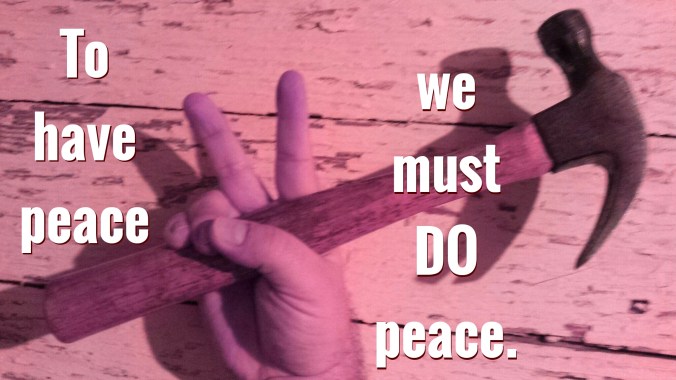
If we want to have peace – personal, interpersonal, or international – in our own lives, we can’t rely on outside forces to retreat from conflict and leave us alone to our apathy. Acts of creation and generosity can transform enemies into allies, battlefields into sources of shared harvest. To have peace, we must do peace.

For all his message of doom, the prophet Amos does paint a picture of what the peaceful Kingdom will look like:

they shall rebuild the ruined cities and inhabit them;
they shall plant vineyards and drink their wine,
and they shall make gardens and eat their fruit. (Amos 9:14)

It is not that these activities are possible because we live in some conflict-free vacuum we label peace, but that these activities are peace and create the conditions for its survival.

We all have conflicts. What cities of friendship have we left in ruin? What vineyards of opportunity have we trampled? What refugees of family have we driven away? We can choose to simply retreat from these battles, but let’s not mistake indifference for peace. Rather, let’s regroup and prayerfully consider how we might do peace. When we do peace rather than wait for it, the harvest will be abundant.

Comfort: We are not helpless in the face of conflict. We can rely on God to show us how to live peace.

Challenge: Explore organizations in your local community which work toward peace. Look for ways you might contribute.

Prayer: Relieve the troubles of my heart, and bring me out of my distress. Consider my affliction and my trouble, and forgive all my sins. (Psalm 25:17-18)

Discussion: Where have you settled for indifference instead of peace? What can you do about it?

Join the discussion! If you enjoyed this post, feel free to join an extended discussion as part of the C+C Facebook group. You’ll be notified of new posts through FB, and have the opportunity to share your thoughts with some lovely people. Or feel free to comment here on WordPress, or even re-blog – the more the merrier!

Hope. Always.

1449326142133

Readings: Psalms 90; 149, Amos 5:18-27, Jude 17-25, Matthew 22:15-22


Ever since the world began, people have been predicting its end. For many that “end” is not so much a final obliteration, as a renewal when the evil, violence, and injustice will be swept away to make room for something better. The prophet Amos speaks of the day when God will “let justice roll down like waters, and righteousness like an ever-flowing stream.” When we read headlines and watch the news, don’t we long for the same?

We can react to adversity with despair or with hope. While we may naturally tend toward one or the other, it is ultimately a choice. In the midst of suffering hope may seem futile or naive, but it has real consequences. Repeated studies show that a positive attitude promotes healing from illness and surgery. On a fundamental level, hope is essential to survival; hunger, thirst, and fear may seem like negatives, but they are hard-wired into us with an assumption that we will continue to live.

Though hope is more than a belief in continued existence. Despair also assumes existence but resigns us to inaction and victimhood, where hope spurs us to positive action. Hope makes charity possible, because it allows for positive change. Without the promise of hope could we even contemplate mercy?

In an age when tragedy around the world is broadcast into our homes 24 hours a day in high definition, hope can be hard to maintain. The truth is that on the whole violence in the world has been decreasing steadily for decades. Data and statistics are not necessarily comforting in the face of immediate crisis, so how do we work (and it is intentional work) to maintain hope? Minister and children’s television host Fred Rogers famously quotes his mother who told him the best thing to do in times of disaster is “look for the helpers” – people who move toward a tragedy to improve the situation. While it seems counterintuitive, could the Kingdom actually be ushered in when we move nearer to tragedy, where we are also nearer to mercy and charity? That is the end we hope for.

Comfort: We are closer to the promises of the God’s Kingdom every day.

Challenge: You can’t help everyone, but somewhere nearby there is a tragic situation waiting for you to inject hope into it. Find it and act.

Prayer: Restore us, O God of hosts; let your face shine, that we may be saved. (Psalm 80:7)

Discussion: Is hope something that comes naturally to you?

Join the discussion! If you enjoyed this post, feel free to join an extended discussion as part of the C+C Facebook group. You’ll be notified of new posts through FB, and have the opportunity to share your thoughts with some lovely people. Or feel free to comment here on WordPress, or even re-blog – the more the merrier!

Hope Authentically

1449028560917

Readings: Psalms 50; 47, Amos 3:12-4:5, 2 Peter 3:1-10, Matthew 21:12-22


In the New International Version of the Bible, the word “hypocrite” (or some variant of it) appears roughly four dozen times. About half of those instances are attributed to Jesus as he chastised the self-righteous. Amos and other prophets condemn example after example of the hypocrisy of God’s people. They say God finds it so detestable that no quantity or quality of sacrifices can make up for it.

As we hope for the coming of the Kingdom, let’s do what we can to eliminate the hypocrisies in our own lives. We all have them; they’re virtually inescapable. Maybe we don’t feel we are capital-H hypocrites like those who troubled Jesus, but condemning them while ignoring our own failings is … well … hypocritical.

These behaviors are insidious, because often we justify our hypocrisy enough not to be bothered by it. Like when we rail against the sleazy tactics of the opposing political party, yet turn a blind eye toward less than honorable actions of our own side because they are doing it “for the right reason.” Or when we compromise our principles (“I believe in sustainability!”) because they might cost us money (“But fair trade coffee is a dollar more per pound!”). And when we claim to follow Christ, then find reasons to blame the poor, the alien, the imprisoned, the sick, and the sinful for their plight rather than love and serve them as we’ve been told.

The Kingdom we hope for is not one where everyone else changes and we get to bask in the satisfaction of how right we’ve been all along. To be good citizens of the Kingdom — now or in the future — we can’t assume we’ll be better people because the world will be a better place. That’s like saying: “I’ll learn to turn the other cheek when you cease to offend me.” To the contrary, the world will be a better place because we will be better people living into the fullness of Christ’s love.

It’s not easy to face our own hypocrisy, nor realistic to think we will eliminate it entirely, but the nearer we draw to Christ the more authentic we become.

Comfort: God loves us as we are, and because God loves us we can be better.

Challenge: Ask someone you trust to point out an area where you can be hypocritical.

Prayer: Hear a just cause, O LORD; attend to my cry; give ear to my prayer from lips free of deceit. (Psalm 17:1)

Discussion: What hypocrisies have you discovered within yourself?

Join the discussion! If you enjoyed this post, feel free to join an extended discussion as part of the C+C Facebook group. You’ll be notified of new posts through FB, and have the opportunity to share your thoughts with some lovely people. Or feel free to comment here on WordPress, or even re-blog – the more the merrier!