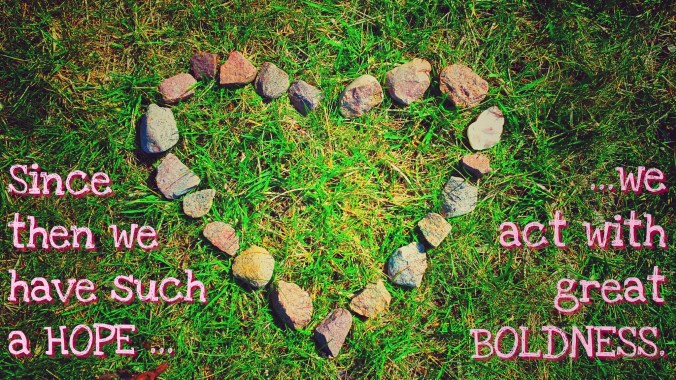
Hearts Of Stone

1458243566040.jpg

Today’s readings (click below to open in new tab/window):
Psalms 27; 147:12-20, Exodus 7:25-8:19, 2 Corinthians 3:7-18, Mark 10:17-31


In his second letter to the church in Corinth, Paul tells the people the law under Moses (which he calls the “ministry of death”) was chiseled in stone, while the ministry of the Spirit is written on their hearts. He also distinguishes them as the ministry of condemnation and the ministry of justification.  For people who were used to having all of God’s requirements written down in an agreed-upon format, this was an understandably difficult transition.

The New Testament wasn’t compiled until well after Paul’s death. When he preached about Christ, Paul wasn’t beholden to specific texts, a situation with both challenges and advantages. He had to constantly meditate on what the will of Christ might be, since he was the first person bringing this message to most of the people he encountered. On the other hand, not being bound by chapter and verse, he was free to speak the language of the heart, which created opportunities for mercy often unthinkable under the restrictions of pure law.

The New Testament is a collection of testimony and letters of advice and encouragement, not a basis for hard and fast laws, no matter how much some might like it to be. So how do we know what to do? The challenge of the ministry of justification is that we can’t actually read what is written on anyone else’s heart. Because it’s our nature to prefer defined expectations, we tend to assume it matches what is written on our own, and build our expectations for them on that basis. If we begin to judge people for not meeting our own self-imposed limits and rules, we are back to the ministry of condemnation, and the living words written on our hearts harden like stone tablets.

Our job is to understand what God has written on our own hearts, and live accordingly. Paul’s ministry of justification assumes the law is on our hearts, and encourages us to assume the same of others. Christ invites and trusts us to fulfill the law of love, and encourages us to allow others the freedom to do the same.

Comfort: The ministry of death has passed. Christ offers us new life.

Challenge: We are responsible for discerning, through our relationship with Christ, what is right and what is wrong.

Prayers: Merciful God, thank you for the ministry of life made possible through Jesus Christ. I pray for the wisdom and discernment to follow your will, not my own. Spare me from judgment as I spare my neighbor. Amen.

Discussion: What hard and fast rules do you cling to that may be more yours than God’s?

Join the discussion! If you enjoyed this post, feel free to join an extended discussion as part of the C+C Facebook group. You’ll be notified of new posts through FB, and have the opportunity to share your thoughts with some lovely people. Or feel free to comment here on WordPress, or even re-blog – the more the merrier!

Barnacle-Free Faith

barnacles and crustations

Today’s readings (click below to open in new tab/window):
Psalms 104; 149, Genesis 29:1-20, Romans 14:1-23, John 8:47-59


One characteristic of an effective movement, whether religious or secular, is an ability to stay focused. Unfortunately, the older and larger a movement grows, the more likely it is to lose focus. We need look only as far as the church to see a primary example. Early Christians were focused around the idea that Jesus was the savior, and through him all sin was forgiven. They had de facto leaders but no real bureaucracy, and were more focused on freedom than restriction.

Is that what the church looks like today? Can we imagine Peter poring over investment policy revisions, or Paul reading the latest theories on why you should have one third more seats than you do members? These activities aren’t wrong in and of themselves, but if we’re not careful we may start thinking and behaving as if the point of church is to perpetuate church, rather than to serve God.

One of Paul’s purposes in writing to the Roman (and other) churches was to encourage them to stick to the basics of the faith. Like present-day churches, the simple ideas and practices that bound them as a community began to accumulate individual and cultural restrictions. Like barnacles on a ship – sometimes known as fouling organisms – these additions adversely impacted the performance and structure of the church. Paul told the Romans they needed to scrape off “fouling” ideas.

Today’s church can be just as prone to fouling ideas. Most of the time we can recognize them because they separate us from each other or the world around us. Any time we decide someone who professes dedication to Christ is not a “real” Christian because their denomination, practices, or identity don’t fit our mold, we are probably victims of fouled faith. Rifts have developed over everything from whether coffee is allowed in the sanctuary to politically correct language in hymns to the proper order of a liturgy. As Christians, we are called to find ways to rise above such trivialities and unite rather than divide.

Paul adds a wrinkle though: we can’t just write off people with sincerely held belief in more rules than we believe as silly or misguided. In Paul’s example, the “strong” who believed no food was unclean didn’t need to make a show of eating certain foods to the “weak” who clung to prior practices. Relationship with Christ and God is central to faith and community, so causing someone to feel they were undermining that relationship was not “walking in love;” if someone believed something was unclean, it was indeed unclean to them. Your stumbling blocks and someone else’s may differ.

Of course, if it’s our belief-barnacle we will struggle to recognize it as such, and the older and bigger it is, the more difficult it will be to scrape off. Then there’s the danger that in our zeal to tear off the non-essentials we carelessly go too far and scrape away part of the hull; we don’t want to damage or discard what is necessary and true. And there’s the balance of community: learning to respect each other’s sincerely held beliefs and practices without imposing them on each other – and over time stripping away all that is not part of Christ.

Faith is not always simple, but let’s resist the temptation to complicate it unnecessarily. If we focus on winning souls instead of winning arguments, the barnacles on our faith fall away much more easily.

Comfort: Christ is the lens that focuses our faith.

Challenge: What barnacles have you accumulated? Scrape them off.

Prayer: God of Abundance, I will keep my eye on Christ. Amen

Discussion: If you’re not a sailor, barnacles may not mean much to you. What are some other metaphors for religious or spiritual “clutter?”

Join the discussion! If you enjoyed this post, feel free to join an extended discussion as part of the C+C Facebook group. You’ll be notified of new posts through FB, and have the opportunity to share your thoughts with some lovely people. Or feel free to comment here on WordPress, or even re-blog – the more the merrier!