So You Had a Bad Day

badday

Today’s readings (click below to open in new tab/window):
Psalms 62; 145, Ecclesiastes 7:1-14, Galatians 4:12-20, Matthew 15:21-28


This quote from Marilyn Monroe is all over social media: “If you can’t handle me at my worst, then you sure as hell don’t deserve me at my best.” It’s frequently used out of context when someone wants to deflect criticism of  their own bad behavior. We don’t like someone telling us our behavior is bad, or even unhealthy. We might think other people need to hear criticism (again, reference social media for scathing comments about the scandal du jour) but when it’s leveled against us we call it “judging.” Since Jesus told us “judge not” we toss that out as a conversation stopper.

Except we take that out of context too: Jesus didn’t render us incapable of moral evaluation, but reminded us to be merciful to others because we want God to be merciful to us. We are allowed to call out injustice, and to be called out for committing it. While how we behave on our worst days isn’t the standard by which others should judge us, it’s also not above legitimate criticism.

When Paul wrote to the Galatians about the importance of including Gentiles in the Christian community, he reminded them they’d met him during some of his worst days, a period when he suffered from an unidentified ailment. The specifics are unknown, but it seems his condition was, at the very least, unpleasant. He wrote: “though my condition put you to the test, you did not scorn or despise me, but welcomed me as an angel of God, as Christ Jesus.” Was this because Paul told them: “If you can’t handle my worst you don’t deserve my best?” No. It was because even at his lowest points, Paul focused first on delivering the gospel message. His weakness was not a source of shame, nor an excuse for behaving badly, but evidence that Christ helps us endure all things.

No matter what, the world will find reasons to criticize us. We all have weak moments and bad days, so sometimes the world will be right to do so. How we handle criticism of our worst days tells people more about our character and our faith than a hundred of our best days.

Comfort: Your worst days are some of faith’s greatest opportunities.

Challenge: It can be tempting and easy to use stress as an excuse to be dismissive or abusive. Remember that your bad day does not give you latitude to ruin someone else’s.

Prayer: God of mercy, teach me to be merciful. Amen.

Discussion: Are you able to take constructive criticism?

Join the discussion! If you enjoyed this post, feel free to join an extended discussion as part of the C+C Facebook group. You’ll be notified of new posts through FB, and have the opportunity to share your thoughts with some lovely people.

Washing Our Hands of Mercy

hands-809870_1920_edit

Today’s readings (click below to open in new tab/window):
Psalms 122; 149, Ecclesiastes 5:8-20, Galatians 3:23-4:11, Matthew 15:1-20


Christianity has existed for almost two thousand years. Over the centuries it has evolved in some ways into something Jesus might barely recognize. Or maybe it evolved into something he would find all too familiar: an institution whose highest priority is too often its own preservation;  an institution that claims a scriptural basis but predictably twists that scripture to justify human preferences and biases. If that criticism sounds harsh, consider today’s reading from Matthew.

The Pharisees and scribes criticized Jesus and his disciples for not performing the traditional hand-washing before meals. Jesus countered by condemning them for using man-made conventions to help people shelter their money through the temple when they didn’t want to “waste” it taking care of their aging parents. The letter of the law permitted this practice, but undermined the spirit of the commandment to “honor thy father and mother.” When the disciples later expressed concern he’d offended the Pharisees, he said:

Do you not see that whatever goes into the mouth enters the stomach, and goes out into the sewer? But what comes out of the mouth proceeds from the heart, and this is what defiles. For out of the heart come evil intentions […] These are what defile a person, but to eat with unwashed hands does not defile.

Twenty centuries have accumulated a lot of traditions which obscure the message of Christ. Many of them were intended to guide us, but often we have let them come to define us. Rules and practices specific to a time or culture are revered like commandments not because they honor God, but because they honor our self-righteousness.

“We take communion the proper way. We baptize the proper way. We say the proper Sinner’s Prayer. We don’t do X, Y and Z…” Jesus does not ask us only to avoid sin, he asks us to love proactively. What good is not taking the Lord’s name in vain if we don’t speak that same glorious name in love to others? How well do we serve God by condemning abortion but neglecting the hungry children of single mothers?

Law and ethics are separate fields of study partly because you can observe the first without having any concern for the second. Our duty as Christians is to love God and our neighbors. Often our disagreements about how to execute that duty are based more in traditions and biases than in love. When we are quick to discipline or enforce in God’s name, but slower to demonstrate mercy, we disrespect God’s character. As Psalm 103:8 tells us, “The LORD is compassionate and gracious, Slow to anger and abounding in lovingkindness.”

Let’s demonstrate our love for God – and by extension each other – with both our lips and our hearts.

Comfort: God’s love is bigger than our traditions.

Challenge: Sometimes to love, we must unlearn.

Prayer: Loving God, teach me the humility necessary to follow your will instead of human laws.

Discussion: Have you had to discard any traditions or customs to better follow your faith?

Join the discussion! If you enjoyed this post, feel free to join an extended discussion as part of the C+C Facebook group. You’ll be notified of new posts through FB, and have the opportunity to share your thoughts with some lovely people.

Civil Disobedience

mercy_not_sacrifice

Today’s readings (click below to open in new tab/window):
Psalms 51; 148, Proverbs 8:1-21, 2 John 1-13, Matthew 12:1-14


The Gospels contain several examples of Christ breaking the Law to serve a greater good. In today’s reading from Matthew he hits the Pharisees with a double whammy. First, he and his hungry disciples pick heads of grain to eat while they are walking through a field, though the Law forbid harvesting on the Sabbath. Then Jesus heals a man with a withered hand (also work forbidden on the Sabbath) and justifies it by asking his critics if, had they only one sheep and it fell into a ditch on the Sabbath, would they lift it out?

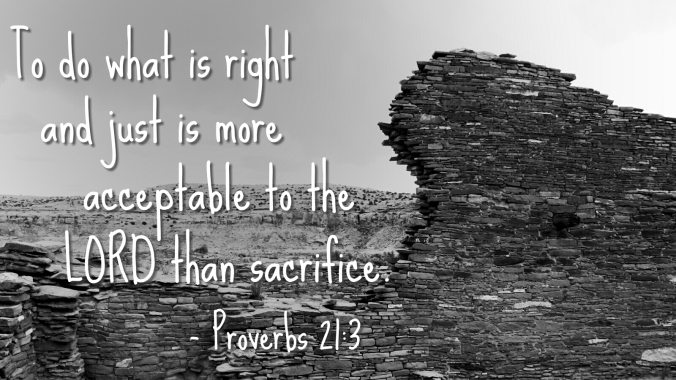
As followers of Christ we understand God “desires mercy and not sacrifice” yet many civil and religious laws attempt to bind us to legalism over mercy. When are we called to civil disobedience – that is, disobeying the law out of Christian conscience? Without respect to their merit, some examples include conscientious objectors during wartime, refusal to sign marriage certificates for gay couples, and passing out food to homeless people despite local ordinances forbidding it. Further complicating the matter, Paul tells us in many scriptures to obey the civil authorities because they have been appointed by God.

What can we learn from Jesus’s examples of lawbreaking? Jesus breaks the law to show mercy to others – the sick, the hungry, and the outcast. He doesn’t do it to benefit himself, or to make a show of his piety. To the contrary, his actions compelled religious leaders to seek his destruction. Even when he cleansed the temple by driving out the money changers and livestock dealers, he was confronting a system that was technically legal but exploiting the disadvantaged. That’s the flip side of the coin: pretending our adherence to the law excuses our unmerciful behaviors.

We can’t opt out of society’s laws altogether – that’s simply anarchy – but when the law compels us to do something contrary to God’s desire for mercy, we must stand for God. Like Jesus we must be willing to suffer the consequences of obeying that higher law. And we must do it with the humility of a king whose only crown was thorns.

Comfort: You don’t have to fight every little aspect of society that doesn’t dovetail with your faith…

Challenge: …but you should be willing to stand up in the face of injustice.

Prayer: God of wisdom, teach me when to humbly respect authority, and when to humbly confront it. Amen.

Discussion: Have you broken the law – or the rules – to show mercy?

Join the discussion! If you enjoyed this post, feel free to join an extended discussion as part of the C+C Facebook group. You’ll be notified of new posts through FB, and have the opportunity to share your thoughts with some lovely people.

Gleaning Compassion

OLYMPUS DIGITAL CAMERA


Today’s readings (click below to open in new tab/window):
Psalms 99; 147:1-11, Leviticus 19:1-18, 1 Thessalonians 5:12-28, Matthew 6:19-24


Sometimes it can feel difficult to reconcile the God of the Old Testament with the God of the New Testament. Even if we consider Christ’s sacrifice a watershed event (the moment when we were freed from the law and its harsh demands), the God who wiped out entire nations to make room for the Israelites seems very far from the God of Christ who wants us to love our enemies. But even in the hundreds of laws laid out in Leviticus and Deuteronomy we see glimpses of Christ’s teachings.

Amid rules like being cast out for eating sacrificed food after three days, God commands his people not to harvest to the edge of their fields, and not to pick up the fallen crops and grapes. This is so the poor and alien among them – those whom Jesus might call “the least of these” – can find food. This practice, called gleaning, was a mandate to the nation. God tells his people to render justice impartially, without regard to poverty or wealth, foreshadowing Paul’s message that in Christ there is no slave or free. Perhaps most tellingly, God instructs them to “love your neighbor as yourself.” When most people use that phrase they’re thinking of the Gospels, not rule-laden Leviticus.

In 1 Thessalonians Paul advises: “test everything; hold fast to what is good.” When tackling difficult portions of the Old Testament, the standard against which we can test them is Christ’s message of love. Even though Christ tells us to refrain from judgment, we must be careful not to set the standard as “all is forgiven so anything goes.” The Old Testament, even the parts that seem barbaric by modern standards, contains many valuable lessons and we do ourselves a disservice if we dismiss or ignore them. At the very least, they help us understand how our perception of and relationship to God has evolved over the years.

Paul also tells them “to admonish the idlers, encourage the faint hearted, help the weak, be patient with all of them.” From gleaners to Thessalonians, in every age God teaches us to love and care for all his children.

Comfort: God always loves us.

Challenge: Be open-minded about weakness, whether yours or another’s.

Prayer: Loving God, thank you for allowing me to test all things. Teach me what is good, that I may hold fast to it. Amen.

Discussion: Are you patient with people you see as weak, idle, or fearful? What weaknesses do you have that you wish you could hide from others?

Join the discussion! If you enjoyed this post, feel free to join an extended discussion as part of the C+C Facebook group. You’ll be notified of new posts through FB, and have the opportunity to share your thoughts with some lovely people.
The Seat of Mercy

Today’s readings (click below to open in new tab/window):
Psalms 92; 149, Exodus 25:1-22, Colossians 3:1-17, Matthew 4:18-25


The LORD said to Moses: Tell the Israelites to take for me an offering; from all whose hearts prompt them to give you shall receive the offering for me.
– Exodus 25:1-2

The Ark of the Covenant was a container built to hold the tablets of the Ten Commandments, God’s first laws for Israel. Its golden cover, with grand cherubim sculpted into either end, was called the Mercy Seat. The Mercy Seat was where God was present in the center of his people, and where sacrifices were offered for atonement of the sins of the people. All the gold for the Ark, as well as materials for the tabernacle (portable temple) which housed it – other precious metals, fine fabrics, gems, leather, spices, etc. – were collected voluntarily from people whose hearts were moved to give. This was a special kind of generosity since the people of the nation of Israel had only the possessions they had taken with them when they fled Egypt, and were a wandering, exiled people without other resources or trading partners. Each contribution was a meaningful sacrifice. What a wonderful metaphor: God’s dwelling place is created by the generosity of the community.

The Ark was secured in the innermost part of the tabernacle, and later in the temple at Jersualem, called the Holy of Holies. Only high priests were permitted to be in the presence of the Ark, and each year on the Day of Atonement they would sprinkle sacrificial blood on the Mercy Seat. Flash Forward a few centuries and in the outermost part of the temple we would find the money-changers whose presence offended Jesus so much that he drove them out with a whip. What started with the generosity of the people had become a place for the powerful to exploit the poor.

Offering himself as the ultimate sacrifice, Christ fulfilled the law and made the Mercy Seat obsolete. His was the blood of the new covenant, shed for all. We are no longer separated from God by law, but redeemed to him by love. As Paul taught the Colossians, in Christ there is no male or female, Greek or Jew, slave or free … inside the Holy of Holies or outside; all are equal members of the Body of Christ. Together, through our generosity and love, we are tasked with building a holy place, more precious than gold, with this new covenant at its center.

Comfort: God dwells among us.

Challenge:  When you can, work toward reconciliation.

Prayer: Loving God, I thank you for the sacrifice of Jesus the Christ. Make me a worthy bearer of his covenant. Amen.

Discussion: What divisions do you observe among the body of Christ? Conservative or liberal? Catholic or Protestant? Others?

Join the discussion! If you enjoyed this post, feel free to join an extended discussion as part of the C+C Facebook group. You’ll be notified of new posts through FB, and have the opportunity to share your thoughts with some lovely people.

Org Chart

wantjustice

Today’s readings (click below to open in new tab/window):
Psalms 97; 145, Exodus 18:13-27, 1 Peter 5:1-14, Matthew (1:1-17) 3:1-6


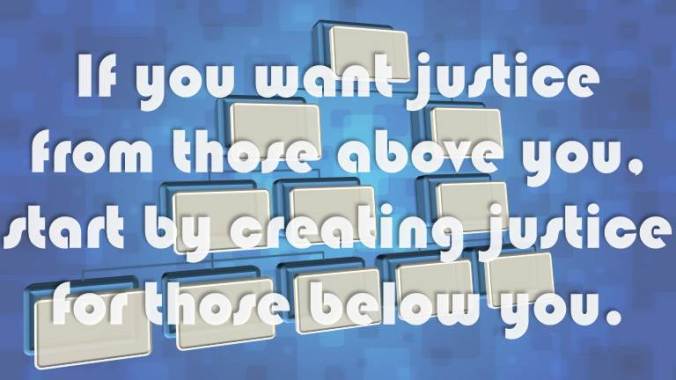
Did you know Moses had to develop an organizational chart? He was spending morning to evening serving as judge for the people. His father-in-law, Jethro, realized this situation was unsustainable; Moses would soon be exhausted and the people would suffer for it. Jethro suggested he select trustworthy men to share the burden, so Moses appointed judges “over thousands, hundreds, fifties, and tens.” Does this system of lower and higher courts sound familiar? Only the most difficult cases floated up to Moses, a “supreme court” of one, which was probably fine since he reported directly to God.

Lawyers get blamed for our lawsuit-happy culture, but people have been seeking compensation for wrongs for millenia. The preamble to the Code of Hammurabi, the oldest known recorded set of laws pre-dating Moses by 300 years, states the Code was created in part “so that the strong should not harm the weak” and to “[bring] about the well-being of the oppressed.” Some of the penalties required under both Hammurabi and Moses might make that difficult to believe (adultery was punishable by death), but it’s important to remember both represented tremendous advances. “An eye for an eye” is a vast improvement over an essentially lawless culture practicing “the lives of your children for my eye.”

Whatever structure our legal system takes, people of faith must remember God’s justice does not begin with “what do people deserve?” but with “what do people need?” After all, the hungry steal less bread if there are fewer of them, and a person who has to leap twice as many hurdles to reach the same opportunity as someone else is half as likely to get there honestly. If we are to reflect God’s grace, unearned but freely given, we must found our sense of justice on mercy, not revenge. By the time punishment needs to be applied, the “justice” system has already failed.

Tens of people seeking God’s justice together soon form fifties. Then hundreds. Then thousands. While we look higher on the org chart and seek mercy, let’s be sure to look lower to see those who hopes for the same from us.

Comfort: God’s grace is freely given. Your job is to accept it, not earn it.

Challenge: Seriously consider where your ideas of justice diverge from the ideas Christ describes.

Prayer: Loving God, forgive me my sins as I forgive those who sin against me. Amen. 

Discussion: In what areas are you more concerned with the satisfaction of revenge or punishment than establishing a truly just society? What changes can you make in yourself and the world?

Join the discussion! If you enjoyed this post, feel free to join an extended discussion as part of the C+C Facebook group. You’ll be notified of new posts through FB, and have the opportunity to share your thoughts with some lovely people.

Holy Friday

1458878752643.jpg

Today’s readings (click below to open in new tab/window):
Psalms 22; 148, Lamentations 3:1-9, 19-33, 1 Peter 1:10-20, John 13:36-38

Readings for Good Friday:
Isaiah 52:13-53:12, Psalm 22, Hebrews 10:16-25, John 18:1-19:42


If “Good Friday” seems like an odd name for a day commemorating a crucifixion, understand that good used to mean holy. All over the world, Christians re-enact Christ’s journey to Golgotha (also called Calvary) and his terrible execution. From congregations reading the passion together, to prayer groups walking the stations of the cross in troubled neighborhoods, to entire towns becoming Jerusalem for the day, Christians feel compelled to relive the story.

Because we know how the story turns out, we may find it easy to judge the crowds whose cheers turned to condemnation, or Peter, who – as Christ predicted – denied knowing him not not once, not twice, but three times. Certainly we would not have shouted “Crucify him!” We could never deny him … could we?

Let’s assume we could. Actually, let’s assume we have – because it’s true. None of us lives perfectly. That being the case, isn’t it comforting to know the person Jesus hand-picked to found the church was as flawed as we are? Maybe that’s why in passion stories most of us play the angry mob: to be reminded each of us is in need of forgiveness, and so don’t have the right to judge anyone. Christ later assured Peter he was still loved, but surely the knowledge of that moment of fear, weakness, and betrayal never left him. And almost as surely that memory helped forge the compassion and mercy for others that would have been necessary to speak for Christ.

When we feel like judging, let’s remember Peter – weak, frightened, impulsive, imperfect Peter. Then let’s remember Christ forgave him, as he forgives us, and calls us to forgive. It was the sin of the world that Christ forgave on that cross, including the sin of our own imperfect mercy and tarnished compassion.

From noon this day until Sunday morning, the disciples were without Christ. They thought the story was over, and despaired. This holy Friday and Saturday, let’s contemplate what it would mean to live without hope of forgiveness for ourselves and others. Today Christ hangs on the cross. We shouted “Crucify him!” Now we weep.

Comfort:

Challenge: Pray for forgiveness.

Prayer: Lord Jesus Christ, son of the living God, have mercy on me, a sinner.

Discussion: What does Good Friday mean to you?

Join the discussion! If you enjoyed this post, feel free to join an extended discussion as part of the C+C Facebook group. You’ll be notified of new posts through FB, and have the opportunity to share your thoughts with some lovely people. Or feel free to comment here on WordPress, or even re-blog – the more the merrier!
Stop! Collaborate and Listen.

1458394389372.jpg

Today’s readings (click below to open in new tab / window):
Psalms 43; 149, Exodus 10:21-11:8, 2 Corinthians 4:13-18, Mark 10:46-52


Mark tells the story of Bartimaeus, a blind beggar who was sitting by the roadside when Jesus passed by on his way out of Jericho. When he realized it was Jesus, he began to cry out to him, but many people tried to silence him. Mark doesn’t identify these people who “sternly ordered him to be quiet,” but the implication is they were following Christ. The blind man’s persistence paid off when Jesus stopped to wait for him, then healed him saying: “Go; your faith has made you well.”

Have we ever been one of the silencers?

During Sunday worship as we follow Jesus down the road from the first hymn to the eventual benediction and dismissal, we aren’t generally fond of interruptions. How would we react to a blind beggar shouting out in faith in the middle of that Sunday journey? To a crying baby and exhausted mother? To a grieving widower who sobs when the joyful song we sing reminds him of the wife he just lost? Annoyed or uncomfortable, we may say something directly or simply rely on the pressure of the group to impose silence on their obvious need. Either way, the message is clear: don’t interrupt.

Perhaps we justify our reacting by telling ourselves they should wait for a more appropriate moment to express their pain. Yet what moment could be more appropriate than a gathering of the followers of Jesus? In worship or in everyday life, following Jesus means stopping where he would stop. If we won’t respond to need and pain until a convenient break in the scheduled activities … we’ve marched Jesus right out of town.

We can’t run down every single side street searching for blind beggars, but we must be careful not to ignore or silence the needy along our path because we insist on maintaining an inflexible agenda. They are not in the way; they are the way. Worship is more than prayer and praise; it is any expression of love and gratitude for God and his creation. Sometimes an interruption is an opportunity to do our most meaningful worship.

Comfort: Jesus hears your cries, even when others seem to ignore or silence you.

Challenge: God’s plans aren’t always going to be your plans.

Prayers: God of Mercy, teach me to be merciful to those in need. Help me hear their cries as I trust you to hear my own. Let me respond with loving words and deeds. Amen.

Discussion:  Who do you think you have silenced, accidentally or intentionally?

Join the discussion! If you enjoyed this post, feel free to join an extended discussion as part of the C+C Facebook group. You’ll be notified of new posts through FB, and have the opportunity to share your thoughts with some lovely people. Or feel free to comment here on WordPress, or even re-blog – the more the merrier!

Just Deserts and Just Desserts

1455376584499

Today’s readings (click below to open in new tab/window):
Psalms 43; 149, Ezekiel 39:21-29, Philippians 4:10-20, John 17:20-26


Have you heard the term “food desert?” A food desert is generally understood as an area – usually urban, usually economically distressed – where circumstances limit people’s access to affordable, nutritious food. Picture an inner city neighborhood loaded with overpriced convenience store snacks, but no groceries with fresh produce. Because the available food is junk, people living in food deserts are commonly both overweight and undernourished.

Paul had never heard of food deserts when he told the Philippians he had “learned the secret of being well-fed and of going hungry, of having plenty and of being in need” (Phil 4:12).  He did recognize that we never have so much abundance that we don’t still need Jesus. We can grow fat on the riches of the world, but they will never give us true life. Yet even a small taste of the Bread of Life will leave us satisfied. Like Paul, we will “[learn] to be content with whatever [we] have” (v 11).

We’re all familiar with the practice of giving something up for Lent, a symbolic fast demonstrating our solidarity with Christ’s forty days in the desert. An equally important but less frequently observed tradition is almsgiving, or giving to people in need. Our Lenten sacrifice has more meaning when these practices go hand-in-hand. It’s not our business to judge anyone’s sacrifice, but there is a qualitative difference between giving up chocolate because it dovetails with weight loss goals, and giving up a daily five-dollar latte and donating the money to a food bank instead.

Our wilderness fast with Christ is a time of spiritual growth. The deeper we sink our roots into that desert, the more Living Water we will find.  Desert plants are biologically efficient and waste little energy on unnecessary processes, yet when resources allow they produce stunning blooms. Which of our resources could be put to better use in deserts both spiritual and nutritional? What sacrifices can we make so others might blossom in the love Christ calls us to share? Time and again the prophets remind us God loves mercy above sacrifice, but sometimes we must sow sacrifice to reap mercy.

Comfort: Like Paul, you can learn to be content under all circumstances.

Challenge: Learn more about food deserts and how you can help. What sacrifices of time and money might you be able to make to help people with little access to nutritional food?

Prayer: Gracious and merciful God, I thank you for all things you have given me. Help me understand which are mine to use, and which you have entrusted me to share with others in need. When my hunger for food is satisfied, may I feel even more strongly a hunger to share the Bread of Life with the world. Amen.

Discussion: On what do you spend a lot of time and energy which gives you little to no nourishment in return? Do you think it would be possible to reprioritize that time and energy?

Join the discussion! If you enjoyed this post, feel free to join an extended discussion as part of the C+C Facebook group. You’ll be notified of new posts through FB, and have the opportunity to share your thoughts with some lovely people. Or feel free to comment here on WordPress, or even re-blog – the more the merrier!

Breaking the Law

image

Today’s readings (click below to open in a new tab/window):
Psalms 54; 146, Genesis 15:1-11, 17-21, Hebrews 9:1-14, John 5:1-18


The fourth commandment is “Remember to keep holy the Sabbath.” For most Christians Sunday is the Sabbath but after church is over it’s not much different than the rest of the week. We are free to go shopping, eat out, and do as we please. Therefore we may underestimate the enormity of Jesus’ decision to perform a healing miracle on the Sabbath. This wasn’t someone declining an opportunity to “take it easy” – it was an act of defiance punishable by death.

For observant Jews, the Sabbath is a day of rest and worship, beginning at sunset on Friday and ending with the appearance of the first three stars on Saturday evening. Sabbath is rich with traditions, prayers, obligations, and rules. One key Sabbath concept is that no work is to be done: even candles must be lit and food prepared in advance. Today it is a strictly religious tradition observed more closely by some Jews than others, but among Jesus’ contemporaries there was no distinction between religious and secular law.

What might have been important enough to Christ to merit this act of disobedience? Mercy.

Could he have waited to heal the ailing man? Possibly. People had walked past and over this lame man for decades. Jesus didn’t break rules just for the sake of breaking them: by choosing mercy over law on the Sabbath, he demonstrated that mercy is always God’s highest priority. No excuse – our own need to be “holy” or even the threat of punishment – justifies withholding it.

For all our claims to be a people freed of legalism, Christians have developed plenty of rules to stand between us and mercy. From baptisms to funerals and everything between, we have our own unclean persons, our own restricted privileges, and our own inviolable traditions. Conscience tells us when mercy is the right response, but fear of breaking the rules and being punished by our social group may keep us from exercising it. When the Spirit prompts us, let’s be brave enough to break a rule or two and touch that “untouchable” person with our hands, hearts, and words.

Comfort: The Lord wants us to love mercy – that means receiving as well as giving.

Challenge: Critically consider whether  rules you have set up for yourself get in th way of being merciful to others.

Prayer: Lord Jesus Christ, Son of God, have mercy on me, a sinner.

Discussion: What does our willingness (or unwillingness) to show mercy say about our relationship with Christ?

Join the discussion! If you enjoyed this post, feel free to join an extended discussion as part of the C+C Facebook group. You’ll be notified of new posts through FB, and have the opportunity to share your thoughts with some lovely people. Or feel free to comment here on WordPress, or even re-blog – the more the merrier!