Palms to Palms

A leave (frond) @ mom's portico

Daily readings:
Psalms 84; 150, Zechariah 9:9-12, 1 Timothy 6:12-16, Matthew 21:12-17

Palm Sunday readings:
Psalm 118:1-2, 19-29, Matthew 21:1-11, Isaiah 50:4-9a, 31:9-16, Philippians 2:5-11, Matthew 26:14-27:66


For most Christians around the world, today is Palm Sunday. It’s the Sunday when we remember Jesus’s triumphal arrival in Jerusalem as he rode a donkey down a road covered in branches – traditionally palm fronds – placed there by a cheering crowd. We also remember how the same crowd, at the urging of their religious leaders, later turned on him and demanded his crucifixion.

For English speakers, “palms” figure into this story again, but this time as the traditional site where the nails were driven through Christ’s hands. Since the gospel texts were originally written in Hebrew or Greek, this similarity is a mere accident of language, but it highlights the mixture of highs and lows of Holy Week.

As Good Friday and the cross draw nearer, like Peter we reaffirm our commitment to Christ, but we must admit that, also like Peter (and the rest of the Twelve), we have and will inevitably fail him in some capacity. Like the crowds who greet Christ as a King, our community celebrates the victory we anticipate our Messiah will deliver. And also like the crowds, we must confront our failures to follow him when we let our leaders – religious, political, or cultural – persuade us the difficulty, danger, or sacrifice will be too great.

This is a week to remember strangers we have rebuffed, the poor and sick we have neglected, the tribalism we’ve used to justify withholding mercy, the times we have asked forgiveness in advance because we’d rather sin than suffer.

Holy Week exists because the triumph of the resurrection is at hand, but – painful though it might be to admit – it also exists because we are the people who crucified Christ. During the time between the cross and the empty tomb, the disciples were lost, left to grieve their failures and shattered hopes. Can we spend a week in that space where they were and contemplate what it means to be utterly lost? It’s a challenge to imagine, because while we know what comes next Sunday, they thought Christ was gone forever. Palms to palms, contemplating what it means to have lost Christ might deepen our appreciation when that Easter victory arrives.

Comfort: Christ is triumphant.

Challenge: Read the passion narrative from Matthew a few times this week, putting yourself in the place of a different character (Peter, Judas, Simon, Pilate, Mary, etc.) each time.

Prayer: God of mercy, thank you for freely bestowing the grace I can not earn. Amen.

Discussion: What character in the Passion story do you most identify with?

Join the discussion! If you enjoyed this post, feel free to join an extended discussion as part of the C+C Facebook group. You’ll  have the opportunity to share your thoughts with some lovely people. Or feel free to comment here on WordPress, or even re-blog – the more the merrier!
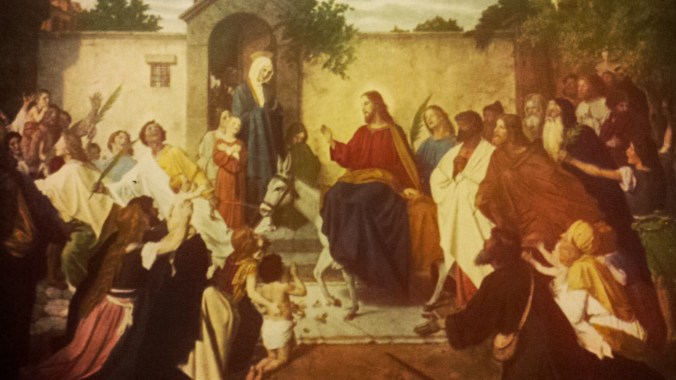
Unthinkable Donkeys

20160320_222231-01.jpeg

Christ Entering Jerusalem by Ernst Deger

Today’s readings (click below to open in new tab):
Psalms 84; 150, Zechariah 9:9-12, 1 Timothy 6:12-16, Zechariah 12:9-11, 13:1, 7-9


The Sunday before Easter is Palm (or Passion) Sunday, when we remember Christ’s triumphal entry into Jerusalem. At the height of his ministry and controversy, Christ entered the city riding a donkey, and the huge crowd gathered for Passover greeted him by throwing palm fronds on the path before him. This gesture was a sign of respect for victorious warrior kings … but that donkey told another story.

The prophet Zechariah wrote about the coming messiah as someone who would “command peace to the nations.” Traditionally a warrior king rode into conquered territory on an armored warhorse to signal his victory and dominance. A donkey, though, sent a message of humility. To a people hoping for a military savior to conquer their oppressors, this idea would have chafed. Yet Zechariah was not the only prophet telling the people of Israel to expect the unexpected. Christ’s reign was accomplished not only through peace, but through subservience, including submission to death on a cross. It was unthinkable. It certainly wasn’t what people wanted to hear, but prophetic voices told them anyway.

Like the Israelites, do we hope to assert our future through force? Every year churchgoers read the passion story and join our voices to those who shouted: “Crucify him!” By Easter we’re back to celebrating the resurrection, and little has changed. Rather than humbly live as we believe, we try to pass laws imposing our beliefs on the nation. We fail to speak truth to power – because in this time and place we are the power. All our talk of peace crumbles when we feel threatened; surely Jesus didn’t expect us to suffer for our faith when we could defend ourselves by going on the offensive?

Jesus enters the world through the poor, the sick, and the oppressed. Through our enemies. When we treat them with love we aren’t doing it on behalf of Jesus – we are doing it for Jesus. Christ reaches us not through merely unexpected avenues, but through unthinkable ones. Following Christ means choosing the donkey instead of the warhorse, even when that palm-strewn road leads to the cross.

Comfort: There are voices telling us how to follow Christ. We just need to learn to listen for them.

Challenge: Be careful not to confuse civic and secular authority with salvation and grace.

Prayer: God of Love, teach me the humble way of Jesus. Grant me ears to hear the truth, even when I don’t like it. Set words of peace and justice on my lips. Amen.

Discussion: What leaders appeal to your sense of anger, force, or division? When they speak, are you able to separate what you want to hear from the truth?

Join the discussion! If you enjoyed this post, feel free to join an extended discussion as part of the C+C Facebook group. You’ll be notified of new posts through FB, and have the opportunity to share your thoughts with some lovely people. Or feel free to comment here on WordPress, or even re-blog – the more the merrier!